Quick Answer
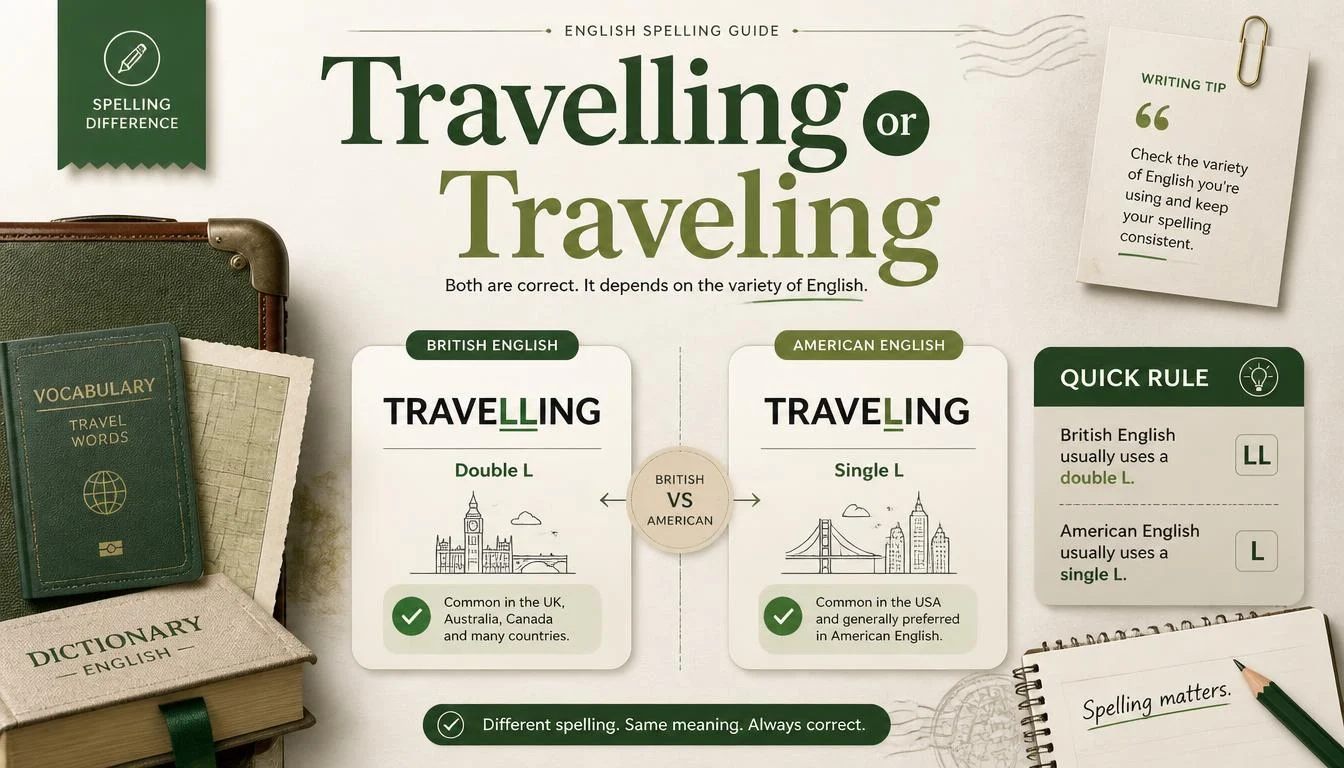
The difference between “travelling” and “traveling” is purely regional spelling. Both are correct spellings of the present participle and gerund of the verb “travel.” “Traveling” (one “l”) is the standard spelling in American English, while “travelling” (two “l’s”) is the standard spelling in British English and other Commonwealth countries .
If you’re writing an email, preparing a report, or composing content and find yourself hesitating between “travelling” and “traveling,” you’re not alone. This spelling confusion is one of the most common dilemmas English writers face, regardless of their proficiency level. The uncertainty often leads to second-guessing, and in professional contexts, inconsistent spelling can undermine credibility. This confusion exists because both spellings are correct just in different versions of English. The choice depends entirely on your audience’s location and the variety of English you’re using.
In this guide, you’ll learn exactly when to use each spelling, why the difference exists, and practical strategies for making the right choice every time. We’ll also explore related spelling patterns and common pitfalls to help you communicate with confidence in any context.
What’s the Difference Between Travelling and Traveling?
The core difference between “travelling” and “traveling” is spelling not meaning, usage, or grammar. Both forms function identically as the present participle and gerund of the verb “travel,” meaning the act of journeying from one place to another, especially over a significant distance . The distinction lies entirely in regional spelling conventions.
While the spelling differs, both words are pronounced identically. The ear hears no difference; only the eye registers the variation . This means you never need to worry about being misunderstood in spoken communication the issue is strictly written.
The pronunciation of “travel” itself has stress on the first syllable, which is the key to understanding the American spelling rule, as we’ll explore in the next section.
Is It a Grammar, Vocabulary, or Usage Issue?
This is primarily a spelling or orthographic difference, not a grammar, vocabulary, or usage issue. The distinction belongs to the realm of spelling conventions that vary between American and British English. From a grammatical perspective, both words are the same part of speech, used in the same contexts, and carry identical meanings .
Key points about categorization:
- Grammar Classification: Both forms are the present participle and gerund of the verb “travel.” They follow identical grammar rules and patterns.
- Vocabulary Difference: There is no vocabulary difference. They are exactly the same word with a spelling variation.
- Usage Difference: The only usage difference is regional. American writers use “traveling” for all audiences in the US; British writers use “travelling” in the UK and Commonwealth countries.
- Interchangeability: They are interchangeable in meaning but not in regional context. Using “travelling” in American English will be marked as a spelling error; the reverse is true for British English.
In formal English, academic writing, and business communication, consistency with the appropriate regional standard is essential. A paper submitted to a US university should use “traveling,” while a report for a UK-based organization should use “travelling.” The same applies to everyday conversation and informal writing consistency within your chosen English variety is what matters most.
Practical takeaway: Choose the spelling based on your audience’s location or the English variety you’re using, and stick with it throughout your document. This is not a matter of right versus wrong but of appropriateness.
The American Standard: Traveling (One L)
“Traveling” (one “l”) is the standard spelling in American English. This form is used in the United States and is the preferred spelling in American institutions, publications, and style guides .
Meaning and Usage
Traveling” means moving from one place to another, typically over a distance. It can function as:
- A present participle in continuous tenses: “She is traveling to Chicago tomorrow.”
- A gerund functioning as a noun: “Traveling broadens the mind.”
- An adjective: “The traveling salesman visited every week.”
Common Collocations
- Traveling companion
- Traveling expenses
- Traveling salesman
- Traveling bag/suitcase
- Traveling abroad
Workplace Example
“After traveling extensively for work over the past three years, I’ve learned to pack efficiently and navigate airport security without stress. The company reimburses traveling expenses within two weeks of submission.”
Academic Example
“Traveling to international conferences allows researchers to present their findings and establish valuable professional connections with peers from other institutions.”
Technology Example
“The app tracks your traveling habits and provides detailed summaries of distances covered, routes taken, and carbon footprint estimates based on your mode of transportation.”
Email Example
Subject: Traveling Plans for Next Week’s Meeting
“Hi Sarah, I’ll be traveling to the New York office on Monday and will be available for in-person meetings Tuesday through Thursday. Please let me know if you need anything from me before I leave.”
Daily Conversation Example
“Are you traveling anywhere this summer? We’re thinking of driving up the coast for a few days, but nothing’s booked yet.”
Learner Mistake
A common mistake is using the British spelling in US contexts. Writing “I am travelling to Boston next week” in a US business email will likely be marked as incorrect. It’s not wrong in British English, but it’s wrong for that audience.
Mini Recap: Use “traveling” when writing for American readers or following American English conventions. This is the form you’ll find in US publications, US-based style guides, and American schools.
The British Standard: Travelling (Two L’s)
“Travelling” (two “l’s”) is the standard spelling in British English and is used in the United Kingdom, Ireland, Canada, Australia, New Zealand, India, and other Commonwealth nations .
Meaning and Usage
Travelling” means exactly the same as “traveling” the act of journeying from one place to another. It functions identically:
- As a present participle: “She is travelling to London tomorrow.”
- As a gerund: “Travelling is my greatest passion.”
- As an adjective: “The travelling circus arrives next week.”
Common Collocations
- Travelling companion
- Travelling expenses
- Travelling community (refers to Romani or itinerant groups in UK usage)
- Travelling light
- Travelling abroad
Workplace Example
“I’ve been travelling for work almost every month this year, and I’ve learned to make the most of my time in different cities. The company covers travelling expenses for all staff members.”
Academic Example
“Travelling for research purposes requires careful planning and adherence to university guidelines regarding safety and funding allocation.”
Technology Example
“Online check-in apps have transformed the way we approach travelling, allowing passengers to skip queues and access digital boarding passes directly from their phones.”
Email Example
Subject: Travelling to the London Office Next Week
“Dear James, I’ll be travelling to London on Monday and would like to schedule a meeting while I’m in town. Are you available Tuesday afternoon?”
Daily Conversation Example
“What are you doing this weekend? I’m travelling to Edinburgh to visit my sister. The train journey takes about four hours.”
Learner Mistake
Learners sometimes incorrectly use “travelling” with American punctuation or formatting. For example, writing “I’m travelling to the U.S. next week” in a paper for a US university may be considered a spelling error. In British English, it’s correct.
Mini Recap: Use “travelling” for British, Australian, Canadian, and other Commonwealth audiences. This spelling is expected in the UK and in countries following British English conventions.
When Not to Use Each Word
Writers commonly choose the wrong spelling in the following situations:
1. Writing for a US Audience but Using “Travelling”
When you write for an American reader, “traveling” is correct. Using “travelling” will make your writing appear inconsistent or possibly as a misspelling to US readers who rarely encounter the British form. The mistake often happens when writers learn English from multiple sources and mix spelling conventions.
2. Writing for a UK Audience but Using “Traveling”
British readers expect “travelling” as the standard spelling. Using the American form may suggest inattentiveness to regional conventions. This mistake is common among American writers who may not realize the British spelling preference.
3. Mixing Spellings Inconsistently Within the Same Document
Using “traveling” in one paragraph and “travelling” in another suggests carelessness or a lack of editorial oversight. Consistency matters for readability and professional presentation.
4. Following the Wrong Regional Standard in International Contexts
If you’re writing for an international audience, choose one standard and apply it consistently throughout your content. Many global organizations use American English as a default, but British English is equally common. The key is consistency.
5. In Academic Submissions to the Wrong Institution
US universities expect “traveling”; UK universities expect “travelling.” Ensure your spelling matches your institution’s style guide.
6. In Professional Publications with an Established Style
If your company or publication follows a specific style guide (like APA, Chicago, or a house style), adhere to it. APA, for example, follows American English conventions.
7. On Websites Targeting Multiple Regions
For global websites, consider your primary audience. You may also implement region-specific versions or choose a standard and apply it consistently. Some organizations use American English for global content, while others use British English.
Common Mistakes: A Quick Reference
| Correct Sentence (US) | Incorrect Sentence (US) | Explanation |
|---|---|---|
| We are traveling to Florida next week. | We are travelling to Florida next week. | “Travelling” is the British spelling, which is incorrect for US audiences. |
| The traveler arrived late. | The traveller arrived late. | “Traveller” is the British spelling of “traveler.” |
| I traveled extensively last year. | I travelled extensively last year. | “Travelled” is the British spelling; “traveled” is American. |
| She is a frequent traveler. | She is a frequent traveller. | “Traveller” is British, “traveler” is American. |
Decision Box
- If you are writing for a US audience or following American English conventions → Use Traveling
- If you are writing for a UK, Australian, Canadian, or Commonwealth audience, or following British English conventions → Use Travelling
- If you are writing for an international or mixed audience → Choose one consistent spelling and apply it throughout.
The rule is simply: one L for Americans, two L’s for the British.
Real-World Examples
Office Communication
“Management is considering implementing a new policy on traveling expenses. Please submit all travel requests at least two weeks before your departure.” (US)
“The board has approved a new policy regarding travelling expenses. Please submit all travel requests at least two weeks before your departure.” (UK)
Business Email
“I’m traveling to the Denver office on Thursday and will be back on Friday afternoon. Please forward any urgent matters to my assistant.” (US)
“I’m travelling to our Edinburgh office on Thursday and will return on Friday afternoon. Please forward any urgent matters to my assistant.” (UK)
University Setting
“Graduate students are expected to present their research at least twice during their program, often requiring traveling to conferences outside the state.” (US)
“Graduate students are expected to present their research at least twice during their programme, often requiring travelling to conferences outside the UK.” (UK)
Customer Support
“We are currently traveling and may not be able to respond immediately. Please include your order number in any correspondence so we can assist you efficiently when we return.” (US)
“We are currently travelling and may not be able to respond immediately. Please include your order number in any correspondence so we can assist you efficiently when we return.” (UK)
Technology Context
“After traveling to three different countries for product demonstrations, I’ve concluded that localizing the user interface is the priority.” (US)
“After travelling to three different countries for product demonstrations, I’ve concluded that localising the user interface is the priority.” (UK)
Artificial Intelligence Context
“The AI-powered travel assistant handles all trip logistics, allowing travelers to focus on their actual destination rather than the process of traveling there.” (US)
“The AI-powered travel assistant handles all trip logistics, allowing travellers to focus on their actual destination rather than the process of travelling there.” (UK)
Daily Conversation
“Are you traveling anywhere for the holidays?” (US)
“Are you travelling anywhere for the holidays?” (UK)
Modern Technology and the Traveling/Travelling Distinction
In the context of modern technology, the spelling distinction remains unchanged but appears across various digital platforms:
- Voice assistants like Siri, Alexa, and Google Assistant use text-to-speech and will read either spelling identically. The distinction only appears in written transcriptions or text-based interactions.
- Chatbots and AI writing tools often suggest the spelling based on their language settings or the user’s location. An AI writing assistant may default to one standard depending on its training data.
- Business software like Microsoft Word, Google Docs, and Grammarly check spelling based on the language setting. Setting your document to English (US) will mark “travelling” as incorrect, while English (UK) will mark “traveling” as incorrect .
- International websites and apps frequently use geolocation to determine which spelling to display, or they allow users to select their preferred English variety.
The rise of global digital communication has made this distinction more visible but also more manageable. Spelling and grammar tools help maintain consistency, and many writers deliberately choose the standard most appropriate for their primary audience.
Word Origin
The split between “traveling” and “travelling” traces back to the early 19th century and the efforts of one man: Noah Webster. Webster, the author of the first American dictionary, was a committed spelling reformer. He believed that American English should be simpler and more logically spelled than its British counterpart .
Webster’s 1841 dictionary introduced a systematic approach to American spellings, including:
- Reducing unnecessary letters (color instead of colour, honor instead of honour)
- Changing -re endings to -er (center instead of centre)
- Doubling consonants only when the final syllable was stressed
For “travel,” Webster reasoned that since the stress falls on the first syllable, the final consonant should not be doubled. This gave Americans “traveling,” “traveled,” and “traveler.” In British English, a different rule applied: verbs ending in an unstressed vowel + “l” still double the “l” before suffixes beginning with a vowel, resulting in “travelling,” “travelled,” and “traveller” .
This pattern applies to other words as well, such as “cancel” (canceled/cancelled), “label” (labeled/labelled), “model” (modeled/modelled), and “fuel” (fueled/fuelled) .
Expert Insight
When teaching this distinction to students, I emphasize that the difference is remarkably narrow. “Traveling” with one L is not a correction of a misspelled word; it’s simply the American version of an identical word. British readers understand “traveling” as an American variant, and American readers know “travelling” as a British variant.
The spelling variation is a result of historical development, not a difference in correctness. Students often benefit from understanding that language is a living system it changes across time and borders. The shift that occurred when Noah Webster standardized American spelling was just one of many changes in the modern history of English.
For those learning English as a second language, knowing the standard of their target audience is more useful than focusing on which is “more correct.” In an increasingly connected world, the most practical skill is the ability to recognize both forms and choose the appropriate one based on context.
Error Prevention Checklist
- ✅ Always use “traveling” if you’re writing for Americans or using American English conventions
- ✅ Always use “travelling” if you’re writing for British, Australian, Canadian, or other Commonwealth audiences
- ✅ Never use both spellings within the same document or publication
- ✅ Check your spelling if your organization has a specific style guide adhere to it consistently
- ✅ Apply the same rule to “traveled/travelled” and “traveler/traveller”
- ✅ Set your document’s language to the appropriate English variant in your word processor to catch inconsistencies
- ✅ Remember the mnemonic: “One L for the Land of the Free, two L’s for the Queen’s English”
Related Grammar Confusions
Understanding the traveling/travelling distinction is part of a broader pattern of regional spelling differences. Here are related comparisons worth knowing:
- Color vs. Colour: American vs. British spelling of the word for shade or hue
- Honor vs. Honour: American vs. British spelling for respect or integrity
- Favor vs. Favour: American vs. British spelling for preference or goodwill
- Canceled vs. Cancelled: The same L-doubling rule applies to this word
- Labeled vs. Labelled: Another example of the L-doubling rule in action
- Modeled vs. Modelled: Yet another L-doubling example
- Traveler vs. Traveller: The noun form follows the same pattern
- Centered vs. Centred: American vs. British spelling for positioned in the middle
- Defense vs. Defence: American vs. British spelling for protection or argument
- License vs. Licence: American noun/verb same spelling vs. British noun/verb distinction
FAQs
Is “traveling” or “travelling” correct in the US?
In the US, “traveling” with one L is the correct and standard spelling. This form is preferred in American publications, schools, and business communications. Using “travelling” in a US context will be marked as a spelling error by most editing software .
Why is “traveling” spelled with one L and “travelling” with two?
The difference comes from Noah Webster’s spelling reforms in 19th-century America. Webster preferred shorter spellings and decided that because the stress in “travel” falls on the first syllable, the L should not be doubled when adding “-ing.” British English retained the traditional spelling with two L’s .
Is it “traveled” or “travelled”?
Both are correct. “Traveled” (one L) is the American spelling, and “travelled” (two L’s) is the British spelling. The rule is the same as “traveling” vs. “travelling.” The pronunciation is identical .
Is it “traveler” or “traveller”?
Both are correct. “Traveler” (one L) is American; “traveller” (two L’s) is British. Use the same rule that applies to “traveling” and “travelling” .
What is the rule for doubling L in British English?
In British English, verbs ending in an unstressed vowel + L double the L before suffixes beginning with a vowel. For example: travel → travelling, cancel → cancelling, label → labelling. In American English, the L is not doubled when the stress falls on the first syllable .
Which spelling should I use for international content?
For international or global content, choose one consistent spelling standard and apply it throughout. Many organizations prefer American English for global content, but British English is equally valid. The key is consistency. You may also consider your primary target audience’s location .
Conclusion
The choice between “travelling” and “traveling” is one of the simplest spelling decisions you’ll make once you know your audience. Neither spelling is incorrect; both are accepted standards in different regions. “Traveling” is the American form, and “travelling” is the British form. The difference is purely regional, not grammatical or semantic.
Remember this practical rule: If you’re writing for American readers, use one L. If you’re writing for British, Australian, Canadian, or other Commonwealth audiences, use two L’s. For international audiences, choose one standard and apply it consistently. The same rule applies to “traveled/travelled” and “traveler/traveller.”
By paying attention to your audience and maintaining consistency, you’ll communicate with clarity and professionalism every time.
Read More Related Articles:
- Pronounciation vs Pronunciation | Common Error You Can Avoid In 2026
- Privilege vs Priviledge | Learn the Correct Word Fast In 2026
- Suing or Sueing | Don’t Let This Spelling Trip You Up In 2026

Lucas Mitchell is a content writer at synoseek.com. He writes simple, thoughtful pieces that focus on everyday ideas, observations and general knowledge topics. His work is shaped by a calm, realistic tone that keeps the reader engaged without overstatement.
3 thoughts on “Travelling or Traveling | Difference Every Writer Should Know In 2026”