Quick Answer
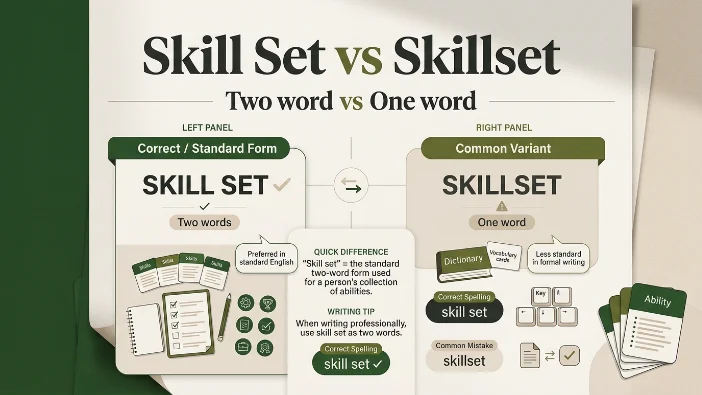
Skill set (two words) is the standard, dictionary-recognized form used in formal writing, resumes, and business documents. Skillset (one word) is a common informal variant that has grown popular in tech and casual writing but isn’t yet accepted by most major dictionaries. When in doubt, especially for professional documents, use “skill set.”
You’re updating your resume, and you type the word without thinking twice. Then spellcheck underlines it in red. Should it be “skill set” or “skillset”? You’ve seen both versions everywhere on LinkedIn profiles, in job postings, even in books written by professional editors. That inconsistency isn’t your imagination. It’s a real and growing split in how English speakers write this term.
At its core, a skill set refers to the range of abilities, knowledge, and expertise a person has developed, usually related to their job or a specific task. Whether you write it as one word or two, the meaning stays exactly the same. What changes is how formal, polished, or search-engine-friendly your writing looks.
People mix these up because English is full of compound words that eventually merge into one think “website” or “email,” which used to be “web site” and “e-mail.” Skill set is somewhere in the middle of that transition right now, which is exactly why the confusion exists. Get the wrong form on a resume or in a formal report, and it can look like a small but noticeable error. By the end of this guide, you’ll know exactly which version to use, when the “wrong” version is actually acceptable, and how to never second-guess yourself again.
Skill Set vs Skillset: What’s the Difference?
The short answer: there’s no difference in meaning, only in spelling convention and formality.
Both forms describe the combined talents, technical knowledge, and practical experience a person brings to a role. The difference lies entirely in which one style guides and dictionaries currently recognize as standard.
“Skill set” is a noun phrase made of two separate words: “skill” (an ability learned through practice) and “set” (a collected group). Written this way, it follows the traditional pattern of English compound nouns before they fully merge. Skillset,” on the other hand, treats the phrase as a single closed compound word the way “toolbox” or “keyboard” eventually became single words after starting out as two.
| Feature | Meaning | Part of Speech | Refers To | Typical Usage | Example | Common Confusion |
|---|---|---|---|---|---|---|
| Skill Set | Collection of abilities and expertise | Noun (compound phrase) | A person’s combined abilities | Formal writing, resumes, HR documents | “Her skill set includes data analysis and project management.” | Treated as one word due to frequent casual usage |
| Skillset | Same meaning as above | Noun (closed compound, informal) | A person’s combined abilities | Casual writing, tech blogs, internal team docs | “Our team has a strong skillset in cloud computing.” | Assumed to be the “modern” or “correct” spelling |
Here’s the recap: if you’re writing something formal a resume, a cover letter, a business report, or academic content stick with “skill set.” If you’re writing casually, especially in tech or startup culture where compound words merge faster, “skillset” won’t raise many eyebrows. Neither version will confuse your reader, but one will look more polished on paper.
Is Skill Set a Grammar, Vocabulary, or Usage Issue?
This isn’t really a grammar rule in the traditional sense it’s a usage and style convention that hasn’t fully settled yet. Grammar dictates sentence structure and word function; this is about spelling preference for a compound noun.
From a vocabulary standpoint, both forms carry identical meaning, so a reader will never misunderstand you either way. The real issue is consistency and formality. Major dictionaries, including Merriam-Webster, still list “skill set” as the primary two-word form, while treating “skillset” as an increasingly common variant spelling rather than a fully separate entry.
In formal English, business English, and academic writing, “skill set” remains the safer, more widely accepted choice. Style guides like the Chicago Manual of Style tend to favor the traditional two-word spelling until a compound becomes overwhelmingly standardized as one word across all major publications. In everyday conversation and informal writing texts, casual emails, internal Slack messages either spelling works fine, and most readers won’t notice or care.
Practical takeaway: treat “skill set” as your default for anything that leaves your personal device and lands in front of a recruiter, client, editor, or professor. Save “skillset” for casual, low-stakes writing where speed matters more than polish.
Skill Set: The Complete Guide
Meaning: A combination of abilities, both technical and interpersonal, that a person has developed through training, education, or experience.
Pronunciation: /skɪl sɛt/ stressed evenly across both words.
Part of speech: Noun (compound noun phrase, two words).
Common collocations: “diverse skill set,” “broad skill set,” “technical skill set,” “the right skill set,” “expand your skill set,” “match the skill set.”
Typical sentence pattern: [Subject] + has/needs/requires + [adjective] + skill set + [prepositional phrase].
Workplace example: “We’re looking for a candidate whose skill set includes both project management and client communication.”
Academic example: “The research fellowship requires a skill set that combines statistical analysis with clear scientific writing.
Technology example: “Machine learning engineers need a skill set that spans mathematics, coding, and data infrastructure.”
Email example: “Thanks for reaching out I think my skill set aligns well with what your team is building this quarter.”
Daily conversation example: “Honestly, cooking just isn’t part of my skill set.”
One learner mistake: Non-native speakers sometimes write “skills set” (plural “skills” plus “set”), which is incorrect. The word “skill” stays singular here because it’s functioning as a modifier, similar to “shoe store” rather than “shoes store.”
Mini recap: “Skill set” is the traditional, dictionary-preferred spelling. Use it in resumes, formal emails, and professional documents whenever you want to look polished and error-free.
Skillset: The Complete Guide
Meaning: Identical to “skill set” a person’s combined range of abilities and expertise.
Pronunciation: /ˈskɪlˌsɛt/ spoken as a single compressed word, though it sounds nearly identical to “skill set” out loud.
Part of speech: Noun (closed compound, informal or emerging standard).
Common collocations: “strong skillset,” “diverse skillset,” “technical skillset,” “build your skillset,” “skillset gap.”
Typical sentence pattern: [Subject] + brings/offers/has + [adjective] + skillset + [context].
Workplace example: “She brings a rare skillset that combines design thinking with backend development.”
Academic example: “Coding bootcamps aim to build a practical skillset in a short, intensive timeframe.”
Technology example: “AI tools are reshaping what skillset developers need to stay competitive.”
Email example: “Loved chatting today your skillset sounds like exactly what our startup needs right now.”
Daily conversation example: “Public speaking has never been part of my skillset, honestly.”
One learner mistake: Some writers assume “skillset” is now the universally accepted spelling because they see it constantly online. It’s common, but many formal style guides and resume-screening software still flag it as nonstandard, so relying on it in professional contexts carries a small risk.
Mini recap: “Skillset” works well in casual, tech-forward, or startup-style writing, but treat it as the more informal cousin of “skill set” rather than an interchangeable formal option.
When Not to Use Each Word
Mistake 1: Using “skillset” on a resume. Applicant tracking systems and formal HR reviewers often expect the traditional spelling. Why it happens: writers copy the spelling they see most often on job boards or LinkedIn. Fix: default to “skill set” in any document meant to be evaluated formally.
Mistake 2: Writing “skills set” instead of either correct form. This happens because “skills” (plural) feels grammatically natural when describing multiple abilities. Remember it this way: the word functions like an adjective here, so it stays singular, just like “tool kit” isn’t “tools kit.
Mistake 3: Switching between both spellings within the same document. This usually happens when multiple people edit a document or when a writer copies text from different sources. Fix: pick one spelling at the start and use your word processor’s find-and-replace tool to keep it consistent.
Mistake 4: Assuming “skillset” is always wrong. Some overly cautious writers avoid it completely, even in casual contexts where it’s perfectly natural. It isn’t a grammar error it’s simply less formal.
Mistake 5: Using “skill-set” with a hyphen. This hybrid form isn’t standard in either direction. Hyphenation is typically reserved for compound adjectives before a noun, like “skill-based training,” not for this noun phrase itself.
Mistake 6: Overusing the term when a simpler word would work better. Sometimes “skills,” “abilities,” or “expertise” communicates the same idea more naturally. Reserve “skill set” for moments when you’re specifically referring to a bundled, job-relevant combination of abilities.
Mistake 7: Using “skillset” in academic papers. Academic writing tends to favor conservative, dictionary-standard spellings. Reviewers and professors may see “skillset” as a minor red flag for informal writing habits.
Mistake 8: Forgetting subject-verb agreement. Because “skill set” is singular, it takes a singular verb: “Her skill set is impressive,” not “Her skill set are impressive.”
Common Mistakes Table
| Correct Sentence | Incorrect Sentence | Explanation |
|---|---|---|
| “My skill set includes both writing and editing.” | “My skills set includes both writing and editing.” | “Skill” stays singular when used as a modifier before “set.” |
| “Her skill set is well-suited for this role.” | “Her skill set are well-suited for this role.” | The phrase is singular, so it needs a singular verb. |
| “We’re building a strong technical skillset.” (casual context) | “We’re building a strong technical skill-set.” | Hyphenating the noun phrase isn’t standard usage. |
| “Please update your resume to reflect your current skill set.” | “Please update your resume to reflect your current skillset.” (formal HR document) | Formal documents typically expect the traditional two-word spelling. |
| “His skillset grew quickly after the bootcamp.” | “His skill sets grew quickly after the bootcamp.” | Making “set” plural is unnecessary when referring to one collection of abilities. |
Quick Decision Box
If you’re writing something formal a resume, cover letter, academic paper, or business report use skill set.
If you’re writing something casual a blog post, internal message, or tech-industry content skillset is widely accepted and reads naturally.
If you’re unsure, default to skill set. It’s the safer, more universally recognized choice.
Real World Examples
Office communication: “During the meeting, our manager mentioned that the new hire’s skill set fills a gap our team has had for months.”
Business email: “I wanted to follow up and highlight how my skill set particularly in budgeting and vendor negotiation fits this position.”
School or university: “The scholarship committee looks for applicants with a well-rounded skill set, not just strong grades.”
Customer support: “Our support agents are trained with a skillset that covers both technical troubleshooting and de-escalation techniques.”
Technology: “The job listing specified a skillset that included Python, SQL, and cloud deployment experience.”
Artificial intelligence: “As AI tools automate repetitive tasks, employers increasingly value a skillset centered on judgment, creativity, and oversight.”
Daily conversation: “Fixing cars just isn’t in my skill set I always end up calling a mechanic.”
Skill Set in Modern Technology
In tech and AI-related writing, “skillset” appears constantly in job postings, LinkedIn bios, startup pitch decks, and product descriptions. This is largely because tech culture moves fast, and language in fast-moving industries tends to compress and simplify more quickly than in traditional formal writing.
Virtual assistants and AI chatbots are frequently described in terms of their “skillset” the range of tasks they can perform, from scheduling to data analysis. Software companies often use “skillset” in marketing copy because it feels modern and streamlined. However, official documentation, terms of service, and formal white papers from the same companies often revert to “skill set,” since these documents are typically edited more conservatively.
If you’re writing about AI tools, developer capabilities, or software features for a general audience, “skillset” will feel right at home. If you’re writing technical documentation meant to look authoritative and polished, lean toward “skill set.”
Word Origin
Skill” traces back to Old Norse “skil,” meaning distinction or discernment the idea of knowing the difference between doing something well and doing it poorly. “Set,” from Old English “settan,” originally meant to place or arrange. Together, “skill set” emerged in the mid-20th century as businesses began describing employees’ combined abilities as a collected, arrangeable group much like a “tool set” or “data set.” The one-word “skillset” is a much more recent development, gaining traction alongside other digital-era compound words as written communication moved online and favored shorter, faster typing patterns.
Expert Insight
Here’s something worth remembering: English constantly compresses two-word phrases into one word once they’re used often enough, together, in the same context. “Note book” became “notebook.” “Web site” became “website.” “Skill set” is very likely heading in that same direction, but it hasn’t fully arrived yet. That’s exactly why you’ll see disagreement even among professional editors. The safest approach isn’t to memorize a permanent rule it’s to match your spelling choice to the formality of what you’re writing, and stay consistent once you’ve picked one.
Error Prevention Checklist
- Always use skill set in resumes, cover letters, academic writing, and formal business communication.
- Use skillset only in casual, informal, or tech-culture writing where the tone is already relaxed.
- Never confuse them if you remember this: formal documents favor tradition, casual writing favors speed.
- Quick memory tip: two words for two-piece thinking (formal), one word for one quick thought (casual).
Related Grammar Confusions
Mindset vs Mind Set Nearly identical situation to skill set, where the closed compound has become far more standardized than “skill set” has.
Toolkit vs Tool Kit Another compound word in transition, useful for understanding how English merges phrases over time.
Everyday vs Every Day Unlike skill set, this pair actually changes meaning depending on spelling, making it a higher-stakes mistake.
Login vs Log In A classic example of a noun form (login) versus a verb phrase (log in) that trips up even experienced writers.
Workout vs Work Out Follows the same noun-versus-verb-phrase pattern as login, worth learning together.
Setup vs Set Up One of the most commonly confused word pairs in professional writing, especially in tech documentation.
Well-being vs Wellbeing Shows how hyphenation adds a third spelling option into an already confusing mix.
Data Set vs Dataset Directly parallel to skill set, especially relevant for anyone writing about technology or research.
Follow up vs Follow-up vs Followup A three-way version of this same confusion, common in business emails.
Checklist vs Check List Demonstrates a compound that has almost fully merged into one word across all writing styles.
FAQs
Is “skillset” one word or two?
Both skill set and skillset are used in English, but skill set remains the more established form in formal and edited writing. The closed form skillset has become increasingly common, particularly in business, technology, and workplace communication.
Which spelling should I use on my résumé?
Skill set is the safer choice for a résumé or CV, especially when you’re aiming for a formal and polished style. It is widely recognized and leaves little room for questions about spelling or formatting.
Is “skills set” ever correct?
Generally, no. The standard expression is skill set, with skill in the singular acting as a modifier of set. For example, “She has a strong skill set” is correct. The plural skills can be used separately, as in “She has several valuable skills.”
Does Merriam-Webster recognize “skillset” as a word?
Dictionaries vary in how they treat the closed form. Skill set is the long-established standard spelling, while skillset has gained substantial usage in modern professional English. If you’re following a specific dictionary or style guide, use the form it recommends.
Can I use “skill-set” with a hyphen?
Skill-set is not normally needed when the phrase is used as a noun. The most common choices are skill set and, increasingly, skillset. If you’re following a particular style guide, check its treatment of compound terms and use that convention consistently.
Will using “skillset” hurt my writing?
Usually, no. Readers will understand skillset without difficulty, and the closed form is common in modern workplace writing. However, skill set may be preferable in highly formal, academic, or carefully edited content because it remains the more traditional form.
Conclusion
The difference between “skill set” and “skillset” isn’t about right versus wrong it’s about formality and consistency. “Skill set,” written as two words, remains the safer and more widely recognized choice for resumes, business writing, and academic work. “Skillset,” written as one word, has earned its place in casual and tech-industry writing, where language tends to move faster and compress sooner.
If you remember nothing else from this guide, remember this: match the spelling to the room you’re writing for. Formal spaces call for “skill set.” Casual, fast-moving spaces welcome “skillset.” Either way, your reader will understand you perfectly the only thing at stake is polish.