Quick Answer
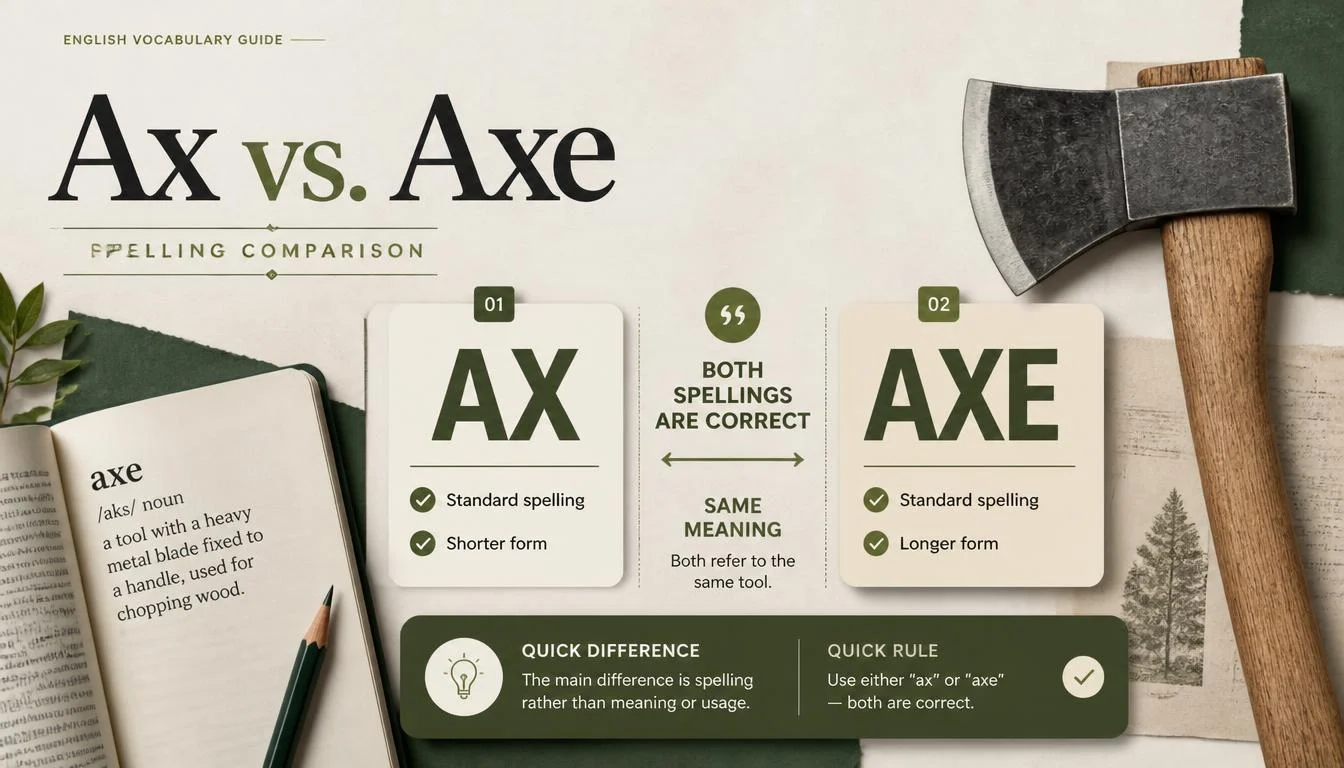
“Ax” and “axe” mean exactly the same thing a cutting tool with a heavy blade, or the verb meaning to cut or remove something. There is no difference in meaning between ax and axe. The only real distinction is regional spelling: “ax” is standard in American English, while “axe” is preferred in British, Canadian, and Australian English.
You’re writing an email, drafting a report, or finishing a story, and you pause on a single letter. Should it be “ax” or “axe”? Both spellings look correct, both sound identical when read aloud, and yet most writers only ever use one without knowing why. This tiny inconsistency trips up students, professionals, and even experienced editors more often than you’d expect.
Here’s the short version: ax and axe refer to the same object and the same action. One isn’t more “correct” English than the other in any global sense it’s a matter of geography, not grammar. American publications, dictionaries, and style guides generally favor “ax,” while British, Canadian, and Australian English almost always use “axe.” Choosing the wrong spelling for your audience doesn’t create confusion about meaning, but it can make your writing look inconsistent or even mildly unprofessional, especially in formal documents where regional spelling conventions matter.
By the end of this guide, you’ll know exactly which spelling fits your writing situation, how each word behaves in a sentence, and how to avoid the small mistakes that make readers do a double take.
Ax vs. Axe: What’s the Difference?
There is no difference in meaning between ax and axe the difference is entirely about which English dialect you’re writing in.
Both words describe the same physical tool: a handle attached to a heavy, sharp blade used for chopping wood, cutting through material, or in some cases, symbolic uses like “cutting” a budget. Both words also work as verbs, meaning to eliminate, cancel, or remove something suddenly, as in “the company axed 200 jobs.”
The words are pronounced identically. Neither is more formal, more modern, or more “proper.” The variation exists purely because American English simplified certain British spellings during the 19th century, largely under the influence of lexicographer Noah Webster, who favored shorter, more phonetic spellings across many English words.
| Feature | Ax | Axe |
|---|---|---|
| Meaning | Cutting tool / to remove suddenly | Cutting tool / to remove suddenly |
| Part of Speech | Noun, Verb | Noun, Verb |
| Refers To | Same physical object and action | Same physical object and action |
| Typical Usage | American English | British, Canadian, Australian English |
| Example | “He split the log with an ax.” | “He split the log with an axe.” |
| Common Confusion | Writers assume one spelling is a typo | Writers assume “ax” is incorrect |
So if you’re writing for a US-based audience a business report, a school assignment following American style, or a blog aimed at American readers “ax” is the expected choice. If you’re writing for a UK, Canadian, or Australian audience, “axe” is the standard form. Neither one is wrong on its own; the mistake only happens when you mix both spellings in the same document.
Is Ax vs. Axe a Grammar, Vocabulary, or Usage Issue?
This is purely a spelling and regional usage issue, not a grammar or vocabulary problem.
Grammatically, both words function identically. They take the same plural form in writing conventions (“axes” for both, though pronounced slightly differently depending on context), follow the same verb conjugation patterns (“axed,” “axing”), and occupy the same position in a sentence. There’s no vocabulary distinction either you’re not choosing between two different concepts, the way you might with “affect” and “effect.” You’re choosing between two accepted spellings of one concept.
In formal writing, the expectation shifts depending on your style guide. Academic papers written for American journals should stick to “ax,” while academic papers following British academic conventions should use “axe.” Business English follows the same logic a company writing for American clients uses “ax,” while one writing for British or Commonwealth clients uses “axe.” In everyday conversation, this distinction barely matters, since spelling differences don’t affect speech at all.
The practical takeaway: pick one spelling based on your target audience or house style, and stay consistent throughout the entire piece of writing.
Understanding “Ax”
“Ax” is the American English spelling, used as both a noun and a verb, pronounced the same way regardless of spelling: /æks/.
As a noun, “ax” refers to the physical tool with a blade and handle. As a verb, it means to eliminate or cut something suddenly and often decisively. Common collocations include “to ax a project,” “to ax jobs,” “to grind an ax” (meaning to have a personal grievance or agenda), and “battle ax,” a term sometimes used informally.
Typical sentence patterns place “ax” after a determiner in its noun form (“the ax,” “an ax,” “his ax”) and directly after a subject in its verb form (“the network axed the show”).
Workplace example: “Management decided to ax the entire marketing budget for next quarter.”
Academic example: “The study examined how quickly companies ax underperforming departments during a recession.”
Technology example: “The startup axed its free-tier plan after struggling with server costs.”
Email example: “Just a heads-up leadership is planning to ax the Friday meetings starting next month.”
Daily conversation example: “I heard they’re going to ax that bus route because not enough people use it.”
A common learner mistake is assuming “ax” is a casual shortening of “axe,” similar to how “thru” shortens “through.” It isn’t. “Ax” is a fully standard, dictionary-recognized American spelling, not an informal variant.
Mini recap: “Ax” is the standard American spelling for both the tool and the verb meaning to cut or eliminate fully correct, not a shortcut.
Understanding “Axe”
“Axe” is the standard spelling across British, Canadian, Australian, and most other varieties of English outside the United States, and it’s pronounced identically to “ax.”
As a noun, it names the same chopping tool. As a verb, it carries the same meaning of removing or cancelling something abruptly. British newspapers frequently use headlines like “Minister axes controversial policy” or “Broadcaster axes long-running series,” where the verb form dominates news writing because it’s short and punchy.
Common collocations include “axe to grind,” “get the axe” (meaning to be fired or cancelled), “axe-wielding,” and “double-edged axe.”
Workplace example: “The board voted to axe two underperforming branches by the end of the year.”
Academic example: “Researchers in the UK studied why local councils axe library funding during budget cuts.”
Technology example: “The tech firm axed its cloud storage service after years of declining users.”
Email example: “Quick note HR confirmed they’re axing the annual bonus scheme this year.”
Daily conversation example: “Did you hear the council axed the weekend market again?”
A frequent mistake among American learners is assuming “axe” is old-fashioned or archaic. It isn’t outdated at all it’s simply the standard form in the majority of English-speaking countries outside the US.
Mini recap: “Axe” is the default spelling in British and Commonwealth English, used identically to “ax” in both meaning and grammar.
When Not to Use Each Word
Mistake 1: Using “ax” in British-audience writing. This happens when American writers forget their audience is international. If your readers are primarily UK, Canadian, or Australian, switch to “axe” to match their expectations.
Mistake 2: Using “axe” in strict American style guides. Many US publications, including major newspapers and the AP Stylebook, specify “ax” as the house spelling. Using “axe” in this context isn’t wrong English, but it breaks house style consistency.
Mistake 3: Mixing both spellings in one document. This is the most common error. A writer might type “ax” in one paragraph and “axe” three paragraphs later without noticing. Readers pick up on this instantly, and it signals a lack of proofreading.
Mistake 4: Assuming one spelling is “more correct” universally. Neither spelling outranks the other globally. The “correct” one depends entirely on which English variety you’re following.
Mistake 5: Overcorrecting in edited work. Some writers, after learning about this distinction, become anxious and start “fixing” every instance inconsistently, sometimes introducing more errors than they solve. Pick your standard once and apply it uniformly.
Mistake 6: Ignoring compound and idiomatic forms. Phrases like “battle-ax” or “axe to grind” have their own established spelling conventions in different dialects. Check whether the idiom itself has a fixed regional spelling before applying your general rule.
Mistake 7: Using autocorrect blindly. Many word processors default to one spelling based on your language settings, silently changing your intended word. Always check your document’s language setting before finalizing a manuscript.
Mistake 8: Forgetting the plural form. Both spellings become “axes” in plural noun form, so writers sometimes second-guess themselves here unnecessarily. “Axes” works for both American and British English.
Common Mistakes Table
| Correct Sentence | Incorrect Sentence | Explanation |
|---|---|---|
| “The company decided to ax the project.” (US style) | “The company decided to axe the project.” (in a strictly AP-style US document) | Breaks house style consistency, not grammar |
| “The council voted to axe the funding.” (UK style) | “The council voted to ax the funding.” (in UK publication) | Doesn’t match regional convention |
| “He used an ax to chop the firewood.” | “He used an ax to chop the firewood, then grabbed the axe from the shed.” | Mixes two spellings in one document |
| “Layoffs are expected; several roles will be axed.” | “Layoffs are expected; several roles will be axeed.” | Incorrect verb form “axed,” not “axeed” |
| “They have an axe to grind with the new policy.” | “They have an ax to grind with the new policy.” (in UK context) | Idiom traditionally spelled “axe” in British English |
Quick Decision Box
If you’re writing for an American audience or following AP style, use Ax.
If you’re writing for a British, Canadian, Australian, or international audience, use Axe.
If you’re unsure of your audience, pick one spelling and use it consistently throughout the entire document.
Real-World Examples
Office communication: An American manager writes in a memo, “We’re going to ax the outdated approval process starting Monday,” while a UK-based colleague replies, “Agreed, we should axe it before the next quarter.”
Business email: A US company drafts a press release using “ax the merger talks,” while its UK subsidiary rewrites the same release using “axe the merger talks” for local media.
School or university: An American student writing an essay for a US professor uses “ax,” while a student at a UK university writing the same essay topic uses “axe” to match academic conventions.
Customer support: A support agent in the US tells a customer, “We had to ax that feature due to low usage,” while a UK-based support team says, “We had to axe that feature due to low usage.”
Technology: A US tech blog headline reads “Company Axes Legacy App After Security Concerns,” while a UK tech outlet publishes “Firm Axes Legacy App Over Security Fears.”
Artificial Intelligence: An AI company based in California announces it will “ax support for an older model version,” while its European partner announces it will “axe support” for the same model.
Daily conversation: An American friend says, “They finally axed that annoying subscription fee,” while a British friend says, “They finally axed that annoying subscription fee” identical in speech, since pronunciation never changes.
Ax vs. Axe in Modern Technology
Modern technology writing uses both spellings constantly, almost always in the verb form, because tech journalism loves short, punchy words for cancellations and shutdowns.
In artificial intelligence coverage, headlines frequently describe companies that “ax” or “axe” outdated models, discontinued tools, or unpopular features. Virtual assistants and voice assistants themselves rarely use the word in their own responses, but writers covering AI news rely on it heavily because it’s shorter and more attention-grabbing than “discontinue” or “eliminate.”
Software companies use the verb form in changelogs and release notes: “We’ve axed the legacy dashboard in favor of the new interface.” Business tools and SaaS platforms use similar phrasing when retiring features, and the spelling chosen almost always reflects whether the company is headquartered in the US or elsewhere.
Chatbots and AI writing assistants typically default to whichever spelling matches the language setting selected by the user, which is why checking your document’s regional language setting matters more than memorizing a rule.
Word Origin
Both spellings trace back to the Old English word “æx,” which itself descended from a common Germanic root shared with words in Old Norse and Old High German for the same cutting tool. For centuries, English spelling wasn’t standardized, and both “ax” and “axe” appeared interchangeably in manuscripts and early printed texts.
The split became more formalized in the 1800s, when Noah Webster’s American dictionaries pushed for simplified, phonetic spellings across American English, dropping silent or redundant letters where possible. “Axe” retained its extra “e” in British usage partly through printing tradition and partly through resistance to American spelling reforms. Neither spelling is a modern invention or an error both have equally long historical roots.
Expert Insight
As a language instructor, I tell students that regional spelling pairs like ax and axe aren’t really “grammar problems” at all they’re audience problems. The question isn’t “which spelling is correct,” but “who am I writing for, and what do they expect to see.” Once you frame it that way, the anxiety around choosing the wrong word tends to disappear, because you’re no longer chasing a single universal rule that doesn’t exist. Pick your audience first, then let that decision guide every spelling choice that follows.
Error Prevention Checklist
- Always use Ax when writing for an American audience or following AP style.
- Always use Axe when writing for British, Canadian, Australian, or international audiences.
- Never confuse them if you check your document’s language setting before you start writing.
- Quick memory tip: “Axe” has an extra letter, just like “British” spelling tends to have extra letters compared to American spelling (think “colour” vs. “color”).
Related Grammar Confusions
- Gray vs. Grey another American vs. British spelling pair worth mastering for the same audience-based reasons.
- Color vs. Colour one of the most well-known US/UK spelling differences in everyday writing.
- License vs. Licence a spelling split that also changes depending on noun versus verb use in British English.
- Practice vs. Practise commonly confused because American English uses one spelling for both noun and verb forms.
- Traveling vs. Travelling a single-letter difference rooted in the same US/UK spelling divide.
- Judgment vs. Judgement a legal and everyday writing distinction tied to regional preference.
- Affect vs. Effect unlike ax/axe, this pair involves an actual meaning difference worth learning separately.
- Canceled vs. Cancelled another double-letter spelling variation between American and British English.
- Theater vs. Theatre a spelling split influenced by the same historical American simplification trend.
- Defense vs. Defence a common source of confusion in both everyday and legal writing contexts.
FAQs
Is “Ax” a Real Word or Just a Typo for “Axe”?
“Ax” is a fully standard, dictionary recognized word. It is not a typo for “axe.” In American English, “ax” is a common spelling for both the tool and the verb meaning to cut or eliminate something.
Which Spelling Should I Use in a Resume or Professional Document?
Choose the spelling that matches your audience’s regional English. Use “ax” for American employers. Use “axe” for British, Canadian, or Australian employers to follow local spelling conventions.
Do “Ax” and “Axe” Have Different Plural Forms?
No. Both spellings use the same plural form, “axes.” This remains true regardless of which singular spelling you use.
Is One Spelling More Formal Than the Other?
No. Neither spelling is more formal or professional. The difference is mainly regional. Your choice should depend on the variety of English you are using.
Why Does My Spell Checker Keep Changing “Axe” to “Ax”?
Your document’s language setting may be set to American English. Spell checkers and autocorrect tools often follow the selected language and may therefore suggest “ax” as the preferred spelling.
Can I Use Both Spellings in the Same Article if I’m Writing for a Global Audience?
It is usually better to choose one spelling and use it consistently throughout the article. Even when writing for a global audience, switching between “ax” and “axe” can appear inconsistent or like an editing oversight.
Conclusion
Ax and axe mean exactly the same thing, function the same way grammatically, and sound identical when spoken aloud. The only real decision you’re making is which regional spelling fits your audience “ax” for American English, “axe” for British, Canadian, and Australian English. Once you understand that this is a geography choice rather than a grammar rule, the confusion disappears almost entirely.
The one habit worth building is consistency: whichever spelling you choose, use it throughout your entire document, email, or article. That single habit will do more for your credibility than memorizing any deeper rule ever could.
Read More Related Articles:
- Pronounciation vs Pronunciation | Common Error You Can Avoid In 2026
- Privilege vs Priviledge | Learn the Correct Word Fast In 2026
- Suing or Sueing | Don’t Let This Spelling Trip You Up In 2026

Zoe Chambers works as a content writer at synoseek.com, contributing thoughtful pieces on everyday subjects and ideas. She writes in a simple, grounded way, often drawing from real-world experiences. Her focus is on keeping content natural, clear and easy for readers to connect with.
2 thoughts on “Ax vs. Axe | Same Tool, Different Spelling In 2026”