Quick Answer
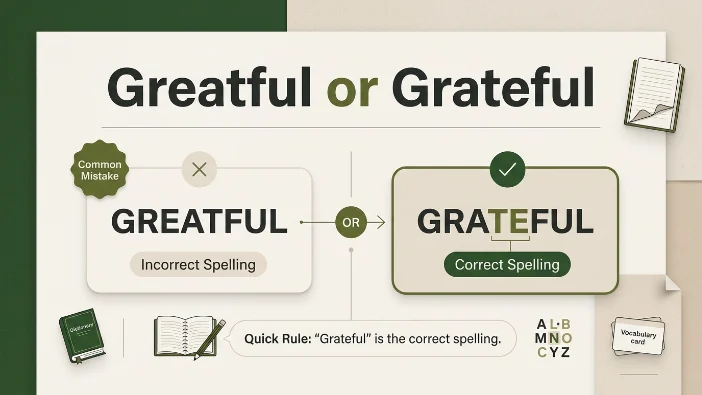
“Grateful” is the correct spelling, meaning deeply appreciative of kindness or benefits received. “Greatful” is a common misspelling. The difference is simple: grate + ful = grateful, not great + ful. Always use “grateful” in all professional and personal writing to maintain credibility and clarity.
Every English learner eventually encounters this frustrating spelling dilemma. You’re writing an important email, crafting a thank-you note, or preparing a business message, and suddenly you pause is it “greatful” or “grateful”? The spelling seems logical both ways, but only one is correct.
This confusion stems from the way we pronounce “grateful” and how our brains naturally connect it to the familiar word “great.” When we hear that initial “gr” sound, many writers instinctively reach for “great” and add “-ful,” creating an entirely wrong word. Understanding why “greatful” is incorrect and why “grateful” is always right will transform your confidence in professional communication. In this comprehensive guide, you’ll discover the origins, proper usage, and memory techniques that ensure you never misspell this meaningful word again.
What’s the Difference Between Greatful and Grateful?
The core difference is simple: “grateful” is the only correct spelling, while “greatful” doesn’t exist in standard English dictionaries and is considered a spelling error. When you understand why this is the case, you’ll never confuse them again.
The confusion between “greatful” and “grateful” represents one of the most common spelling mistakes in English, but the difference is not about meaning or usage it’s purely about correct versus incorrect spelling. Here’s a clear breakdown:
| Aspect | Grateful | Greatful |
|---|---|---|
| Meaning | Feeling or showing appreciation for kindness, benefits, or help received | No meaning (misspelling of grateful) |
| Part of Speech | Adjective | N/A |
| Refers To | Appreciation, thankfulness, recognition of kindness | N/A |
| Typical Usage | Expressing thanks, acknowledging help, recognizing benefits | Never used in proper writing |
| Example | “I am grateful for your support during this project.” | “I am greatful for your support” (incorrect) |
| Common Confusion | Writers mistakenly use “great” + “ful” | The incorrect spelling that results |
The word “grateful” derives from the Latin root “gratus,” meaning pleasing, thankful, or agreeable. When you add the suffix “-ful” (meaning full of), you create “grateful” full of gratitude or thankfulness. The spelling preserves the connection to its Latin origin.
Here’s the key insight: “grateful” is related to “gratitude,” not “greatness.” The word has nothing to do with being “great” or “large.” Instead, it connects to concepts of thanks, appreciation, and recognition of kindness. Once you recognize this connection, the spelling becomes much easier to remember.
Is Grateful a Grammar, Vocabulary, or Usage Issue?
Understanding whether “grateful” represents a grammar, vocabulary, or usage issue helps clarify why mastering this distinction matters for effective communication.
Grammar Classification
From a grammatical standpoint, “grateful” functions as an adjective a word that describes nouns or pronouns. It modifies people, feelings, or actions, indicating that someone experiences or expresses thanks. For example, in “The grateful employee thanked her manager,” the adjective “grateful” describes the employee’s state of being. This grammatical classification is essential because adjectives follow specific patterns in sentences, such as appearing before nouns (“a grateful response”) or after linking verbs (“She seemed grateful”).
Vocabulary Difference
The vocabulary issue here is simpler: “grateful” is a legitimate English word, while “greatful” does not exist in standard English vocabulary. This is not a matter of choosing between two similar words with different meanings it’s a matter of knowing that only one spelling is accepted. Building your vocabulary means not only learning new words but also understanding their correct spellings and forms.
Usage Distinction
“Grateful” appears across all contexts of formal and informal English. Whether you’re writing a business thank-you email, composing a personal note, speaking in a professional meeting, or creating academic writing, “grateful” remains the appropriate choice. The word fits naturally in sentences like:
- “We are grateful for the community’s generous response.”
- “She expressed how grateful she felt for the opportunity.”
- “The team was grateful to receive such positive feedback.”
Interchangeability
There is no question of interchangeability because “greatful” simply isn’t a word. However, some writers confuse “grateful” with similar-sounding but distinct words like “great,” “gratuitous,” or “gracious.” Understanding that “grateful” exclusively relates to thanks and appreciation helps you choose the correct word every time.
Different English Contexts
Across formal English, business English, academic writing, and everyday conversation, “grateful” maintains the same spelling and meaning. This consistency is a blessing for English learners once you master the correct spelling, you can apply it in any context without worrying about variations.
- In workplace emails, “grateful” appears in phrases like “We’re grateful for your continued partnership.”
- In academic writing, you might write, “The research team is grateful to the study participants.”
- In casual conversation, the word is equally natural: “I’m so grateful you could make it.”
Practical Takeaway
The distinction between “grateful” and “greatful” is essentially a spelling and vocabulary issue rather than a grammatical one. By understanding that “grateful” comes from “gratitude” (not “great”), you can confidently use the correct spelling in all your professional and personal writing.
Understanding Grateful: Meaning, Usage, and Examples
Meaning
“Grateful” is an adjective that describes a feeling of deep appreciation or thankfulness for benefits, kindness, or help received. When someone is grateful, they recognize that they have received something valuable and feel a genuine sense of appreciation. The word encompasses emotional gratitude, acknowledgment of others’ efforts, and a positive recognition of good fortune or assistance.
Pronunciation
“Grateful” is pronounced as /ˈɡreɪt.fəl/ (GRAYT-full). The stress falls on the first syllable, which sounds identical to “great” in many dialects. This identical pronunciation is exactly why so many people misspell the word as “greatful” the spoken word sounds like “great” followed by “full,” making the erroneous spelling seem entirely logical.
Part of Speech
As an adjective, “grateful” modifies nouns and pronouns. It can appear in sentences as a predicate adjective following a linking verb (“She is grateful”) or as an attributive adjective before a noun (“the grateful recipient”). This grammatical flexibility makes it useful in countless contexts.
Common Collocations
- Deeply grateful – “I am deeply grateful for your guidance”
- Eternally grateful – “We will be eternally grateful for your support”
- Truly grateful – “She was truly grateful for the recognition”
- Grateful for – “I’m grateful for your patience”
- Grateful to – “We are grateful to our volunteers”
- Grateful that – “I’m grateful that you could attend”
Typical Sentence Patterns
- Subject + linking verb + grateful + for + noun: “We are grateful for your assistance.”
- Subject + linking verb + grateful + to + person: “She is grateful to her mentors.”
- Subject + linking verb + grateful + that + clause: “I’m grateful that you considered my application.”
- Subject + linking verb + grateful + infinitive: “He was grateful to receive the award.”
Natural Workplace Example
“After the challenging merger, our entire department felt deeply grateful for the leadership team’s transparent communication and steady guidance.”
Academic Example
“In her acknowledgments section, the doctoral candidate expressed being profoundly grateful to her research advisor for years of dedicated mentorship and scholarly support.”
Technology Example
“I’m genuinely grateful for the software development team’s quick response to our bug reports they resolved critical issues within 24 hours and kept our systems running smoothly.”
Email Example
Subject: Thank You
Dear Sarah,
I wanted to express how truly grateful I am for your thoughtful feedback on my presentation. Your suggestions about simplifying the data visualization made a significant difference in how the audience received our quarterly results.
Thank you again for your generosity with your time and expertise.
Warm regards,
Michael
Daily Conversation Example
“I was so grateful when my neighbor brought over dinner after I’d been sick all week. It was such a thoughtful gesture that I didn’t expect.”
One Learner Mistake
Incorrect: “I am greatful for your help.”
Correct: “I am grateful for your help.”
This mistake happens because the pronunciation of “grateful” sounds like “great full,” leading learners to assume that “greatful” is the logical spelling. However, the word derives from “gratitude” (not “great”), so the spelling follows this linguistic origin.
Mini Recap
“Grateful” expresses thankfulness and appreciation. It always contains the letters “grate” (from Latin “gratus”) plus “-ful,” never “great” plus “-ful.” Remembering the connection to “gratitude” is the most reliable way to maintain correct spelling.
Common Mistakes When Using Grateful
Many writers, even native English speakers, make mistakes when using “grateful.” Understanding these common errors will help you avoid them in your own writing.
1. Spelling “Greatful”
Why it happens: As discussed, the identical pronunciation leads writers to spell the word as if it were “great” + “ful.” This is the most widespread spelling error.
How to fix it: Always remember “grateful” relates to “gratitude,” not “great.” If you’re unsure, substitute “thankful” in your sentence if that works, use “grateful.”
2. Confusing “Grateful” with “Gracious”
Why it happens: Both words involve positive social qualities and start with “gr,” but they’re not interchangeable. Being “gracious” means being courteous, kind, and pleasant even when dealing with difficult situations or people. Being “grateful” specifically means feeling and expressing thanks.
How to fix it: Ask yourself if you’re describing general politeness (gracious) or specific thankfulness (grateful). If you’re thanking someone, use “grateful.”
3. Using “Grateful” in Insincere or Overly Formal Contexts
Why it happens: Some writers believe formal language requires more elaborate expressions, leading to unnecessary use of “grateful” when simpler words would work better.
How to fix it: Use “grateful” when you genuinely feel appreciation. For routine acknowledgment, simpler phrases like “thanks” or “I appreciate that” may feel more natural. Reserve “grateful” for situations where deeper thanks are appropriate.
4. Forgetting the Preposition
Why it happens: “Grateful” requires specific prepositions depending on the context, and writers sometimes omit them.
How to fix it: Use these patterns:
- Grateful for something (a benefit or action)
- Grateful to someone (a person)
- Grateful that (a clause)
5. Using “Grateful” Instead of “Great”
Why it happens: The similar pronunciation leads some writers to substitute “grateful” for “great” when expressing enthusiasm about something positive.
How to fix it: If you want to say something is excellent or wonderful, use “great.” “Grateful” is only for expressing thanks.
6. Overusing “Grateful” in Professional Communication
Why it happens: Writers sometimes default to “grateful” in every thank-you message, reducing the impact of the word.
How to fix it: Reserve “grateful” for moments of genuine appreciation and use a variety of thanking expressions. Vary with phrases like “I appreciate,” “thank you for,” or “I’m thankful that.”
Common Mistakes Comparison Table
| Correct Sentence | Incorrect Sentence | Explanation |
|---|---|---|
| “I am grateful for your assistance.” | “I am greatful for your assistance.” | “Greatful” is a misspelling. “Grateful” comes from “gratitude,” not “great.” |
| “We are grateful to our sponsors.” | “We are grateful our sponsors.” | Missing the preposition “to” when identifying the person receiving thanks. |
| “She expressed grateful appreciation.” | “She expressed gracious appreciation.” | Gracious” means polite and kind; “grateful” means thankful. |
| “I’m grateful that you could help.” | “I’m grateful for that you could help.” | Incorrect preposition usage; use “that” + clause, not “for that.” |
| “The event was a great success.” | “The event was a grateful success.” | “Grateful” describes feelings, not qualities of events. Use “great” for excellence. |
| “He was grateful for the opportunity.” | “He was grateful for the opportunity.” | This is correct! Just noting that many people misspell it incorrectly. |
Decision Guide: When to Use Grateful
If you’re expressing thanks, appreciation, or acknowledging kindness, use Grateful.
If you’re describing something excellent, large, or important, use Great.
If you’re talking about politeness and courtesy, use Gracious.
Never use Greatful it’s simply incorrect in all contexts.
This decision guide provides a quick reference for choosing the right word. When you’re writing a thank-you note, an acknowledgment in a professional document, or simply expressing appreciation to someone, remember that “grateful” is your correct choice.
Real-World Examples of Grateful in Action
Office Communication
From: Lisa Chen, Project Manager
To: Marketing Team
Subject: Project Completion
Team,
I want to express how grateful I am for the incredible effort everyone put into the Q3 campaign. We launched on time, exceeded our engagement targets, and received outstanding client feedback.
I’m particularly grateful for the late nights and weekend work many of you dedicated to the deliverables. Your commitment didn’t go unnoticed.
Thank you all for your hard work.
Lisa
Business Email
Dear Mr. Thompson,
I am writing to express how grateful we are for your continued partnership over the past five years. The guidance and expertise you’ve provided have been instrumental in our growth.
We’re especially grateful for your flexibility during the recent supply chain challenges your willingness to adapt made a significant difference in our operations.
We look forward to our continued collaboration.
Sincerely,
Elena Rodriguez
Operations Director
School or University Context
Professor Williams,
I wanted to write and express how grateful I am for the feedback you provided on my research proposal. Your comments about strengthening the methodology section helped me clarify my approach significantly.
I’m also grateful for the additional resources you recommended; they’ve been invaluable as I refine my literature review.
Thank you for your time and dedication to your students.
Respectfully,
James Okafor
Customer Support
Thank you for choosing our service. Our team is genuinely grateful for your business and trust in us. We’re grateful for customers like you who help us improve through your thoughtful feedback.
Daily Conversation
After her friend helped her move apartments, Mei said: “I’m so grateful you were available this weekend. Having your help made the whole process so much easier.”
Grateful in Modern Technology
Artificial Intelligence and Virtual Assistants
In the age of AI, the word “grateful” appears frequently in technology contexts, particularly when acknowledging the value of digital tools and services. For example, “I’m grateful for AI-powered translation tools that help me communicate with international colleagues.” The emphasis here is on appreciation for how technology enhances our capabilities.
Chatbots and Automation
Customer service chatbots are often programmed with expressions like “We’re grateful for your patience” during wait times. While these automated messages can sometimes feel impersonal, companies use them to maintain a human touch in digital interactions. Real gratitude in technology contexts means showing authentic appreciation for users’ time and engagement.
Business Tools
Modern business tools increasingly incorporate expressions of appreciation to build positive user experiences. You might see messages like “We’re grateful to have you as a customer” or “Thank you for your feedback we’re grateful for the opportunity to improve.”
Technology Example
The feedback feature on our design platform reads: “We’re grateful for every user review. Your suggestions directly improve our tools and help us create a better experience for the entire creative community.”
Word Origin of Grateful
The word “grateful” has a fascinating linguistic history that explains its spelling and meaning. Understanding this origin is your secret weapon against the “greatful” misspelling.
Etymology
“Grateful” entered the English language in the mid-16th century. It comes from the Latin word “gratus,” which means pleasing, thankful, or agreeable. This same Latin root gives us other words like “gratitude,” “gratify,” “gratuity,” and “gratuitous.”
Language History
The word passed through Old French “grat” before entering English as “grate” (meaning thankful). When English speakers added the suffix “-ful” (meaning full of), they created “grateful” literally “full of thanks” or “full of appreciation.
Meaning Development
From its earliest usage in English, “grateful” has maintained a remarkably consistent meaning. In the 1500s, it meant “pleasing to the mind” or “agreeable.” By the 1600s, the meaning had shifted to the sense we use today: “thankful” or “appreciative of kindness received.
Why This History Matters
This linguistic history demonstrates that “grateful” connects to “gratitude” (Latin “gratus”) rather than “great” (Old English “greát,” meaning large or important). The spelling reflects the word’s Latin origins, not a logical combination of English words.
Quick Pronunciation Note
Despite its spelling, “grateful” is pronounced “GRAYT-full” in most English dialects. This pronunciation matches “great” + “full,” which is exactly why people mistakenly spell it “greatful.” Remembering that the pronunciation is a trap helps you avoid the spelling error.
Expert Insight
As an experienced language instructor, I’ve seen countless students struggle with spelling “grateful” correctly. The most effective teaching approach I’ve developed is simple: whenever a student spells it “greatful,” I ask them to think about the relationship between the words “grateful” and “gratitude.”
Here’s the practical insight that helps everyone remember: If you’re writing a thank-you note or expressing appreciation, you’re showing gratitude. The word “gratitude” contains the letters “g-r-a-t” at its beginning. Follow that same pattern for “grateful.” When you connect the spelling of “grateful” to “gratitude,” the incorrect “greatful” becomes obviously wrong because “greatitude” isn’t a word either.
What makes this mistake so common is that English spelling is famously inconsistent. We have words like “great” and “grateful” that share similar pronunciations but different spellings and meanings. This is why I always tell my students: English isn’t a phonetic language; it’s an etymological one. Words often preserve their spelling from their linguistic ancestors rather than following modern pronunciation rules.
The practical takeaway is this: when you’re unsure about spelling, think about the word’s family. “Grateful” belongs to the “gratitude” family, not the “greatness” family. This single connection will dramatically reduce your spelling errors and increase your writing confidence.
Error Prevention Checklist
Always use “grateful” when:
- You’re expressing thanks or appreciation
- You’re acknowledging someone’s kindness or help
- You’re writing a thank-you note or acknowledgment
- You’re feeling or showing gratitude
- The word “thankful” could be substituted naturally
Never use “greatful” because:
- It’s not a word in any standard English dictionary
- It’s considered a spelling error in all contexts
- Using it undermines your credibility
- Spell-check will flag it as incorrect
Quick memory tip: “Grateful” connects to “Gratitude” both start with G-R-A-T. Remember this connection, and you’ll always spell it correctly.
Double-check yourself:
- If you’re tempted to write “greatful,” stop and think: would “greatitude” be a word? No, so “greatful” isn’t either.
- Substitute “thankful” if it fits, use “grateful.”
- Read the sentence aloud does the meaning involve thanks or appreciation? If so, use “grateful.”
Related Grammar Confusions
- Accept vs. Except – Understanding the difference between receiving (accept) and excluding (except) is crucial for clear communication.
- Affect vs. Effect – This common confusion between verb (affect) and noun (effect) frequently appears in professional and academic writing.
- Principle vs. Principal – Differentiating between a rule (principle) and a person or primary thing (principal) eliminates many writing errors.
- Compliment vs. Complement – Avoid confusion between praise (compliment) and completion (complement) in your writing.
- Emigrate vs. Immigrate – Understanding the direction of movement helps you choose correctly between leaving a country (emigrate) and entering one (immigrate).
- Who vs. Whom – Learning the subject/object distinction helps you write more formally and correctly.
- Lay vs. Lie – One of the most challenging verb pairs in English, with “lay” meaning to place and “lie” meaning to recline.
- Its vs. It’s – A simple apostrophe rules that many writers still get wrong.
- They’re vs. Their vs. There – Mastering these three homophones is essential for basic writing accuracy.
- To vs. Too vs. Two – Understanding the distinction between direction/preposition (to), excess (too), and number (two).
FAQs
Why do people write “greatful” instead of “grateful”?
People write “greatful” because of pronunciation confusion. Both words share the same first syllable sound (“grāte”), leading writers to assume the spelling should follow the more familiar word “great.” Additionally, English spelling rules don’t provide clear guidance, and many writers apply the logical but incorrect pattern of combining “great” with the suffix “-ful.
Is “greatful” a word in the dictionary?
No, “greatful” is not recognized as a standard word in major English dictionaries. It’s consistently considered a common misspelling of “grateful.” Every major dictionary, including Oxford, Cambridge, and Merriam-Webster, lists only “grateful” as the correct spelling. Using “greatful” will be flagged as an error by all spell-checking software.
What is the main difference between “grateful” and “greatful”?
The main difference is that “grateful” is the correct spelling while “greatful” is incorrect. There’s no difference in meaning because “greatful” has no meaning it’s simply a common spelling error. When people write “greatful,” they’re attempting to express the same appreciation they’d express with “grateful,” but they’re spelling it incorrectly.
How can I remember the correct spelling of “grateful”?
The most effective memory technique is to connect “grateful” with “gratitude.” Both words start with “g-r-a-t-” and relate to thanks and appreciation. Since “gratitude” is spelled with “grat” (not “great”), you can remember that “grateful” follows the same pattern. Another helpful trick: think about being full of gratitude, and you’ll remember “grateful” has the same first four letters.
Is “grateful” formal or informal?
“Grateful” works well in both formal and informal contexts. In professional writing, academic papers, and business correspondence, it conveys appropriate appreciation without being overly emotional. In casual conversations and personal notes, it expresses warmth and sincerity. The word is versatile enough to suit any context where you’re expressing thanks.
What’s the most common preposition used with “grateful”?
“Grateful” most commonly appears with the preposition “for” when referring to something you appreciate (e.g., “grateful for the opportunity”) or “to” when referring to someone you appreciate (e.g., “grateful to my parents”). The pattern is typically: grateful to someone + for something. For example: “I’m grateful to my boss for the promotion.”
Conclusion
Understanding the difference between “grateful” and “greatful” comes down to one fundamental fact: only one is correct, and the other is a common but easily avoidable spelling error. By remembering the connection between “grateful” and “gratitude,” you can confidently use the correct spelling in all your writing.
The word “grateful” has served English speakers for centuries, consistently expressing one of our most meaningful emotions appreciation. Whether you’re writing a professional email, a personal thank-you note, or an academic acknowledgment, spelling this word correctly demonstrates your attention to detail and respect for your reader.
Here’s a practical rule to remember: next time you feel that twinge of uncertainty when writing “grateful,” simply ask yourself whether you’re showing gratitude. If the answer is yes, spell it like its linguistic cousin G-R-A-T-E-F-U-L. This one small choice ensures your writing maintains credibility and your appreciation comes through without any distracting spelling errors.
1 thought on “Greatful or Grateful | Learn the Right Spelling in Seconds In 2026”