Quick Answer
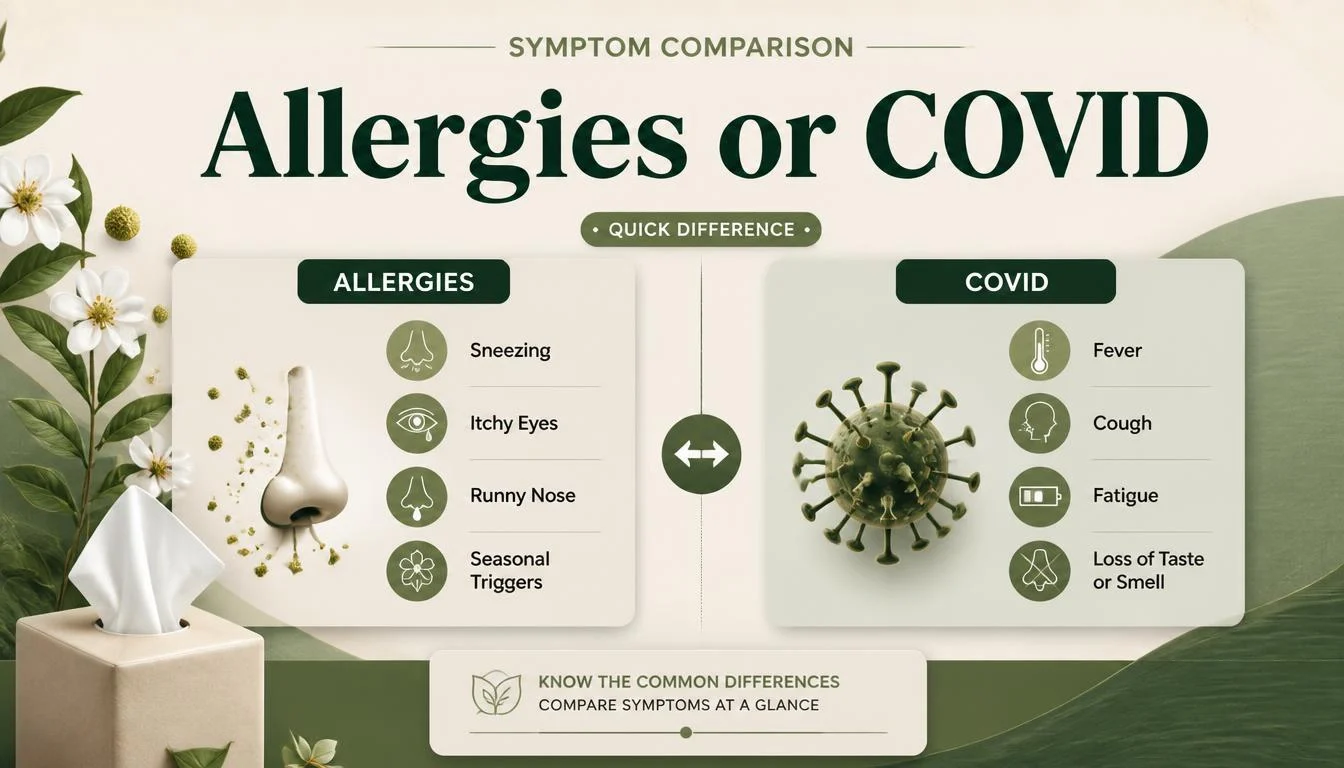
The main difference between allergies and COVID-19 lies in their cause and symptom patterns. Allergies result from immune system reactions to environmental triggers like pollen or dust, while COVID-19 is a viral infection caused by SARS-CoV-2. Key distinguishing features include fever (present in COVID, absent in allergies), itchy eyes (common in allergies, rare in COVID), and symptom progression (allergies are consistent, COVID symptoms evolve).
You wake up with a scratchy throat, a runny nose, and that nagging feeling that something isn’t quite right. Your first thought might be, “Is this just seasonal allergies, or could it be COVID-19?” It’s a question millions of people have asked themselves over the past few years, and for good reason.
The symptoms of allergies and COVID-19 overlap significantly, creating genuine confusion even for healthcare professionals. Both conditions can cause coughing, fatigue, headaches, and nasal congestion. Both can leave you feeling miserable and uncertain about whether you should go to work, visit family, or head to the doctor’s office. The stakes feel higher now than ever before, because confusing allergies for COVID doesn’t just affect you it can impact everyone around you.
This guide walks you through the critical differences between allergies and COVID-19, helping you recognize which condition you’re dealing with and what steps to take next. We’ll cover symptom comparisons, timing, treatment options, and practical decision-making strategies that go beyond the basic information you’ll find in most articles. By the end, you’ll have a clear framework for distinguishing between these two common health concerns.
What’s the Difference Between Allergies and COVID-19?
At their most fundamental level, allergies and COVID-19 involve completely different mechanisms in your body. Allergies occur when your immune system overreacts to harmless substances like pollen, dust mites, or pet dander. Your body mistakenly identifies these triggers as threats and releases histamines, causing inflammation and the classic allergy symptoms we all recognize.
COVID-19, on the other hand, is an infectious disease caused by the SARS-CoV-2 virus. When the virus enters your body, it attaches to cells in your respiratory system, replicates, and triggers an immune response designed to fight off the infection. This immune response, combined with the virus’s direct effects on your body, produces symptoms that can range from mild to life-threatening.
Core Differences at a Glance
| Feature | Allergies | COVID-19 |
|---|---|---|
| Cause | Immune reaction to allergens (pollen, dust, pet dander, mold) | SARS-CoV-2 virus infection |
| Contagious | Not contagious | Highly contagious |
| Fever | Almost never present | Common, especially in early stages |
| Itchy Eyes/Nose | Very common | Rare or absent |
| Symptom Onset | Sudden, consistent, or seasonal | Gradual progression over days |
| Duration | Weeks to months (seasonal) | 5-14 days typical, can persist longer |
| Sneezing | Frequent, often in bursts | Possible but less common |
| Runny Nose | Clear, watery discharge | Clear to thicker discharge |
| Loss of Taste/Smell | Uncommon | Common, often early symptom |
| Body Aches | Rare | Common, sometimes severe |
| Treatment | Antihistamines, avoidance | Antivirals, supportive care, vaccines |
| Prevention | Allergen avoidance, air filters | Vaccination, masks, distancing |
The most important distinction to remember is that allergies don’t cause fever. If you have a temperature above 100.4°F (38°C), you should strongly consider COVID-19 or another infection rather than allergies. Similarly, the sudden loss of taste or smell without nasal congestion is a hallmark COVID symptom that rarely occurs with allergies.
Is This a Grammar, Vocabulary, or Usage Issue?
From a language perspective, choosing between “allergies” and “COVID-19” isn’t really a grammar or vocabulary issue it’s a medical clarity and precision issue. However, when we talk about how people discuss these conditions, we enter the realm of usage: knowing which term to use when communicating symptoms, seeking medical advice, or describing your condition to others.
Grammar Classification
Both terms function as nouns in English. “Allergies” is a plural countable noun (you can have one allergy or multiple allergies). “COVID-19” is a proper noun, being the official name of a disease. When using them in sentences, they follow standard noun patterns:
- “My allergies are acting up today.”
- “I tested positive for COVID-19.”
Vocabulary Differences
The vocabulary surrounding these terms differs significantly. Allergies vocabulary includes words like antihistamines, allergens, pollen, dust mites, seasonal, hay fever, and immunology. COVID-19 vocabulary includes vaccines, variants, testing, isolation, respiratory, infection, contagious, and transmission.
Usage in Different Contexts
Formal English: In medical documentation or official communications, using precise terminology matters. You wouldn’t write “patient presents with allergies” if they actually have COVID-19. The distinction is clinically significant.
Business English: Workplace communications require clarity about whether someone is dealing with allergies or a contagious illness. Saying “I have allergies” versus “I have COVID-19” carries very different implications for workplace policies and colleague safety.
Academic Writing: Research papers distinguish between allergic conditions and infectious diseases with precision. You’ll find separate journals, research methodologies, and treatment approaches for each.
Everyday Conversation: People commonly use “allergies” as a catch-all for any respiratory annoyance, and “COVID” as a catch-all for any virus-like illness. This casual usage creates the very confusion this article aims to resolve.
Practical Takeaway
When discussing your symptoms, be precise. Say “I think I have allergies because my symptoms are seasonal and I don’t have a fever” rather than just “I feel sick.” This precision helps others understand your situation and respond appropriately.
Allergies: A Comprehensive Guide
What Are Allergies?
Allergies are your immune system’s overreaction to substances that are typically harmless to most people. When you have an allergy, your body produces Immunoglobulin E (IgE) antibodies in response to an allergen. These antibodies trigger the release of histamine and other chemicals, causing inflammation and symptoms.
Common Allergens
- Pollen from trees, grasses, and weeds (seasonal allergies)
- Dust mites (perennial allergies)
- Pet dander from cats, dogs, and other animals
- Mold spores (both indoor and outdoor)
- Foods like peanuts, shellfish, and dairy
- Insect stings from bees, wasps, and fire ants
- Medications like penicillin
- Latex and other materials
Pronunciation
“Allergies” is pronounced as /ˈæl.ər.dʒiz/ – AL-er-jeez.
Part of Speech and Collocations
Part of Speech: Noun (countable, usually used in plural form)
Common Collocations:
- Severe allergies
- Seasonal allergies
- Food allergies
- Allergies to [substance]
- Allergy symptoms
- Allergy medication
- Allergy testing
- Allergy season
- Allergy shots (immunotherapy)
- Allergy relief
Typical Sentence Patterns:
- “I have allergies to pollen and dust.”
- “My allergies are worse in the spring.”
- “She developed allergies later in life.”
- “Allergies run in my family.”
Real-World Examples
Workplace Example:
“During spring, I always keep antihistamines at my desk because my allergies make it hard to focus when the pollen counts are high.”
Academic Example:
“The study examined how climate change affects pollen production and the subsequent increase in allergy severity among urban populations.”
Technology Example:
“The new air purifier uses HEPA filtration to remove 99.97% of allergens from indoor air, providing significant allergy relief.”
Email Example:
“Hi team, I’ll be working from home today as my allergies are particularly bothersome. I’m available via email and Slack throughout the day.”
Daily Conversation Example:
“Every spring I forget how miserable allergies can be until I step outside and immediately start sneezing.”
Common Learner Mistakes
English learners often confuse “allergies” with “allergic” or use incorrect prepositions.
Incorrect: “I have allergy to cats.” (missing the word “an” or using singular incorrectly)
Correct: “I have an allergy to cats.” or “I have allergies to cats.”
Incorrect: “I’m allergic of peanuts.”
Correct: “I’m allergic to peanuts.”
Mini Recap
Allergies are immune responses to harmless substances, causing symptoms like sneezing, runny nose, and itchy eyes. They’re not contagious and typically don’t involve fever.
COVID-19: A Comprehensive Guide
What Is COVID-19?
COVID-19 is an infectious disease caused by the SARS-CoV-2 virus. The name “COVID-19” stands for “Coronavirus Disease 2019” because the virus was first identified in December 2019. It primarily spreads through respiratory droplets when infected individuals cough, sneeze, talk, or breathe.
How COVID-19 Affects the Body
When SARS-CoV-2 enters your body, it uses its spike proteins to attach to ACE2 receptors on cells in your respiratory tract, particularly in the lungs. The virus replicates inside these cells, causing damage and triggering an immune response. This response, which includes inflammation and fluid accumulation, leads to the symptoms associated with COVID-19.
In severe cases, the immune response can become overactive, leading to what’s called a “cytokine storm” an excessive inflammatory response that damages organs beyond the lungs.
Pronunciation and Terminology
COVID-19 is pronounced as /ˈkoʊ.vɪd naɪnˈtiːn/ – KOH-vid nine-TEEN. In everyday speech, many people simply say “COVID” /ˈkoʊ.vɪd/.
Part of Speech and Collocations
Part of Speech: Proper noun (uncountable)
Common Collocations:
- COVID-19 pandemic
- COVID-19 infection
- COVID-19 symptoms
- COVID-19 testing
- COVID-19 vaccination
- COVID-19 transmission
- COVID-19 variants
- COVID-19 treatment
- COVID-19 isolation
- COVID-19 long-hauler
Typical Sentence Patterns:
- “They tested positive for COVID-19.”
- “COVID-19 vaccines are highly effective.”
- “The COVID-19 pandemic changed how we live and work.”
- “COVID-19 symptoms can vary widely.”
Real-World Examples
Workplace Example:
“Our company implemented a policy requiring employees to stay home for five days after testing positive for COVID-19, regardless of symptom severity.”
Academic Example:
“Research into COVID-19 has accelerated our understanding of viral transmission and vaccine development in unprecedented ways.”
Technology Example:
“Contact tracing apps using Bluetooth technology helped track COVID-19 exposure during the early stages of the pandemic.”
Email Example:
“Hello team, I’ve tested positive for COVID-19 and will be working remotely while I recover. Thank you for your flexibility.”
Daily Conversation Example:
“I’m still feeling tired weeks after COVID-19 the fatigue just seems to linger longer than I expected.”
Common Learner Mistakes
English learners sometimes incorrectly pluralize COVID-19 or use it with prepositions incorrectly.
Incorrect: “I had COVID-19s last year.”
Correct: “I had COVID-19 last year.” (it’s uncountable, so no plural)
Incorrect: “She has COVID-19 since Monday.”
Correct: “She has had COVID-19 since Monday.” (use present perfect for ongoing situations)
Mini Recap
COVID-19 is a viral infection with symptoms including fever, cough, fatigue, and loss of taste or smell. It’s highly contagious and can range from mild to severe.
When to Avoid Each Term
Situations Where “Allergies” Is Incorrect
- When you have a fever: If your temperature is elevated, you likely have an infection, not allergies. Saying “it’s just allergies” could delay proper medical treatment.
- When you’ve been exposed to COVID-19: If you know you’ve had recent exposure to someone with COVID-19, don’t assume it’s allergies. Get tested.
- When symptoms are severe or getting worse: Allergies tend to remain fairly consistent. Worsening symptoms, especially difficulty breathing, require medical attention and aren’t “just allergies.”
- When you lose sense of taste or smell: This symptom strongly indicates COVID-19. While nasal congestion from allergies can affect smell, complete loss without severe congestion is a red flag.
- When you have body aches: Muscle aches and joint pain are typical COVID symptoms but rare with allergies.
Situations Where “COVID-19” Is Incorrect
- When you have seasonal symptoms only: If your symptoms appear at the same time each year and you’ve never had a fever, it’s more likely allergies.
- When antihistamines provide relief: If over-the-counter allergy medication effectively stops your symptoms, you’re dealing with allergies.
- When you’ve been allergy tested: If you have documented allergies and your symptoms match your known triggers, it’s probably allergies.
- When others in your home don’t have symptoms: COVID-19 is highly contagious; if you’re sick and family members are fine, consider allergies or another non-contagious condition.
- When symptoms have been stable for weeks: Allergies often persist for weeks or months during specific seasons. COVID-19 typically resolves within 1-2 weeks.
Quick Recall Memory Tip
Remember: Fever = Not allergies. If you have a temperature above 100.4°F (38°C), it’s time to suspect infection, not allergies. This single distinction rules out allergies in most cases.
Common Mistakes and Their Corrections
| Correct Sentence | Incorrect Sentence | Explanation |
|---|---|---|
| “My allergies are acting up because the pollen count is high.” | “My COVID is acting up because the pollen count is high.” | COVID is a viral infection, not affected by pollen. |
| “I need to take a COVID-19 test.” | “I need to take an allergy test.” | COVID tests detect the virus; allergy tests detect immune responses to allergens. |
| “Allergies don’t cause fever.” | “Allergies cause fever sometimes.” | This is a medical fact: allergies do not cause fever. |
| “I tested positive for COVID-19.” | “I tested positive for allergies.” | You can’t “test positive” for allergies in the same way; allergy tests identify triggers. |
| “COVID-19 spreads from person to person.” | “Allergies spread from person to person.” | Allergies are not contagious. |
| “The COVID-19 vaccine helped protect me.” | “The allergy vaccine helped protect me.” | Allergy shots (immunotherapy) treat allergies; COVID vaccines prevent infection. |
Quick Decision Guide
If you have a fever: → This is probably not allergies. Consider COVID-19 or another infection.
If your eyes are itchy and watery: → This points toward allergies, especially if you also have sneezing and a clear runny nose.
If you’ve lost your sense of taste or smell: → This strongly suggests COVID-19, particularly if other COVID symptoms are present.
If antihistamines help: → You’re likely dealing with allergies.
If you’ve been around someone with COVID-19: → Get tested, regardless of whether symptoms seem mild.
If it’s spring and pollen counts are high: → Allergies are more likely.
If symptoms came on suddenly with fever and body aches: → Think COVID-19 or another viral infection.
Real-World Examples for Everyday Decisions
Healthcare Communication
“During my telehealth appointment, I told the doctor I had a fever of 101°F, cough, and fatigue but no itchy eyes or sneezing. Based on these symptoms, she recommended a COVID-19 test rather than assuming allergies.”
Office Scenario
“My coworker kept sneezing and mentioned his allergies were terrible. Since he had no fever and took antihistamines, I felt comfortable being in the same meeting room. A week later, he mentioned his allergy symptoms had resolved completely.”
Parenting Challenge
“When my daughter’s preschool sent home a notice about a COVID-19 case, I started monitoring her for symptoms. When she developed a fever and cough but no itchy eyes, I kept her home and scheduled a test rather than assuming seasonal allergies.”
Social Planning
“My friend wanted to cancel dinner plans because she had a runny nose and headache. I asked if she had a fever or loss of taste she said no. We changed our plans to an outdoor restaurant to minimize risk, and it turned out to be allergies.”
Allergies and COVID-19 in Modern Technology
Technology has transformed how we understand and manage both allergies and COVID-19. Understanding these terms in their technological context helps you navigate modern healthcare tools.
Artificial Intelligence and Symptom Checkers
AI-powered symptom checkers now help people distinguish between allergies and COVID-19 by analyzing symptom patterns. These tools use machine learning algorithms trained on thousands of confirmed cases to provide likelihood assessments.
How They Work: When you input symptoms like cough, fever, and runny nose, the AI compares your pattern against known cases of allergies and COVID-19, providing a probability score for each condition.
Digital Health Tools
- Symptom tracking apps help users log daily symptoms and identify patterns over time
- Wearable devices monitor heart rate, temperature, and blood oxygen levels that might indicate COVID-19
- Pollen tracking apps provide real-time allergen data to help allergy sufferers anticipate symptoms
Telemedicine and Remote Care
Telemedicine platforms have integrated features specifically for respiratory symptoms. Virtual consultations allow healthcare providers to ask detailed questions, reducing unnecessary in-person visits while ensuring accurate diagnoses.
Indoor Air Quality Technology
Air purifiers with HEPA filters and UV-C light have become increasingly sophisticated, helping remove both allergens and airborne viruses from indoor spaces. Some newer devices even differentiate between pollen particles and viral particles in their filtration approach.
Where These Words Come From
Origins of “Allergy”
The term “allergy” was coined in 1906 by Austrian pediatrician Clemens von Pirquet. He created the word from the Greek words allos (meaning “other”) and ergon (meaning “work” or “action”). Literally, it means “other action” or “altered reaction,” which perfectly describes how allergic reactions represent an altered immune response to normally harmless substances.
Origins of “COVID-19”
COVID-19 is a much newer term, officially designated by the World Health Organization on February 11, 2020. The acronym stands for:
- CO = Corona (referring to the crown-like spikes on the virus surface)
- VI = Virus
- D = Disease
- 19 = The year the virus was first identified (2019)
The name was chosen to be accurate without stigmatizing specific geographic locations or populations, following WHO naming guidelines for new infectious diseases.
Expert Insight for Language and Medical Clarity
As a language instructor who’s worked with thousands of professionals navigating healthcare terminology, I’ve noticed a recurring pattern: people tend to use medical terms loosely when stressed or uncertain. This is completely understandable when you’re not feeling well, precision can feel less important than simply getting through the day.
However, the distinction between allergies and COVID-19 represents a situation where clarity matters enormously. I always tell my students to think of it this way: when you describe your symptoms, you’re not just asking for help you’re also helping others understand what level of caution to take.
If you’re unsure, it’s always better to use more specific language. Instead of saying “I feel sick,” try “I have seasonal allergy symptoms” or “I have COVID-like symptoms.” This small shift in word choice gives listeners crucial context without requiring you to self-diagnose.
Remember, these words are tools for communication. Using them precisely doesn’t just make you sound more educated it helps protect your health and the health of everyone around you.
Error Prevention Checklist
Always suspect allergies when:
- You have no fever
- Your eyes are itchy and watery
- Your symptoms appear during specific seasons
- Antihistamines provide significant relief
- You’ve been diagnosed with allergies before
Always suspect COVID-19 when:
- You have a fever above 100.4°F (38°C)
- You’ve lost your sense of taste or smell
- You’ve had known exposure to someone with COVID-19
- Your symptoms include significant body aches
- Symptoms develop progressively over several days
Never confuse them if:
- You’re making medical decisions always consult a healthcare provider
- You’re deciding whether to isolate from others err on the side of caution
- You’re communicating with healthcare professionals use precise symptom descriptions
Quick memory tip:
“Fever says infection, itching says allergic. Smell loss equals COVID, sneezing equals allergies.”
Related Grammar Confusions Worth Knowing
Here are similar vocabulary comparisons that often confuse English learners and native speakers alike:
- Cold vs. Flu – Similar to allergies vs. COVID, these involve different severities, symptom patterns, and treatment approaches.
- Virus vs. Bacteria – Understanding whether an illness is viral or bacterial affects treatment decisions and terminology usage.
- Symptom vs. Side Effect – Symptoms are disease manifestations; side effects are medication reactions.
- Quarantine vs. Isolation – Quarantine is for possible exposure; isolation is for confirmed infection.
- Vaccine vs. Immunization – A vaccine is the treatment; immunization is the process of becoming immune.
- Acute vs. Chronic – Acute conditions are short-term; chronic conditions persist long-term.
- Pandemic vs. Epidemic – Pandemic is global; epidemic is regional.
- Contagious vs. Infectious – Contagious diseases spread through contact; infectious diseases can spread through various means.
- Test vs. Diagnosis – A test provides data; a diagnosis interprets that data.
- Antibodies vs. Antigens – Antibodies fight infections; antigens trigger immune responses.
FAQs
Can allergies cause shortness of breath like COVID-19?
Yes, severe allergies can cause shortness of breath, particularly in people with asthma or those experiencing anaphylaxis. However, COVID-19 shortness of breath often comes with other symptoms like fever and cough. If breathing becomes difficult, seek emergency medical attention regardless of the suspected cause.
How long do COVID-19 symptoms typically last compared to allergies?
COVID-19 symptoms usually last 5-14 days, though some people experience symptoms for weeks or months (long COVID). Allergies persist as long as you’re exposed to the trigger this can be weeks, months, or year-round depending on the allergen and season.
Can I have both allergies and COVID-19 at the same time?
Yes, it’s possible to have allergies and contract COVID-19 simultaneously. Your allergy symptoms might mask early COVID symptoms, so it’s important to monitor for any changes. If new symptoms like fever or loss of taste develop, get tested even if you usually have allergies.
Is it safe to take allergy medication if I might have COVID-19?
Generally, allergy medications like antihistamines are safe to take while you have COVID-19 and may help with symptoms. However, they won’t treat the viral infection. Consult a healthcare provider if you have concerns about medication interactions.
Should I get a COVID-19 test if I think it’s just allergies?
If you have any symptoms that could be COVID-19, especially if you’ve been exposed or have fever, testing is recommended. Testing helps protect others and ensures you receive appropriate treatment. Many people mistake early COVID for allergies, so testing provides clarity.
When should I see a doctor instead of assuming it’s allergies?
See a doctor if you have difficulty breathing, persistent chest pain, confusion, inability to stay awake, or bluish lips or face. Also seek medical attention for fever lasting more than a few days, worsening symptoms, or if you have underlying health conditions that put you at higher risk.
Why do allergies cause sneezing but COVID-19 doesn’t always?
Sneezing is a reflex triggered by irritation in the nasal passages. Allergens directly irritate nasal tissues, causing sneezing. COVID-19 affects the respiratory system differently it primarily targets lung tissue and can cause coughing, but nasal irritation is less common, which explains why sneezing is not a hallmark symptom.
How accurate are home COVID tests compared to allergy symptoms?
Home COVID tests are generally accurate when used correctly and at the right time (after symptom onset). However, they cannot distinguish between allergies and COVID they simply detect the presence of the virus. Negative tests don’t definitively rule out COVID if symptoms persist.
Do allergy symptoms change with the seasons while COVID symptoms don’t?
Yes, seasonal allergies follow predictable patterns based on pollen counts. COVID-19 can occur any time of year, with no seasonal pattern beyond the general respiratory virus season in fall and winter. If you have symptoms at the same time each year, allergies are more likely.
What treatments work for both allergies and COVID-19 symptoms?
Over-the-counter pain relievers like acetaminophen and ibuprofen can help with headaches, body aches, and fever from COVID-19. They can also help with allergy-related headaches. Rest, hydration, and using a humidifier benefit both conditions. However, antivirals work only for COVID-19, and antihistamines work only for allergies.
Conclusion
The confusion between allergies and COVID-19 is understandable given their overlapping symptoms, but knowing the key differences can help you make better decisions about your health and the health of those around you. Remember: allergies are your immune system overreacting to harmless environmental triggers, while COVID-19 is a viral infection that spreads between people.
The single most helpful distinction is the presence of fever allergies don’t cause fever, while COVID-19 often does. Pay attention to itchy eyes, which strongly suggest allergies, and loss of taste or smell, which points toward COVID-19. Consider the timing: seasonal patterns favor allergies, while recent exposure to someone sick suggests COVID-19.
When in doubt, getting tested is always the safest approach. Testing provides clarity, protects your community, and helps you access appropriate treatment. And most importantly, never hesitate to seek medical care for severe symptoms whether they turn out to be allergies, COVID-19, or something else entirely.
Keep this simple rule in mind: “If you’re contagious or feverish, think viral. If you’re sneezy and itchy, think allergy.” This mental shortcut, combined with the detailed guidance in this article, will help you navigate the confusion with confidence.
Read More Related Articles:
- Pronounciation vs Pronunciation | Common Error You Can Avoid In 2026
- Privilege vs Priviledge | Learn the Correct Word Fast In 2026
- Suing or Sueing | Don’t Let This Spelling Trip You Up In 2026

Zoe Chambers works as a content writer at synoseek.com, contributing thoughtful pieces on everyday subjects and ideas. She writes in a simple, grounded way, often drawing from real-world experiences. Her focus is on keeping content natural, clear and easy for readers to connect with.