Quick Answer
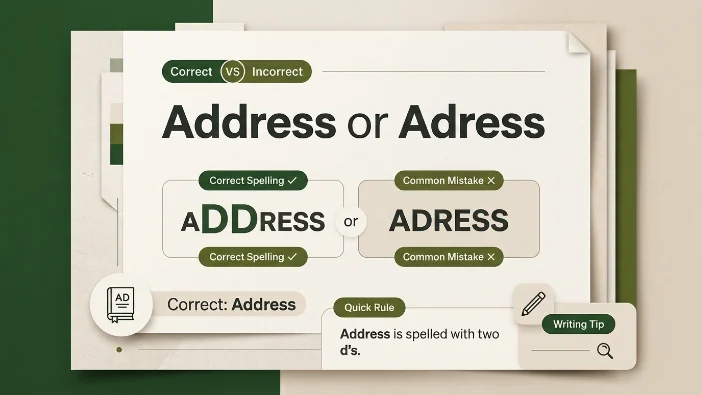
Address is the only correct spelling in standard English. “Adress” is simply a common misspelling that drops one of the two D’s. Whether you’re writing a home address, addressing an envelope, or asking someone to address a problem, the word always needs double D a-d-d-r-e-s-s. Remembering this one rule prevents a mistake that shows up constantly in emails, forms, and resumes.
You’re filling out a shipping form, typing fast, and suddenly you pause. Is it “address” or “adress”? One D or two? It happens to native speakers and English learners alike, and there’s a good reason for that hesitation the word looks like it should follow a simpler pattern, but English rarely plays fair.
Address is a real, standard English word with two D’s, used as both a noun (your home address) and a verb (to address a crowd, or to address a problem). Adress, on the other hand, isn’t a recognized word in any English dictionary at all. It’s a misspelling that happens because people either mishear the pronunciation, get influenced by similar words in other languages, or simply type too quickly and drop a letter.
The mix-up matters more than it seems. A misspelled word on a job application, a business email, or a shipping label can look careless, even if the content is otherwise flawless. Small spelling slips like this one quietly chip away at how professional your writing appears.
By the end of this guide, you’ll know exactly why “address” carries two D’s, how to never second-guess yourself again, and how the word functions in different contexts from everyday conversation to technology and business writing.
Address vs Adress: What’s the Difference?
The direct answer is simple: there is no real difference, because only one of these is an actual word. Address is correct. Adress is incorrect in every context, in every English-speaking country, and in every style guide.
This isn’t a case like “effect” versus “affect,” where both words exist but mean different things. It’s closer to writing “recieve” instead of “receive” a spelling error rather than a genuine vocabulary choice. Still, because so many people type “adress” out of habit, it’s worth breaking down exactly where the confusion comes from and how the correct form behaves grammatically.
| Feature | Address (Correct) | Adress (Incorrect) |
|---|---|---|
| Meaning | Location, or to speak to/deal with something | No meaning not a word |
| Part of Speech | Noun and Verb | None |
| Refers To | A place, or the act of speaking/dealing with | Nothing; spelling error |
| Typical Usage | Standard in all writing | Never appears in formal or accepted writing |
| Example | “Please confirm your home address.” | Should be corrected to “address” |
| Common Confusion | Number of D’s, influence from other languages | Mistyped or misremembered spelling |
After looking at this side by side, the takeaway is straightforward. English speakers sometimes drop the second D because the word is pronounced quickly, almost blending the two D sounds into one. In several other languages including French (adresse, with one D but a double S) and Spanish (dirección, an entirely different structure) the spelling pattern doesn’t match English at all, which adds to the confusion for non-native speakers. Once you know the correct form has two D’s and two S’s, the spelling becomes automatic with a little practice.
Is “Address” a Grammar, Vocabulary, or Usage Issue?
This is purely a spelling issue, not a grammar or vocabulary problem. Address” doesn’t have a competing correct form the way words like “gray” and “grey” do in American versus British English. There’s one accepted spelling, and “adress” simply doesn’t exist as an alternative in any recognized dictionary, including Oxford, Cambridge, or Merriam-Webster.
That said, the word does carry some genuine complexity once you move past spelling:
- Grammar classification: Address functions as both a countable noun (“I have two addresses”) and a regular verb (“She addressed the audience”).
- Vocabulary difference: As a noun, it usually means a physical or digital location. As a verb, it can mean to speak directly to someone, to label something with a destination, or to deal with a problem.
- Formal versus everyday use: In business and academic writing, “address” often appears as a verb meaning to tackle an issue “The report addresses three key concerns.” In daily conversation, it’s more commonly the noun form referring to where someone lives.
The practical takeaway here is this: once the spelling is locked in, the word adapts easily across formal reports, casual texts, emails, and technical writing without changing form.
Understanding “Address” as a Noun
Meaning: A physical location where someone lives or where mail is delivered, or a formal speech given to an audience.
Pronunciation: Stress can fall on either syllable depending on meaning and region uh-DRESS is common for both noun and verb in American English, though some speakers stress the first syllable (AD-ress) when referring to a location.
Part of speech: Noun.
Common collocations: home address, email address, IP address, mailing address, return address, keynote address, deliver an address.
Typical sentence pattern: [Subject] + [verb] + [possessive] + address. Example: “She updated her billing address.”
Workplace example: “Can you send the invoice to our new office address before Friday?”
Academic example: “The professor’s opening address set the tone for the entire conference.”
Technology example: “Double-check the recipient’s email address before sending confidential files.”
Email example: “Please update your shipping address in your account settings.”
Daily conversation example: “What’s your new address? I want to send you a card.”
One learner mistake: Writing “adress” on forms, especially shipping or registration forms, where the error can cause real confusion or delays.
Mini recap: As a noun, “address” almost always points to a place or a formal speech and it always needs that second D.
Understanding “Address” as a Verb
Meaning: To speak directly to a person or group, to write a destination on an envelope or package, or to deal with a problem or situation.
Pronunciation: Typically stressed on the second syllable uh-DRESS.
Part of speech: Verb (regular; past tense “addressed”).
Common collocations: address a concern, address the issue, address the audience, address a letter.
Typical sentence pattern: [Subject] + address + [object]. Example: “The manager addressed the complaint immediately.”
Workplace example: “We need to address the budget shortfall before the next quarterly review.”
Academic example: “This essay addresses the causes of the economic downturn in three parts.”
Technology example: “The software update addresses several security vulnerabilities.”
Email example: “Thank you for reaching out I’ll address your concerns one by one below.”
Daily conversation example: “You really need to address that issue with your landlord soon.”
One learner mistake: Confusing “address” with “dress,” which unrelated meaning (“to put on clothes”) sometimes trips up learners who assume the words share a root idea.
Mini recap: As a verb, “address” is about action speaking up, labeling, or solving and again, it never drops that second D.
When Writers Commonly Get This Wrong
1. Typing too fast on forms. Digital forms move quickly, and the brain sometimes types the word the way it sounds rather than the way it’s spelled, dropping the extra D.
2. Influence from other languages. Speakers of French, Portuguese, or Scandinavian languages sometimes carry over a single-D spelling pattern from their native word for “address.”
3. Autocorrect gaps. Not every text field has spellcheck enabled, especially in address bars, chat apps, or basic web forms, so the error slips through unnoticed.
4. Confusing it with similar-looking words. Words like “dress” or “stress” have a single leading consonant cluster, which can subconsciously shape how “address” gets typed.
5. Rushing through resumes and cover letters. Job seekers under pressure often make this exact mistake in the contact information section ironically one of the most visible parts of the document.
6. Copy-paste errors from translated content. When content is translated or paraphrased from another language, spelling patterns from the original sometimes carry over.
7. Never double-checking short, “easy” words. Writers tend to proofread complex vocabulary carefully but skim past short, familiar words like “address,” assuming they can’t be wrong.
8. Learning the word by ear before seeing it in print. If someone hears “address” in conversation long before reading it, they may guess at the spelling based on pronunciation alone.
The simplest way to remember the fix: picture the word split as “ad” + “dress,” like getting dressed for an occasion. Two clear parts, two D’s.
Common Mistakes Table
| Correct Sentence | Incorrect Sentence | Explanation |
|---|---|---|
| “Please confirm your shipping address.” | “Please confirm your shipping adress.” | Missing the second D changes it to a non-word. |
| “The CEO will address the shareholders tomorrow.” | “The CEO will adress the shareholders tomorrow.” | The verb form also requires two D’s. |
| “I need to update my email address.” | “I need to update my email adress.” | Common error on account settings and sign-up forms. |
| “This memo addresses the delay in shipping.” | “This memo adresses the delay in shipping.” | Doubling the S is correct too “adresses” is also wrong. |
| “Her address book is full of old contacts.” | “Her adress book is full of old contacts.” | The compound noun “address book” keeps the same spelling rule. |
Quick Decision Box
If you’re ever unsure, remember this:
Always use “Address.” There is no situation, formal or informal, where “adress” is acceptable. If you’re referring to a location, a speech, or the act of dealing with something it’s always spelled with two D’s and two S’s.
Address in Real-World Situations
Office communication: “Can everyone update their extension and office address in the company directory by end of day?”
Business email: “We’ve received your request and will address the billing discrepancy within 48 hours.”
School or university: “Students must provide a permanent mailing address when submitting their application.”
Customer support: “I’m sorry for the inconvenience let me address that issue for you right away.”
Technology: “Enter your IP address in the network settings to complete the connection.”
Artificial intelligence: “The chatbot is designed to address common customer questions instantly.”
Daily conversation: “I still haven’t found time to address the mess in the garage.”
Each of these examples shows how flexible the word is one spelling, multiple real situations, zero exceptions.
Address in Modern Technology
In tech contexts, “address” shows up constantly, and getting the spelling wrong can cause more than embarrassment it can break a system. An IP address is the numerical label assigned to a device on a network. An email address identifies where digital messages are delivered. Even memory addresses in programming refer to specific locations in a computer’s memory.
Virtual assistants and AI chatbots are frequently described as tools built to “address user needs” meaning they’re designed to respond to and resolve requests efficiently. Voice assistants like the ones on smartphones often ask users to confirm their address for delivery or location-based services, which makes accurate spelling essential when configuring accounts or writing documentation.
In software development, a single typo like “adress” in a variable name, form label, or API field can cause bugs, broken links, or failed form submissions. This is one of the clearest real-world cases where a spelling mistake has consequences far beyond appearance.
Where the Word Comes From
Address” traces back to the Old French word adresser, meaning “to guide” or “to direct,” which itself came from Latin roots related to “directing” or “making straight.” As the word moved into English usage, it picked up the double consonant pattern common in many English words borrowed from French and Latin. Over centuries, its meaning expanded from simply “directing” something to include both physical locations and the act of formally speaking to someone two meanings that still share that same underlying idea of directing attention or communication toward a specific point.
Expert Insight
As a language instructor, one thing I tell students constantly: short, everyday words are often the ones people trust too much. Learners spend hours memorizing complex vocabulary but breeze past simple words like “address,” assuming familiarity equals accuracy. The truth is, the words you type most often are exactly the ones worth double-checking, because a small, repeated error becomes a habit fast. Once you consciously correct “adress” to “address” a few times, the correct spelling becomes automatic and that awareness carries over to other commonly misspelled words too.
Error Prevention Checklist
- Always use “Address” when referring to a location, a formal speech, or the act of dealing with a problem.
- Always double the D and double the S no matter which meaning you’re using.
- Never trust muscle memory on short words; a quick visual check takes two seconds.
- Quick memory tip: think “ad” + “dress” two parts, two D’s, just like getting properly dressed for the occasion.
Related Grammar Confusions Worth Learning
- Accept vs Except one means to receive, the other means to exclude; easily confused in fast writing.
- Affect vs Effect a genuine vocabulary distinction between a verb and a noun, unlike address/adress.
- Its vs It’s a classic possessive-versus-contraction mix-up that trips up even experienced writers.
- Complement vs Compliment spelled almost identically but with very different meanings.
- Principal vs Principle a homophone pair that confuses students and professionals alike.
- Stationary vs Stationery one letter changes the entire meaning of the word.
- Discreet vs Discrete two words that sound alike but serve very different purposes.
- Loose vs Lose a spelling mix-up almost as common as address/adress.
- Advice vs Advise the noun and verb forms are frequently swapped in writing.
- Personal vs Personnel a workplace-specific confusion worth mastering for professional writing.
FAQs
Is “adress” ever correct in British English?
No. Adress is not a correct spelling in British English or any other standard variety of English. The correct spelling is address, with two d’s and two s’s.
Why do people often misspell address with one D?
The mistake usually happens because of fast typing, pronunciation, or simply forgetting that address contains two d’s. Since the word is so familiar, writers may overlook the missing letter during proofreading.
Does “address” have the same spelling as a verb and a noun?
Yes. Address has the same spelling whether it is used as a noun or a verb. It can refer to a location, as in “What is your address?”, or to dealing with an issue, as in “We need to address the problem.”
Is “address” spelled differently in other English-speaking countries?
No. American, British, Australian, and Canadian English all use the same spelling: address. There is no standard regional variation using adress.
What’s an easy way to remember the correct spelling?
Break address into “ad” + “dress.” This can help you remember the first d and the second d. Also remember that the word ends with -ss, giving you two d’s and two s’s.
Can spellcheck always catch “adress”?
Not always. Some forms, address fields, apps, or websites may have limited spell-checking or none at all. That’s why it’s useful to check the spelling manually, especially when entering an address on an important form or document.
Conclusion
The difference between “address” and “adress” isn’t really a difference at all it’s a matter of one word being correct and the other being a common typo. Every context, from a home mailing address to a formal speech to a workplace email, calls for the same spelling: two D’s, two S’s, no exceptions.
The easiest rule to remember going forward is this: if you’re ever unsure, think of the word as “ad” plus “dress.” That mental split takes two seconds and permanently prevents the mistake from showing up again in your writing.
Read More Related Articles:
- Halves or Halfs | Quick Guide to the Right Plural In 2026
- Women or Woman | Grammar Rule That Makes It Easy In 2026
- Light vs Lite | Know the Difference Before You Write In 2026

Zoe Chambers works as a content writer at synoseek.com, contributing thoughtful pieces on everyday subjects and ideas. She writes in a simple, grounded way, often drawing from real-world experiences. Her focus is on keeping content natural, clear and easy for readers to connect with.
2 thoughts on “Address or Adress | Learn the Right Spelling in Seconds In 2026”