Quick Answer
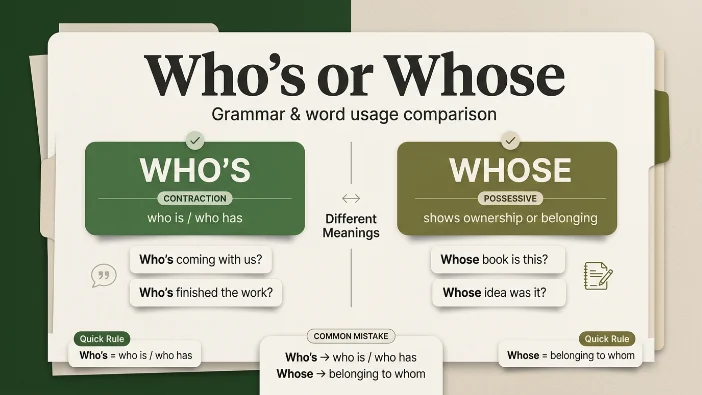
Choose “whose” to show possession (Whose phone is this?) and “who’s” only as a contraction of “who is” or “who has” (Who’s coming to dinner?). The confusion happens because apostrophe S typically indicates possession in English, but with “who,” the apostrophe signals a contraction instead.
If you have ever paused mid-sentence while trying to decide between “who’s” and “whose,” you are far from alone. This tiny apostrophe creates outsized confusion, even for native English speakers who have been writing their entire lives. The problem is straightforward: English grammar has a rule about apostrophes showing possession, but “whose” breaks that pattern.
The difference between who’s and whose matters more than you might think. When you write “Whose going to the meeting?” in a professional email, you signal more than a simple typo. You signal a gap in foundational grammar knowledge that can undermine your professional credibility. In academic writing, business communication, and content creation, these small errors accumulate into a larger impression of carelessness. This guide will permanently solve your confusion through practical explanations, realistic examples, and memory tricks that actually work.
What’s the Difference Between Who’s and Whose?
The core distinction is simple. “Whose” indicates possession or ownership. “Who’s” is a contraction that combines “who” with either “is” or “has.”
Think about it this way: every time you write “who’s,” silently expand it in your head to “who is” or “who has.” If the expanded version fits the sentence, “who’s” is correct. If it sounds wrong or awkward, you need “whose.”
| Aspect | Who’s | Whose |
|---|---|---|
| Meaning | Contraction of “who is” or “who has” | Possessive form of “who” |
| Part of Speech | Contraction (two words combined) | Possessive pronoun |
| Refers To | A state of being or action | Ownership or relationship |
| Typical Usage | “Who is going” or “Who has finished” | “The person whose car…” |
| Example | Who’s ready for lunch? | Whose jacket is this? |
| Common Confusion | Mistakenly used for possession | Mistakenly replaced with “who’s” |
The confusion arises because English speakers are conditioned to use apostrophe S for possession. “The dog’s bone,” “Sarah’s house,” “the company’s policy”—these all use apostrophe S to show ownership. But “whose” is the exception to this rule. It already indicates possession without needing an apostrophe.
Here is the essential distinction: if you are describing an action or state of being involving a person, use “who’s.” If you are describing something belonging to or associated with a person, use “whose.”
Is This a Grammar, Vocabulary, or Usage Issue?
Understanding the nature of this confusion helps you remember the correct choice. This is primarily a usage and grammar issue rather than a vocabulary problem.
Grammar classification: The who’s vs. whose distinction falls under grammar because it involves the correct application of possessive forms and contractions. English grammar rules dictate that contractions use apostrophes to indicate missing letters, while possessive pronouns (like “whose,” “its,” and “theirs”) do not.
Vocabulary difference: While both words relate to the same root pronoun “who,” they serve completely different grammatical functions. They are not synonyms or alternate forms of the same word. They are different tools for different purposes.
Usage difference: The choice between these words depends entirely on what you are trying to express. Are you contracting “who is” or “who has”? Use who’s. Are you showing that something belongs to someone? Use whose.
Are they interchangeable? Absolutely not. Using one when you mean the other changes the meaning of your sentence or creates grammatical nonsense.
| Context | Preferred Choice | Why? |
|---|---|---|
| Formal English | Both appear frequently, but contractions are often avoided in extremely formal writing | Formal writing tends to avoid contractions entirely |
| Business English | Both are acceptable, but accuracy is critical for professional image | Errors undermine credibility |
| Academic Writing | “Whose” is common; “who’s” is usually avoided | Academic style prefers complete words |
| Everyday Conversation | “Who’s” is very common in speech and casual writing | Contractions reflect natural spoken English |
Practical takeaway: When writing formally, expand “who’s” to “who is” or “who has” to avoid contractions entirely. When choosing between “whose” and “who is,” remember that one shows possession and the other describes action.
When to Use Whose
“Whose” functions as the possessive form of “who.” It asks or states that something belongs to a specific person or is associated with them. Use “whose” when you need to indicate ownership, relationship, or connection.
Part of speech: Possessive pronoun, specifically an interrogative possessive pronoun when asking questions and a relative possessive pronoun when connecting clauses.
Common collocations and patterns:
- Whose + noun (Whose book, whose idea, whose responsibility)
- Whose + noun + verb (The woman whose dog barked)
- Preposition + whose + noun (The person to whose attention)
Pronunciation: /huːz/ (rhymes with “news”)
Workplace Example
“I need to speak with the employee whose project was selected for the quarterly presentation. The manager whose team won the award will receive a bonus.”
Academic Example
“The researcher whose methodology we adopted published her findings in a peer-reviewed journal. Students whose grades fall below the threshold must attend tutoring sessions.”
Technology Example
“The developer whose code caused the bug has already submitted a fix. Any system whose security protocols are outdated faces significant risk.”
Email Example
“Dear Sarah, Could you please confirm the client whose account is being audited? I also need the contact information for the representative whose signature is required on the final documents.”
Daily Conversation Example
“Do you know whose backpack this is? I found it in the conference room. The person whose phone keeps ringing should probably answer it.”
Common Learner Mistake
Incorrect: “Do you know who’s backpack this is?”
Correct: “Do you know whose backpack this is?”
Why the mistake happens: Learners apply the apostrophe S rule for possession, which works for “the dog’s bone” but fails for “whose.”
Mini Recap
Use “whose” whenever you need the possessive form of “who.” This includes asking about ownership, connecting a person to something they possess, or describing a relationship between a person and something associated with them. If you cannot replace the word with “who is” or “who has,” you need “whose.”
When to Use Who’s
Who’s” is a contraction, meaning it combines two words into one by omitting certain letters and replacing them with an apostrophe. Specifically, “who’s” stands for either “who is” or “who has.”
Part of speech: Contraction
Common collocations and patterns:
- Who’s + verb-ing (Who’s coming, who’s going)
- Who’s + been/past participle (Who’s been working, who’s finished)
- Who’s + adjective (Who’s ready, who’s available)
Pronunciation: /huːz/ (identically pronounced to “whose”)
Workplace Example
“Who’s leading the meeting tomorrow? I need to know who’s responsible for the quarterly report. Who’s already completed their portion of the project?”
Academic Example
“Who’s presenting at the conference next month? The professor who’s teaching the advanced seminar just published a new book. Who’s finished the required reading?”
Technology Example
“Who’s scheduled to deploy the update tonight? The engineer who’s been working on this feature will handle the rollout. Who’s tested the new integration thoroughly?”
Email Example
“Subject: Meeting Reminder. Who’s available for a quick call at 2 PM? I need to know who’s reviewed the proposal before we proceed. Please let me know who’s attending the client lunch.”
Daily Conversation Example
“Who’s calling at this hour? I wonder who’s going to win the game tonight. Who’s been eating all the snacks? Who’s ready for the weekend?”
Common Learner Mistake
Incorrect: “Whose going to the store with me?”
Correct: “Who’s going to the store with me?”
Why the mistake happens: The pronunciation is identical, so writers often choose “whose” when they are uncertain, especially since “whose” follows the pattern of apostrophe S indicating possession.
Mini Recap
Use “who’s” when you mean “who is” or “who has.” Always expand the contraction mentally to confirm it makes sense. If the expanded version works, you have made the right choice.
When NOT to Use Each Word
Understanding when to avoid each word is just as important as knowing when to use them. Here are common situations where writers mistakenly choose the wrong word.
Mistake 1: Using “Who’s” for Possession
Why the mistake happens: The apostrophe S pattern for possession is so ingrained that writers automatically add an apostrophe to show ownership.
Which word is correct: Use “whose” for possession.
How to remember: If the sentence could be replaced with “who is” or “who has,” use “who’s.” If not, use “whose.”
Mistake 2: Using “Whose” for “Who Is”
Why the mistake happens: Identical pronunciation creates confusion, especially in fast writing where the writer doesn’t pause to think.
Which word is correct: Use “who’s” when contracting “who is.
How to remember: Substitute “who is” into the sentence. If it works, write “who’s.”
Mistake 3: Confusing “Whose” with “Who’s” in Questions
Why the mistake happens: Both words appear in questions, and the question context doesn’t automatically clarify which form is needed.
Which word is correct: Ask yourself: is the question asking about action/state (who’s) or possession (whose)?
How to remember: Questions about ownership use “whose.” Questions about identity or action use “who’s.”
Mistake 4: Using “Who’s” in Formal Writing
Why the mistake happens: Writers assume contractions are always fine, even in formal contexts.
Which word is correct: If you would write “who is” in formal writing, write it out fully. Avoid contractions entirely for maximum formality.
How to remember: Formal academic and business writing generally avoids contractions.
Mistake 5: Misusing “Whose” for Objects
Why the mistake happens: Some writers think “whose” only applies to people.
Which word is correct: “Whose” can apply to both people and objects (the company whose policies changed, the book whose cover is torn).
How to remember: “Whose” works for both people and things, unlike “who” which only applies to people.
Mistake 6: Choosing “Who’s” When “That” Would Be Better
Why the mistake happens: Writers default to “who” when they mean inanimate objects.
Which word is correct: Use “that” or “which” for inanimate objects, “whose” for possession by people or things.
How to remember: Reserve “whose” for possession, not as a general relative pronoun.
Common Mistakes Table
| Correct Sentence | Incorrect Sentence | Explanation |
|---|---|---|
| Whose car is parked outside? | Who’s car is parked outside? | This is possession, not a contraction of “who is” |
| Who’s coming to the party tonight? | Whose coming to the party tonight? | This contracts “who is coming,” so “who’s” is correct |
| I know the woman whose dog escaped. | I know the woman who’s dog escaped. | The dog belongs to the woman, so use “whose” |
| She asked whose responsibility it was. | She asked who’s responsibility it was. | The responsibility belongs to someone, so use “whose” |
| Who’s finished their assignment already? | Whose finished their assignment already? | This contracts “who has finished,” so use “who’s” |
| The company whose stocks fell today. | The company who’s stocks fell today. | The stocks belong to the company, so use “whose” |
| Who’s going to take over the project? | Whose going to take over the project? | This contracts “who is going,” so use “who’s” |
| I wonder whose phone this is. | I wonder who’s phone this is. | The phone belongs to someone, so use “whose” |
Quick Decision Guide
If you mean the action of being or having, use “who’s.”
If you mean ownership or association, use “whose.”
The distinction becomes automatic once you mentally expand “who’s” to “who is” or “who has” every time you encounter it. If the expansion sounds natural, the contraction is correct. If the expansion makes no sense, you need “whose.”
Real-World Examples
Office Communication
“The manager whose department exceeded its quarterly goals announced that who’s attending the conference will receive additional training. I checked the schedule to see who’s presenting and whose presentation overlaps with the lunch break.”
Business Email
“Dear Team, I need to confirm whose budget covers the new software licenses. Additionally, who’s responsible for submitting the compliance report by Friday? Please reply with the name of the person whose approval we require before finalizing the order.”
School or University
“The professor whose research focuses on climate change announced that who’s interested in joining the study should attend the information session. Students whose GPA falls below 3.0 should consider tutoring options, and who’s already signed up for tutoring should check their email for confirmation.”
Customer Support
“Thank you for contacting support. Could you confirm whose account needs assistance? Also, who’s the primary contact person on this issue? The representative whose case load is lightest will be assigned to help you promptly.”
Technology
“The developer whose commit caused the merge conflict is working on a resolution. Before we deploy, let’s confirm who’s approved the final version and whose API keys are still valid in the production environment.”
Artificial Intelligence
“The AI system whose training data included diverse sources produced more accurate results. Before deployment, the team needs to verify who’s reviewed the model’s performance metrics and whose signature validates the compliance checklist.”
Daily Conversation
“I need to figure out whose turn it is to walk the dog. Also, who’s cooking dinner tonight? The friend whose birthday we’re celebrating just texted that who’s bringing the cake should double-check the order.”
Who’s and Whose in Modern Technology
The distinction between these words appears frequently in technology discussions, particularly around artificial intelligence, virtual assistants, and software documentation.
Artificial Intelligence: “The system whose algorithm we implemented achieved 95% accuracy. We need to determine who’s responsible for ongoing model maintenance and whose dataset was used for validation.”
Virtual Assistants: “Who’s activating the new voice assistant features? The user whose preferences are stored in the system will receive personalized responses.”
Voice Assistants: “The assistant whose speech recognition model performs best will be selected for the consumer release. Who’s leading the voice team’s weekly review?”
Chatbots: “The chatbot whose responses feel most natural uses advanced NLP. Who’s configuring the fallback responses for unrecognized queries?”
Software: “The developer whose code review checklist we follow just released an updated version. Who’s deploying the hotfix this evening?”
Business Tools: “The tool whose interface is most intuitive typically wins enterprise adoption. Who’s scheduled the vendor demo for next week?”
Word Origin
Understanding the history of these words provides useful context for remembering their proper usage.
“Whose” has been part of English since Old English times, evolving from the genitive (possessive) form of “who.” It has always functioned as a possessive pronoun, consistently maintaining this role through centuries of language evolution. This explains why “whose” does not follow the apostrophe S pattern—its possessive form predates the apostrophe convention in English.
“Who’s” emerged much later as a contraction during the development of modern English. The apostrophe indicates where letters have been omitted: “who is” or “who has” become “who’s.” This contraction follows the same pattern as “he’s” for “he is” or “he has” and “she’s” for “she is” or “she has.”
The key insight is that “whose” and “who’s” developed independently and serve different grammatical functions. Their identical pronunciation is coincidental, created by the natural evolution of English sounds rather than any intentional relationship between the words.
Expert Insight
The most effective way to internalize the who’s/whose distinction is to stop thinking about possession rules and start thinking about mental substitution. Every English contraction works the same way: “don’t” means “do not,” “can’t” means “cannot,” and “who’s” means “who is” or “who has.” The apostrophe in “who’s” marks missing letters, exactly as it does in every other contraction. The apostrophe does not mark possession, even though this is a common use of apostrophes elsewhere. Treating “who’s” as a contraction first and possession as a separate concept eliminates the confusion entirely.
When you write “who’s,” you are writing two words collapsed into one. When you write “whose,” you are writing a single word with a unique grammatical purpose. These are not variations of the same concept; they are different concepts that happen to sound the same.
Error Prevention Checklist
Always use WHOSE when:
- You are showing ownership or possession
- You are asking about belonging or relationship
- You can substitute “his,” “her,” or “their” without changing the sentence
- The sentence describes something that belongs to someone
Always use WHO’S when:
- You mean “who is
- You mean “who has
- You can expand it to “who is” or “who has” without changing meaning
- You are describing an action or state of being
Never confuse them if:
- You remember that “who’s” = “who is” or “who has”
- You remember that “whose” shows possession like “his” or “hers”
Quick memory tip:
- If you could say “who is” or “who has,” use who’s (apostrophe)
- If you could say “his,” “her,” or “their,” use whose (no apostrophe)
Related Grammar Confusions
Its vs. It’s: Similar possessive vs. contraction confusion. Its” shows possession; “it’s” means “it is” or “it has.” Learning this alongside who’s/whose reinforces the pattern that possessive pronouns lack apostrophes.
Your vs. You’re: Another contraction vs. possessive pair. Your” shows possession; “you’re” means “you are.
There vs. Their vs. They’re: Three-way confusion involving possession (their), location (there), and contraction (they’re).
Whom vs. Who: Different grammatical cases of the same pronoun. “Who” is subjective; “whom” is objective.
Which vs. That vs. Who: Relative pronoun choices that affect meaning and formality.
Affect vs. Effect: Verb vs. noun confusion that often appears in professional writing.
Lay vs. Lie: Common verb confusion involving transitive and intransitive usage.
Farther vs. Further: Physical distance vs. metaphorical distance.
Less vs. Fewer: Countable vs. uncountable nouns.
Peak vs. Pique vs. Peek: Homophones with distinct meanings.
Each of these topics follows a similar pattern to who’s vs. whose: understanding the underlying grammatical or logical difference eliminates confusion. Mastering one pair helps reinforce the mental discipline required for the others.
FAQs
Is “whose” only used for people?
No, “whose” can refer to both people and things. You can correctly write “the company whose profits increased” or “the book whose cover was torn” as well as “the person whose car was stolen.” The possessive form “whose” works for any noun, whether animate or inanimate.
Can I use “who’s” in formal writing?
You can, but formal writing typically avoids contractions. Instead of “who’s,” write “who is” or “who has” fully. This applies to academic papers, business reports, legal documents, and other contexts where formal register is expected. In business emails and casual writing, “who’s” is completely acceptable.
Why do so many people confuse these words?
The primary reason is identical pronunciation. “Whose” and “who’s” sound exactly the same in spoken English. Additionally, the apostrophe S rule for possession is deeply embedded in English grammar, making “whose” seem like an exception that should have an apostrophe. The mental habit of adding apostrophe S for possession overrides the specific rule for “whose.”
How do I remember the difference quickly?
Always expand “who’s” to “who is” or “who has.” If the expansion makes sense, you need the contraction. If it doesn’t, you need “whose.” This mental check takes one second and eliminates all confusion. Practice it every time you encounter the word until it becomes automatic.
Does “whose” work with “whom”?
“Whose” is the possessive form of both “who” and “whom.” When you need the possessive of “whom,” you also use “whose.” For example: “The person to whom I spoke, whose advice I valued, has left the company.” The possessive connection to the person uses “whose” regardless of whether the original pronoun would be “who” or “whom.”
Is there any context where “who’s” shows possession?
No. “Who’s” never shows possession. It always contracts “who is” or “who has.” Any sentence using “who’s” to show possession is grammatically incorrect. If you need to show possession, you need “whose.”
Conclusion
The difference between who’s and whose comes down to one simple question: are you contracting two words or showing possession? “Who’s” always expands to “who is” or “who has.” “Whose” always shows ownership, connection, or association. These are different tools for different purposes, and confusing them changes your intended meaning.
Remember this rule: if you can replace the word with “who is” or “who has,” write who’s with an apostrophe. If you can replace it with “his,” “her,” or “their,” write whose without an apostrophe. This distinction takes practice to internalize, but once you master it, you will never hesitate again.
The confident use of “whose” for possession and “who’s” for contraction marks competent writers who understand English grammar beyond surface-level rules. Every time you choose correctly, you reinforce good habits that extend to other grammar challenges.
1 thought on “Who’s or Whose | Practical Guide to Meaning and Usage In 2026”