Quick Answer
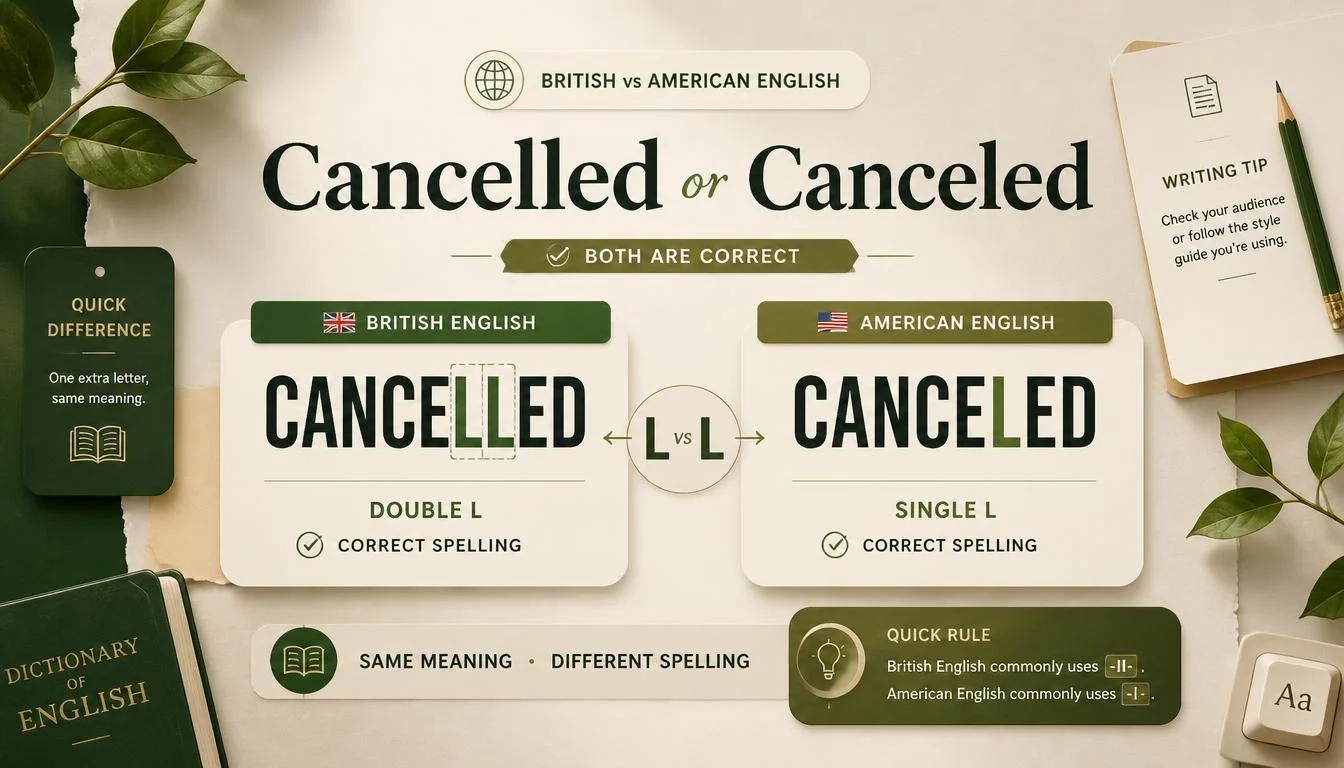
The difference between “cancelled” and “canceled” comes down to regional spelling conventions. American English uses “canceled” with one “l,” while British English uses “cancelled” with two “l’s.” Both spellings are correct within their respective dialects, and the choice depends entirely on your audience’s location and expectations.
Nothing derails a piece of writing faster than inconsistent spelling. You type “cancelled” in one paragraph and “canceled” in the next, and suddenly your work looks sloppy. The same goes when you’re writing for a U.S. audience but using British spellings. These small inconsistencies don’t just confuse readers they undercut your credibility.
If you’ve ever hesitated before typing this word, you’re not alone. Many writers pause, unsure whether to double that “l” or keep it single. The confusion is understandable because English spelling rules are full of exceptions. Unlike many grammar issues involving meaning, this one has no right or wrong answer just different conventions depending on who you’re writing for. As an experienced language educator, I’ll break down everything you need to know about “cancelled” versus “canceled,” when to use each, and how to confidently choose the correct spelling every time.
What’s the Difference Between Cancelled and Canceled?
At its core, the difference between “cancelled” and “canceled” is purely regional. Both words mean the same thing: to call off, annul, or mark something as no longer valid. They function identically as the past tense and past participle of the verb “cancel.”
| Aspect | Canceled | Cancelled |
|---|---|---|
| Meaning | Called off; no longer happening | Called off; no longer happening |
| Part of Speech | Verb (past tense/past participle) | Verb (past tense/past participle) |
| Primary Usage | American English | British English |
| Spelling Rule | Single “l” after the stressed syllable | Double “l” after the stressed syllable |
| Example | The flight was canceled due to weather. | The flight was cancelled due to weather. |
| Common Confusion | Writers may add a second “l” unnecessarily | Writers may remove the second “l” incorrectly |
Here’s the quick rule of thumb: if you’re writing for an American audience, use “canceled” (one “l”). If you’re writing for a British, Australian, Canadian, or other Commonwealth audience, use “cancelled” (two “l’s”). That’s really all there is to it. The spelling doesn’t change the meaning, pronunciation, or grammatical function of the word in any way.
Is This a Grammar, Vocabulary, or Usage Issue?
The “cancelled” versus “canceled” question falls squarely into the category of usage rather than grammar or vocabulary. The grammatical rules governing both spellings are identical they’re both correct past tense forms. The vocabulary meaning remains unchanged. The only variable is how the word is used in different regions.
Understanding this distinction matters because it changes how you approach the problem. You’re not learning a new grammar rule or memorizing a new vocabulary word. You’re learning to adapt your spelling to match your audience’s expectations. This is a practical skill that separates competent writers from exceptional ones.
In formal writing contexts, consistency matters more than which spelling you choose. If you’re writing a business report for a U.S. company, consistently using “canceled” signals professionalism. If you’re writing for a British publication, “cancelled” demonstrates attention to detail. Even academic writing follows regional conventions American universities typically expect American spellings, while British institutions follow British usage.
The same applies to everyday conversation. When writing emails, social media posts, or text messages, you can choose either spelling. However, maintaining consistency within a single document or conversation prevents your writing from looking careless.
The American Spelling: Canceled
Meaning and Pronunciation
Canceled” carries the same meaning as its British counterpart to annul, call off, or render something void. Pronounced KAN-suhld, the stress falls firmly on the first syllable, which is the key to understanding the spelling rule that governs this word.
Part of Speech and Common Collocations
“Canceled” functions as both the simple past tense and the past participle of “cancel.” You’ll encounter it frequently in everyday situations, often paired with these common collocations:
- Canceled flight
- Canceled event
- Canceled subscription
- Canceled appointment
- Canceled check
- Canceled meeting
- Canceled order
Example Sentences
Workplace Example
The marketing team canceled the product launch after discovering a technical issue during final testing.
Academic Example
The professor canceled office hours for the week due to a conference she was attending out of state.
Email Example
Hi Sarah, I’ve canceled our lunch meeting for Thursday since we’re both attending the all-staff event. Let’s reschedule for next week.
Technology Example
The software update was canceled at the last minute because developers identified a security vulnerability that required immediate attention.
Daily Conversation Example
“Did you hear? They canceled the outdoor concert because of the thunderstorm warnings.”
Common Learner Mistake
A frequent error involves applying the double consonant rule incorrectly. Some writers double the “l” in “canceled” because they assume it follows the same pattern as “traveled” (which can use either one or two “l’s” in American English). Remember, American English generally uses a single “l” when the stress falls on the first syllable, as in “cancel.”
Mini Recap
“Canceled” is the standard American spelling. Use it for U.S. audiences, American publications, and any context following U.S. English conventions. It’s pronounced the same way regardless of spelling.
The British Spelling: Cancelled
Meaning and Pronunciation
Cancelled” means exactly the same thing as “canceled” to annul or call off something previously arranged. The pronunciation remains KAN-suhld, identical to the American version. The double “l” simply reflects British spelling conventions.
Part of Speech and Common Collocations
Like its American counterpart, “cancelled” serves as both past tense and past participle. You’ll find it used with the same common collocations:
- Cancelled flight
- Cancelled event
- Cancelled subscription
- Cancelled appointment
- Cancelled cheque (British spelling of “check”)
- Cancelled meeting
- Cancelled order
Example Sentences
Workplace Example
The board of directors cancelled the shareholder meeting after the CEO’s sudden resignation left too many unanswered questions.
Academic Example
The university cancelled all lectures on Friday after the building’s heating system failed during the winter storm.
Email Example
Dear Mr. Thompson, I regret to inform you that we have cancelled your appointment for tomorrow. Our clinic will contact you to reschedule.
Technology Example
The system automatically cancelled the transaction when it detected suspicious activity on the account.
Daily Conversation Example
“Can you believe they cancelled the festival again this year? I was really looking forward to it.”
Common Learner Mistake
Non-native speakers sometimes struggle with the double consonant rule because their native languages may have different spelling patterns. The key to remembering is that British English typically doubles the final consonant when adding “-ed” to verbs ending with a consonant-vowel-consonant pattern, even when the stress falls on the first syllable.
Mini Recap
“Cancelled” is the standard British spelling. Use it for U.K., Australian, New Zealand, Canadian, and other Commonwealth audiences. The pronunciation remains identical to “canceled.”
When NOT to Use Each Word
Choosing the wrong spelling creates confusion primarily because of regional expectations. Here are situations where writers commonly make mistakes:
Writing for an American Audience
If your document will be read by Americans, “cancelled” will look foreign and potentially distract readers. American publications, U.S.-based companies, and American teachers typically expect “canceled.” Using “cancelled” in this context signals either carelessness or lack of familiarity with American conventions.
Writing for a British Audience
Conversely, “canceled” appears incorrect to British readers. British publications, U.K. companies, and Commonwealth institutions use “cancelled” almost exclusively. American spellings in these contexts can make your writing seem unprofessional.
Academic and Publishing Contexts
Academic style guides vary by region. The APA Style guide recommends American spellings, while the Chicago Manual of Style follows American conventions. British universities often require British spellings. Always check your institution’s guidelines before submitting formal work.
Email and Casual Writing
In informal contexts, your audience matters less, but consistency still matters. Switching between “canceled” and “cancelled” within the same email or post makes your writing look sloppy, even in casual settings.
Formal Business Documents
Contracts, legal filings, and formal business correspondence demand consistency with regional conventions. A contract using inconsistent spellings could undermine its professional appearance, even if the legal content remains unchanged.
Applying the Double Consonant Rule Incorrectly
Some writers overcorrect, using “cancelled” everywhere because they assume it’s “more correct.” Others undercorrect, using “canceled” everywhere without considering their audience. Remember, both are correct choose based on your reader.
Common Spelling Mistakes
| Correct Sentence | Incorrect Sentence | Explanation |
|---|---|---|
| The meeting was canceled due to a scheduling conflict. | The meeting was cancelled due to a scheduling conflict. | Both are correct depending on the audience. Inconsistent spellings are the real problem. |
| Our subscription was automatically canceled after six months. | Our subscription was automatically canceled after six months. | For American English, this is correct. For British English, “cancelled” would be preferred. |
| I haven’t canceled my gym membership yet. | I haven’t canceled my gym membership yet. | The incorrect version uses the British spelling in an American context, which may seem inconsistent. |
| The flight was cancelled due to heavy fog. | The flight was canceled due to heavy fog. | Correct for British English; incorrect for American English. Regional context matters. |
| She canceled the order before it shipped. | She cancelled the order before it shipped. | American usage uses “canceled.” Consistency is key. |
| The concert was cancelled because of low ticket sales. | The concert was canceled because of low ticket sales. | The British spelling is correct for British audiences. |
Important Note: When you see “incorrect” in the table above, it means inconsistent with the regional convention shown. In practice, both spellings are valid, but only one fits each regional standard. The table demonstrates how context determines correctness.
Quick Decision Guide
- If you’re writing for American readers → Use canceled (one “l”)
- If you’re writing for British readers → Use cancelled (two “l’s”)
- If you’re writing for Australian, Canadian, or New Zealand readers → Use cancelled (two “l’s”)
- If you’re following APA Style → Use canceled (American spelling)
- If you’re following Oxford Style → Use cancelled (British spelling)
- If you’re writing for international audiences → Choose one spelling and stick with it consistently
Real-World Examples Across Contexts
Office Communication
“I need to confirm whether the vendor canceled our contract renewal or if they’ll be sending updated terms next week.”
Business Email
“Dear Team, Unfortunately, we’ve canceled tomorrow’s strategy session because our guest speaker fell ill. We’ll reschedule once we have a new date.”
Academic Environment
“The research symposium was canceled after the university reduced funding for humanities programs.”
Customer Support
“Your account has been canceled as requested. You’ll receive confirmation of your refund within three business days.”
Technology Context
“The build process was canceled automatically when the testing suite detected critical errors in the deployment configuration.”
Artificial Intelligence
“The AI system canceled the backup operation after determining that storage capacity had reached critical levels.”
Daily Conversation
“I’m so disappointed. My kids were devastated when they heard the field trip got canceled.”
The British Double Consonant Rule Explained
Understanding why British English doubles the “l” helps you remember the pattern. British spelling follows the rule that when adding a suffix beginning with a vowel, you double the final consonant if the word ends in consonant-vowel-consonant, regardless of stress. This differs from American English, which typically doubles only when the stress falls on the final syllable.
Consider these examples:
- Travel → travelled (British), traveled (American)
- Label → labelled (British), labeled (American)
- Cancel → cancelled (British), canceled (American)
This rule gives British English its distinctive double consonants, while American English often streamlines spellings. Knowing this pattern helps you apply the correct spelling across similar words, not just “cancelled” versus “canceled.
Word Origin and History
Cancel” entered English from the Anglo-French word “canceller,” which derived from the Latin “cancellare” meaning “to cross out.” The Latin root connects to “cancelli,” meaning “lattice” or “crossbars,” reflecting how writers would cross out or mark through text to cancel it.
The spelling variations emerged as English spread across continents. Noah Webster, the influential American lexicographer, famously simplified many English spellings in his 1828 dictionary. His reforms included reducing double consonants where he felt they were unnecessary, producing the American “canceled” with a single “l.” British English maintained the original spelling pattern, keeping the double “l.”
Expert Insight
When teaching this concept to my students, I emphasize a simple principle: consistency tells the reader you know what you’re doing. The choice between “canceled” and “cancelled” matters less than the choice to be consistent throughout your writing. I tell my students to decide based on their audience and then use a spell-checker set to their preferred language variant. This small habit eliminates the guesswork and lets them focus on communicating clearly.
Error Prevention Checklist
- ✅ Always use canceled (one “l”) for American English writing
- ✅ Always use cancelled (two “l’s”) for British English writing
- ✅ Never switch between spellings in the same document
- ✅ Set your spell-checker to the correct language variant
- ✅ Consider your audience’s location before you start writing
- ✅ When in doubt, remember: Americans simplify the spelling
- ✅ Consistency matters more than which spelling you choose
Quick Memory Tip: Americans like to keep things simple single “l” for single country.
Related Grammar Confusions
- Traveled vs. Travelled – Same regional difference as “canceled” vs. “cancelled”
- Labeled vs. Labelled – Another double-consonant regional variation
- Modeled vs. Modelled – Follows the same American/British pattern
- Counseled vs. Counselled – Identical regional spelling difference
- Fulfill vs. Fulfil – American uses double “l,” British uses single “l” (opposite pattern)
- Enroll vs. Enrol – American uses double “l,” British uses single
- Realize vs. Realise – American “z” versus British “s” variation
- Organize vs. Organise – Same American “z” versus British “s” pattern
- Color vs. Colour – American omits “u,” British keeps it
- Center vs. Centre – American “er” versus British “re” reversal
FAQs
Is “cancelled” or “canceled” correct in American English?
“Canceled” with one “l” is the standard and preferred spelling in American English. This is the spelling used by major American publications, the Associated Press Stylebook, and most U.S. educational institutions. If you’re writing for an American audience, “canceled” is your only choice.
Do you spell “canceled” with one “l” or two in Canada?
Canadian English typically follows British spelling conventions, so “cancelled” with two “l’s” is the standard spelling in Canada. However, due to proximity to the United States, some Canadian writers and publications may use American spellings, so consistency matters more than which spelling you choose.
Why do people spell “cancelled” differently?
The difference stems from regional spelling reforms. American English, influenced by Noah Webster’s dictionary simplifications, reduced many double consonants to single ones. British English maintained the original spelling patterns. Both versions are correct within their respective dialects.
Does “canceled” have one or two “l’s” in the past tense?
In American English, “canceled” has one “l.” In British English, “cancelled” has two “l’s.” The spelling you use depends entirely on the audience you’re writing for. There is no universal “correct” spelling.
Is it “canceling” or “cancelling”?
The same rule applies: “canceling” (one “l”) is American, while “cancelling” (two “l’s”) is British. This pattern holds for all forms of the verb, including “cancels,” “canceled,” and “canceling.”
Which spelling should I use in academic writing?
Check your institution’s style guide or ask your instructor. American universities generally require American spellings (“canceled”), while British universities require British spellings (“cancelled”). If no specific guidance exists, choose one and be consistent throughout your paper.
Does my spell-checker know the difference?
Most modern spell-checkers identify both spellings as correct but may mark one as incorrect based on your language settings. Set your software to your preferred English variant (U.S. or U.K.) and it will automatically flag inconsistencies.
Is “cancelled” a misspelling?
No, “cancelled” is not a misspelling it’s the correct British spelling. It only appears incorrect to American readers. The key is knowing which version your audience expects.
Conclusion
The choice between “cancelled” and “canceled” ultimately reflects a broader truth about English spelling: regional variation is natural, acceptable, and even expected. Neither spelling is more correct than the other. What matters is knowing your audience and maintaining consistent usage throughout your writing.
Remember this simple rule: if you’re writing for Americans, use one “l” in “canceled.” If you’re writing for British readers, use two “l’s” in “cancelled.” For everyone else, choose one spelling and stick with it consistently. This practical approach will guide you whenever you hesitate before typing this common word.
The One Rule You’ll Never Forget: Use one “l” for American shores, two for British doors.
Read More Related Articles:
- Lended or Lent | Easy Way to Remember the Difference In 2026
- Addition vs Edition | Key Difference You Need to Know In 2026
- Nosy or Nosey | Simple Guide to Getting the Spelling Right In 2026

Caleb Dawson is a content writer at synoseek.com, where he works on simple, reader-focused articles across a range of everyday topics. His writing style is practical and grounded, aiming to present information in a clear and relatable way without unnecessary complexity.
4 thoughts on “Cancelled or Canceled | British vs. American English Explained In 2026”