Quick Answer
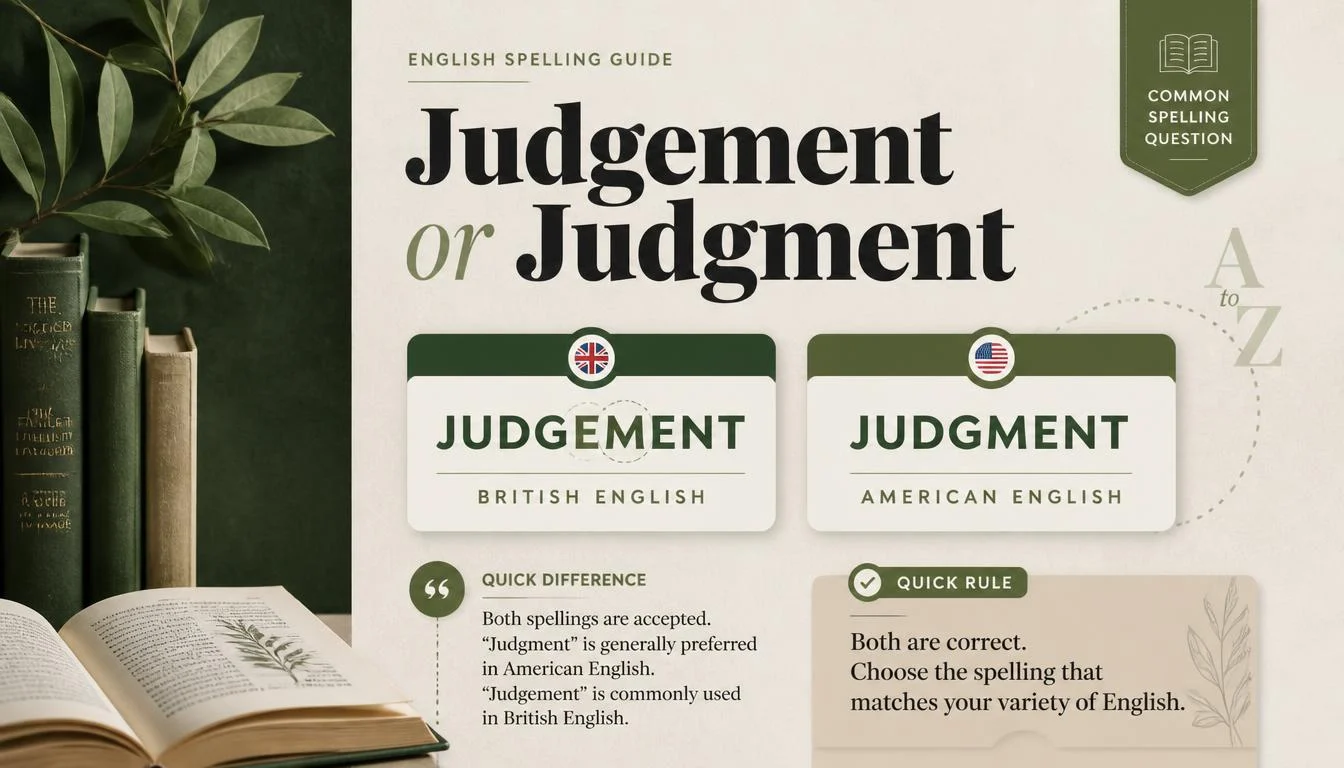
Judgment is the preferred spelling in American English, while judgement is more common in British English. Both spellings are correct and mean the same thing: the ability to make considered decisions or the official decision of a court. The difference is purely regional, not grammatical.
If you’ve ever stared at your screen wondering whether to type “judgement” or “judgment,” you’re not alone. This spelling confusion trips up native speakers and English learners alike, partly because both versions appear in published writing and partly because the rules seem to shift depending on where you look.
The truth is simpler than you might think. Both spellings are acceptable, but your choice depends largely on where your readers live and the context of your writing. In this guide, we’ll clear up the confusion once and for all, explain why both spellings exist, and help you choose the right version for your specific audience.
By the end of this article, you’ll understand exactly when to use each spelling and why the difference matters for professional, academic, and everyday writing.
Judgement or Judgment: What’s the Difference?
The short answer is that both spellings refer to the exact same word with the exact same meaning. The difference is regional preference rather than any grammatical or vocabulary distinction.
Judgment is the standard spelling in American English. It appears in U.S. legal documents, American publications, and educational materials used throughout the United States.
Judgement is the preferred form in British English, Australian English, and other Commonwealth varieties. You’ll also encounter this spelling in Canadian writing, though Canadian style guides often suggest using “judgment” for legal contexts.
Here’s a quick comparison to help you visualize the difference:
| Feature | Judgment | Judgement |
|---|---|---|
| Primary Usage | American English | British, Australian, Canadian English |
| Part of Speech | Noun | Noun |
| Refers To | Decision, opinion, or legal ruling | Decision, opinion, or legal ruling |
| Legal Context | Preferred in U.S. courts | Preferred in U.K., Australian, Canadian courts |
| Dictionary Preference | Merriam-Webster | Oxford English Dictionary |
| Example | The judge announced her judgment. | The judge announced her judgement. |
Despite these regional differences, both words function identically in sentences. They can mean:
- A formal decision made by a court
- The ability to make sensible decisions
- An opinion or evaluation formed about something
The spelling variation comes from the history of the English language. When English spelling became more standardized, American English simplified certain words, dropping the “e” in words like “judgment,” “abridgment,” and “acknowledgment.” British English retained the “e” more frequently, though even British writers sometimes drop it in legal writing.
Is This a Grammar, Vocabulary, or Usage Issue?
Understanding the classification helps you approach the problem correctly. The judgment vs. judgement issue falls squarely under usage and spelling preferences rather than grammar or vocabulary.
Grammar Classification
From a grammar perspective, both spellings are nouns. They follow all the same grammatical rules, take the same modifiers, and function identically in sentences. You can pluralize both as “judgments” or “judgements.” No grammar rule dictates one spelling over the other.
Vocabulary Classification
As vocabulary, both words share identical definitions and connotations. There’s no subtle meaning difference between the two spellings. A “judgment call” and a “judgement call” mean precisely the same thing, regardless of which spelling you choose.
Usage Classification
This is where the real difference lies. Usage refers to the conventions that guide how we use language in specific contexts. The choice between judgment and judgement is a usage decision based on:
- Geographic location: Where your readers are located
- Publication style: Which style guide you’re following
- Professional context: Legal writing, academic publishing, or business communication
Are They Interchangeable?
Technically yes, but practically no. While both spellings are correct, using “judgement” in an American legal document would look incorrect to U.S. readers, just as using “judgment” in a British newspaper might seem like an error.
In formal English, both spellings appear but their acceptance depends on the style guide. The Chicago Manual of Style, widely used in American publishing, prefers “judgment.” The Oxford Style Guide, used in British publishing, accepts both but leans toward “judgement.”
In business English, the preferred spelling depends on your company’s location and your audience. American companies typically use “judgment” while British and Australian companies use “judgement.”
In academic writing, you should follow your institution’s style guide or the preferred spelling of the journal you’re submitting to. Consistency matters more than which version you choose.
In everyday conversation, the spelling you use reflects your version of English and won’t cause confusion either way.
Practical Takeaway: Choose “judgment” for American audiences and “judgement” for British, Australian, and Commonwealth audiences. In legal writing, follow the standard of the court or jurisdiction.
Understanding “Judgment” (American Spelling)
“Judgment” is the preferred spelling throughout the United States and in many international organizations that follow American style conventions.
Meaning
Judgment refers to the ability to make considered decisions, the formation of opinions or evaluations, or a formal legal decision. It encompasses both the intellectual capacity for sound thinking and the practical outcomes of that thinking.
Pronunciation
judg-MENT (two syllables: JUDG-ment)
Part of Speech
Noun (countable and uncountable)
Common Collocations
These word combinations frequently appear with “judgment”:
- Sound judgment
- Poor judgment
- Good judgment
- Professional judgment
- Legal judgment
- Critical judgment
- Moral judgment
- Value judgment
- Final judgment
- Default judgment
- Summary judgment
Typical Sentence Patterns
- Subject + verb + judgment
- The jury delivered its judgment after three days of deliberation.
2. Subject + verb + judgment + prepositional phrase
- She exercised sound judgment in handling the difficult client.
3. Subject + verb + judgment + that clause
- The manager reached a judgment that the project needed more time.
Real-World Examples
Workplace Example
“After reviewing all the evidence, I trust your professional judgment on this matter. Please proceed with the approach you think best serves our clients.”
Academic Example
“The researcher’s study examines how cognitive biases affect human judgment in financial decision-making contexts.”
Technology Example
“The algorithm uses machine learning to mimic human judgment in identifying potentially fraudulent transactions.”
Email Example
Subject: Decision Regarding Marketing Strategy
Dear Team,
Based on your expert judgment, we’ll move forward with the digital campaign and postpone the print advertising until Q3. I appreciate the thoughtful analysis you’ve provided.
Daily Conversation Example
“You really showed poor judgment by skipping that meeting without telling anyone. Next time, just send a quick email.”
One Learner Mistake
Many English learners mistakenly treat “judgment” as a verb or confuse it with “judge” (the person who makes judgments). Remember: judgment is the noun form of the verb “judge.” If you’re referring to the decision itself or the ability to decide, use judgment. If you’re referring to the person making the decision, use judge.
Mini Recap
Judgment is the standard American spelling that works in all contexts for U.S. audiences. It follows the American pattern of dropping unnecessary letters that appeared in some British spellings. Use it in American legal writing, business communication, and academic work submitted to U.S. institutions.
Understanding “Judgement” (British Spelling)
“Judgement” is the preferred spelling in British, Australian, New Zealand, and South African English. It’s also common in Canada, though Canadian style guides often recommend “judgment” for legal contexts.
Meaning
Judgement carries the exact same meanings as its American counterpart. It refers to the ability to make considered decisions, the process of forming opinions, or a court’s official ruling. The “e” is the only difference.
Pronunciation
judge-MENT (two syllables: JUDGE-ment). Some British speakers pronounce it with three syllables (JUDGE-uh-ment), but this is less common.
Part of Speech
Noun (countable and uncountable)
Common Collocations
These word combinations appear with British spelling:
- Sound judgement
- Poor judgement
- Exercise judgement
- Professional judgement
- Value judgement
- Moral judgement
- Clinical judgement
- Business judgement
- Judgement day (religious context)
- Judgement call
Typical Sentence Patterns
- Subject + verb + judgement
- The committee reached its judgement after extensive debate.
2. Subject + verb + judgement + on + noun
- We must reserve judgement on the proposal until we see the full budget.
3. Subject + verb + judgement + about + noun
- The critics passed harsh judgement about the new production.
Real-World Examples
Workplace Example
“Before we make a final decision, I’d like to hear your professional judgement on this vendor’s proposal. Your experience with similar suppliers would be invaluable.”
Academic Example
“The study explores how cultural background influences aesthetic judgement in art appreciation among university students in the UK.”
Technology Example
“While automation handles routine tasks, human judgement remains essential for interpreting complex data patterns that machines cannot fully understand.”
Email Example
Subject: Review of Candidate Applications
Hi Sarah,
I’ve attached my assessment of the shortlisted candidates. Please review my judgements and let me know if you have any additional insights before we schedule interviews next week.
Daily Conversation Example
“I trust your judgement on this restaurant choice. You always know the best places to eat around here.”
One Learner Mistake
A common error is adding the “e” when the word is used as a verb or pluralized incorrectly. Remember: judgement is always a noun. The plural is “judgements” (with the “e” retained in British spelling). Don’t confuse it with “judge” as a verb or noun.
Mini Recap
Judgement is the standard British spelling that follows the traditional pattern of retaining the “e” after “g” in words derived from French. It’s the preferred form in UK writing, Australian publications, and throughout the Commonwealth. Use it when writing for British audiences or following British style guides.
When to Avoid Each Spelling
Writers sometimes choose the wrong spelling because they’re unsure which version their audience expects. These situations commonly cause confusion:
In American Legal Documents
U.S. courts standardize on “judgment.” Filing legal documents with the “e” spelling could be seen as an error or, worse, as carelessness that reflects poorly on your credibility. Always use “judgment” for American legal writing.
In British Court Documents
British courts prefer “judgement.” While some English judges use “judgment” in official rulings (following centuries-old tradition), the general expectation in UK legal writing is the “e” spelling. Follow your court’s specific style guide.
In Style Guide-Dependent Writing
If you’re writing for a publication or organization with a specific style guide, follow it exactly. The Associated Press Stylebook prefers “judgment.” The Chicago Manual of Style uses “judgment.” The Oxford University Press prefers “judgement.” When in doubt, check your guidelines.
In International Communication
When writing for a global audience, consider choosing one spelling and being consistent throughout your document. Alternatively, use “judgment” for American readers and “judgement” for British readers. Avoid mixing spellings in the same document.
In Academic Submissions
Journals and universities have preferred spellings. American journals typically require “judgment.” British journals accept “judgement.” Check the submission guidelines before finalizing your paper.
In Business Branding
If your company operates internationally, decide on one spelling for all official communications. Consistency builds credibility and prevents confusion about your brand’s professional standards.
Common Mistakes Table
| Correct Sentence | Incorrect Sentence | Explanation |
|---|---|---|
| The court reached its judgment after two weeks. | The court reached its judgement after two weeks. | In American English, the correct legal spelling is “judgment” without the “e.” |
| I question your judgment on this matter. | I question your judgement on this matter. | For American readers, “judgment” is the expected spelling in business contexts. |
| Her judgement was clouded by personal bias. | Her judgment was clouded by personal bias. | In British English, “judgement” is standard, though “judgment” appears occasionally. |
| The final judgment will be announced tomorrow. | The final judgement will be announced tomorrow. | American legal documents require “judgment.” The “e” spelling would be considered incorrect. |
| I trust your judgement in hiring decisions. | I trust your judgment in hiring decisions. | In British workplaces, “judgement” is the preferred spelling. |
| The judgment in the Smith case set a precedent. | The judgement in the Smith case set a precedent. | U.S. legal citations use “judgment” exclusively. |
| Please submit your written judgment by Friday. | Please submit your written judgement by Friday. | American courts and legal professionals use “judgment” exclusively. |
Decision Box
Choose “judgment” when:
- Writing for an American audience
- Submitting to American courts or legal publications
- Following American style guides (Chicago, AP, APA)
- Writing U.S. business documents
Choose “judgement” when:
- Writing for British, Australian, or Commonwealth audiences
- Submitting to UK courts or legal publications
- Following British style guides (Oxford, Cambridge)
- Writing UK business documents
Remember this quick test: If you’re writing for the United States, drop the “e.” If you’re writing for the United Kingdom, keep it. When in doubt about your audience, choose “judgment” (without the “e”) for American readers and “judgement” (with the “e”) for everyone else.
Real-World Examples in Context
Seeing these words in action helps solidify your understanding. Here are practical situations where you might encounter either spelling.
Office Communication
American Office:
“Based on my professional judgment, we should delay the product launch until we’ve resolved the quality control issues. The potential damage to our reputation isn’t worth the risk of meeting the original deadline.”
British Office:
“Based on my professional judgement, we should delay the product launch until we’ve resolved the quality control issues. The potential damage to our reputation isn’t worth the risk of meeting the original deadline.”
Business Email
American Email:
“I appreciate your judgment on the vendor selection. Could you prepare a summary of your recommendations for our meeting on Thursday?”
British Email:
“I appreciate your judgement on the vendor selection. Could you prepare a summary of your recommendations for our meeting on Thursday?”
Academic Context
American Academic:
“The study examines how emotional intelligence affects ethical judgment among business school students, controlling for demographic variables.”
British Academic:
“The study examines how emotional intelligence affects ethical judgement among business school students, controlling for demographic variables.”
Customer Support
American Support:
“Our support team exercised good judgment in escalating your case to the engineering department. We’ll update you within 48 hours.”
British Support:
“Our support team exercised good judgement in escalating your case to the engineering department. We’ll update you within 48 hours.”
Technology Context
American Technology:
“The AI system processes user data and makes automated judgments about content relevance, but human reviewers verify each significant decision.”
British Technology:
“The AI system processes user data and makes automated judgements about content relevance, but human reviewers verify each significant decision.”
Artificial Intelligence
American AI:
“Machine learning models often struggle with nuanced judgment tasks that require understanding human values and cultural context.”
British AI:
“Machine learning models often struggle with nuanced judgement tasks that require understanding human values and cultural context.”
Daily Conversation
American Conversation:
“You showed real judgment when you decided to apologize instead of fighting. That’s going to work out better for everyone.”
British Conversation:
“You showed real judgement when you decided to apologise instead of fighting. That’s going to work out better for everyone.”
Judgement or Judgment in Modern Technology
The spelling debate has extended into modern technology contexts, where both versions appear depending on the developer’s location and the intended audience.
Artificial Intelligence
In artificial intelligence, “judgment” is commonly used in American research papers and technical documentation. However, British AI researchers and European publications tend to use “judgement.” When reviewing international AI literature, you’ll encounter both spellings routinely.
Virtual Assistants
Virtual assistants like Siri, Google Assistant, and Alexa are programmed with regional language preferences. An American user might see “judgment” in their assistant’s responses while a British user sees “judgement” for identical queries.
Chatbots
Business chatbots adapt to user preferences. Many enterprise chatbots detect user location or browser language settings to display regionally appropriate spelling, including the choice between “judgment” and “judgement.”
Software Documentation
Software documentation follows the same regional patterns as other written content. American software companies use “judgment” while British and European companies use “judgement.” International software often includes both versions depending on local settings.
Business Tools
Project management platforms, decision-making software, and analytics tools all contain features related to “judgment” or “judgement.” The spelling reflects the company’s primary market or language localization settings.
Word Origin and History
Both spellings trace back to the Latin word “judicium,” which meant “judgment” or “trial.” The word entered English through Old French “jugement,” which was spelled with an “e” after the “g.”
When English spelling became standardized in the 17th and 18th centuries, the “e” remained in British English but was increasingly dropped in American English. This pattern followed a broader trend in American spelling reform.
American lexicographer Noah Webster advocated for simplified spellings in his 1828 dictionary, removing silent or unnecessary letters from many words. His reforms included changes like “color” instead of “colour,” “center” instead of “centre,” and “judgment” instead of “judgement.”
British English largely retained the traditional spellings, maintaining the “e” in words derived from French. The American simplifications became standard in U.S. writing while British, Australian, Canadian, and other Commonwealth varieties kept the older forms.
The legal field provided an exception. British courts had long used “judgment” without the “e” in formal legal writing. This tradition persisted despite the broader British preference for “judgement,” creating the interesting situation where British legal documents sometimes use the American spelling.
Today, the “e” spelling dominates in British general writing while the “e” spelling is considered standard in British law. In American English, “judgment” is universal across all contexts.
Expert Insight: Teaching the Difference
As an English language instructor with decades of classroom experience, I’ve seen hundreds of students struggle with this exact distinction. The good news is that understanding the regional pattern simplifies everything.
I tell my American students that they can safely use “judgment” in every context. They never need to worry about whether they should add an “e.” For my British students, I recommend the opposite.
For my international students who need to write for both audiences, I suggest a simple strategy: think about who’s reading your work.
- If you’re writing to a client in New York, use “judgment.”
- If you’re writing to a client in London, use “judgement.”
- If you’re writing for a global audience, pick one spelling and stick with it throughout your document.
The real error isn’t choosing the wrong regional spelling. It’s mixing both versions in the same document. Inconsistent spelling creates a sloppy impression, whether you’re a student submitting an essay or a professional representing a company.
Error Prevention Checklist
Always use “judgment” when:
- Writing for an American audience
- Submitting to U.S. courts or legal publications
- Following American style guides (Chicago, AP, APA, MLA)
- Writing for U.S. business communications
- Sending emails to American colleagues or clients
Always use “judgement” when:
- Writing for British, Australian, or Commonwealth audiences
- Submitting to UK, Australian, or Canadian courts (unless otherwise specified)
- Following British style guides (Oxford, Cambridge)
- Writing for UK business communications
- Sending emails to British, Australian, or Commonwealth colleagues or clients
Never confuse them when:
- You’re uncertain about your audience. When in doubt, research your reader’s location and preferred spelling conventions.
- You’re writing for a global audience. Choose one spelling consistently throughout your document.
Quick memory tip: America has no “e” in its name, and American English drops the “e” from “judgment.” England has an “e,” and British English keeps the “e” in “judgement.” This simple association can help you remember which spelling to choose.
Related Grammar Confusions
These similar spelling and usage questions often come up alongside the judgment vs. judgement debate. Each topic follows the same pattern of regional spelling variation or common grammatical confusion.
- Acknowledge or Acknowledge? Actually, this is “acknowledge” vs. “acknowledgement.” American spelling drops the “e” after “g” while British spelling retains it.
- Abridge or Abridgement? American spelling shortens to “abridgment” while British spelling keeps “abridgement.”
- Acknowledgement or Acknowledgment? American spelling drops the “e” as with “judgment.”
- Ageing or Aging? British spelling keeps the “e” while American spelling drops it.
- Centre or Center? The classic American vs. British spelling difference.
- Colour or Color? Another example of American simplification.
- Travelling or Traveling? American English doubles the “l” less frequently than British English.
- Fulfil or Fulfill? American spelling doubles the final “l” while British spelling uses one.
- Woollen or Woolen? British doubles the “l” while American uses one.
- Programme or Program? The British use “programme” for events and “program” for software; Americans use “program” for everything.
Each of these pairs follows the same pattern of regional variation, making them useful to learn together. Understanding the general principles of American and British spelling differences helps you navigate all these word pairs more confidently.
FAQs
Is “judgement” or “judgment” correct?
Both spellings are correct. Judgment is the standard spelling in American English, while judgement is commonly preferred in British, Australian, and other Commonwealth varieties of English. Both have the same meaning.
Why is “judgement” spelled with an “e” sometimes?
The spelling judgement reflects the word’s historical development from Old French jugement. British English retained the “e” in the spelling, while American English generally adopted the shorter form judgment.
Does “judgement” mean the same as “judgment”?
Yes. Both words have the same meaning. They can refer to the ability to make decisions, the process of forming an opinion, or an official ruling made by a court. The main difference is the regional spelling preference.
Which spelling should I use in legal writing?
In American legal writing, judgment without the “e” is the standard form. British legal writing has also traditionally used judgment, although judgement is common in general British English. When writing for a specific court or jurisdiction, follow its established spelling convention.
Can I use “judgement” in American English?
Technically, judgement can be found in American English, but judgment is overwhelmingly preferred by American readers, editors, and style guides. For professional and academic writing in the United States, judgment is the safer choice.
What about the plural forms?
The plural follows the spelling used in the singular form. In American English, the plural is judgments, while British English commonly uses judgements. In both cases, the plural is formed by adding “s.”
Is one spelling considered more correct than the other?
Neither spelling is universally more correct. Judgment and judgement are both established spellings, with regional preferences determining which form is most appropriate. Choose the spelling that matches your audience, location, or applicable style guide.
Conclusion
The choice between “judgment” and “judgement” comes down to one simple factor: your audience. American English prefers the shorter spelling without the “e,” while British English keeps the traditional “e” after the “g.” Both forms are correct and mean exactly the same thing.
The key to using these words correctly isn’t memorizing complex rules but understanding regional preferences.
- If you’re writing for Americans, use “judgment.”
- If you’re writing for British or Commonwealth readers, use “judgement.”
- If you’re writing for both audiences, choose one spelling and be consistent throughout your work.
Remember this practical rule: when in doubt about your audience, check the publication’s style guide or the location of your readers. Consistency matters more than which spelling you ultimately choose. Pick one version and stick with it to project professionalism and attention to detail in your writing.
Read More Related Articles:
- Pronounciation vs Pronunciation | Common Error You Can Avoid In 2026
- Privilege vs Priviledge | Learn the Correct Word Fast In 2026
- Suing or Sueing | Don’t Let This Spelling Trip You Up In 2026

Caleb Dawson is a content writer at synoseek.com, where he works on simple, reader-focused articles across a range of everyday topics. His writing style is practical and grounded, aiming to present information in a clear and relatable way without unnecessary complexity.
3 thoughts on “Judgement or Judgment | Spelling Difference Made Easy In 2026”