Quick Answer
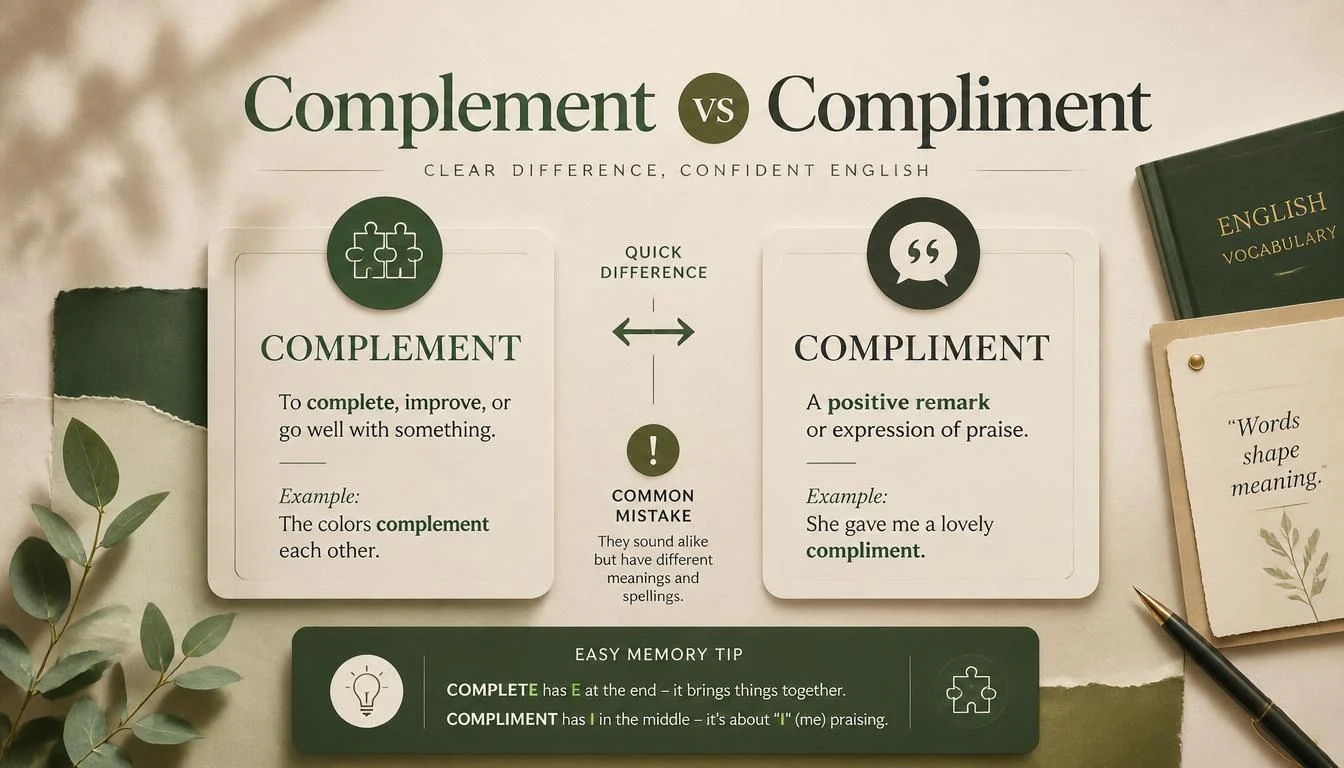
A complement completes or enhances something, like “the scarf complements her coat.” A compliment is praise, like “he gave her a compliment on her work.” The word complement relates to completion, while compliment relates to courtesy. Remembering this one-letter difference an “e” for “enhance” versus an “i” for “I like it” clears up the confusion instantly.
You’re typing a message to a coworker. You want to tell them their presentation looked great, but as your fingers hover over the keyboard, a small doubt creeps in. Is it “compliment” or “complement”? Both words sound exactly the same when spoken aloud, and both look almost identical on the page. That single swapped vowel has embarrassed plenty of careful writers, and it’s one of the most searched grammar questions in English today.
Complement and compliment are classic homophones words that sound alike but carry completely different meanings. A complement adds something that makes a whole complete, like a wine that complements a meal. A compliment is a kind remark, an expression of admiration or approval. Mixing them up doesn’t just look like a typo; it can genuinely confuse your reader, especially in professional emails, academic writing, or customer messages where precision matters.
By the end of this guide, you’ll know exactly which word fits which sentence, why English speakers confuse them so often, and how to remember the difference for good. We’ll walk through real examples from workplaces, schools, and everyday conversation, so the distinction sticks.
Complement vs Compliment: What’s the Difference?
The core difference comes down to this: complement means “to complete or go well with,” while compliment means “to praise or express admiration.
Think of complement as the word for balance and completion. If two things complement each other, they work together to form something better or more whole. A pair of shoes might complement an outfit. A skill set might complement a team. Complement can also work as a noun, referring to something that completes or the full number needed, as in “the ship had a full complement of crew.”
Compliment, on the other hand, lives entirely in the world of kindness and social praise. When you compliment someone, you’re telling them something nice about their work, their appearance, their idea. As a noun, a compliment is the praise itself: “She received several compliments on her essay.”
Both words can function as either a verb or a noun, which adds to the confusion. But their meanings never overlap.
| Meaning | Part of Speech | Refers To | Typical Usage | Example | Common Confusion |
|---|---|---|---|---|---|
| To complete or enhance | Verb or Noun | Things, qualities, sets | Design, food, skills, teams | “The tie complements the suit.” | Written as “compliments” |
| To praise or admire | Verb or Noun | People, actions, appearance | Social interaction, feedback | “She complimented his cooking.” | Written as “complements” |
Here’s the short version: if something makes another thing better or more complete, you want complement. If you’re being kind or offering praise, you want compliment. That’s really the entire rule, and once it clicks, it tends to stay clicked.
Is Complement/Compliment a Grammar, Vocabulary, or Usage Issue?
This isn’t a grammar rule in the traditional sense there’s no verb tense trouble or sentence structure to untangle here. It’s purely a vocabulary and spelling issue caused by two words that happen to be pronounced identically.
Because they’re homophones, spell check often won’t catch the mistake. Your software sees a correctly spelled word; it just doesn’t know if it’s the right word for your sentence. That’s why this error slips past so many writers, even experienced ones.
The two words are never interchangeable, regardless of tone or setting. In formal English, academic writing, and business communication, getting this wrong can undercut your credibility, especially in something like a performance review or a client email. In casual conversation, people usually catch the meaning from context, but written text doesn’t offer that safety net.
One practical takeaway: whenever you’re praising a person, picture the word compliment with a capital “I” in the middle, standing for the “I” who is speaking the praise. If you’re describing something that completes or enhances another thing, picture the “e” in complement standing for “enhance.” That small mental hook solves the problem almost every time.
Complement: Meaning, Usage, and Examples
Complement means to complete, enhance, or make something whole. It comes from the idea of filling a gap or rounding something out. Pronounced “KOM-pluh-ment,” it functions as both a noun and a verb, and it shows up often in design, food pairing, teamwork, and even grammar itself, where a “complement” refers to a word or phrase that completes the meaning of a sentence.
Common collocations include “complement each other,” “perfect complement,” “full complement,” and “complementary colors.” Notice that adjective form complementary which follows the same “e” spelling pattern.
Workplace example: “Her analytical skills complement his creative approach, which is why they work so well as a team.”
Academic example: “The lab results complement the theoretical model discussed in Chapter Four.”
Technology example: “This plugin complements the main software by adding automated backup features.”
Email example: “The new marketing materials complement our current branding strategy nicely.”
Daily conversation example: “I think this jacket complements your outfit perfectly.”
A common learner mistake is assuming complement only applies to physical objects like clothing or colors. In reality, it applies just as often to abstract things skills, ideas, strategies, personalities. Two people can complement each other’s strengths, and two arguments can complement each other in an essay.
Mini recap: Complement means to complete or enhance. Use it when one thing improves or balances another, whether that’s a color scheme, a business strategy, or a coworker’s skill set.
Compliment: Meaning, Usage, and Examples
Compliment means to express praise, admiration, or approval, usually toward a person or their work. Pronounced the same way as complement, “KOM-pluh-ment,” it’s the word you reach for whenever kindness or flattery is involved.
As a noun, a compliment is the praise itself. As a verb, to compliment someone means to give them that praise directly. Common collocations include “pay someone a compliment,” “backhanded compliment,” “compliment on,” and “take it as a compliment.”
Workplace example: “My manager complimented me on how I handled the client call yesterday.”
Academic example: “The professor complimented the class on their improved essay structure.”
Technology example: “Users have complimented the app’s clean, simple interface in several reviews.”
Email example: “I wanted to compliment your team on the fast turnaround for this project.”
Daily conversation example: “Thanks for the compliment that really made my day.”
A frequent learner mistake is using compliment when describing something that pairs well with something else, like food or fashion. Saying “This sauce compliments the pasta” is incorrect; the sauce isn’t praising the pasta, it’s enhancing it. That sentence needs complement.
Mini recap: Compliment means to praise. Use it whenever kindness, admiration, or a nice remark is the point of the sentence.
When Not to Use Each Word
Even confident writers slip up in specific, predictable situations. Here are the most common ones.
Describing food pairings. Writers often default to “compliments” when talking about flavors, as in “the wine compliments the steak.” Flavors don’t offer praise they enhance one another. The correct word is complement.
Talking about teamwork or personality fit. “They compliment each other well as business partners” is a frequent mistake. Unless partners are literally praising one another, this should be complement, since the sentence is really about how their skills combine.
Responding to praise in writing. People sometimes write “I’ll take that as a complement” after receiving a nice remark. Since praise is being discussed, this needs compliment.
Referring to a full set or amount. Phrases like “a full complement of staff” get misspelled as “compliment” fairly often, especially in business or military writing, because the phrase sounds formal and unfamiliar.
Design and fashion writing. Bloggers describing how accessories or colors work together frequently reach for compliment by habit, even though the sentence is about visual harmony, not praise.
Grammar terminology. In sentence structure, a “complement” is a word or phrase that completes the meaning of a verb or subject. Students studying grammar sometimes misspell this technical term as compliment, which changes its meaning entirely.
Customer service replies. “We complimented our product line with a new warranty,” said in a company update, should almost always be complement, since the sentence describes an addition that completes the offering.
Signing off emails. “With compliments” is actually a correct, formal phrase used at the end of a letter, similar to “regards.” Writers sometimes second-guess this and change it to “complements,” which is wrong in that specific context.
Common Mistakes Table
| Correct Sentence | Incorrect Sentence | Explanation |
|---|---|---|
| The shoes complement the dress beautifully. | The shoes compliment the dress beautifully. | Shoes enhance an outfit; they don’t praise it. |
| She complimented me on my speech. | She complemented me on my speech. | Praise for a person requires compliment. |
| The ship sailed with a full complement of sailors. | The ship sailed with a full compliment of sailors. | “Full complement” refers to a complete set. |
| He took the review as a compliment. | He took the review as a complement. | Receiving praise is a compliment. |
| These colors complement the room’s design. | These colors compliment the room’s design. | Colors enhance a space rather than praise it. |
| I received several compliments after the interview. | I received several complements after the interview. | Kind remarks are compliments. |
Quick Decision Box
If you mean the action of completing or enhancing something, use complement. If you mean praise, admiration, or a kind remark, use compliment. Ask yourself: “Am I describing praise, or am I describing something that fits together?” That question answers it every time.
Real World Examples
Office communication: “Your report complements the data we already have, and I want to compliment you on how clearly it’s organized.”
Business email: “Please accept our compliments on your recent promotion. Your leadership style really complements the team’s current direction.”
School or university: “The teacher complimented the student’s essay, noting that the conclusion complemented the introduction perfectly.”
Customer support: “Thank you for your compliment about our service. We’re also adding a feature that complements our current app design.”
Technology: “The new update complements the existing dashboard, and users have already left compliments about how intuitive it feels.”
Artificial Intelligence: “The AI assistant’s tone was designed to complement human customer service, and early testers complimented how natural it sounded.”
Daily conversation: “That color really complements your eyes I mean that as a genuine compliment.”
Complement and Compliment in Modern Technology
Technology writing uses both words constantly, often in the same paragraph, which makes this pair especially worth mastering if you write about software or AI.
When describing how a tool, feature, or plugin works alongside another system, complement is almost always the correct choice. A voice assistant might complement a smart home setup by adding hands-free control. A chatbot feature might complement a company’s existing support team rather than replace it. This usage shows up constantly in software release notes and product descriptions.
Compliment appears in tech writing too, usually in the context of user feedback or product reviews. “Users have complimented the app’s speed” or “reviewers complimented the clean design” are both common phrasings in software marketing and testimonials.
Virtual assistants and AI tools themselves are sometimes described as complementing human work, since they add capability without replacing the person doing the job. Meanwhile, when a user tells an AI tool “great answer,” that’s a compliment, not a complement, even though it’s easy to see how the tech context blurs the two.
Where the Words Come From
Both words trace back to the Latin word complementum, meaning “that which completes.” Over centuries, English speakers split this root into two separate spellings with two separate meanings. Complement kept the original sense of completion. Compliment branched off through French, picking up the social meaning of courtesy and praise, likely influenced by the idea of “completing” a polite social exchange with kind words.
Knowing this shared origin helps explain why the words still sound identical today, even though their meanings drifted apart hundreds of years ago.
Expert Insight
As a language instructor, I always tell students to trust their ears less and their meaning more with this pair. Because complement and compliment sound identical, relying on how a sentence “feels” out loud won’t help you spell it correctly. Instead, pause and ask what your sentence is actually doing. If you’re adding, balancing, or completing something, that’s complement. If you’re being kind or offering praise, that’s compliment. Training yourself to ask this one question before you write either word will eliminate the mistake almost entirely, even under time pressure.
Error Prevention Checklist
- Always use complement when something completes, enhances, or balances another thing.
- Always use compliment when praise, admiration, or a kind remark is involved.
- Never confuse them if you remember: complement = complete, compliment = kind comment.
- Quick memory tip: compliment has an “I” in it, just like the person giving a compliment says “I like this.”
Related Grammar Confusions
Affect vs Effect One is a verb about influence, the other a noun about results, and mixing them up changes your entire sentence.
Its vs It’s A tiny apostrophe separates possession from a contraction, and it trips up even skilled writers.
Then vs Than One word compares, the other shows sequence, yet they’re often typed interchangeably.
Farther vs Further Physical distance versus figurative progress, a distinction many writers never learned clearly.
Advice vs Advise A noun and a verb that sound close enough to cause constant spelling slips.
Principal vs Principle A leader or main idea versus a fundamental truth, easily confused in formal writing.
Stationary vs Stationery Standing still versus paper supplies, two meanings hiding behind one extra letter.
Accept vs Except Agreeing to something versus excluding something, a mix-up that changes meaning drastically.
Loose vs Lose A spelling difference that causes some of the most common typing errors online.
Elicit vs Illicit Drawing out a response versus something illegal, a pair worth knowing for formal writing.
FAQs
Is it “take it as a compliment” or “take it as a complement”?
It is “take it as a compliment.” You are referring to praise or a positive remark someone has given you, so compliment is the correct word. Complement refers to something that completes, enhances, or goes well with something else.
How do you remember the difference between complement and compliment?
A simple way to remember the difference is that compliment has an “I,” which you can associate with the person giving praise. Complement has an “E,” which can remind you of “enhance” or “complete.” This memory trick can make the two spellings easier to distinguish.
Can compliment be used as a verb?
Yes. Compliment can be used as a verb meaning to praise or express admiration toward someone. For example, “She complimented his presentation skills.” It can function as both a noun and a verb.
What does “complementary colors” mean?
Complementary colors are colors positioned opposite each other on the color wheel that create visual contrast and enhance one another when paired. For example, blue and orange are complementary colors. This uses complement because the colors enhance or complete each other rather than express praise.
Is “with compliments” correct on a business card or letter?
Yes. “With compliments” is a standard formal expression meaning something is being provided as a courtesy or goodwill gesture. It is commonly found on business correspondence, cards, and items provided free of charge. The correct spelling in this expression is compliments.
Why do complement and compliment sound exactly the same?
Complement and compliment are homophones, meaning they have the same pronunciation but different spellings and meanings. Their similar pronunciation and closely related historical origins are part of why they are so easy to confuse in writing.
Conclusion
The difference between complement and compliment comes down to one simple test: are you completing something, or are you praising someone? Complement belongs with balance, addition, and completeness. Compliment belongs with kindness, admiration, and praise.
Once you tie each word to its true meaning instead of its sound, the confusion disappears for good. The next time you’re unsure, just ask yourself whether your sentence is about enhancement or encouragement that question will lead you to the right word almost every time.
Read More Related Articles:
- Lier or Liar | Easy Way to Get This Word Right In 2026
- Layed or Laid | Stop Making This Common Spelling Mistake In 2026
- Ballon or Balloon | Avoid This Common Spelling Error In 2026

Lucas Mitchell is a content writer at synoseek.com. He writes simple, thoughtful pieces that focus on everyday ideas, observations and general knowledge topics. His work is shaped by a calm, realistic tone that keeps the reader engaged without overstatement.
11 thoughts on “Complement vs Compliment | Common Confusion Finally Explained In 2026”