Quick Answer
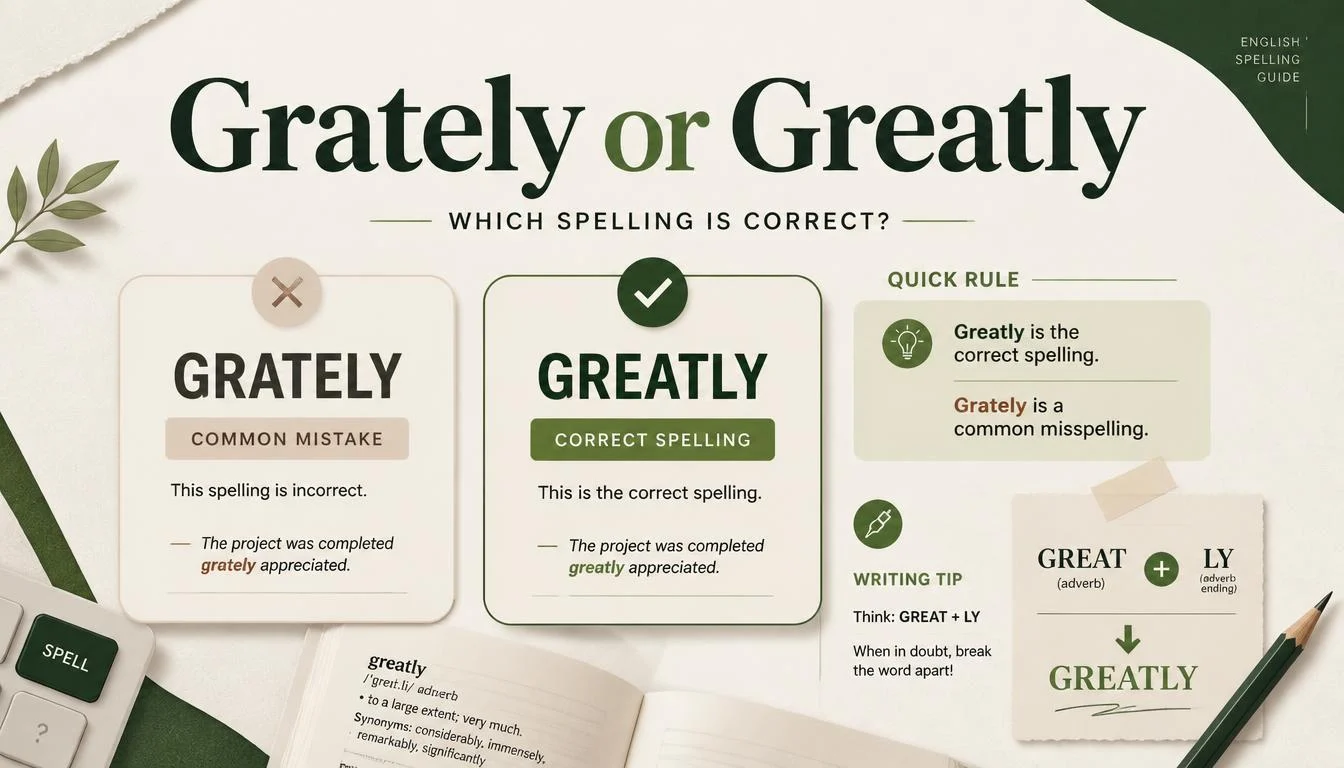
“Greatly” is the correct spelling. It means “to a very large extent or degree” or “very much.” “Grately” is a common misspelling that has no meaning and is not recognized as a standard English word. Always use “greatly” in your writing for clear, professional communication .
If you’re wondering whether it is Grately or Greatly, the correct spelling is greatly. “Grately” is a common spelling mistake and should not be used in standard English writing. Greatly is an adverb that means to a large degree, very much, or considerably.
Knowing the difference between Grately or Greatly can help you avoid simple spelling errors in emails, essays, professional writing, and everyday communication. In this guide, we’ll explain why “greatly” is correct and show you how to use it naturally in a sentence.
In this guide, we will break down the difference to ensure you never make this mistake again. You will learn why one word is correct, why the other is always wrong, and exactly how to use “greatly” in all kinds of writing to sound more credible and polished .
What’s the Difference Between Grately and Greatly?
The core difference between “grately” and “greatly” is that one exists in the English language and the other does not. It is not a matter of formal versus informal usage, nor is it a choice between American and British English. It is simply a question of correct spelling versus a spelling mistake .
“Greatly” is a legitimate word and a very common adverb. It is used to modify a verb, adjective, or another adverb to indicate that something is done to a significant degree or extent. When you say you “greatly appreciate” something, you mean you appreciate it very much. Its meaning is universally understood .
“Grately,” on the other hand, has no place in standard English. It is an incorrect spelling that has become common largely because it is a phonetic error. When people say “greatly” out loud, the “t” and “r” sounds, combined with the unstressed second syllable, can lead them to mistakenly think it should be spelled like the word “grate” (as in a fireplace grate or grating cheese) followed by “-ly.” This is a classic example of a spelling mistake driven by pronunciation .
This confusion is similar to other common errors, such as mixing up “definitely” and “definately.” The best way to avoid this mistake is to remember that “greatly” is derived from the adjective “great.” If you want to say something is done in a “great” way, you spell it “greatly.”
| Feature | Greatly | Grately |
|---|---|---|
| Meaning | To a large extent; very much | None |
| Part of Speech | Adverb | None (Misspelling) |
| Derivation | From the adjective “great” | A phonetic misspelling of “greatly” |
| Formal/Informal | Used in all forms of English | Always incorrect |
| Example | She was greatly affected by the news. | ❌ She was grately affected. |
Is This a Grammar, Vocabulary, or Usage Issue?
The confusion between “grately” and “greatly” is primarily a spelling and vocabulary issue, but it has significant implications for your usage. You are choosing the wrong letter combination, which results in a non-existent word. However, the practical effect is a usage error—you have used a misspelled word that can undermine your credibility.
- Grammar Classification: When you use the correct word, “greatly,” you are using an adverb. Its grammatical job is to modify verbs, adjectives, or other adverbs to describe the degree or intensity of an action or quality .
- Vocabulary Difference: The vocabulary difference is absolute. One word is part of the English vocabulary, and the other is not. “Greatly” is a powerful and useful word for expressing intensity. “Grately” is an empty placeholder that a competent editor will immediately flag as a mistake.
- Usage in Different Contexts: “Greatly” is versatile and can be used effectively in formal and informal settings. You might write in an academic paper that a “new theory greatly influenced the field,” or in a business email, “Your support is greatly appreciated.” In casual conversation, you could say, “I was greatly relieved to hear the news.”
- Interchangeability: Since “grately” is not a word, it is not interchangeable with anything. The only correct choice for expressing “to a great extent” is “greatly” or a synonym like “significantly,” “considerably,” or “highly” .
Practical Takeaway: Treat “grately” as a red light in your writing. If you type it, stop and correct it. The correct choice is always “greatly.”
What Does “Greatly” Mean and How Is It Used?
Greatly: Meaning and Part of Speech
“Greatly” is an adverb used to express a high degree or intensity. It can mean “very much,” “to a great extent,” or “to a significant degree.” The word comes from the adjective “great,” with the suffix “-ly” turning it into an adverb that modifies verbs, adjectives, and participles.
Common Collocations and Sentence Patterns
“Greatly” commonly appears with verbs related to emotions, improvement, influence, appreciation, and change.
Greatly + verb:
This pattern places emphasis on the extent of an action or effect.
- I was greatly impressed by her presentation.
- The new software will greatly simplify the process.
Subject + verb + greatly:
“Greatly” can also come after the main verb, particularly in sentences describing changes or results.
- His performance improved greatly over time.
- Her contribution to the project was valued greatly.
Subject + be + greatly + past participle:
This structure is especially common in professional and formal communication.
- Our efforts are greatly appreciated.
- The community was greatly impacted by the storm.
Real-World Examples of “Greatly”
Workplace example:
“The new manager’s leadership style has greatly improved team morale.”
Academic example:
“Her research greatly influenced the development of modern economics.”
Technology example:
“Cloud computing has greatly enhanced the ability of businesses to scale their operations.”
Email example:
“Your prompt feedback on this draft will be greatly appreciated.”
Daily conversation example:
“I would greatly prefer the window seat, if it’s not too much trouble.”
Common Learner Mistake
English learners sometimes place “greatly” where it sounds less natural. For example, both “I greatly enjoyed the show” and “I enjoyed the show greatly” are grammatically possible, but the first version is generally more natural in modern English.
As a simple rule, place “greatly” before the main verb when you want the sentence to sound clear and natural, especially in professional or formal writing.
When Not to Use “Grately” and Why It’s Wrong
Understanding why “grately” is wrong is key to remembering the correct spelling. There are no specific situations where “grately” is correct because it simply is not a word. The mistakes happen when people choose the wrong spelling based on a misunderstanding.
- Why the Mistake Happens: The error is almost always a result of phonetic confusion. When you say the word “greatly” at a normal speed, the syllables blend together. The “-ate” sound in “great” is a long “a,” while the “-ate” in “grate” is a slightly different sound, but they can sound very similar in fast, colloquial speech. This leads people to spell it as “grately” by analogy with other words like “lately,” which is spelled with an “a” .
- Which Word is Correct: The correct word is “greatly.” If you are expressing that something is “very much” or “to a large degree,” “greatly” is the only correct option. The origin of the word is from “great,” not “grate.” Remember, a “grate” is a metal frame, while “great” means large or significant. You would not describe a metal frame in an email. Therefore, you should not use its spelling.
How to Remember the Difference:
A simple and effective memory trick is to break the word down: it’s Great + ly. This emphasizes its link to the word “great.” You can think to yourself, “If something is done in a great way, it’s done greatly.” This small mental step can prevent the error from ever appearing in your writing.
Decision Box: Your 10-Second Rule
Use this quick guide if you are ever unsure:
| If you mean... | Then use… |
|---|---|
| Very much, to a large extent, or significantly. | Greatly ✅ |
| Any other word, or you are unsure. | Greatly ✅ |
Real-World Examples
To see how this word functions in daily life, consider these realistic scenarios.
- Office Communication:
“The new workflow system has greatly reduced the time it takes to process invoices.” - Business Email:
“Dear Ms. Chen, your detailed proposal is greatly appreciated by the entire team. We look forward to discussing it further.” - School or University:
“The candidate’s previous research experience greatly strengthened her application to the PhD program.” - Customer Support:
“We understand this issue is frustrating and greatly value your patience as we work on a solution.” - Technology:
“The integration of AI into the app has greatly improved user personalization and recommendations.” - Artificial Intelligence:
“Advances in natural language processing have greatly enhanced the ability of AI to understand and respond to human queries more naturally.” - Daily Conversation:
“I was greatly disappointed when the concert was postponed, but I’ll definitely go to the rescheduled date.”
Word Origin
While the origin is not necessary for correct usage, it can help cement the meaning. The word “great” entered English from the Old English word grēat, which meant “large, big, or coarse.” It is a word with Germanic roots and has been a fundamental part of the English language for centuries. Over time, the suffix “-ly” was added to form the adverb “greatly,” which has been used since Middle English times to mean “in a great degree” .
Expert Insight
Here’s a tip from an experienced language educator:
The most effective way to master tricky spellings is to understand their family tree. When you write “greatly,” remember you are part of a very common and logical spelling pattern in English: adjective + -ly = adverb. The pattern is the same for words like quick → quickly, bad → badly, and sad → sadly. By associating “greatly” with this pattern, you move it from being a word you have to guess at to a word you understand. This makes your writing more fluent and confident because you are applying a rule instead of relying on phonetic memory.
Error Prevention Checklist
- Always use “greatly” when you want to say something is “very much” or “to a large extent.”
- Never use “grately.” It is an incorrect spelling in any context.
- Never confuse them if… you remember the root word is “great.”
- Quick memory tip: It’s Great + ly. Think of something being done in a “great” way.
Related Grammar Confusions to Explore
Understanding the difference between “grately” and “greatly” is just one step in mastering English. Many other common spelling and grammar confusions can trip up writers. Learning them can help you avoid similar mistakes and improve your overall writing accuracy.
- Advise vs. Advice: Learn the difference between the verb and the noun.
- Affect vs. Effect: A classic grammar conundrum that relies on understanding parts of speech (verb vs. noun).
- Then vs. Than: Mixing up sequence with comparison is another phonetic trap.
- Your vs. You’re: A common homophone mistake that can undermine your writing.
- Its vs. It’s: Confusing the possessive form with the contraction.
- To vs. Too: A simple mistake with two very different meanings (direction vs. also/excess).
- Accept vs. Except: Understanding the difference between receiving and excluding.
- Lose vs. Loose: This mix-up often causes confusion due to similar pronunciation in some contexts.
- “Definitely” vs. “Definately”: Similar to “grately,” this is a common misspelling based on how the word is pronounced .
FAQs
Is “grately” ever correct?
No, “grately” is never a correct spelling in standard English. It is not a word and has no definition. Any instance of “grately” in a sentence is a spelling error that should be corrected to “greatly” .
Why do people confuse “grately” and “greatly”?
The confusion is caused by a phonetic error. When spoken quickly, “greatly” can sound like it might be spelled with an “a,” as in “grately.” This is a classic example of a spelling mistake driven by how a word sounds rather than its actual root .
Does British English spell it “grately”?
No, “grately” is not accepted in any form of English. Both British and American English use the exact same spelling, “greatly.” There is no regional difference for this word .
Is “greatly appreciated” correct?
Yes, “greatly appreciated” is a very common and correct phrase in both formal and informal English. It is a polite way to express that you are very thankful or that something is highly valued by you or your team .
What is a good synonym for “greatly”?
Depending on the context, good synonyms for “greatly” include significantly, considerably, highly, profoundly, and enormously. For example, you could say “significantly improved” or “highly valued” .
Conclusion
The difference between “grately” and “greatly” is simple but crucial for clear and professional writing. “Greatly” is the only correct spelling, meaning “to a large extent” or “very much,” and is a powerful adverb you can use in any context. The misspelling “grately” is not a real word and stems from a phonetic misunderstanding.
By remembering that “greatly” is simply great + ly, you can easily avoid this common error and ensure your writing is always accurate and credible. Next time you want to express intensity, choose “greatly” with confidence.
Read More Related Articles:
- Shiny or Shiney | Avoid This Simple Spelling Error in English In 2026
- Occasion or Ocassion | Common Mistake Explained with Real-Life Examples In 2026
- Cacoon or Cocoon | Simple Rule You’ll Never Forget In 2026

Zoe Chambers works as a content writer at synoseek.com, contributing thoughtful pieces on everyday subjects and ideas. She writes in a simple, grounded way, often drawing from real-world experiences. Her focus is on keeping content natural, clear and easy for readers to connect with.