Quick Answer:
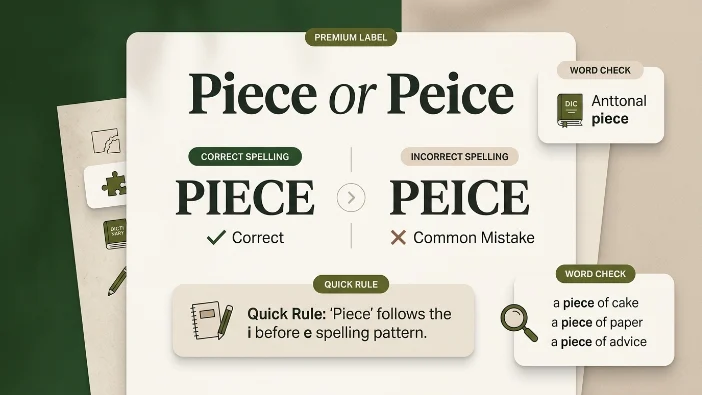
Only piece is correct in English. Peice is a common misspelling that comes from mixing up the “i before e” rule. Piece means a part of something, like a slice of cake or a section of music. Remember: the “e” comes before the “i” in piece, and there is no situation where “peice” is the right spelling.
If you’re unsure whether the correct spelling is piece or peice, you’re not alone. These words look very similar, but only one is accepted as the standard English spelling. Knowing the correct form can help you avoid common spelling mistakes in both everyday and professional writing.
In this guide, we’ll explain why piece is correct, what it means, and why peice is incorrect. You’ll also find simple examples and a quick memory trick to make the spelling easier to remember.
Why This Mix-Up Happens More Than You’d Think
If you’ve ever paused halfway through typing “piece” and wondered whether it’s p-i-e-c-e or p-e-i-c-e, you’re not alone. This is one of the most searched spelling questions in English, and it trips up native speakers just as often as learners.
The confusion usually comes from a half-remembered rule most of us learned in school: “i before e, except after c.” That little rhyme works for words like receive and ceiling, where the c comes right before the ei. But piece doesn’t have a c anywhere near the ie combination, so the rule actually tells you to keep i before e which is exactly what the correct spelling does. The problem is that people remember the rule exists, forget how it applies, and end up guessing the reversed order.
Getting this wrong isn’t just a typo issue. In an email to a client, a school essay, or a resume, “peice” signals carelessness even if the rest of your writing is sharp. Spelling mistakes like this one are small, but they’re the kind of small thing that readers notice immediately.
By the end of this guide, you’ll know exactly why piece is spelled the way it is, how to avoid ever second-guessing yourself again, and where similar spelling traps tend to hide in everyday English.
Piece vs Peice: What’s the Difference?
There isn’t really a difference in meaning, because only one of these is a real word. Piece is the correct, standard English spelling. Peice is not a word at all it’s simply a misspelling that happens to look plausible.
| Meaning | Part of Speech | Refers To | Typical Usage | Example | Common Confusion |
|---|---|---|---|---|---|
| A part or portion of something | Noun (also used as a verb, e.g., “piece together”) | Objects, ideas, artwork, food, information | Everyday writing, business, academic, creative | “She ate the last piece of pizza.” | Spelled “peice” due to reversed i/e order |
| Not applicable | Not a word | Nothing | Never correct in any context | N/A | Often typed by mistake or from memory error |
So this isn’t really a “when do I use which word” situation like affect vs effect. It’s purely a spelling issue. Once you lock in the correct order, the confusion disappears for good.
Is Piece vs Peice a Grammar, Vocabulary, or Usage Issue?
This is strictly a spelling issue, not a grammar or usage one. Piece functions correctly as a noun or verb depending on context, and there’s nothing tricky about how it behaves in a sentence. The only challenge is getting the letters in the right order.
Because “peice” isn’t a recognized word, it doesn’t have its own grammar rules, definitions, or usage patterns to learn. There’s no formal versus informal version of this choice, no British versus American spelling variant, and no academic exception. Every major English dictionary Oxford, Cambridge, and Merriam-Webster lists only “piece” as valid.
In formal writing like business reports or academic papers, misspelling piece as peice can undermine credibility fast, since spell-checkers usually catch it, but not always in fast typing or when autocorrect has been disabled. In casual texting or chat, it’s a minor slip, but it’s still worth correcting the habit early so it doesn’t carry into more formal writing.
Practical takeaway: Treat this as a one-time memory fix rather than an ongoing grammar rule to apply differently depending on context.
Piece: Meaning, Usage, and Examples
Piece (pronounced “peess,” rhyming with “geese”) is a noun that refers to a part, section, or individual item that belongs to a larger whole. It’s also commonly used as a verb, especially in the phrase “piece together.”
Common collocations include a piece of cake, piece of advice, piece of paper, piece of music, piece of art, and piece together information.
Typical sentence patterns follow “a piece of + noun” or “piece + object” when used as a verb.
- Workplace example: “Can you send me that piece of the report before the 3 p.m. meeting?”
- Academic example: “The professor asked us to analyze a piece of Victorian poetry for next week’s seminar.”
- Technology example: “Developers had to piece together the error logs to find the bug.”
- Email example: “Attached is the first piece of the proposal I’ll send the rest by Friday.”
- Daily conversation example: “Do you want the last piece of pizza, or should I finish it?”
Common learner mistake: Writing “peice” out of habit, especially when typing quickly or relying on memory instead of double-checking.
Mini recap: Piece is the only correct spelling, and it shows up constantly in everyday, academic, and professional English from describing objects to referring to written or musical work.
Peice: Why It’s Never Correct
Peice isn’t a real word in any dictionary, so it has no meaning, pronunciation, or accepted usage. It’s simply the result of reversing the “ie” in piece to “ei.”
This mistake often happens because English has plenty of legitimate “ei” words like receive, weight, and neighbor and the brain sometimes overgeneralizes that pattern to words it shouldn’t apply to. Piece isn’t one of the “after c” exceptions, so the standard “i before e” rule applies normally.
- Workplace example (incorrect): “I’ll send you that peice of the document later.” (Should be “piece.”)
- Academic example (incorrect): “This peice of writing needs revision.” (Should be “piece.”)
- Technology example (incorrect): “The software peices together user data automatically.” (Should be “piece.”)
Common learner mistake: Assuming that because words like receive follow “e before i,” other similar-sounding words must too.
Mini recap: There’s no context, formal or informal, where “peice” is acceptable. If you see it written this way, it’s always an error that needs correcting to “piece.”
When Writers Commonly Get This Wrong
Even confident writers slip up here, usually for predictable reasons. Here are the situations where it happens most.
1. Typing quickly without proofreading. When you’re rushing through an email or message, your fingers sometimes type the more “familiar-feeling” letter order rather than the actual correct one.
2. Relying on sound instead of spelling. Piece and “peace” sound identical, and some writers blend the spelling patterns of the two words in their heads, leading to odd combinations like “peice.
3. Overapplying the “i before e except after c” rule incorrectly. People remember there’s an exception involving c, but misapply it to words where c isn’t even present.
4. Muscle memory from misspelling it once. If you typed “peice” once and it wasn’t corrected, your fingers may keep repeating that same wrong pattern.
5. Autocorrect inconsistency. Some messaging apps and older software don’t flag “peice” as a spelling error, so writers assume it must be fine.
6. Confusing it with words like “seize” or “weird.” These irregular English spellings can make writers doubt themselves on words that actually follow the standard rule.
7. Non-native English learners applying rules from their first language. Some languages have more consistent phonetic spelling, so English’s irregularities can make learners second-guess correct forms.
8. Visual similarity to “peace.” Since piece and peace look and sound so close, the letters sometimes get crossed in memory.
The fix for all of these is the same: build a quick mental check you can run every time you write the word.
Common Mistakes Table
| Correct Sentence | Incorrect Sentence | Explanation |
|---|---|---|
| “This is my favorite piece of jewelry.” | “This is my favorite peice of jewelry.” | Piece follows standard i-before-e spelling; peice reverses the letters incorrectly. |
| “He wrote a piece for the school newspaper.” | “He wrote a peice for the school newspaper.” | Peice is not a recognized word in any English dictionary. |
| “Let’s piece this puzzle together.” | “Let’s peice this puzzle together.” | The verb form follows the same spelling as the noun. |
| “She kept a piece of the old photograph.” | “She kept a peice of the old photograph.” | Peice is a spelling error, not an alternate form. |
Quick Memory Trick
If you’re ever unsure, remember this: piece has “pie” hidden inside it. Everyone loves pie, and you eat pie one piece at a time. Spell “pie,” then add “ce,” and you’ll never write it wrong again.
If you mean any kind of part, section, or portion, always use piece. If you find yourself typing “peice,” stop and rewrite it there’s no situation where that spelling is acceptable.
Real-World Examples
Office communication: A manager might write, “Please review this piece of the contract before we send it to legal,” when referring to one section of a larger document.
Business email: “I’ve attached the final piece of the budget report let me know if anything needs adjusting.
School or university: A teacher grading essays might comment, “This piece shows strong analysis, but the conclusion needs more support.”
Customer support: A support agent might say, “It looks like one piece of your order shipped separately and should arrive by Thursday.
Technology: “Our engineering team is piecing together the logs from last night’s outage to identify the root cause.”
Artificial Intelligence: “The AI model was trained by piecing together thousands of small datasets from different sources.”
Daily conversation: “Can I have another piece of that chocolate cake?”
Each of these situations shows how naturally “piece” fits into different tones and settings, from formal reports to casual chats about dessert.
Piece in Modern Technology
Piece shows up constantly in tech and AI contexts, usually describing components, data fragments, or content sections. In software development, teams often talk about “pieces” of code, meaning individual functions or modules that work together as part of a larger system.
Virtual assistants and chatbots are frequently described as being built from many different “pieces” separate models or systems for understanding language, retrieving information, and generating responses, all pieced together into one experience.
In business tools, project management software might break large tasks into smaller “pieces” so teams can track progress more easily. Even in everyday tech use, phrases like “send me that piece of the file” or “this piece of the app isn’t working” show how naturally the word fits into modern digital vocabulary.
Because “peice” isn’t a real word, it never appears correctly in technical documentation, code comments, or professional tech writing another good reason to lock in the correct spelling early.
Where the Word Piece Comes From
Piece traces back to Old French piece, meaning a part or portion, which itself came from Vulgar Latin roots related to breaking something into fragments. English borrowed the word directly, keeping both its spelling and its core meaning largely intact for centuries.
This French origin is actually part of why the spelling can feel a little unusual to English speakers many French-derived words in English don’t follow perfectly phonetic patterns, which is exactly why memorization tricks like the “pie” method are so useful.
Expert Insight
As a language instructor, I always tell students that spelling confusion usually isn’t about intelligence it’s about pattern conflict. Piece feels like it should follow the same rule as words like receive, but it doesn’t need to, because there’s no c involved. The fastest way to fix a mix-up like this isn’t repeating the rule over and over. It’s creating one strong, personal memory hook like linking piece to pie so your brain has an instant shortcut instead of a rule to calculate every time.
Error Prevention Checklist
- Always use “piece” when referring to a part, section, or portion of something, whether it’s food, writing, music, or data.
- Never use “peice” in any context it isn’t a recognized English word.
- Double-check yourself if you’re writing quickly or relying on autocorrect that may not flag the error.
- Quick memory tip: Piece has “pie” inside it pie first, then “ce.”
Related Grammar Confusions Worth Learning
Piece vs Peace: These two words sound identical but mean completely different things, so mixing them up can create real confusion in writing.
Affect vs Effect: One of the most common grammar mix-ups in English, since both words relate to causing or experiencing change.
Receive vs Recieve: A classic i-before-e spelling trap that follows the “except after c” rule, unlike piece.
Weird vs Wierd: Another irregular spelling that breaks the standard i-before-e pattern, making it a frequent target for mistakes.
Their vs There vs They’re: A foundational homophone confusion that affects both spelling and grammar accuracy.
Its vs It’s: A punctuation-driven mix-up that changes meaning depending on whether an apostrophe is used.
Complement vs Compliment: Two words that sound alike but carry very different meanings in professional and academic writing.
Principal vs Principle: A common confusion in school and business writing, since both words relate to importance or authority.
Advice vs Advise: A noun-versus-verb distinction that trips up even experienced writers.
Loose vs Lose: A spelling mix-up that often appears in casual writing and social media posts.
FAQs
Is “peice” ever correct in British English?
No. Piece is the standard spelling in both British and American English. Unlike words such as colour and color, this word has no regional spelling difference.
Why do people write “peice” instead of “piece”?
The mistake usually comes from reversing the ie sequence while typing. Because English has many words with different vowel patterns, writers may second guess the correct order and accidentally produce “peice.”
Is “peice” a typo or an accepted spelling variant?
“Peice” is simply a misspelling of piece. It is not recognized as an alternative form in standard English, whether the writing is formal, informal, academic, or conversational.
Does spell check always catch “peice”?
Most modern spell checkers will identify “peice” as an error and suggest piece. However, spelling tools are not completely reliable, particularly in some messaging apps or when automatic correction is disabled. A quick proofread is still useful.
What is an easy trick for remembering “piece”?
A helpful memory trick is to spot the word “pie” at the beginning of piece. The sequence pie can remind you that the i comes before the e: pie + ce = piece.
Does “piece” change in formal or informal writing?
No. The spelling remains piece regardless of the setting. You can use it in everyday conversation, professional emails, academic writing, and formal documents without changing its form.
Conclusion
The difference between piece and peice really comes down to one simple fact: only “piece” exists as a correct English word. “Peice” is a common but entirely avoidable mistake that usually comes from misapplying a spelling rule that doesn’t even apply to this word in the first place.
Once you connect piece to the word “pie,” this mix-up becomes almost impossible to repeat. It’s a small fix, but one that instantly makes your writing look more polished and professional, whether you’re sending a quick text or finishing a formal report.