Quick Answer
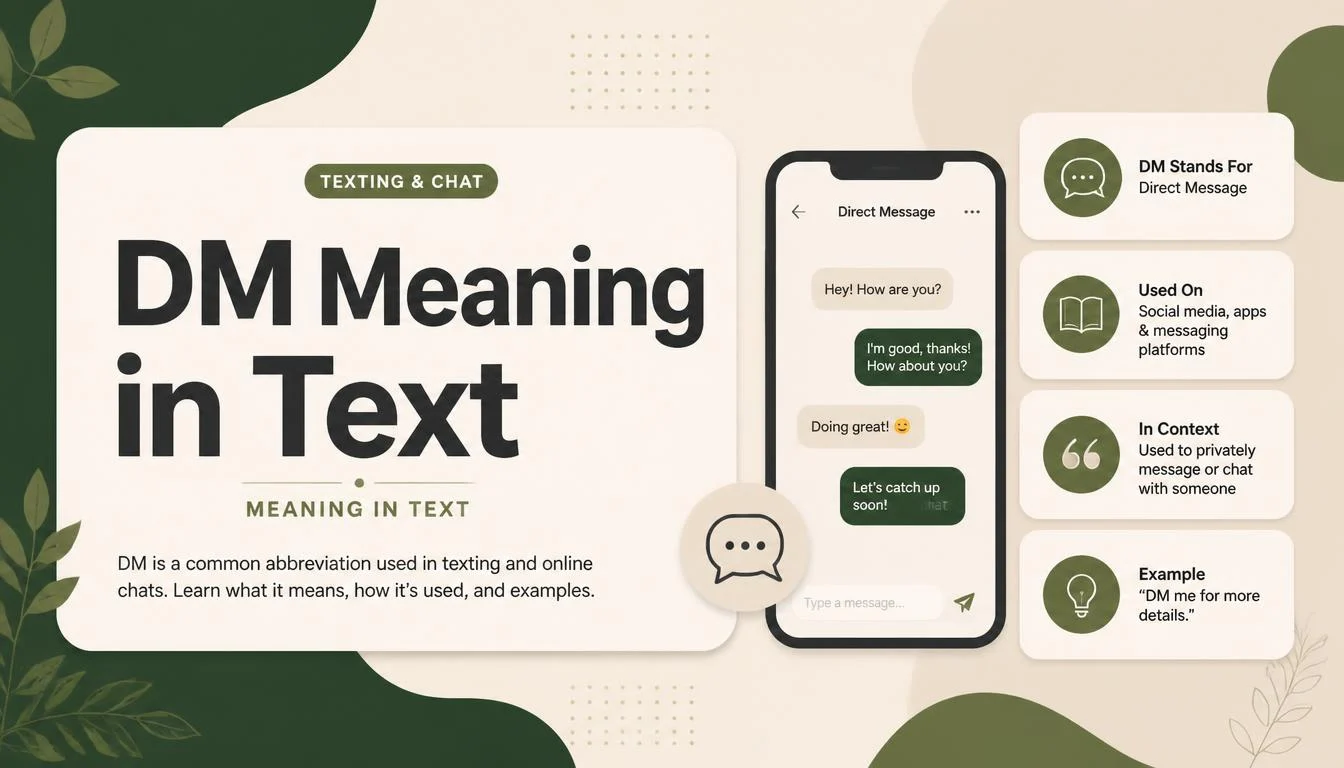
In text conversations, DM usually means “direct message.” It refers to a private message sent to someone through a social media platform or messaging service rather than posted publicly. You may see phrases such as “DM me,” “send me a DM,” or “I’ll DM you” when someone wants to continue a conversation privately. Depending on context, DM can have other meanings, but “direct message” is the standard meaning in online conversations.
Wondering about the DM Meaning in Text? DM usually stands for “direct message,” a private message sent to someone through social media or messaging platforms. It is commonly used when people want to have a private conversation instead of posting publicly.
The meaning of DM can vary slightly depending on the context, but it generally refers to a private message or the act of messaging someone directly. Understanding how people use DM can help you follow conversations on social media and in everyday texting.
What Does DM Mean in Text?
When someone writes DM in a text or online conversation, they are usually talking about a direct message. A direct message is a private communication sent from one person to another through a platform that supports private messaging.
For example, someone might comment on an Instagram post, “DM me the details.” They are asking the other person to send the information privately rather than putting it in the comments.
The abbreviation is common because it is quick to type. It has also become part of ordinary online vocabulary. People may use it even when they are discussing messages sent through different platforms.
You might hear:
- “DM me when you get home.”
- “I sent you a DM.”
- “Can you DM the address?”
- “She asked me to DM her.”
- “Check your DMs.”
In all of these examples, the person is referring to a private message.
What Is a Direct Message?
A direct message is a private message exchanged through an online platform. Unlike a public comment, a direct message is normally visible only to the participants in the conversation, although the exact privacy rules depend on the service.
The term is especially associated with social media. Platforms such as Instagram, Facebook, X, TikTok, and LinkedIn provide private messaging features, although each service uses its own interface and terminology.
The important difference is public versus private communication.
If you comment, “Great photo!” under a public Instagram post, other people may be able to see it. If you send the same message through Instagram’s private messaging system, it becomes part of a private conversation.
That simple distinction explains why people use the word DM so often.
How DM Is Used in Everyday Texting
The abbreviation can appear in several different forms. The meaning stays essentially the same, but the sentence changes depending on what the sender wants you to do.
“DM Me”
This is probably the most familiar use.
“DM me” means “send me a private message.”
Example:
“I have the information you need. DM me.”
The speaker is inviting the other person to contact them privately.
You may also see “DM me” in social media comments, advertisements, community groups, and online discussions.
“I’ll DM You”
This means the speaker plans to send a private message.
Example:
“I’ll DM you the details tonight.”
The person is saying that the information will not be posted publicly. They intend to send it through a private messaging feature.
“Check Your DMs”
This means look at your private messages.
Example:
“I sent you the photos. Check your DMs.”
Here, “DMs” is the plural form. The sender expects the recipient to open their private-message inbox.
“Slide Into My DMs”
This is a more informal expression.
“Slide into my DMs” means send me a private message, often in a casual, friendly, flirtatious, or humorous way.
The phrase is strongly associated with social media culture. Its tone depends on the relationship between the people involved.
For example:
“If you want the recipe, slide into my DMs.”
In this case, the phrase may simply be playful. It does not necessarily have a romantic meaning.
DM vs. Text Message
A DM and a regular text message are both private forms of communication, but they are not necessarily the same thing.
A traditional text message is generally associated with a mobile phone number and a cellular messaging service. A DM is normally connected to an online platform or social network account.
| Feature | DM | Text Message |
|---|---|---|
| Basic meaning | Private online message | Message sent through a phone messaging service |
| Usually connected to | Social media or online account | Phone number |
| Common examples | Instagram, X, TikTok, LinkedIn | SMS or mobile messaging |
| Public alternative | Comment or post | Usually none |
| Typical phrase | “DM me” | “Text me” |
| Account needed | Usually a platform account | Usually a phone number |
There can be overlap. Some modern messaging services blur the old boundaries between traditional texting and internet messaging. Still, “DM” usually points toward a platform’s private-message feature.
DM on Different Social Media Platforms
The basic idea is similar across platforms, but the surrounding culture can differ.
On Instagram, DMs are widely used for personal conversations, sharing posts, sending images, and contacting accounts.
Someone might write:
“DM me for the price.”
This tells interested users to contact the account privately instead of asking about the price in a public comment.
Facebook also supports private conversations through its messaging system. People may casually refer to these conversations as DMs, even though Facebook has historically used the term Messenger for its messaging service.
For example:
“I’ll DM you the link.”
The speaker is simply saying they will send the link privately.
X
On X, formerly known as Twitter, private messages are commonly called DMs. The abbreviation can appear in casual conversation, posts, and replies.
For example:
“Send me a DM if you want to collaborate.”
The request is for a private conversation rather than a public exchange.
TikTok
TikTok also has private messaging features. Users may use DM in the same general way:
“DM me if you have questions.”
The abbreviation therefore carries a familiar meaning even when the platform changes.
On LinkedIn, people may use DMs when discussing professional opportunities, networking, hiring, or business matters.
A message such as:
“Please DM me your email address.”
is asking for the information privately.
The tone on LinkedIn is often more professional than on casual social platforms, but the basic abbreviation remains the same.
Why Do People Say “DM” Instead of “Message”?
The abbreviation is short, recognizable, and closely tied to social media.
Saying “DM me” is faster than saying “send me a private message.” Over time, the abbreviation became common enough that many users understand it without needing the phrase explained.
It also communicates something specific. The word “message” can mean almost any type of communication. “DM” usually signals that the message should happen privately through an online platform.
This distinction is useful in public conversations.
Imagine someone posts a phone number in a comment. Another person might respond, “DM me instead.” They are suggesting a private channel rather than making personal information visible to everyone.
Is DM Formal or Informal?
DM is generally informal or conversational.
You will commonly see it in social media posts, chats, comments, online communities, and casual workplace conversations.
For formal writing, it is often clearer to write direct message or private message on the first mention, depending on the audience.
For example, instead of writing:
“Please DM me regarding your application.”
a formal business message could say:
“Please send me a private message regarding your application.”
That does not mean DM is inappropriate everywhere at work. Many modern workplaces use the abbreviation naturally. The right choice depends on the audience and communication style.
What Does “DM Me” Mean From a Stranger?
When a stranger says “DM me,” the meaning depends heavily on the situation.
In a social media discussion, it may simply mean they want to continue the conversation privately. A seller might use it to discuss pricing or availability. A content creator might use it when offering additional information.
Sometimes, however, a stranger may use a private message to make an unsolicited offer, request personal information, or promote something.
That is why the phrase itself does not tell you whether a conversation is trustworthy. It only tells you where the conversation is supposed to continue.
If the request involves passwords, financial information, verification codes, or other sensitive details, be cautious before sharing anything.
DM vs. PM: Are They the Same?
DM and PM can have very similar meanings.
DM usually stands for direct message. PM commonly stands for private message or sometimes personal message, depending on the platform or community.
| Abbreviation | Common meaning | Typical use |
|---|---|---|
| DM | Direct message | Social media and online platforms |
| PM | Private message | Forums, communities, chats, and some social platforms |
| SMS | Short Message Service | Traditional mobile texting |
| MMS | Multimedia Messaging Service | Mobile messages containing multimedia content |
The terms are not always interchangeable in every online community. Platform-specific terminology matters.
For example, a website may officially call its private communication feature “messages,” while its users still casually call those messages DMs.
Other Meanings of DM
Although direct message is the common online meaning, DM can represent other things in different contexts.
For example, in medicine, DM can be an abbreviation for diabetes mellitus. In tabletop gaming, DM can mean Dungeon Master, especially in Dungeons & Dragons.
There is also a music-related use. DM can refer to Depeche Mode, the English electronic music band, when the surrounding conversation makes that interpretation clear.
These meanings show why context matters.
If someone says, “DM me,” they almost certainly mean “direct message me.” If someone says, “The DM is running the campaign tonight,” the gaming context points toward Dungeon Master instead.
The words surrounding an abbreviation usually provide the clue.
Common Examples of DM in Text
Here are some everyday examples and their meanings:
| Message | What it means |
|---|---|
| “DM me.” | Send me a private message. |
| “I’ll DM you.” | I will send you a private message. |
| “Check your DMs.” | Look at your private-message inbox. |
| “Did you get my DM?” | Did you receive my private message? |
| “DM me for details.” | Contact me privately for more information. |
| “She slid into my DMs.” | She contacted me privately, often casually or romantically. |
| “My DMs are open.” | I am willing to receive private messages. |
| “I get too many DMs.” | I receive many private messages. |
These phrases are especially common on social media.
What Does “My DMs Are Open” Mean?
When someone says “my DMs are open,” they are telling other users that they can contact them privately.
The phrase may appear in a profile, post, comment, or online community.
For example:
“If anyone has questions about the project, my DMs are open.”
Here, the speaker is inviting private questions.
The phrase does not necessarily mean that everyone can message the person without restrictions. Platform privacy settings may still affect who can send messages.
What Does “DM for Details” Mean?
“DM for details” means that additional information will be provided through a private message.
It is common in social media selling, event promotion, freelance services, and online communities.
For example:
“Custom orders available. DM for details.”
The seller is asking interested people to contact them privately.
This wording can be convenient when the information varies from one person to another. It can also keep personal or transaction-related details out of a public comment section.
How Should You Reply to a DM?
Your response depends on what the person wrote.
If someone simply says:
“Hey!”
you might reply:
“Hey! How are you?”
If they ask for information, answer the question directly.
If someone sends an unwanted message, you do not have to respond. Depending on the platform, you may be able to ignore, restrict, block, or report the account.
For professional communication, a short and clear response usually works well.
For example:
“Thanks for reaching out. I’ll review the information and get back to you.”
There is no special grammar rule for replying to a DM. Treat it like any other conversation and match the tone to the situation.
Common Mistakes With DM
A few misunderstandings appear frequently.
Thinking DM Always Means Text Message
A DM is usually a private online message rather than a traditional SMS. If someone specifically asks you to “DM” them, look for the platform where they contacted you.
Assuming DM Is Always Romantic
A private message can be romantic, but it can also be completely ordinary. Friends, customers, coworkers, creators, and strangers may all use DMs.
Assuming Every Platform Uses the Same Term
Not every service officially calls its private messages DMs. Users may still use the abbreviation informally, though.
Sharing Sensitive Information Too Quickly
A DM is private from the general public, but that does not automatically make the person on the other end trustworthy. Avoid sharing passwords, security codes, or sensitive financial information simply because someone asks privately.
FAQs
Can DM mean “text me”?
Sometimes, but not exactly. DM normally refers to sending a private message through an online platform. “Text me” more specifically suggests using a phone-based texting service.
Is it correct to say “DMs”?
Yes. DMs is the common plural form of DM. For example, “I have several DMs to answer” means the person has several private messages.
Can you DM someone without following them?
That depends on the platform and the recipient’s privacy settings. Some services allow message requests from people who do not follow each other, while others may restrict or filter those messages.
What does “DM request” mean?
A DM request is a message request from someone who is not yet part of your regular private conversation list. The platform may require you to accept the request before a normal conversation begins.
Is DM capitalized?
DM is commonly written in capital letters because it is an abbreviation for “direct message.” In casual online writing, lowercase forms such as “dm me” are also common.
What is the difference between a DM and a comment?
A comment is generally posted where other people can see it, while a DM is intended to be private between the participants. Privacy settings and group messaging features can create exceptions.
Conclusion
DM is one of the most common abbreviations in online communication. In ordinary texting and social media conversations, it usually means direct message, or a private message sent through an online platform. Once you understand the public versus private distinction, phrases such as “DM me,” “check your DMs,” and “my DMs are open” become easy to understand. Context still matters because the same abbreviation can have different meanings in medicine, gaming, music, and other fields.