Quick Answer
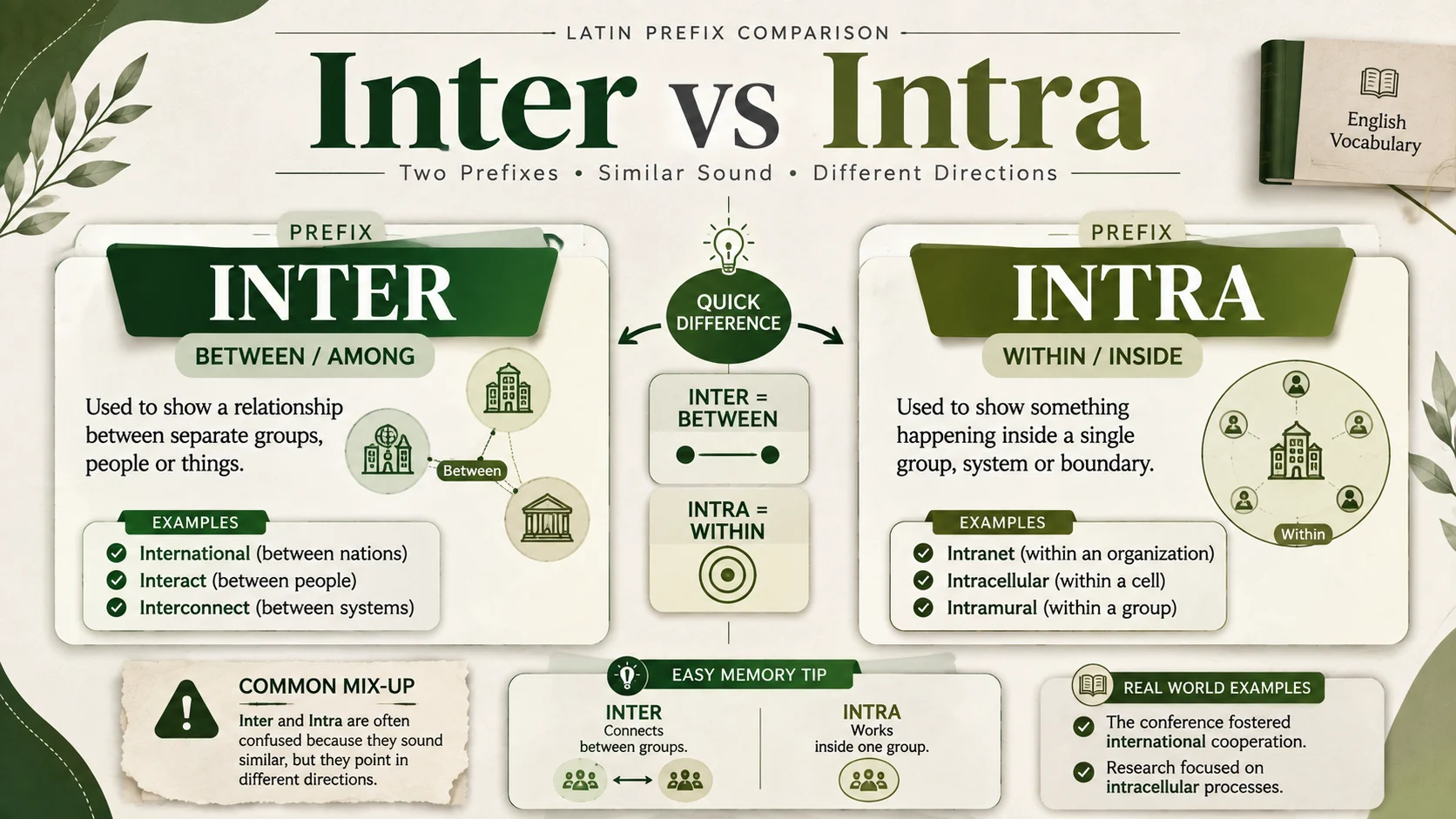
The key difference between inter and intra is that inter- means “between or among different groups” while intra- means “within a single group.” Inter- refers to connections or interactions that occur across boundaries, while intra- describes activities or situations contained entirely inside one specific entity.
Here’s something that trips up even experienced writers: should you write “interdepartmental” or “intradepartmental”? These two prefixes look almost identical, but they mean completely different things. Getting them wrong can confuse your readers or, worse, completely reverse what you’re trying to say.
The inter vs intra confusion happens because both prefixes describe relationships between things. But that’s where the similarity ends. Inter- points outward, connecting across boundaries. Intra- points inward, staying within boundaries. Understanding this simple distinction will immediately improve your writing precision, whether you’re sending a business email, writing an academic paper, or creating content for a global audience.
In this guide, we’ll break down exactly when to use inter vs intra, explore real-world examples from business and technology, and give you practical memory tools so you never confuse them again.
What’s the Difference Between Inter and Intra?
The core difference between inter and intra comes down to boundaries: inter- means across or between different entities, while intra- means within a single entity. Both are prefixes word parts added to the beginning of root words to modify their meaning.
| Aspect | Inter- | Intra- |
|---|---|---|
| Meaning | Between, among, across different groups | Within, inside a single group |
| Part of Speech | Prefix | Prefix |
| Refers To | Interactions across boundaries | Activities contained internally |
| Typical Usage | Interpersonal, international, interfaith | Intramural, intravenous, intracellular |
| Example | “The interdepartmental meeting brought together teams from marketing, sales, and IT.” | “The intradepartmental meeting was only for the marketing team.” |
| Common Confusion | Mistaking “between groups” for “within groups” | Using intra- when referring to cross-group interactions |
Here’s the simple way to think about it: inter- opens doors; intra- keeps things inside. If you’re talking about something that happens between multiple groups, use inter-. If you’re talking about something that stays within one group, use intra-.
Consider this: an “interstate highway” connects different states. An “intrastate highway” stays within one state’s borders. Same prefix, completely different meaning. The boundary determines everything.
Is Inter vs Intra a Grammar, Vocabulary, or Usage Issue?
This is primarily a usage and vocabulary issue rather than a strict grammar rule. Grammar deals with sentence structure and word order. The inter vs intra distinction is about selecting the correct word to express your intended meaning which falls firmly into vocabulary and usage territory.
Both prefixes function as derivational morphemes, meaning they attach to root words to create new words with modified meanings. They’re not interchangeable, and using one when you meant the other changes your meaning entirely.
In formal writing, precision matters. An “interagency agreement” means collaboration across different agencies. An “intra-agency agreement” means something happening inside one agency. These documents often have legal implications using the wrong prefix could create confusion about responsibilities.
In business English, mixing these up can make you look less professional. Saying “intra-organizational communication” when you mean “inter-organizational” would fundamentally misrepresent your message.
In academic writing, where definitions and boundaries matter, using these prefixes correctly demonstrates careful thinking.
In everyday conversation, the stakes are lower, but the distinction still helps clarity. Interpersonal skills” means how you relate to others; “intrapersonal skills” means self-awareness and internal reflection. They’re both valuable but entirely different.
The bottom line: this isn’t a grammar rule you can break creatively. It’s a vocabulary choice with a clear right and wrong answer depending on what you’re describing.
What Does Inter- Mean?
Inter- comes from Latin meaning “between” or “among.” It attaches to words to describe connections, interactions, or relationships that cross boundaries between separate entities.
Common Words with Inter-
- International – between or among nations
- Interpersonal – between people
- Interdisciplinary – across different academic fields
- Interstate – between states
- Intertwine – to twist together
Pronunciation
In-ter – pronounced /ɪn.tər/ in British English and /ɪn.tɚ/ in American English.
Common Collocations and Sentence Patterns
Professional context:
“The interdepartmental task force included representatives from finance, operations, and human resources.”
Academic context:
“Her dissertation examined intercultural communication patterns in multinational corporations.”
Technology context:
“The software allows for interoperability between different operating systems.”
Email example:
“Dear team, we’re scheduling an inter-office exchange program to help colleagues from different branches share best practices.”
Daily conversation:
“They’re organizing an interfaith dialogue event at the community center next month.”
One Common Learner Mistake
Students often write “inter-personal” with a hyphen or use “inter” when they mean “inner.” Remember: inter- always involves multiple things connecting.
Mini Recap
Use inter- whenever you’re describing something happening between or among distinct, separate groups. The key indicator is crossing a boundary.
What Does Intra- Mean?
Intra- comes from Latin meaning “within” or “inside.” It attaches to words to describe activities, situations, or relationships that happen entirely inside a single entity.
Common Words with Intra-
- Intramural – within the same school or institution
- Intravenous – within or into a vein
- Intracellular – within a cell
- Intrastate – within a state
- Intrapersonal – occurring within the individual mind or self
Pronunciation
In-tra – pronounced /ˈɪn.trə/ in British English and /ˈɪn.trə/ in American English.
Common Collocations and Sentence Patterns
Professional context:
“The CEO announced a new intradepartmental training initiative for the accounting division.”
Academic context:
“The study focused on intra-group dynamics among team members in the same project.”
Technology context:
“The company’s intranet provides intra-office communication tools.”
Email example:
“Hi everyone, we’re starting an intra-team mentorship program. Please let HR know if you’d like to participate.”
Daily conversation:
“The intramural basketball tournament is only open to students enrolled at the university.”
One Common Learner Mistake
Learners often think intra- is just a variation of inter-. It’s not. Think of intra- as “inside” and you’ll always get it right.
Mini Recap
Use intra- when everything is contained within one group, system, or boundary. Nothing crosses over to the outside.
When NOT to Use Each Word
When NOT to Use Inter-
- When everything stays inside one group – If you’re talking about something that only involves members of the same organization, don’t use inter-. That would be intra-.
- When there’s no crossing of boundaries – Inter- specifically implies moving across. If there’s no boundary-crossing, inter- is wrong.
- When referring to internal processes – An “inter-organizational process” would involve multiple organizations. If your process is internal, use intra-.
- When describing self-reflection – “Interpersonal skills” are about others. Self-awareness is “intrapersonal.”
- When local is the scope – If you mean within a city, that’s “intracity,” not “intercity” (which means between cities).
- When the root word is singular – Inter- generally connects multiple things. If you’re only referring to one group, intra- is likely correct.
When NOT to Use Intra-
- When multiple groups are involved – If you’re discussing collaboration across different organizations, that’s inter-. Intra- would suggest it’s all internal.
- When there’s cross-border activity – Trade between countries is “international,” not “intranational” (which would mean within one country).
- When you mean across distances – “Interstate commerce” crosses state lines. “Intrastate” means it doesn’t.
- When the root word clearly implies multiple – Words like “interfaith” and “intercultural” naturally involve multiple faiths or cultures. Using intra- would contradict the meaning.
- When referring to relationships between people – Relationships are “interpersonal.” “Intrapersonal” is something else entirely.
- When you want to emphasize connection – If your point is about bridges between groups, you want inter-.
Common Mistakes Table
| Correct Sentence | Incorrect Sentence | Explanation |
|---|---|---|
| “The interagency task force includes members from three federal departments.” | “The intra-agency task force includes members from three federal departments.” | Members are from different agencies, so it’s inter-, not intra-. |
| “The company’s intranet supports intra-office communication.” | “The company’s intranet supports inter-office communication.” | Communication is happening inside the same office network. |
| “Interpersonal skills are essential for effective teamwork.” | “Intrapersonal skills are essential for effective teamwork.” | Teamwork involves relationships between people. |
| “The study examined intra-family relationships.” | “The study examined inter-family relationships.” | The study looks at relationships within one family. |
| “International students must apply for a visa.” | “Intranational students must apply for a visa.” | Students are coming from different countries, so it’s inter-. |
Decision Box
If your meaning involves crossing boundaries between groups → use INTER-
- Between departments? Interdepartmental.
- Across countries? International.
- Among different faiths? Interfaith.
If your meaning involves staying within one group → use INTRA-
- Within the same department? Intradepartmental.
- Inside one country? Intranational.
- Inside a single organization? Intra-organizational.
Quick memory test: Think of INTERmission it’s the break between acts. Think of INTRAvenous it goes inside a vein. Between vs within. That’s it.
Real-World Examples Across Contexts
Office Communication
Inter- “Our interdepartmental project requires coordination between marketing, engineering, and design teams to succeed.”
Intra- “The intradepartmental newsletter is only distributed to our sales team members.”
Business Email
Inter- “Dear partners, we’re looking to create an inter-organizational working group to address shared challenges in the industry.”
Intra- “Dear team, please review the new intra-team workflow procedures effective next Monday.”
School or University
Inter- “The university offers interdisciplinary programs that combine computer science with digital arts.”
Intra- “The intramural soccer league is reserved for students currently enrolled at the university.”
Customer Support
Inter- “Customer feedback is shared via an inter-departmental system that notifies product, support, and development teams.”
Intra- “Our support team uses an intra-team chat channel for quick problem-solving during busy periods.”
Technology
Inter- “The new protocol enables interoperability between Apple and Android devices.”
Intra- “The company’s intra-network security protocols prevent unauthorized internal data access.”
Artificial Intelligence
Inter- “The system uses inter-modal learning to process both text and image data together.”
Intra- “Intra-modal analysis examines patterns within a single data type.”
Daily Conversation
Inter- “We need better intergenerational programs to connect young people with seniors in the community.”
Intra- “The intra-family communication breakdown caused misunderstandings about the holiday plans.”
Inter vs Intra in Modern Technology
The inter vs intra distinction has become particularly important as technology connects us globally while also requiring internal systems to stay secure and functional.
Artificial Intelligence: AI systems often handle both inter-modal and intra-modal processing. Inter-modal analysis connects different types of data like understanding a video using both audio and visual inputs. Intra-modal processing works within a single data type, like analyzing text alone.
Virtual and Voice Assistants: When a voice assistant connects with other services (like ordering a ride through a rideshare app), that’s inter-service communication. When it processes commands using only its own internal systems, that’s intra-system processing.
Chatbots: An inter-platform chatbot works across different messaging apps. An intra-platform chatbot only operates within one.
Software: Inter-process communication (IPC) allows different programs on your computer to exchange data. Intra-process communication happens inside a single program’s components.
Business Tools: Companies use both inter-company collaboration tools (like Slack for connecting with partners) and intra-company systems (like internal HR portals).
The pattern remains consistent: if data, information, or communication crosses a boundary, it’s inter-. If it stays contained, it’s intra-.
Word Origin
Both prefixes trace back to Latin, and understanding their origins makes them easier to remember.
Inter- comes from the Latin preposition inter, meaning “between” or “among.” You see this same root in words like “interval” (space between) and “intervene” (come between). Latin speakers used inter to describe anything positioned between separate points or objects.
Intra- comes from the Latin preposition intra, meaning “within” or “inside.” It’s related to interior and internal. Romans used intra to describe location, action, or movement inside a single boundary.
The two prefixes coexisted in Latin with exactly the same distinction they have today. When English absorbed these Latin elements through centuries of use, the meanings remained intact. This historical clarity is why they’ve survived as one of the most precise distinctions in English vocabulary.
Expert Insight
As a language instructor who’s taught English for over a decade, I’ve noticed that students struggle with inter vs intra not because the rule is complicated, but because they overthink it. The boundary concept is intuitive we naturally understand what it means to be “between” and what it means to be “inside.” When you stop thinking about the prefixes and start thinking about the situation is this crossing a line or staying within it? the correct choice becomes obvious. Inter- and intra- aren’t interchangeable synonyms with subtle nuances. They’re opposites with entirely different jobs. Once you frame it that way, the decision becomes much simpler.
Error Prevention Checklist
- ✅ Always use inter- when: You’re describing connections, interactions, or relationships between different groups.
- ✅ Always use intra- when: You’re describing activities, processes, or situations entirely within one group.
- ⚠️ Never confuse them if: You’re writing anything formal business reports, academic papers, or professional documents where precision matters.
- 💡 Quick memory tip: Think “INTERnational” connects nations; “INTRAvenous” goes inside a vein. Between vs within.
Related Grammar Confusions Worth Learning
- Affect vs Effect – One is usually a verb, one is usually a noun. Understanding this improves all your writing.
- Further vs Farther – Distance vs depth. Often confused but easy to master.
- Principle vs Principal – Rule vs person/primary. These trip up many writers.
- Compliment vs Complement – Praise vs completion. The spelling difference matters.
- Stationary vs Stationery – Still vs writing supplies. One letter makes all the difference.
- Everyday vs Every Day – Adjective vs adverbial phrase. This distinction improves everyday writing.
- Accept vs Except – Receive vs exclude. Knowing the difference prevents errors.
- Insure vs Ensure vs Assure – Insurance, guarantee, and promise. Three different words.
- E.g. vs I.e. – Examples vs clarification. These abbreviations serve different purposes.
- Who vs Whom – Subject vs object. Still relevant in formal writing.
Frequently Asked Questions
Is it inter or intra in interpersonal?
It’s interpersonal. Interpersonal refers to relationships between people. Intra-personal (often written as intrapersonal) refers to internal self-reflection. The prefix inter- is correct here because you’re talking about connections between different individuals.
How can I remember inter vs intra easily?
Use this memory trick: inter- starts with “enter,” and when you enter something, you’re going between or among. More simply, think “international” (between nations) versus “intravenous” (within a vein). Between vs within.
Is it interdepartmental or intradepartmental?
Both exist, but they mean different things. Interdepartmental means across or between different departments. Intradepartmental means within a single department. You would say “interdepartmental collaboration” to describe multiple departments working together.
What is the difference between interstate and intrastate?
Interstate means between or among states like an interstate highway that crosses state borders. Intrastate means within a single state like intrastate commerce that stays within state borders. The prefix determines the scope.
Is it international or intranational?
International is the correct word for between or among nations. Intranational refers to within a single nation and is rarely used. When you’re discussing global matters, international is what you need.
What are some common mistakes with inter and intra?
The most common mistake is using intra- when you mean inter- because people vaguely associate both with “between.” Another mistake is hyphenating them incorrectly. Inter- and intra- typically attach directly to root words without a hyphen (except in certain style guides for clarity).
Conclusion
The inter vs intra distinction is one of those language details that separates precise writers from those who occasionally miss the mark. Inter- means between or among different groups it’s about crossing boundaries. Intra- means within a single group it’s about staying inside.
Getting this right matters more than you might think. When you’re writing a business document, an academic paper, or even a clear email, using the correct prefix shows attention to detail and ensures your message is understood exactly as intended. A meeting labeled “interdepartmental” brings together multiple teams. An “intradepartmental” meeting is for your team alone. That’s a significant difference.
Remember the simple test: if it’s between, use inter-. If it’s within, use intra-. This single rule will prevent almost every possible mistake. The next time you reach for one of these prefixes, think about the boundaries and choose accordingly.