Quick Answer
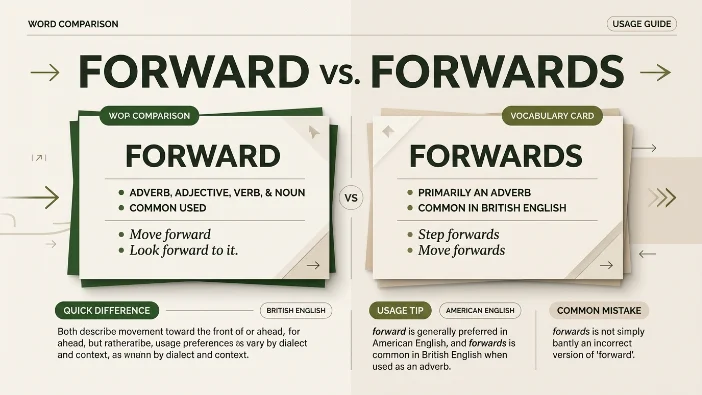
Forward vs forwards comes down to region and style, not strict grammar rules. “Forward” works as an adjective, noun, verb, and adverb in both American and British English. “Forwards” only works as an adverb, and it’s mostly used in British English. American writers should stick with “forward” in almost every situation.
You’re halfway through an email, and your cursor freezes on one word. Should you write “please move the meeting forward” or “please move the meeting forwards”? Both look correct. Both sound fine when you read them out loud. Yet something makes you pause, because you’ve seen both spellings used by people who clearly know what they’re doing.
Here’s the truth: this isn’t really a case of one word being right and the other being wrong. Forward and forwards are close cousins that grew apart depending on which side of the Atlantic they landed on. Forward carries more weight because it can function as several parts of speech, while forwards is limited to describing direction or movement. Mixing them up rarely causes confusion, but using the wrong one in a formal document, a school assignment, or a job application can make your writing look inconsistent.
By the end of this guide, you’ll know exactly when each word fits, why native speakers in different countries choose differently, and how to avoid the small mistakes that trip up even confident writers.
Forward vs Forwards: What’s the Difference?
The core difference is versatility. Forward can act as an adjective, a noun, a verb, and an adverb, while forwards only works as an adverb describing movement or direction.
Think of forward as the all-purpose tool in your grammar toolbox. You can say a “forward motion” (adjective), “the team’s forward” (noun, as in sports), “forward the email” (verb), or “step forward” (adverb). Forwards, on the other hand, only ever tells you which way something is moving. You’ll never see it used as a noun or a verb, and native English speakers instinctively sense when it’s been forced into the wrong slot.
| Meaning | Part of Speech | Refers To | Typical Usage | Example | Common Confusion |
|---|---|---|---|---|---|
| Ahead in position or time | Adjective | Direction, plans, position | “Forward planning” | She has a forward-thinking approach. | Writers sometimes add an “s” even in adjective use. |
| A position or player | Noun | Sports roles | “He plays forward.” | The forward scored twice tonight. | “Forwards” is never used this way. |
| To send something ahead | Verb | Emails, mail, messages | “Forward this message.” | Please forward the invoice to accounting. | People occasionally write “forwards this,” which is incorrect. |
| Toward the front, in either spelling | Adverb | Physical or figurative movement | “Move forward/forwards.” | He leaned forward to hear better. | Region determines which spelling feels natural. |
So here’s the short recap: if you need a word to describe direction, both forward and forwards can technically work as adverbs, though American English strongly favors forward. But the moment you need a noun, a verb, or an adjective, forwards drops out of the running entirely. That single fact solves most of the confusion right there.
Is Forward a Grammar, Vocabulary, or Usage Issue?
This is mostly a usage and regional dialect issue rather than a strict grammar rule. Both words are grammatically acceptable as adverbs, but their acceptability outside that role differs sharply.
From a grammar standpoint, neither word breaks any rule when used as an adverb. “She walked forward” and “she walked forwards” are both grammatically sound sentences. The vocabulary difference shows up when you need the word to do a different job. Forward is the only correct choice for the noun and verb forms, so if you’re emailing a colleague and asking them to “forwards” a document, that’s a usage error, not a stylistic choice.
The two words are interchangeable only in their adverb role, and even then, regional preference decides which one sounds natural. In American formal writing, business English, and academic papers, forward is the safer and more consistent choice across the board. British and Australian English allow forwards more freely in casual and even semi-formal contexts, though forward still dominates in professional writing worldwide.
The practical takeaway: when in doubt, especially in professional or academic writing, choose forward. It works everywhere and never looks out of place.
Understanding Forward
Meaning: Forward means moving or facing toward the front, or relating to future plans and progress.
Part of speech: Adjective, noun, verb, adverb.
Pronunciation note: It’s pronounced FOR-werd, with stress on the first syllable. Some learners mistakenly stretch the second syllable, which makes it sound unnatural.
Common collocations: fast forward, look forward to, forward-thinking, forward planning, move forward, forward this email, straight forward (often written as one word, “straightforward,” when used as an adjective).
Typical sentence patterns: “Look forward to [something],” “move forward with [a plan],” “forward [a document] to [someone],” “a forward step in [a process].”
Workplace example: “Let’s schedule a follow-up call to move the project forward.”
Academic example: “The research presents a forward-looking framework for analyzing climate data.”
Technology example: “Click the button to fast forward through the tutorial video.”
Email example: “I’m forwarding this message so you have the full context before our meeting.”
Daily conversation example: “I’m really looking forward to the weekend.”
One learner mistake: Non-native speakers sometimes write “forward to” without following it with a gerund, producing errors like “I look forward to receive your reply” instead of the correct “I look forward to receiving your reply.” This trips up even advanced learners because “to” here functions as a preposition, not part of an infinitive.
Mini recap: Forward is the flexible, do-it-all option. If you’re ever unsure which word to pick, forward is almost always the safer bet, especially in writing meant for a global or professional audience.
Understanding Forwards
Meaning: Forwards describes the same physical or figurative direction as forward, but it functions strictly as an adverb.
Part of speech: Adverb only.
Pronunciation note: FOR-werdz, with the same stress pattern as forward, just with an added “z” sound at the end.
Common collocations: step forwards, lean forwards, move forwards, push forwards, roll forwards.
Typical sentence patterns: “[Subject] + [verb of motion] + forwards,” such as “walk forwards,” “lurch forwards,” or “slide forwards.”
Workplace example (British English): “Could you push the deadline forwards by two days?”
Academic example (British English): “The committee agreed to bring the review date forwards.”
Technology example (British English): “Drag the slider forwards to increase playback speed.”
Email example (British English): “I’d like to move our call forwards to Tuesday if that works for you.”
Daily conversation example: “The dog ran forwards the moment the door opened.”
One learner mistake: Many learners use forwards where a noun or verb is needed, writing sentences like “please forwards this to the team” instead of “please forward this to the team.” Because forwards can only be an adverb, this kind of substitution is always incorrect.
Mini recap: Forwards is a narrower tool. It only handles adverb duties, and even then, it’s mostly reserved for British and Commonwealth English rather than American writing.
When Not to Use Each Word
Mistake 1: Using “forwards” as a verb. Writers sometimes type “he forwards the package” when they mean the present tense of a completely different pattern, or worse, they write “please forwards this” when asking someone to send something. The verb form is always forward, with an “s” only appearing in third-person singular present tense (“she forwards the email every Monday”), which is grammatically different from the adverb “forwards.”
Mistake 2: Adding “forwards” after “look forward to.” This phrase almost always appears as “look forward to,” never “look forwards to,” even in British English. It’s a fixed idiom, and native speakers rarely deviate from it.
Mistake 3: Using “forwards” in a job title or noun context. A football forward, a business’s forward planning department, or a forward slash never take the “s.” These are fixed noun and adjective uses where only forward applies.
Mistake 4: Assuming American English never uses forwards. While rare, forwards does occasionally appear in casual American speech, especially in phrases like “back and forwards.” Still, most American style guides and editors prefer forward in that same phrase, producing “back and forth” or “forward and backward” instead.
Mistake 5: Overcorrecting in British English. Some British writers assume forwards is always more “proper” and start applying it to verb and noun contexts where it doesn’t belong, producing errors like “I’ll forwards you the file.”
Mistake 6: Confusing forward with foreword. This one isn’t about the s at all, but it trips up plenty of writers. A foreword is the introductory section of a book, spelled with an “e” before the “word.” Forward, describing direction, has no “e” in that position.
Mistake 7: Inconsistent use within the same document. Switching between forward and forwards in a single piece of writing looks careless, even if both are technically acceptable in context. Pick one style, usually based on your target audience’s region, and stay consistent.
Mistake 8: Using forwards in formal American business writing. Even though it’s not technically wrong for direction, American readers may see it as slightly odd or overly formal in a way that doesn’t match the rest of the document’s tone.
Common Mistakes Table
| Correct Sentence | Incorrect Sentence | Explanation |
|---|---|---|
| Please forward the report to the client. | Please forwards the report to the client. | Forward is the only correct verb form; forwards cannot function as a verb. |
| I look forward to hearing from you. | I look forwards to hearing from you. | This is a fixed idiom that never takes an “s,” even in British English. |
| She plays forward for the national team. | She plays forwards for the national team. | Forward is the correct noun for a player position; forwards has no noun use. |
| He stepped forwards to answer the question. (British) | He stepped forward to answer the question is also correct. | Both are acceptable adverbs, but forwards leans British while forward works universally. |
| The company has a forward-thinking strategy. | The company has a forwards-thinking strategy. | Forward is the only correct adjective form in compound modifiers like this. |
| Let’s move the deadline forwards by a week. (British) | Let’s move the deadline forward by a week is equally correct. | Both spellings are valid as adverbs; the choice depends on regional preference. |
Quick Decision Box
If you need a noun, verb, or adjective, always use forward.
If you need an adverb describing direction or movement, use forward in American English or either forward or forwards in British English.
When unsure, forward works correctly in virtually every context, making it the safer default for global and professional writing.
Forward and Forwards in Real World Situations
Office communication: A manager tells the team, “Let’s push this initiative forward next quarter,” using forward as part of a phrasal expression about progress rather than physical direction.
Business email: An assistant writes, “I’ve forwarded your request to the finance department,” demonstrating the verb form doing exactly what it’s built for.
School or university: A professor writes on a paper, “Your argument moves forward logically, but the conclusion needs more support,” using forward as an adverb describing the structure of an essay.
Customer support: A support agent tells a customer, “I’ll forward your ticket to our technical team right away,” another clean example of the verb use that never takes an “s.”
Technology: A user manual instructs, “Press and hold the button to fast forward the recording,” where forward pairs with “fast” to form a compound verb phrase.
Artificial Intelligence: A chatbot developer writes, “The model forwards the user’s query to the retrieval system before generating a response,” a rare technical case where “forwards” appears correctly as the third-person singular verb form, not the adverb.
Daily conversation: A friend says, “Take a step forwards so I can get a better photo,” a casual, direction-focused sentence where either spelling would sound natural depending on where the speaker grew up.
Forward and Forwards in Modern Technology
In artificial intelligence and software design, “forward” shows up constantly, and almost always in its verb or adjective form rather than as forwards. A “forward pass” in machine learning refers to the process of pushing data through a neural network, and you’ll never see this written as a “forwards pass.” Similarly, in networking, a “forward proxy” or “port forwarding” always uses forward, never forwards, because these are fixed technical terms.
Virtual assistants and chatbots also use the verb form heavily. When a system “forwards” a request to another service, that’s simply the present tense of the verb forward, not the adverb forwards, even though the spelling looks identical to the standalone adverb. This is one of the rare situations where confusion is understandable, because the word looks the same in two completely different grammatical roles.
Voice assistants, when giving spoken directions or instructions, tend to favor forward as well. Saying “move forward” or “go forward” sounds cleaner and more universally understood than “move forwards,” especially since many of these systems are designed with American English as the default.
Software tools that manage email, ticketing, or messaging almost always label their buttons “Forward,” not “Forwards,” reinforcing just how dominant the verb form has become in digital spaces.
Word Origin
Forward traces back to Old English “foreweard,” combining “fore” (before, in front) and “weard” (in the direction of), which together described facing or moving toward the front. Forwards developed later as a natural adverbial variant, following a common pattern in English where directional adverbs sometimes gained an “s” ending, similar to how “toward” became “towards” in British usage. Over centuries, American English gradually dropped the “s” variants in most everyday use, while British English retained them more consistently, which explains the regional split we see today.
Expert Insight
If you’re ever stuck deciding between these two, think of forward as your default setting and forwards as an optional variation you can reach for only when you’re certain you’re writing in a British English context and only when you need an adverb. Teaching this to students, I’ve found the fastest way to lock it in is to remember that forward can wear many hats, while forwards can only wear one. That single image tends to stick far better than memorizing a list of exceptions.
Error Prevention Checklist
- Always use forward when you need a noun, verb, or adjective.
- Always use forward in American English writing, regardless of the sentence’s role.
- Use forwards only as an adverb, and only if you’re specifically writing in British or Australian English style.
- Never confuse “forwards” with “foreword,” which refers to a book’s introduction.
- Quick memory tip: if the word could be swapped with “ahead” or “onward” and it’s not doing anything else in the sentence, either spelling might work depending on your audience, but forward is always the safe, universal choice.
Related Grammar Confusions
Toward vs Towards – Follows the exact same American versus British pattern as forward and forwards, making it a natural next topic to master.
Backward vs Backwards – The direct opposite pair, governed by identical regional rules, so learning one helps you learn the other instantly.
Afterward vs Afterwards – Another time-and-direction word with the same US/UK spelling split worth knowing for consistent formal writing.
Farther vs Further – Both deal with distance and progress, but the difference here is about physical versus figurative distance rather than region.
Foreword vs Forward – A spelling trap rather than a grammar one, since these two words sound nothing alike in meaning despite looking similar.
Onward vs Onwards – Yet another adverb pair following the same regional pattern, useful for writers who travel between American and British audiences.
Downward vs Downwards – Completes the directional word family and reinforces the same core rule you’ll use for forward and forwards.
Upward vs Upwards – The upward-facing counterpart, ideal for practicing the pattern until it becomes automatic.
Since vs For – Not directional, but frequently confused by the same learners who struggle with forward-related time expressions.
Ahead of vs In front of – Both describe position, and understanding their nuance rounds out your ability to talk about direction and sequence naturally.
FAQs
Is it “look forward” or “look forwards” to something?
The standard expression is “look forward to,” not “look forwards to.” This fixed phrase is used in both American and British English, especially in professional writing. For example, “I look forward to hearing from you” is correct.
Which one is correct in American English, “forward” or “forwards”?
Forward is the standard and more widely preferred form in American English. It can function as an adverb, adjective, noun, or verb depending on the sentence. Forwards is understood in the US but is much less common.
Can “forwards” ever be used as a verb?
Yes, but this is a different grammatical use. In “She forwards the email,” forwards is the third person singular form of the verb forward. It is not the directional adverb forwards. The spelling changes because the verb follows the normal subject verb agreement rule.
Why do British speakers use “forwards” more often?
British English has traditionally retained several directional adverbs with an -s ending, including towards, backwards, and forwards. American English tends to favor the shorter forms toward, backward, and forward. Both patterns are established varieties of standard English.
Is “forwards” grammatically incorrect in American English?
Not necessarily. Forwards is recognized and understood in American English, but it is considerably less common than forward. In most US writing, particularly professional or edited content, forward will sound more natural.
Does it matter which form I use in a résumé or cover letter?
Consistency and context are more important than simply choosing one form. For American English, forward is the safest choice because it is standard and widely accepted. In a phrase such as “I look forward to hearing from you,” forward is always the appropriate form.
Conclusion
At the end of the day, forward and forwards aren’t rivals fighting for correctness. They’re regional siblings, with forward being the more versatile, globally accepted choice, and forwards surviving mainly as a British adverb variant. Forward can handle nouns, verbs, adjectives, and adverbs without breaking a sweat, while forwards is limited to just one job.
If you remember nothing else from this guide, remember this: when in doubt, use forward. It’s correct almost everywhere, in almost every context, and it will never make your writing look inconsistent or out of place.