Quick Answer
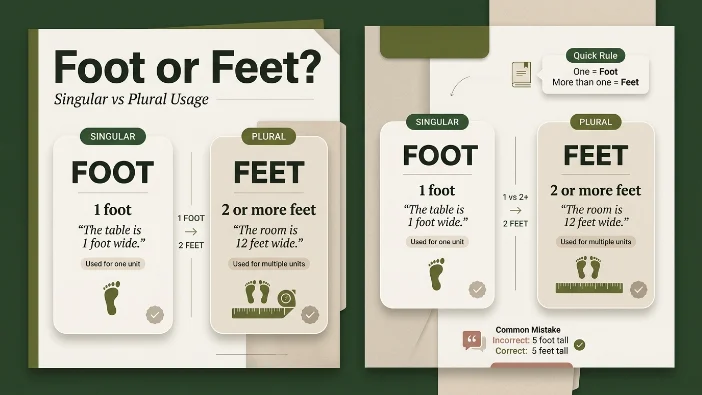
Use foot when talking about one single unit one body part or one unit of measurement. Use feet for two or more. The foot or feet confusion almost always comes down to singular versus plural, though measurement phrases like “a five-foot table” break that rule in one specific way, explained below.
You’re writing a sentence, you pause, and suddenly you’re not sure whether it should be “a six foot fence” or “a six feet fence.” Or maybe you’ve typed “my foots hurt” and something felt off, but you couldn’t say exactly why. This happens to native speakers just as often as it happens to English learners, and it’s not because the rule is complicated. It’s because English handles plurals inconsistently, and foot happens to fall into one of the trickiest categories.
Foot refers to a single unit either the body part at the end of your leg, or a unit of length equal to twelve inches. Feet is simply its plural form, used the moment you’re talking about more than one. The confusion creeps in because English usually adds an “s” to make something plural, but foot doesn’t follow that pattern, and measurement phrases add another twist that trips people up in professional writing, real estate listings, and everyday conversation alike.
By the end of this guide, you’ll know exactly when to use each word, why the measurement exception exists, and how to avoid the mistakes that show up most often in emails, reports, and casual speech.
Foot or Feet: What’s the Difference?
The core difference is simple: foot is singular, feet is plural. One foot, two feet. That’s the entire rule in its most basic form.
Both words function as nouns. Foot refers to the lowest part of the leg, below the ankle, or to a measurement of twelve inches. Feet is its irregular plural, used any time you’re referring to two or more of either the body part or the unit of measurement. Neither word changes meaning based on context in a confusing way the confusion is purely grammatical, not conceptual.
| Meaning | Part of Speech | Refers To | Typical Usage | Example | Common Confusion |
|---|---|---|---|---|---|
| Foot | Noun (singular) | One body part or one 12-inch unit | General singular reference | “She hurt her foot.” | Used incorrectly in plural contexts |
| Feet | Noun (plural) | Two or more body parts or units | General plural reference | “The table is six feet long.” | Used incorrectly as “foots” |
Here’s the recap: if you’re describing one thing, reach for foot. If you’re describing more than one, reach for feet. The exception that trips people up is measurement compounds like “a six-foot ladder,” where foot stays singular even though the number is greater than one that’s a separate rule tied to how adjectives work in English, not a contradiction of the plural rule.
Is Foot or Feet a Grammar, Vocabulary, or Usage Issue?
This is primarily a grammar issue, specifically an issue of irregular plural nouns. It isn’t a vocabulary problem, because both words mean the same core thing one is just the plural form of the other. It also isn’t a formality issue, since both words are used identically across formal and informal English.
Here’s where the actual difficulty lives: English has a small group of nouns that don’t take the regular “-s” plural ending. Foot becomes feet, just as tooth becomes teeth, goose becomes geese, and mouse becomes mice. These are called irregular plurals, and they’re inherited from Old English, which had more complex plural patterns than modern English does.
The words are not interchangeable. You can’t swap one for the other and expect the sentence to remain correct using foot where you mean multiple items, or feet where you mean one, is a factual grammar error, not a stylistic choice.
In formal writing, academic papers, business reports, and everyday conversation, the rule stays exactly the same. There’s no formal version of feet or casual version of foot. The one place where people genuinely hesitate is in measurement phrases, which we’ll break down in the next section.
Practical takeaway: if you remember that foot and feet follow the same singular-plural logic as tooth and teeth, you’ll rarely second-guess yourself again.
Foot: Meaning, Usage, and Examples
Foot is a singular noun referring either to the body part below the ankle or to a unit of length equal to twelve inches.
Pronunciation is straightforward it rhymes with “put,” not “boot.” Common collocations include “on foot,” “foot of the bed,” “foot the bill,” “put your foot down,” and “foot traffic.” These phrases show up constantly in both spoken and written English, which is part of why getting the singular form right matters.
Typical sentence patterns place foot after an article like “a” or “the,” or after a possessive like “my” or “her.” You’ll also see it in compound adjectives before a noun, such as “a two-foot gap.”
Workplace example: “There’s a two-foot clearance required under the new safety code.”
Academic example: “The study measured stride length in relation to foot size.”
Technology example: “The sensor detects when a foot steps onto the mat, triggering the alarm.”
Email example: “Could you confirm the foot traffic numbers from last weekend’s event?”
Daily conversation example: “I stubbed my foot on the coffee table again.”
Common learner mistake: Many learners write “foots” when trying to make the word plural, applying the regular “-s” rule out of habit. This is understandable, since it’s how nearly every other English noun forms its plural, but foot simply doesn’t follow that pattern.
Mini recap: Foot is always singular. Whether you mean the body part or the measurement, if you’re talking about just one, this is your word.
Feet: Meaning, Usage, and Examples
Feet is the irregular plural of foot, used whenever you’re referring to two or more of the body part or the unit of measurement.
There’s no pronunciation trick here beyond the vowel sound shifting from “oo” as in “put” to “ee” as in “see.” Common collocations include “on your feet,” “feet apart,” “cold feet,” “get back on your feet,” and “square feet.” Several of these are idioms, which is worth knowing because idiomatic phrases don’t bend the grammar rule “cold feet” still refers to a plural concept even in its figurative sense.
Workplace example: “The new office space measures three thousand square feet.”
Academic example: “Participants stood with their feet shoulder-width apart during the balance test.”
Technology example: “The drone can detect obstacles up to fifty feet away.”
Email example: “Please confirm the ceiling height in feet before we finalize the layout.”
Daily conversation example: “My feet are killing me after that hike.”
Common learner mistake: Some learners use feet when describing a single measurement, writing something like “a five feet tall building” instead of “a five-foot-tall building.” This happens because the number looks plural, but in compound adjectives before a noun, English keeps the measurement word singular.
Mini recap: Feet is always plural. If you’re counting more than one whether body parts or measurement units used in an open sentence like “it’s ten feet away” this is your word.
When Not to Use Each Word
Even once you understand the basic rule, a handful of specific situations cause repeated mistakes. Here are the ones worth knowing.
Don’t use “foots” as a plural. This is the single most common error. Foot has no regular plural form “feet” is the only correct plural, in every context, without exception.
Don’t use “feet” inside a compound adjective before a noun. When a measurement functions as an adjective directly before the noun it describes, English keeps it singular and hyphenated: “a six-foot fence,” not “a six-feet fence.” The moment the measurement moves after the noun and stands alone, it becomes plural again: “The fence is six feet tall.”
Don’t confuse the poetic or literary meaning of “foot.” In poetry, a “foot” refers to a rhythmic unit of a line this is unrelated to the body part, though the plural still becomes “feet” when referring to multiple rhythmic units in a line of verse.
Don’t use “foot” when referring to the bottom of an object plurally. If you’re describing the base of multiple objects, such as several mountains, you’d say “the feet of the mountains,” not “the foots.”
Don’t mix singular and plural within the same measurement phrase. A sentence like “The room is 10 foot by 12 feet” is inconsistent. Pick one form and apply it consistently: “10 feet by 12 feet,” or as a compound adjective, “a 10-by-12-foot room.”
Don’t assume “feet” always means multiple body parts. In measurement contexts, “feet” almost always refers to the unit of length rather than body parts, so context matters when interpreting a sentence like “the ladder reached twenty feet.
Don’t forget the hyphen rule affects meaning, not just style. “A five foot pole” (missing hyphen) can read awkwardly, while “a five-foot pole” (correctly hyphenated) reads clearly as one grammatical unit.
Common Mistakes Table
| Correct Sentence | Incorrect Sentence | Explanation |
|---|---|---|
| “My feet hurt after the run.” | “My foots hurt after the run.” | Foot has no regular plural; feet is the only correct plural form. |
| “It’s a ten-foot drop.” | “It’s a ten-feet drop.” | Compound adjectives before a noun keep the measurement singular. |
| “The shelf is five feet long.” | “The shelf is five foot long.” | Once the measurement follows the noun as a standalone phrase, plural applies for more than one unit. |
| “He has one foot in each door.” | “He has one feet in each door.” | Referring to a single body part requires the singular form. |
| “The apartment is 800 square feet.” | “The apartment is 800 square foot.” | Area measurements use the plural “feet” when standing alone after a number greater than one. |
Quick Decision Box
- If you’re talking about one one body part, or one unit of measurement standing alone use foot.
- If you’re talking about two or more, standing alone in a sentence, use feet.
- If the measurement sits directly in front of a noun as a descriptive phrase, keep it singular and hyphenated, as in “a three-foot gap,” regardless of the number.
Real World Examples
Office communication: “Please move the desk two feet to the left so it clears the doorway.
Business email: “The warehouse ceiling clearance is twelve feet, which should accommodate the new shelving units.”
School or university: “The professor asked students to measure the length of the hallway in feet, then convert to meters.”
Customer support: “Our standard cable length is six feet, but we also offer a ten-foot option for larger setups.”
Technology: “The router’s signal reaches roughly thirty feet through most standard walls.”
Daily conversation: “I walked there on foot instead of driving it’s only ten minutes away.”
Notice how each example naturally follows the singular-plural pattern without any special exceptions beyond the compound adjective rule already covered.
Foot and Feet in Modern Technology
Technology has actually made this distinction more visible in everyday life, not less. Smart home devices, fitness trackers, and mapping apps constantly reference distance in feet, which means the correct usage shows up in interfaces people read dozens of times a day.
Artificial intelligence and virtual assistants frequently generate responses involving distance, and getting the singular-plural rule right matters for the output to read naturally. If you ask a voice assistant how far away something is, it will typically respond with the plural form: “It’s about two hundred feet away,” never “two hundred foot away,” unless the number is being used as a compound adjective before a noun.
Chatbots and customer support tools dealing with shipping dimensions or product specifications lean on this rule constantly a product listing might read “a six-foot cable” in the title but “the cable measures six feet” in the description, and both are correct because of where the phrase sits in the sentence.
Fitness and health apps that track steps and distance almost always use “feet” when reporting plural distances, reinforcing the standard rule millions of times a day without users even noticing the grammar working correctly in the background.
Software and business tools measuring physical space think architecture or interior design platforms rely on the same compound adjective rule when auto-generating labels like “10-foot ceiling” versus “the ceiling is 10 feet high.”
Word Origin
Foot comes from the Old English word fōt, which itself traces back to a much older Proto-Germanic root shared with words like the German Fuß and the Dutch voet. The irregular plural feet comes from an Old English plural form, fēt, which reflects a pattern called umlaut, where the vowel sound shifted internally rather than adding an ending. This is the same historical process that gave us tooth/teeth and goose/geese a leftover from a much older stage of the English language, long before regular “-s” plurals became the dominant pattern.
Expert Insight
When I explain this rule to learners, I tell them to stop thinking of feet as a “special case” and start thinking of it as part of a small, closed group of English nouns that never got the memo about regular plurals. Once a student memorizes that foot/feet behaves exactly like tooth/teeth and goose/geese, the confusion tends to disappear almost immediately because they’re no longer treating it as an isolated exception, but as a pattern they already recognize from other words.
Error Prevention Checklist
- Always use foot when referring to a single body part or a single, standalone unit of measurement.
- Always use feet when referring to two or more body parts, or a measurement greater than one that stands alone in the sentence.
- Never confuse them if the measurement sits directly before a noun as a compound adjective keep it singular and hyphenated regardless of the number.
- Quick memory tip: if you can replace the word with “teeth” and the sentence logic still works the same way (“my teeth hurt” / “my feet hurt”), you’re using the plural correctly.
Related Grammar Confusions
Tooth vs. Teeth Another irregular plural that follows the exact same vowel-shift pattern as foot and feet.
Goose vs. Geese Useful for reinforcing that irregular plurals form a recognizable family, not isolated exceptions.
Mouse vs. Mice Especially relevant for tech writers, since “mouse” also has a modern computing meaning with its own separate plural debate.
Less vs. Fewer A common measurement-related mix-up that, like foot and feet, depends on whether something is countable or uncountable.
Farther vs. Further Frequently confused in distance-related writing, much like foot and feet often appear in the same sentences.
Its vs. It’s Not related grammatically, but commonly mistaken in the same types of technical and business writing where foot and feet appear.
Who vs. Whom Another classic grammar pairing that trips up writers who learned English rules inconsistently.
Affect vs. Effect Useful to learn alongside foot and feet because both pairs are frequently searched together by English learners building a stronger grammar foundation.
Data vs. Datum A less common but related irregular plural pattern borrowed from Latin rather than Old English.
Person vs. People Another irregular plural worth mastering, since it doesn’t follow the standard “-s” rule either.
FAQs
Is it “6 foot” or “6 feet” tall?
Both are correct, but they follow different grammar rules. He is six feet tall is standard when the measurement stands alone. A six-foot-tall man uses the singular foot because it forms part of a compound adjective before the noun.
Why is the plural of foot not foots?
Foot is an irregular noun inherited from Old English. Instead of adding -s, its vowel changes to form the plural feet. In modern English, feet is the only standard plural form.
Can foot ever mean more than one?
Normally, no. Foot is singular. However, it stays singular in compound measurement adjectives, such as a ten-foot pole or a six-foot wall, because the entire measurement functions as one descriptive unit.
Is “feet” used for both body parts and measurements?
Yes. Feet can refer to multiple body parts, as in My feet are cold, and plural units of measurement, as in The room is ten feet wide. The meaning is clear from the context.
What’s the difference between “on foot” and “on feet”?
Only on foot is correct when referring to traveling by walking. It is a fixed expression, so the word foot remains singular regardless of how many people are walking.
Do British and American English treat foot and feet differently?
No. Both British and American English follow the same singular and plural rules: one foot, two feet, with foot also used in compound adjectives such as a five-foot ladder.
Conclusion
The foot or feet debate really comes down to one dependable rule: foot for one, feet for two or more, with a single, learnable exception for compound measurement adjectives that sit directly before a noun. Once that pattern clicks, the irregular plural stops feeling like a trap and starts feeling like second nature.
If you remember nothing else from this guide, remember this: whenever the measurement or body part stands alone in a sentence and there’s more than one, reach for feet. Whenever it’s tucked directly in front of a noun describing that noun, keep it singular as foot and you’ll get it right every time.
Read More Related Articles:
- Gist or Jist | Stop Making This Common Spelling Mistake In 2026
- Staring or Starring | Grammar Guide to Never Confusing Them Again In 2026
- Cryer or Crier | Surprising Difference Behind These Similar Words In 2026

Caleb Dawson is a content writer at synoseek.com, where he works on simple, reader-focused articles across a range of everyday topics. His writing style is practical and grounded, aiming to present information in a clear and relatable way without unnecessary complexity.
1 thought on “Foot or Feet | Simple Rule That Fixes This Mix-Up for Good In 2026”