Quick Answer
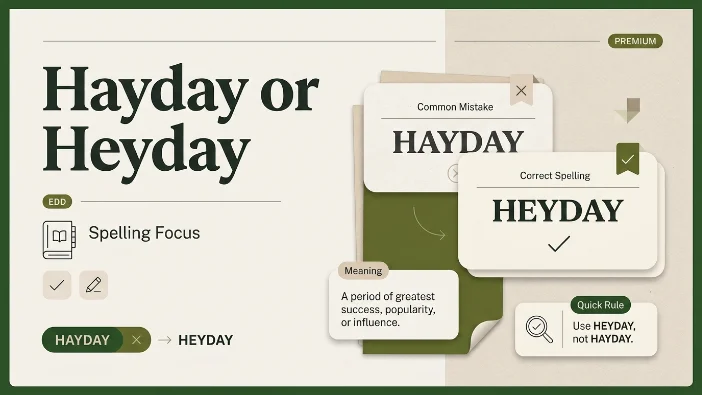
The correct word is “heyday” when referring to a period of greatest success, popularity, or vigor. “Hayday” is a common misspelling and is not recognized as a standard English word. The term originally referred to a time of high spirits or excitement, with its roots in expressions of joy and celebration rather than the harvested grass it resembles.
Have you ever found yourself staring at a sentence, wondering whether to write about someone’s “hayday” or “heyday”? You’re not alone. This confusion pops up frequently in writing, and it’s one of those spelling dilemmas that can quietly undermine your credibility.
The mix-up makes perfect sense when you think about it. Both words sound identical when spoken aloud, and our brains naturally reach for familiar patterns. Hay” is a word we all know that dried grass farmers harvest so “hayday” seems like it should be a real term. But here’s the thing: it’s not. The correct spelling is always “heyday.
Throughout this guide, we’ll explore why “heyday” is the only correct choice, trace its fascinating origins, and give you practical strategies to ensure you never make this mistake again. By the end, you’ll understand exactly why this misspelling happens and how to confidently use “heyday” in any context.
What’s the Difference Between “Hayday” and “Heyday”?
The difference couldn’t be more straightforward: “heyday” is the only correct spelling for describing a period of peak success or activity. “Hayday” is simply a misspelling that has no legitimate usage in standard English.
Let’s look at what each term means:
Heyday refers to the period when someone or something was at their most successful, popular, or vigorous. It’s the golden era, the prime time, the peak moment. Think of a musician’s most celebrated years, a company’s most profitable period, or even your own most energetic and productive phase.
Hayday has no recognized meaning in English dictionaries. It appears occasionally in informal writing as a misspelling, but reputable sources like Merriam-Webster, Oxford, and Cambridge do not list it as a valid word.
| Feature | Heyday | Hayday |
|---|---|---|
| Meaning | Period of greatest success, popularity, or vigor | No recognized meaning (misspelling) |
| Part of Speech | Noun | Not applicable |
| Refers To | Peak performance, golden era, prime time | Nothing in standard English |
| Typical Usage | “The 1990s were the heyday of grunge music.” | Incorrect usage |
| Example | “In her heyday, she was the fastest swimmer in the state.” | “In her hayday, she was the fastest swimmer in the state.” (Incorrect) |
The confusion likely stems from the word’s pronunciation and the visual similarity to “hay.” Since both words sound the same when spoken, writers often default to the spelling they assume makes sense “hay” being a common, concrete noun. However, “heyday” has etymological roots that have nothing to do with grass or farming.
Is This a Grammar, Vocabulary, or Usage Issue?
Understanding the nature of the “hayday vs heyday” confusion helps explain why so many people struggle with it. This is primarily a vocabulary and usage issue rather than a strict grammar problem.
Let’s break it down:
Grammar Classification: “Heyday” functions as a noun, typically a singular countable noun. You can say “the heyday,” “a heyday,” or “someone’s heyday.” It’s not a verb, adjective, or adverb. When people write “hayday,” they’re not making a grammatical error with tense or agreement they’re using a spelling that doesn’t correspond to any actual word.
Vocabulary Difference: This is where the issue lives. Heyday” is a legitimate vocabulary item with a specific meaning. “Hayday” doesn’t exist in the standard English vocabulary. Think of it like writing “definately” instead of “definitely” same pronunciation, but only one spelling is correct.
Usage Difference: The word is used consistently across all contexts. Whether you’re writing formal business reports, academic papers, or casual social media posts, “heyday” remains the same. There’s no “correct” context for “hayday” because it simply isn’t a word.
Are They Interchangeable? No. Only “heyday” is correct in every context. There is no situation where “hayday” would be acceptable in professional, academic, or standard writing.
Formal vs Informal English: “Heyday” works equally well in formal and informal contexts. You might read it in a biography, hear it in a podcast, or use it in conversation. The spelling doesn’t change based on register.
The Practical Takeaway: Always use “heyday” regardless of context. If you’re describing a time of peak performance or success, “heyday” is your only correct choice. There’s no informal exception or accepted variant that uses “hayday.”
Understanding “Heyday”
Meaning and Pronunciation
“Heyday” (pronounced HAY-day) refers to the period when someone or something is at their best, most successful, or most active. It’s the pinnacle of achievement, the zenith of influence, or the golden age of something or someone.
Part of Speech: Noun
Common Collocations:
- In one’s heyday
- The heyday of [something]
- During the heyday
- Past one’s heyday
- Romanticizing the heyday
- Relive one’s heyday
Typical Sentence Patterns:
- [Subject] + was/were in + possessive + heyday
- The + heyday + of + [noun] + was…
- During + the + heyday + of + [noun]…
Real-World Examples
Workplace Example:
“During his heyday as a project manager, Marcus could handle six major accounts simultaneously without breaking a sweat. Those years built his reputation across the entire industry.”
Academic Example:
“The heyday of the Egyptian Empire witnessed unprecedented advances in architecture, mathematics, and medicine that would influence civilizations for millennia.”
Technology Example:
“The heyday of desktop software is behind us now, as cloud-based applications and mobile-first solutions have completely transformed how we work.”
Email Example:
“Subject: Reflecting on Our First Decade
I still remember our heyday in the late 2000s, when every new product launch was an event. The energy in those meetings was electric, and the success we shared cemented our company’s reputation.”
Daily Conversation Example:
“You should have seen him in his heyday. He could play any song by ear, and his performances were absolutely legendary around these parts.”
One Common Learner Mistake
Many English learners assume “heyday” has something to do with hay or farming. They might write “My grandmother’s hayday was in the 1970s” because they’re thinking of a hay harvest as a time of abundance. This is an understandable association, but it’s completely incorrect. The word shares no etymological connection with hay or agriculture.
Mini Recap: “Heyday” is a noun meaning a peak period. It’s always singular, always takes standard noun positioning in sentences, and never changes based on context.
Understanding “Hayday” (The Misspelling)
Why Does This Misspelling Happen?
Hayday” isn’t a word you’ll find in any standard English dictionary. When you see this spelling, it’s always an error. But why does it happen so frequently?
The main reason is pronunciation. Both “heyday” and “hayday” sound exactly the same when spoken. Our brains hear the sound /ˈheɪdeɪ/ and automatically try to map it to familiar visual patterns. Since “hay” is a common, concrete word that children learn early think of hay bales and farmers it becomes the default spelling for some writers.
The error is more common among:
- Native speakers who learned the word orally before seeing it written
- Non-native speakers who rely on phonetic spelling
- Writers who are typing quickly and don’t proofread carefully
Is There Any Legitimate Usage?
None. Despite occasional appearances in informal contexts like personal blogs or social media comments, “hayday” has no recognized meaning, usage, or grammatical function in standard English. It’s what linguists call a “common misspelling,” similar to “alot” instead of “a lot” or “seperate” instead of “separate.
Why Understanding This Matters
If you’re writing for professional purposes, academic work, or any context where your language skills are evaluated, “hayday” will mark you as someone who either doesn’t know the correct spelling or hasn’t taken the time to verify it. Either impression can damage your credibility.
When NOT to Use Each Word
Understanding when to avoid “hayday” is straightforward it’s always wrong. But knowing when to use “heyday” requires some nuance. Let’s explore situations where writers commonly choose the wrong word.
Mistake 1: Describing Abundance or Plenty
The Situation: You’re describing a time when there was an abundance of something like plenty of food, resources, or opportunities.
The Error: You write “hayday” thinking it means a plentiful time.
Why It’s Wrong: “Heyday” isn’t about quantity; it’s about quality, success, and vigor.
The Fix: Use “heyday” only for peak periods of success or activity. For abundance, consider “golden age,” “peak,” “prime,” or simply describe the abundance directly.
Mistake 2: Referring to a Personal Life Stage
The Situation: You’re describing someone’s most productive or energetic years.
The Error: You write “hayday” because the person’s work reminded you of agricultural abundance.
Why It’s Wrong: The association with farming is a false etymology.
The Fix: Always use “heyday.” “In his heyday, he could work fourteen-hour days without exhaustion.”
Mistake 3: Describing a Specific Year
The Situation: You’re specifying a particular year or short period.
The Error: You write “The heyday of 2018” as if “heyday” refers to a year itself.
Why It’s Wrong: “Heyday” describes a qualitative period, not a specific calendar period.
The Fix: “Heyday” describes a period of quality. Write “The years 2018-2020 marked the heyday of the startup.”
Mistake 4: Discussing Geographic or Political Decline
The Situation: You’re writing about a city, country, or civilization’s former success.
The Error: You use “hayday” after the terms “fading,” “past,” or “long-gone.”
Why It’s Wrong: “Heyday” is the correct spelling here.
The Fix: Use “heyday” but note that it’s most naturally paired with “the heyday” rather than “a heyday.” “The empire’s heyday ended with the economic collapse.”
Mistake 5: Comparing Old and New Versions
The Situation: You’re comparing something’s past and present performance.
The Error: You write “The hayday is over.”
Why It’s Wrong: “Heyday” is the correct spelling.
The Fix: Always use “heyday.” “The company’s heyday is over, but the leadership remains ambitious.”
Mistake 6: Casual Writing
The Situation: You think spelling doesn’t matter in informal contexts.
The Error: You use “hayday” in a text message or social media post.
Why It’s Wrong: Even in informal writing, spelling errors undermine clarity and professionalism.
The Fix: Use “heyday” everywhere. Consistency builds good habits.
| Correct Sentence | Incorrect Sentence | Explanation |
|---|---|---|
| “The Beatles’ heyday was the 1960s.” | “The Beatles’ hayday was the 1960s.” | Heyday” is the only correct spelling. |
| “In her heyday, she performed in every major opera house.” | “In her hayday, she performed in every major opera house.” | The spelling “hayday” is not recognized in standard English. |
| “The company’s heyday saw unprecedented growth.” | “The company’s hayday saw unprecedented growth.” | Always use “heyday” for periods of peak success. |
| “During the heyday of jazz, musicians experimented freely.” | “During the hayday of jazz, musicians experimented freely.” | “Heyday” is the standard spelling in formal writing. |
| “He’s past his heyday, but still quite capable.” | “He’s past his hayday, but still quite capable.” | Only “heyday” is acceptable in any context. |
| “The heyday of silent films ended with the 1920s.” | “The hayday of silent films ended with the 1920s.” | “Heyday” is the correct spelling recognized by dictionaries. |
The Decision Box
If you’re ever unsure, follow this simple rule:
- If you’re describing a peak period of success, popularity, or energy → use “heyday.”
- If you’re considering any other spelling → don’t. “Hayday” is never correct.
Think of it this way: “hey” is an old expression of excitement or joy. Heyday” literally means “the day of excitement.” No hay involved.
Real-World Examples
Office Communication
“Sarah’s team was truly innovative during the company’s heyday. I’ve read the reports from that period, and they were launching new products faster than any competitor.”
Business Email
“Dear Team,
I’ve been reflecting on our early years the heyday of our startup culture, when every idea felt revolutionary. I want to capture that energy again with our upcoming projects.”
School or University
“Students who want to understand modern computing need to understand the heyday of IBM, when mainframes dominated and computer science was still finding its identity.”
Customer Support
“Thank you for your patience. We’re aware this isn’t our company’s heyday in terms of response times, but we’re working to return to our standard of excellence.”
Technology
“The heyday of personal computing saw the rise of Microsoft and Apple, two companies that would define how billions of people interact with technology.”
Artificial Intelligence
“We’re arguably entering the heyday of AI research, with breakthroughs happening weekly and applications emerging faster than governance frameworks can adapt.”
Daily Conversation
“You should have seen my grandmother in the kitchen during her heyday. She could prepare a full holiday dinner for twenty people in under four hours, everything from scratch.”
“Heyday” in Modern Technology
While “heyday” might seem like an old-fashioned term, it has found fresh relevance in technology discussions.
Artificial Intelligence and Virtual Assistants
Technology journalists often describe the current period as “the heyday of AI innovation.” The term captures the excitement, rapid progress, and transformative potential of artificial intelligence. It appears in countless articles discussing:
- The heyday of machine learning breakthroughs
- The heyday of generative AI tools
- The heyday of voice recognition systems
Business Tools
Project management software reviews frequently reference “the heyday of remote work” or “the heyday of productivity tools” when discussing how work has evolved in the digital age.
Startups
Founder interviews often include the phrase “in our heyday” when referring to their most successful funding rounds or product launches.
Important Note: Some writers mistakenly think “hayday” is used in tech contexts because “hay” suggests something natural or agricultural. This is incorrect. “Heyday” is the only correct spelling.
Word Origin and History
Understanding the etymology of “heyday” helps explain why it has nothing to do with hay.
The word first appeared in English in the 16th century, originally spelled “heyda” or “heyday.” It comes from the Old English greeting “hey,” which was an exclamation of joy or excitement, combined with “day.” Essentially, it meant “a day of high spirits.”
The Evolution:
- Original Meaning (1500s-1600s): Excitement, high spirits, or jubilation. Someone “in his heyday” was in a state of joyful excitement.
- Shift in Meaning (1600s-1700s): The word gradually came to mean the peak or prime of someone’s life or career, still carrying connotations of energy and vitality.
- Modern Meaning: Today, “heyday” refers specifically to the period of greatest success, popularity, or vigor.
The False Etymology:
Many people assume “heyday” is related to “hay” because both sound similar and hay is associated with abundance and harvest a productive time. This is a classic example of what linguists call “folk etymology” or “false etymology.” The word sounds like it should mean something, so people invent a meaning that fits.
But the evidence is clear:
- The Old English root has nothing to do with hay
- The spelling has been consistently “hey-” since at least the 1500s
- Dictionaries from Samuel Johnson’s time to today confirm this
Expert Insight
The confusion between “hayday” and “heyday” is a perfect example of how our brains process language phonetically. When we learn a word by hearing it before seeing it written, we construct the spelling based on what makes sense to us. Since “hay” is a common word, it’s an easy but incorrect match.
Here’s what I tell my students: think of “heyday” as a shout of celebration. Imagine someone in their prime exclaiming “Hey! What a day!” This reinforces that the word starts with “hey,” not “hay.” You wouldn’t write “hay” when you’re shouting hello, and you shouldn’t write it when describing someone’s peak years either.
The beauty of “heyday” is that it captures exactly what it means a day worth shouting about. It’s not about harvested grass; it’s about a period worth celebrating. When you remember that, you’ll never make the mistake again.
Error Prevention Checklist
Always use “heyday” when…
- You’re referring to a period of peak success or popularity
- You’re describing someone’s prime years
- You’re discussing a golden era in any field
Never use “hayday” because…
- It doesn’t appear in any standard English dictionary
- It’s always a misspelling
- It has no legitimate meaning
Remember the difference with these tips:
- “Hey” is a greeting think of celebrating a peak period
- “Hay” is dried grass nothing to do with success
- If it’s a prime period, use “heyday”
Quick memory trick: “They had a HEYday” → The word starts with “HEY” like a celebration.
Related Grammar Confusions
Understanding “heyday” clarifies how related vocabulary issues work.
- “Reign” vs “Rein” : Reign is royal rule; rein is the strap for controlling a horse both sound identical, like “heyday.
- “Peak” vs “Peek” vs “Pique” : Peak is the highest point, peek is a quick look, and pique is to stimulate interest. A common confusion parallel to “heyday.
- “Historic” vs “Historical” : Historic means significant; historical means related to history. Subtle but important for clear writing.
- “Affect” vs “Effect” : Affect is usually a verb; effect is usually a noun. This distinction is crucial for professional writing.
- “Complement” vs “Compliment” : Complement means to complete; compliment means to praise. Both are frequently misspelled.
- “Principal” vs “Principle” : Principal means main or a school leader; principle means a fundamental rule.
- “Stationary” vs “Stationery” : Stationary means still; stationery means writing supplies.
- “Discrete” vs “Discreet” : Discrete means separate; discreet means careful or unobtrusive.
FAQs
Is “hayday” ever acceptable in informal writing?
No. “Hayday” is not a standard English spelling, even in casual writing. The correct form is “heyday.” While spelling mistakes are common in texts and social media posts, using the standard spelling helps keep your writing clear and consistent.
Why do so many people spell it “hayday”?
The confusion mainly comes from pronunciation. “Heyday” is pronounced /ˈheɪdeɪ/, so the first syllable sounds exactly like the familiar word hay. That can make hayday seem logical, especially to people who have heard the word more often than they have seen it written.
Is “heyday” used in both British and American English?
Yes. “Heyday” is the standard spelling in both British and American English. Its meaning and pronunciation are also essentially the same across these varieties. Hayday is not a recognized regional alternative.
Can “heyday” be used as a verb or adjective?
No. “Heyday” is primarily a noun. It refers to a period when someone or something was at its most successful, popular, or influential. For example, you might say, “The band was at its heyday in the 1990s.” You would not normally use heyday as a verb or adjective.
What is the plural of “heyday”?
The plural form is “heydays,” although it is uncommon. Since heyday usually describes one particular period of peak success, the singular form appears much more often. The plural may be used when comparing several different periods of peak popularity or success.
What are some synonyms for “heyday”?
Depending on the context, useful alternatives include prime, peak, golden age, zenith, and flower. For example, “during the company’s heyday” could become “during the company’s golden age” or “at the company’s peak.” The best choice depends on whether you want to emphasize success, popularity, influence, or a particular historical period.
Conclusion
The question of “hayday or heyday” has a clear answer: “heyday” is always correct, and “hayday” is always incorrect. It’s one of those vocabulary distinctions that seems simple once you know it, but the confusion is understandable given how the word sounds and how our brains process language.
Remember: “heyday” comes from an old expression of excitement and joy, not from hay or farming. It refers to the peak period of success, popularity, or vigor in someone’s life or in something’s existence. Think of it as the “hey” of someone’s life the time worth celebrating.
The next time you’re writing about a golden era, a peak period, or someone’s prime years, you can confidently use “heyday.” And if you see “hayday” in someone else’s writing, you can kindly share that the correct spelling is “heyday.”
Language accuracy matters, not just for spelling but for clear communication and professional credibility. Now you have the knowledge to get this one right every time.