Quick Answer
“I’m rooting for you” is a warm, informal way of telling someone you support them and want them to succeed. If you’re looking for a fresher way to say it, some of the best alternatives are “I’m behind you all the way,” “sending you good vibes,” “I believe in you,” “you’ve got my full support,” and “I’m cheering you on.”
Looking for different ways to say you’re rooting for someone? Whether you’re supporting a friend, encouraging a coworker, or cheering someone on through an important goal, the right words can make your message feel more genuine and meaningful.
There are many ways to express encouragement without repeating the same phrase. In this guide, you’ll find 30+ ways to say you’re rooting for someone, with options ranging from warm and heartfelt to casual and professional.
Why People Search for Other Ways to Say You’re Rooting for Someone
Most people don’t go looking for alternatives to “I’m rooting for you” because they dislike the phrase. They search for it because they’ve said it so many times that it’s starting to feel automatic, and automatic words don’t land the same way when someone needs real encouragement.
Think about it. A friend texts you before a big interview, a sibling is about to run a marathon, a colleague is presenting to the board for the first time. “Good luck” and “rooting for you” are fine, but they’re also the first thing everyone types. When you want your support to actually feel personal, you reach for something with a bit more texture.
There’s also a formal versus casual gap that trips people up. “I’m rooting for you” works great in a text to a friend. It sounds a little too casual in an email to a client or a LinkedIn comment on a coworker’s promotion. So the search intent behind “other ways to say you’re rooting for someone” usually splits into two camps: people wanting more emotional, personal phrases for close relationships, and people wanting more professional English phrases for workplace or written communication.
Spoken English also tends to be shorter and punchier (“go get ’em,” “you’ve got this”), while written English, especially in emails, leans toward fuller sentences (“I have every confidence you’ll do well”). Knowing which lane you’re in makes a huge difference in how natural your message sounds.
The Tone Ladder System
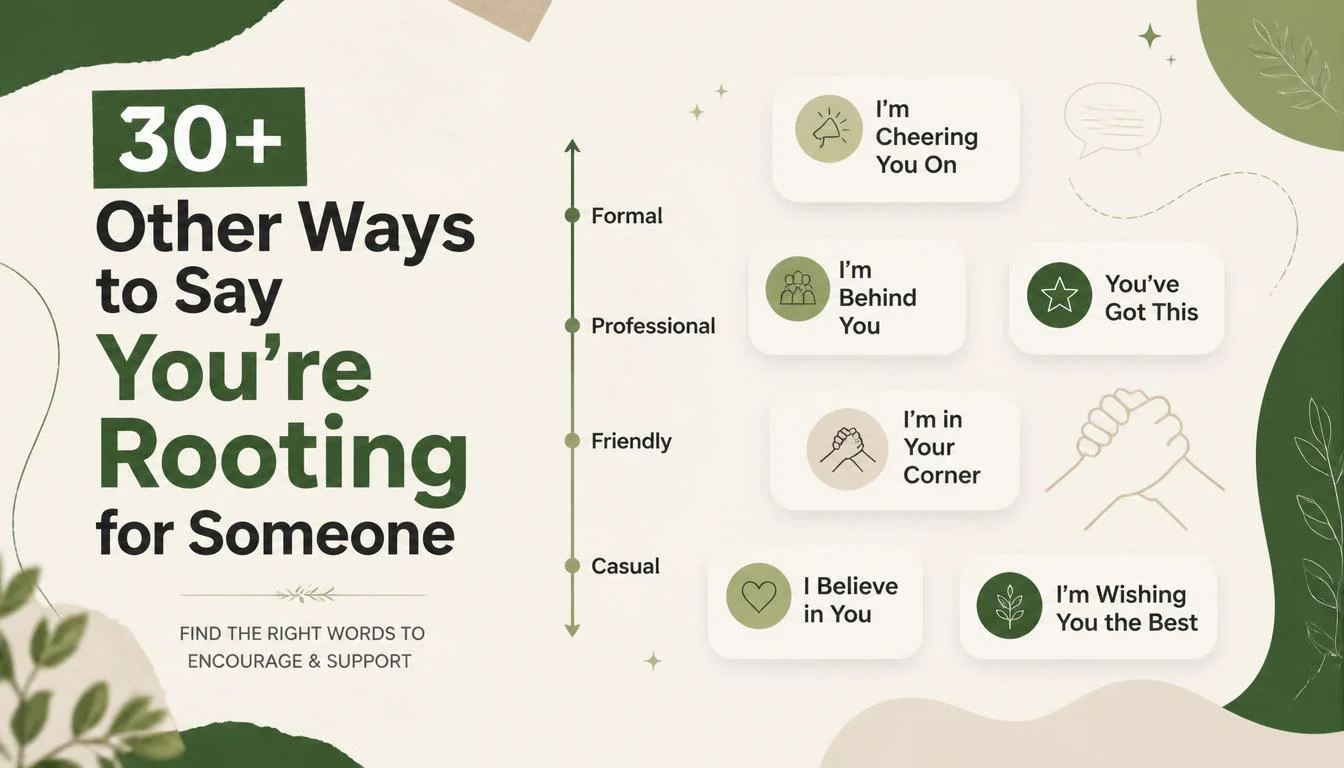
Not every phrase for showing support belongs in the same conversation. A phrase that sounds sincere in a text to your best friend can sound oddly casual in a message to your boss. That’s why it helps to think of these expressions on a ladder, from very formal to very informal.
At the top, very formal phrases show up in official emails, reference letters, or communication with senior leadership. Formal phrases still sound professional but are a little warmer, good for coworkers or clients you know reasonably well. Neutral phrases sit in the middle and work almost anywhere, which makes them the safest default when you’re unsure. Casual phrases are for friends, family, and people you’re comfortable with. Informal phrases are the most relaxed, often used in texting or between close friends who share the same sense of humor.
As a general rule, formal and neutral phrases read better in writing, while casual and informal phrases sound more natural out loud. Saying “I have full confidence in your abilities” out loud to a friend would feel stiff, just like texting your college roommate “warmest regards on your upcoming presentation” would be strange (unless you’re joking).
Tone Classification Table
| Phrase | Tone Level | Formality | Best Situation |
|---|---|---|---|
| I have every confidence in you | Very Formal | High | Reference letters, formal emails |
| Wishing you continued success | Formal | High | Client emails, LinkedIn messages |
| You have my full support | Formal | Medium-High | Workplace conversations |
| I’m in your corner | Neutral | Medium | Friends, coworkers, mentors |
| Sending positive thoughts your way | Neutral | Medium | Texts, cards, casual emails |
| I’m cheering you on | Casual | Low-Medium | Friends, family, social media |
| You’ve got this | Casual | Low | Texts, quick check-ins |
| Go get ’em | Informal | Very Low | Close friends, spoken English |
Quick Selection Guide
If you’re in an interview and want to encourage a friend before theirs, “I have every confidence you’ll do great” hits the right note of sincerity without sounding forced.
For a professional email, “wishing you continued success” or “you have my full support on this” strike the right balance of warmth and polish.
At a networking event, something like “I’m genuinely rooting for what you’re building” sounds natural and memorable without crossing into overly personal territory.
In a casual conversation with a friend, you really can’t go wrong with “you’ve got this” or “I’m cheering you on from the sidelines.”
Real-Life Conversation Transformations
Job Interview Scenario
Before: “Good luck, I’m rooting for you.” After: “You’ve prepared for this more than anyone I know, and I have zero doubt you’re going to walk in there and own it.”
The upgraded version doesn’t just repeat a phrase, it adds specific encouragement that shows you actually believe what you’re saying.
Networking Event Scenario
Before: “Rooting for you with the new business.” After: “What you’re building sounds genuinely exciting, and I’d love to see how it grows. Count me as someone in your corner.”
This version sounds like a real conversation instead of a generic sign-off, which matters a lot in professional settings where first impressions stick.
Email Scenario
Before: “Just wanted to say I’m rooting for you on the promotion.” After: “I wanted to reach out and say how much I’m looking forward to seeing you succeed in this next chapter. You’ve more than earned it.”
Email tends to reward slightly longer, more complete sentences, since there’s no tone of voice to soften a short phrase.
Casual Conversation Scenario
Before: “Rooting for you, man.” After: “Dude, you’re gonna crush this. I’m hyped for you.”
Spoken, informal English often trades full sentences for short bursts of energy, which feels more natural between close friends.
30+ Other Ways to Say You’re Rooting for Someone
I’m behind you all the way
This phrase communicates unwavering support, almost like backup in a fight. Example: “Whatever decision you make, I’m behind you all the way.” Tone: casual to neutral. Best used with friends or family facing a tough choice. It can sound slightly dramatic in a professional email, so save it for personal conversations.
I believe in you
A simple, sincere phrase that works almost anywhere. Example: “I believe in you, and I know this project is going to turn out great.” Tone: neutral. It works well spoken or written, though it can feel a little bare without more context in a formal setting.
You have my full support
A professional-sounding phrase perfect for workplace communication. Example: “You have my full support as you take on this new role.” Tone: formal. Ideal for emails and meetings, less natural in casual texting where it can feel stiff.
Sending you good vibes
A relaxed, modern way to wish someone well. Example: “Sending you good vibes for tomorrow’s big pitch.” Tone: casual. Great for texts and social media, but too informal for client-facing emails.
I’m cheering you on from the sidelines
A visual, friendly phrase that suggests active support. Example: “I’ll be cheering you on from the sidelines during the race.” Tone: neutral to casual. Works in both writing and speech, especially for athletic or competitive events.
You’ve got this
Short, punchy, and universally understood. Example: “You’ve got this, don’t overthink it.” Tone: casual. Best spoken aloud or in quick texts, slightly too casual for formal writing.
I have every confidence in you
A polished, formal alternative that reads well in professional writing. Example: “I have every confidence in you as you step into this leadership role.” Tone: very formal. Excellent for reference letters, awkward if said casually among friends.
Wishing you continued success
A safe, polite phrase common in business communication. Example: “Wishing you continued success in your new position.” Tone: formal. Common on LinkedIn and in farewell emails.
I’m in your corner
Borrowed from boxing, this phrase suggests loyal support through a challenge. Example: “No matter what happens, I’m in your corner.” Tone: neutral. Works well in both spoken and written English, especially during hard times.
Go get ’em
An energetic, informal push before something big. Example: “Go get ’em, you’ve earned this.” Tone: informal. Great for close friends right before an event, too casual for professional use.
I’m pulling for you
A slightly old-fashioned but still natural phrase. Example: “Everyone here is pulling for you.” Tone: neutral. Common in spoken English across age groups, less common in formal writing.
You have what it takes
Focuses on ability rather than luck. Example: “You have what it takes to make this work.” Tone: neutral to formal. Works nicely in encouragement emails or pep talks.
I know you’ll knock it out of the park
A vivid, confident phrase borrowed from baseball. Example: “I know you’ll knock it out of the park tomorrow.” Tone: casual. Fun for texts, a bit too playful for formal settings.
My thoughts are with you
Softer and more reflective, often used for stressful situations. Example: “My thoughts are with you during this busy week.” Tone: formal to neutral. Common in professional and personal messages alike.
I’m hoping for the best for you
A gentle, sincere phrase without excessive energy. Example: “I’m hoping for the best for you as you make this transition.” Tone: neutral. Suitable for both writing and speech.
You’re going to do amazing
Direct and confident, good for quick encouragement. Example: “You’re going to do amazing up there.” Tone: casual. Best spoken right before an event.
I’ve got your back
Suggests loyalty and practical support, not just good wishes. Example: “Whatever you decide, I’ve got your back.” Tone: casual to neutral. Common between friends, coworkers, and even in professional but friendly workplaces.
Sending positive energy your way
A softer, more modern version of “good luck.” Example: “Sending positive energy your way for the exam.” Tone: neutral. Works well in texts and casual emails.
I’m confident you’ll pull it off
A vote of confidence with a slightly formal tone. Example: “I’m confident you’ll pull it off without a hitch.” Tone: neutral to formal. Suitable for workplace check-ins.
Break a leg
A classic idiom, especially before performances. Example: “Break a leg out there tonight.” Tone: casual. Best for theater, presentations, or performances, less fitting for job interviews.
I’m in your camp
Suggests loyalty and alignment, often used in competitive or debate-style situations. Example: “Whatever side you choose, I’m in your camp.” Tone: casual to neutral.
Best of luck, though I doubt you’ll need it
Adds warmth and confidence to a traditional phrase. Example: “Best of luck, though I doubt you’ll need it.” Tone: neutral. Works in both spoken and written contexts.
I’ll be thinking of you
Simple and sincere, good for emotionally significant events. Example: “I’ll be thinking of you during the surgery.” Tone: formal to neutral. Appropriate for serious or sensitive situations.
You’re going to smash it
A casual British-leaning phrase that’s become widely used. Example: “You’re going to smash it today.” Tone: informal. Best for texting and spoken English among friends.
I’m right there with you in spirit
Suggests emotional closeness even from a distance. Example: “I can’t be there in person, but I’m right there with you in spirit.” Tone: neutral to formal. Works nicely in cards or heartfelt messages.
Usage Comparison Table
| Phrase | Spoken Use | Written Use | Context |
|---|---|---|---|
| You’ve got this | High | Low | Texts, casual pep talks |
| I have every confidence in you | Low | High | Formal emails, letters |
| I’m in your corner | High | High | Friends, coworkers, mentors |
| Go get ’em | High | Low | Spoken, close friends |
| Wishing you continued success | Low | High | LinkedIn, business emails |
| I’ve got your back | High | Medium | Friends, casual workplace |
| Sending positive energy your way | Medium | High | Texts, cards, social posts |
Email and LinkedIn Ready Expressions
Email Greetings and Openers
“I wanted to reach out before your big day” or “As you prepare for this next step” both set a warm, professional tone before you offer support.
Professional Introductions
When encouraging someone you don’t know closely, try “I’ve heard great things about your work, and I’m genuinely rooting for your continued success.”
LinkedIn Connection Messages
Keep it short and specific: “Congratulations on the new role, I have no doubt you’ll do wonderfully” reads naturally and doesn’t feel like a copy-paste template.
Follow Up Lines
After an interview or big event, a simple “Thinking of you today, I hope it went exactly as you hoped” works well as a follow-up text or email.
Native Speaker Insight
Native English speakers rarely repeat the exact same phrase twice in one conversation. If someone says “good luck” early in a chat, they’ll usually switch to something like “you’ve got this” or “I’m sure you’ll be great” later on, almost instinctively avoiding repetition.
Shortened spoken versions are common too. “Rooting for ya” or “go get ’em” show up far more in speech than in writing, while fuller phrases like “I have every confidence in you” almost never get said out loud in casual settings because they sound overly formal when spoken.
What tends to sound unnatural is over-formal language used in casual settings, like saying “I extend my heartfelt support” to a friend over text. Native speakers gravitate toward phrases that match the emotional weight of the situation rather than defaulting to the most polished-sounding option.
Common Mistakes and What Not to Say
One common mistake is mixing tone levels, such as saying “I extend my warmest wishes” in a casual group chat, which can come across as sarcastic or oddly distant.
Another mistake is over-formal phrasing directed at close friends. Phrases like “please accept my sincere well-wishes” sound like they belong in a business letter, not a text to your best friend.
Grammar issues also creep in when people try to sound more sophisticated than necessary, such as saying “I am rooting for you’re success,” mixing up “you’re” and “your.”
Lastly, some phrases simply don’t fit certain situations. Saying “break a leg” before a job interview, for instance, doesn’t quite make sense outside of a performance context, and can confuse the listener.
Expansion Phrases
Beyond direct alternatives, there are related expressions that pair naturally with encouragement. Greetings like “hope this finds you well” or “hope you’re doing okay ahead of the big day” set the stage nicely. Introduction phrases such as “I wanted to check in before your presentation” show thoughtfulness. Polite communication alternatives like “please know I’m thinking of you” add warmth without being overly casual, and conversational upgrades like “seriously, you’ve prepared so well for this” make encouragement feel personal rather than generic.
Decision Making Table
| Situation | Best Phrase | Why It Works |
|---|---|---|
| Job interview | I have every confidence you’ll do great | Sounds sincere and professional |
| Wedding or personal milestone | I’ll be thinking of you | Warm without being overly casual |
| Sports event | Go get ’em | Matches the energy of the moment |
| Work presentation | You have my full support | Professional and encouraging |
| Casual hangout before an event | You’ve got this | Short, natural, and friendly |
Quick Fast List
Here are ten reliable alternatives you can use right away:
- I’m behind you all the way
- I believe in you
- You have my full support
- I’m cheering you on
- I’ve got your back
- Sending positive energy your way
- I have every confidence in you
- Wishing you continued success
- You’re going to do amazing
- I’m in your corner
Mini Quiz
1. Which phrase is best suited for a formal email to a client?
A) Go get ’em
B) I have every confidence in you
C) You’ve got this
Answer: B – It matches the professional tone of written business communication.
2. Which phrase would sound most natural said out loud to a close friend?
A) I extend my heartfelt support
B) Go get ’em
C) Wishing you continued success
Answer: B – Informal spoken phrases fit casual relationships best.
3. What’s a common mistake people make with encouragement phrases?
A) Using the same tone throughout a conversation
B) Mixing formal phrases into casual conversations
C) Using short sentences
Answer: B – Mismatched tone is one of the most common issues.
4. Which phrase fits best before a theater performance?
A) You have my full support
B) Break a leg
C) I’m in your camp
Answer: B – It’s a traditional idiom specifically associated with performances.
5. Which phrase works well on LinkedIn?
A) Go get ’em
B) Rooting for ya
C) Wishing you continued success
Answer: C – It maintains a professional tone suited to LinkedIn messaging.
FAQs
Is it polite to say “I’m rooting for you” in a professional setting?
It’s generally fine among coworkers you know well, but slightly more formal alternatives like “I have full confidence in you” tend to read better in official emails.
What is more professional than “good luck”?
Phrases like “wishing you continued success” or “I have every confidence in you” sound more polished in professional writing.
Can I use casual phrases like “you’ve got this” in an email?
Yes, but only with people you already have a friendly, informal relationship with. For clients or senior leadership, lean toward neutral or formal phrases instead.
What do native speakers say instead of “I’m rooting for you”?
Native speakers often switch between phrases like “I’m in your corner,” “go get ’em,” or “I’ve got your back,” depending on how casual the relationship is.
What is the best alternative for a job interview message?
“I have every confidence you’ll do great” strikes a nice balance between warmth and professionalism.
Conclusion
Encouraging someone doesn’t have to rely on the same handful of tired phrases. Whether you’re writing a formal email, sending a quick text, or cheering on a friend in person, matching your tone to the situation makes your support feel genuine rather than automatic.
The next time someone in your life needs a boost, try reaching for one of these alternatives instead of the default. A small shift in wording can make your encouragement land with a lot more warmth, and with practice, choosing the right tone will start to feel completely natural.
Read More Related Articles:
- 35+ Other Ways to Say Happy Thursday | Make Your Greetings More Engaging In 2026
- 35+ Other Ways to Say “Nice to Meet You” | Formal to Casual In 2026
- 35+ Other Ways to Say “Did You Sleep Well” | For Better Communication In 2026

Lucas Mitchell is a content writer at synoseek.com. He writes simple, thoughtful pieces that focus on everyday ideas, observations and general knowledge topics. His work is shaped by a calm, realistic tone that keeps the reader engaged without overstatement.
10 thoughts on “30+ Other Ways to Say You’re Rooting for Someone | Make Your Support Stand Out In 2026”