Quick Answer
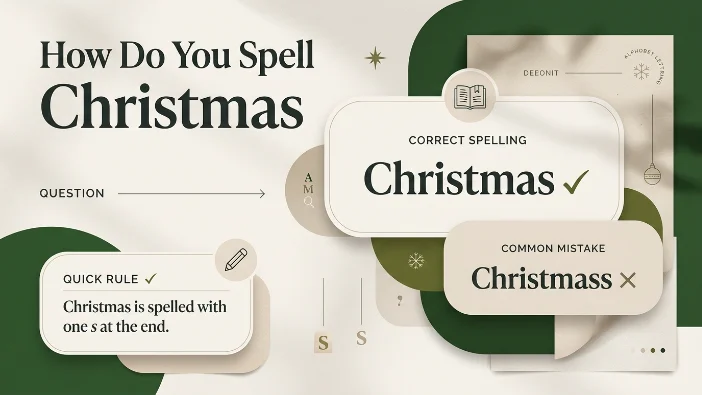
The correct spelling is Christmas (C-H-R-I-S-T-M-A-S). It is a proper noun, always capitalized, and refers to the annual Christian festival celebrating the birth of Jesus Christ on December 25th. A common, informal abbreviation is “Xmas,” which uses the Greek letter Chi (X) to represent “Christ.”
It’s a word we see everywhere during the holiday season, yet many people pause to ask themselves: how do you spell Christmas? You might stumble when writing a greeting card, an email to a client, or even a social media post. The confusion is understandable. The word features a silent “t,” an unusual “ch” sound that’s pronounced like a “k,” and only one “s” at the end, which often trips people up because the word “mass” is spelled with a double “s.”
Getting the spelling right is crucial. It’s a matter of professionalism and respect. Misspelling “Christmas” in a business communication can make you look careless, and in academic or formal writing, it’s simply incorrect. This guide will not only answer the question of how to spell Christmas but will also explain the most common mistakes, the history behind the word, and the difference between “Christmas” and the abbreviation “Xmas,” ensuring you never make a spelling error again.
What’s the Difference Between “Christmas” and “Xmas”?
The primary difference between “Christmas” and “Xmas” is one of formality and usage, not meaning. They refer to the exact same holiday. Christmas” is the formal, traditional, and universally accepted spelling of the word. “Xmas” is a common, informal abbreviation that has been in use for centuries.
The core of the confusion for many people isn’t about meaning but about the origin of the “X.” Many people see “Xmas” as a secular attempt to remove “Christ” from Christmas. This is a popular misconception, but historically, it’s not accurate.
Let’s break down the difference:
In short, the difference isn’t a matter of correctness. Both are correct. The difference is appropriateness. You would use “Christmas” in a formal business proposal, but you might use “Xmas” in a festive social media post.
Is It a Grammar, Vocabulary, or Usage Issue?
The question of how do you spell Christmas is primarily a spelling and usage issue. The word itself is not a complex grammatical structure, and the vocabulary is straightforward; it’s simply the name of a holiday.
The issue arises from two main areas:
- spelling (Usage): The spelling is counterintuitive to how it sounds. The “ch” pronounced as a /k/ and the silent “t” in “Christ” make it a common stumbling block.
- Usage: The choice between “Christmas” and “Xmas” is a matter of formal vs. informal usage.
To be clear, “Christmas” is not an interchangeable word with any other English vocabulary word. It is a proper noun with a fixed spelling. The only real debate is whether to use its full, formal spelling or its informal abbreviation. As a general rule, for formal writing, always use “Christmas.”
Individual Word Guide: Christmas
Meaning
Christmas is the annual Christian festival celebrating the birth of Jesus Christ, observed primarily on December 25th.
Pronunciation
/krɪs-məs/
- Christ is pronounced with a long “i” sound and a silent “t” (/kraɪst/).
- Christmas, however, is pronounced with a short “i” sound (/krɪs/), as in “crisp,” and the “t” is completely silent.
Part of Speech
Proper Noun. It must always be capitalized.
Common Collocations
Typical Sentence Patterns
- Subject + Verb: “Christmas falls on a Tuesday this year.”
- Verb + Object: “We celebrate Christmas with our family.”
- Wish + Someone + Something: “I wish you a very merry Christmas.”
Real-World Examples
- Workplace Email: “Please note that our office will be closed on Christmas Day.”
- Academic Example: “In many Western cultures, Christmas is a time for both religious observance and family gatherings.”
- Daily Conversation: “Are you going home for Christmas this year?”
One Learner Mistake
Mistake: “I love Cristmas.” or “The tree looks beautiful at Christmass.”
Correction: “I love Christmas.” and “The tree looks beautiful at Christmas.”
Why: Remember there is only one “s” at the end. The “t” in “Christ” is silent, but it is not dropped.
Mini Recap
Remember, “Christmas” is a proper noun. Always capitalize it, spell it with a “Christ” at the beginning, and only use one “s” at the end.
When Not to Use “Xmas”
While “Xmas” is a legitimate abbreviation, there are several situations where it is best to avoid it entirely.
- Formal Business Writing: Never use “Xmas” in formal business letters, proposals, or official company communications. It is considered too casual.
- Academic and Scholarly Work: Unless you are specifically discussing the history of the term, use “Christmas” in essays, research papers, and other scholarly work.
- Religious Contexts: If writing to a religious audience or discussing the spiritual significance of the holiday, using the full “Christmas” is more respectful and appropriate.
- When You Are Unsure: If you don’t know the preference of your audience, it is always safer to use “Christmas.” It is the universally accepted standard.
- Journalism: The Associated Press (AP) style guide specifically advises against using “Xmas.” Many other professional style guides have the same rule.
- When Trying to Be Formal: In any context where a professional tone is expected, spelling out the full word is the correct choice.
Common Mistakes Table
| Correct Sentence | Incorrect Sentence | Explanation |
|---|---|---|
| We are celebrating Christmas on the 25th. | We are celebrating Christmass on the 25th. | “Christmas” is spelled with only one “s” at the end. The word “mass” is misspelled here. |
| The Christmas tree is beautiful. | The Christmass tree is beautiful. | The “-mas” in Christmas comes from the Old English word for mass and is spelled with one “s. |
| I hope you have a wonderful Christmas. | I hope you have a wonderful Cristmas. | The “h” in “Christ” must be included. It is a silent letter, but it is essential for the correct spelling. |
| Wish you a Merry Christmas. | Wish you a Merry Xmas. | Both are technically correct, but “Xmas” is informal. “Christmas” is the formal spelling. |
| The holiday is called Christmas. | The holiday is called X-mas. | While “Xmas” is correct, it is never hyphenated as “X-mas.” The hyphen is not standard. |
Quick Decision Box
- If you are unsure which version to use, follow this simple rule:
- If you are writing for a formal, academic, or business purpose, always use “Christmas.”
- If you are writing a casual text message, a quick social media post, or a festive sign, “Xmas” is perfectly acceptable.
Real-World Examples
- Office Communication: “All employees are invited to the annual Christmas party on December 20th.”
- Business Email: “We would like to wish all our clients a very happy Christmas and a prosperous New Year.”
- School/University: “The history class is doing a project on how Christmas was celebrated in Victorian England.”
- Customer Support: “Our customer service team will be available with reduced hours on Christmas Eve.”
- Daily Conversation: “What did you get for Christmas?”
Modern Technology
In the digital age, both “Christmas” and “Xmas” are used frequently. Search engines like Google recognize both terms. Many people use “Xmas” in text messages and on social media to save characters. Virtual assistants like Alexa or Siri will understand the abbreviation.
However, when it comes to email subject lines, website content, or professional communication, “Christmas” is still the superior choice for clarity and professionalism.
Word Origin
The etymology of “Christmas” is a fascinating blend of languages. The word comes from the Old English Cristes mæsse, meaning “Mass of Christ.” The “-mas” part is derived from the Latin missa, meaning “to send (away),” from the concluding formula in the Latin Mass.
The abbreviation “Xmas” has equally ancient roots. It is not a modern secular invention. The “X” is actually the Greek letter “Chi” (Χ), the first letter of the Greek word for Christ, Χριστός (Christos). This abbreviation has been used by Christians for over a thousand years, with examples appearing in texts as early as the Anglo-Saxon era.
Expert Insight
The word “Christmas” often looks more complicated on paper than it sounds in practice. The spelling makes much more sense when you understand it’s a blend of “Christ” and the Old English word for a church service. This is where the spelling with “Christ” comes from, even though the pronunciation of the “i” changes. For learners, remembering this compound word origin is the key to locking the spelling in memory. The “t” in “Christ” is silent, and the “mas” is one word, not “mass.” So, the correct spelling is always C-H-R-I-S-T-M-A-S. Think of it as Christ’s Mass.
Error Prevention Checklist
- Always capitalize “Christmas” because it is a proper noun.
- Always include the “h” after the “c.” It is a “Chr” sound, not “Cr.”
- Always remember the “t” is in the spelling, even though it’s silent.
- Always spell the “-mas” part with only one “s.”
- Never use “Xmas” in formal, professional, or academic writing.
Related Grammar Confusions
- ‘Your’ vs. ‘You’re’ – A classic grammar mistake to master.
- ‘Its’ vs. ‘It’s’ – An essential rule for possession vs. contraction.
- ‘Effect’ vs. ‘Affect’ – A common vocabulary misstep that changes meaning.
- ‘Capital’ vs. ‘Capitol’ – A spelling difference that can confuse anyone.
- ‘Then’ vs. ‘Than’ – A frequent error in comparison writing.
- ‘Who’s’ vs. ‘Whose’ – Another common contraction vs. possessive issue.
- ‘Principal’ vs. ‘Principle’ – A tricky pair of homophones.
- ‘Stationary’ vs. ‘Stationery’ – A spelling rule that many adults forget.
FAQs
Is “Xmas” a disrespectful way to spell Christmas?
Not historically. The idea that the “X” removes or crosses out Christ is a common misconception. The letter comes from the Greek letter Chi, which has been used as an abbreviation for “Christ” for centuries. Even so, Christmas is the better choice for formal or professional writing.
Should I capitalize “Christmas” in a sentence?
Yes. Christmas is a proper noun, so it should always begin with a capital letter. Xmas is also normally capitalized when it is used as a shortened form of the word.
Why is the “t” in Christmas silent?
The t is generally not pronounced in modern English because the sound was gradually reduced in everyday speech. This type of sound loss is known as elision and occurs in several English words where written letters are no longer clearly pronounced.
Is it always wrong to use “Xmas” in a business email?
Not necessarily, but Christmas is usually the safer choice in professional communication. “Xmas” can sound casual or abbreviated, whereas “Christmas” is more polished and appropriate for formal messages, greetings, and company communications.
Why is “Christmas” so difficult to spell?
The spelling can be confusing because it doesn’t closely match its pronunciation. The ch is pronounced with a /k/ sound, the t is silent, and the ending -mas has a pronunciation that doesn’t immediately reveal its spelling. These differences make the word easy to misspell.
Conclusion
Mastering the spelling of “Christmas” is a small but significant step in your journey as a writer. While the pronunciation might be tricky, the spelling is a straightforward, logical combination of “Christ” and “-mas.” To spell it correctly, simply remember “Christ” + “mas” = Christmas.
Avoid the common pitfalls of adding an extra “s” or forgetting the “h” and the silent “t.” When in doubt, choose the formal spelling. Now you know exactly how do you spell Christmas correctly and can use it with confidence in all your writing, whether you’re sending a formal letter or a casual text.