Quick Answer
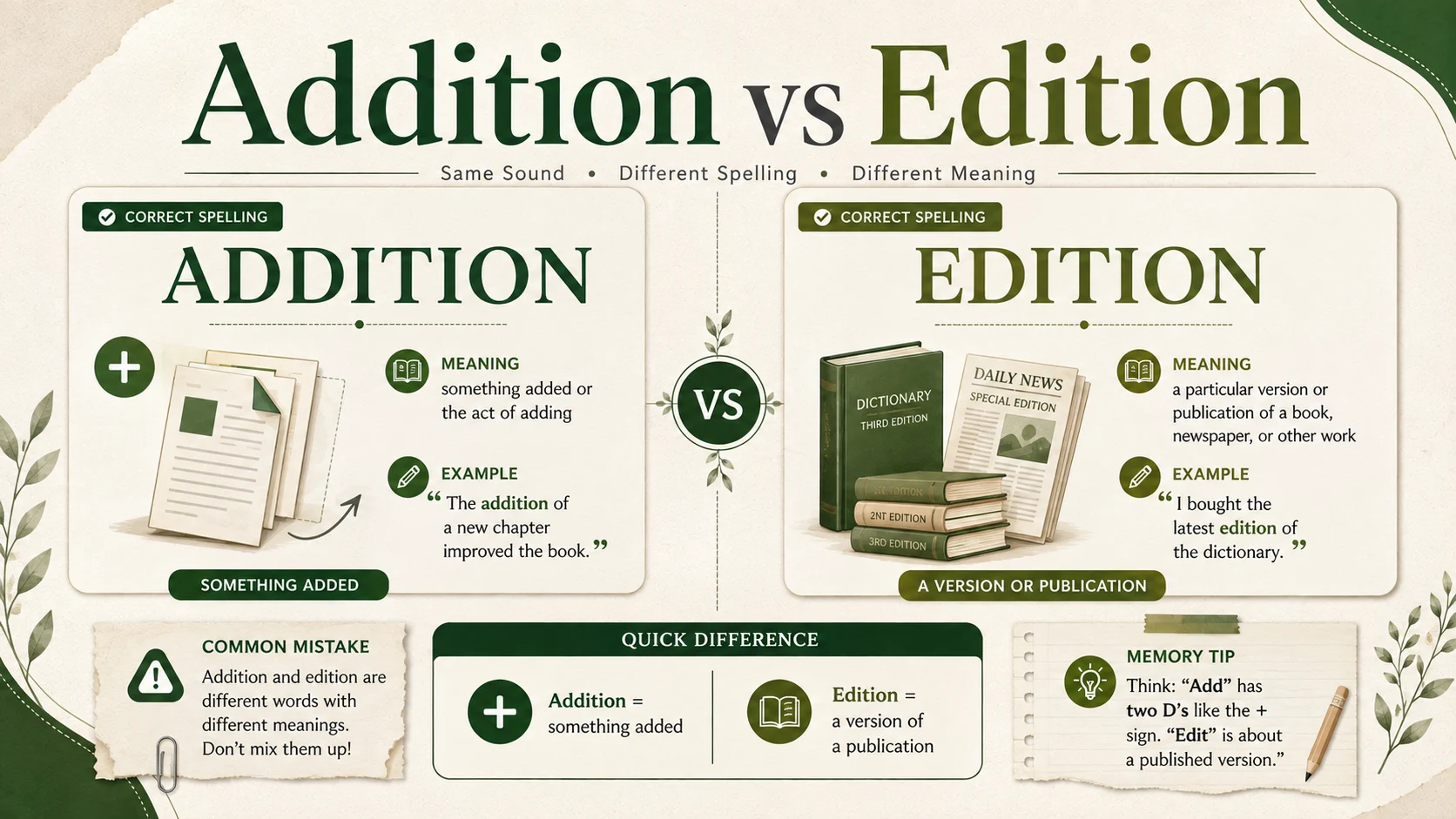
The difference between addition and edition comes down to meaning: addition refers to adding something or the process of adding, while edition refers to a specific version or release of a published work. Using the wrong word can confuse readers and undermine your professional credibility. This guide explains when to use each term correctly
Have you ever stared at a sentence wondering whether to write “addition” or “edition”? You’re not alone. These two words sound remarkably similar when spoken quickly, yet they serve completely different purposes in English. Many writers, including native speakers, occasionally mix them up often with embarrassing results.
This confusion typically happens because both words contain the same “dition” ending and share similar spelling patterns. But here’s the thing: addition is about bringing things together or increasing quantity, while edition deals with published versions and releases. Whether you’re writing a business report, academic paper, or casual email, choosing the right word makes your message clear and professional.
By the end of this guide, you’ll not only understand the difference between addition and edition you’ll feel confident using both words correctly in any context. We’ll explore real-world examples, common mistakes, and practical memory tricks that actually work.
What’s the Difference Between Addition and Edition?
The core difference between addition and edition is straightforward: addition refers to the act of adding something or the thing that has been added, while edition refers to a particular version or release of a published text, product, or work.
Here’s a quick comparison to clarify the distinction:
| Feature | Addition | Edition |
|---|---|---|
| Part of Speech | Noun | Noun |
| Refers To | The act of adding or something added | A specific version or release of something |
| Typical Context | Mathematics, building, improvements | Publishing, software, media |
| Core Meaning | Bringing things together; increasing quantity | A distinct form or version |
| Example | “We made an addition to the house.” | “The new edition of the book is out.” |
| Common Confusion | Confused with “edition” due to similar sound | Confused with “addition” due to similar spelling |
Think of it this way: addition is about more more items, more space, more features. Edition is about version this specific copy, that particular release, a distinct printing.
When you’re adding a room to your house, you’re making an addition. When you’re reading the latest version of a newspaper, you’re reading the latest edition. The difference becomes even clearer when you consider their Latin roots: addition comes from addere (to add), while edition comes from edere (to bring forth or publish).
Is This a Grammar, Vocabulary, or Usage Issue?
When we talk about addition vs edition, we’re dealing primarily with a vocabulary and usage issue rather than a strict grammar problem. Neither word is grammatically incorrect on its own the challenge lies in selecting the appropriate word for your intended meaning.
From a grammar perspective, both words function as nouns and follow standard English noun rules. You can use them in singular or plural forms (addition/additions, edition/editions). There’s nothing grammatically special about either word.
The vocabulary distinction matters because these words represent completely different concepts. Addition belongs to a word family related to adding, increasing, and combining. Edition belongs to a word family related to publishing, releasing, and versioning.
Usage is where most people stumble. In professional writing, academic work, and everyday conversation, using the wrong word signals carelessness and can confuse your reader. Consider these scenarios:
- Formal English: “The committee approved the addition of new safety protocols.” (Correct)
- Formal English: “The committee approved the edition of new safety protocols.” (Incorrect)
- Business English: “We’re releasing a special edition of our annual report.” (Correct)
- Business English: “We’re releasing a special addition of our annual report.” (Incorrect)
- Academic Writing: “This study represents a significant addition to existing research.” (Correct)
- Academic Writing: “This study represents a significant edition to existing research.” (Incorrect)
Are they interchangeable? Absolutely not. Using one when you mean the other creates confusion and undermines your credibility. While they sound similar, their meanings are distinct and non-overlapping.
Takeaway: Focus on the meaning you want to convey. If you’re talking about something new being added, choose “addition.” If you’re talking about a version or release, choose “edition.”
Understanding “Addition”
What Does Addition Mean?
Addition (pronounced uh-DIH-shun) functions as a noun and carries several closely related meanings. At its core, addition describes the act of adding something to something else, or the thing that has been added.
The primary meanings include:
- The action or process of adding something to something else
- A person or thing that has been added to something else
- The arithmetic operation of calculating the sum of two or more numbers
- An increase or enhancement
Common Collocations and Sentence Patterns
Addition appears frequently in specific combinations:
Common phrases:
- “In addition to” (meaning “as well as” or “besides”)
- “A welcome addition”
- “Recent addition”
- “New addition”
- “Valuable addition”
- “Addition to the family”
- “Addition to the team”
Typical sentence patterns:
- Subject + “made” + an addition + to + object
- Subject + “added” + object + “as an addition”
- “In addition to” + noun + comma + main clause
Real-World Examples
Workplace:
“Our department made a valuable addition to the project team by hiring a data analyst with machine learning experience.”
Academic:
“The researcher’s findings represent an important addition to the existing literature on climate adaptation strategies.”
Technology:
“The latest software update includes an addition to the security features, providing better protection against unauthorized access.”
Email:
“Please find attached the revised budget. In addition to the figures you requested, I’ve included a breakdown of projected expenses for the next quarter.”
Daily conversation:
“We’re expecting a new addition to our family next month my sister is having a baby.”
Learner Mistake:
❌ “I bought the latest addition of the magazine.”
✅ “I bought the latest edition of the magazine.”
Mini Recap: Remember that addition is about more adding things, increasing amounts, or bringing new elements into a situation.
Understanding “Edition”
What Does Edition Mean?
Edition (pronounced ih-DIH-shun) functions as a noun and refers to a particular form or version of a published work. The term applies to books, newspapers, magazines, software, and any product that appears in multiple versions or releases.
The primary meanings include:
- A particular version of a published text or work
- The total number of copies of a publication issued at one time
- A version of a product or software
- A particular broadcast of a news program
Common Collocations and Sentence Patterns
Edition appears in predictable combinations:
Common phrases:
- “First edition”
- “Limited edition”
- “Special edition”
- “New edition”
- “Revised edition”
- “Expanded edition”
- “Print edition”
- “Digital edition”
- “Collector’s edition”
- “Evening edition” (of a newspaper)
Typical sentence patterns:
- Subject + “released” + a + edition
- Subject + “published” + a + edition
- Subject + “bought” + the + edition
- The + edition + “features” + something
Real-World Examples
Workplace:
“The company released a special edition of their annual report to commemorate the founder’s retirement.”
Academic:
“The professor recommended the third edition of the textbook because it includes updated research and case studies.”
Technology:
“The developer announced a limited edition of the software package that includes premium features for early adopters.”
Email:
“I’ve attached the digital edition of our quarterly newsletter. The print edition will be mailed to subscribers next week.”
Daily conversation:
“I bought the collector’s edition of the album it comes with extra tracks and a poster.”
Learner Mistake:
❌ “The author is working on a new addition of her novel.”
✅ “The author is working on a new edition of her novel.”
Mini Recap: Edition is about versions specific releases, distinct copies, or particular publications of a work.
When Not to Use Each Word
Common Mistakes with “Addition”
- Talking about a publication version: Writers often write “new addition” when they mean “new edition” of a book, magazine, or software.Why this happens: The words sound similar and the writer isn’t thinking about the specific meaning.Correct use: “The author released a new edition of her cookbook with additional recipes.”
- Referring to a broadcast or release: People sometimes say “morning addition” instead of “morning edition” when talking about news programs.Why this happens: The same sound pattern triggers the wrong spelling.Correct use: “I watch the evening edition of the news for in-depth coverage.”
- Describing version differences: “The collector’s addition” is a common error when discussing special releases.Why this happens: Writers think about something being “added” to make it special.Correct use: “The limited edition includes a signed print from the artist.”
Common Mistakes with “Edition”
- Talking about arithmetic or increases: “Edition” sometimes appears where “addition” belongs.Why this happens: The writer confuses the two due to similar spelling.Correct use: “The addition of solar panels reduced our electricity bills.”
- Describing a new team member: “New edition to the team” is incorrect.Why this happens: The writer incorrectly thinks “edition” means a new version of someone.Correct use: “The new addition to the sales team exceeded all targets.”
- Discussing physical improvements: “House edition” should be “house addition.”Why this happens: The writer focuses on the improvement aspect but uses the wrong term.Correct use: “We built a kitchen addition to create more space.”
Common Mistakes Table
| Correct Sentence | Incorrect Sentence | Explanation |
|---|---|---|
| “The library purchased the latest edition of the encyclopedia.” | “The library purchased the latest addition of the encyclopedia.” | Edition refers to the published version; addition would imply the library bought something extra. |
| “In addition to my salary, I receive bonuses.” | “In edition to my salary, I receive bonuses.” | In addition to is a fixed expression meaning “as well as. |
| “The new edition includes updated statistics.” | “The new addition includes updated statistics.” | Edition indicates a revised version; addition would suggest new content was added to an existing thing. |
| “The museum announced a new addition to its collection.” | “The museum announced a new edition to its collection.” | Addition refers to the new item acquired; edition would suggest a version of something. |
| “Please bring the third edition of the handbook.” | “Please bring the third addition of the handbook.” | Edition specifies which version of the handbook. |
| “The software’s latest edition fixed several bugs.” | “The software’s latest addition fixed several bugs.” | Edition refers to the version release; addition would mean a new feature. |
Quick Decision Guide
If you mean adding something new, increasing, or combining:
→ Use addition
If you mean a version, release, or published copy:
→ Use edition
Still unsure? Try this memory trick:
Addition starts with “add” and it’s about adding.
Edition starts with “edit” and it’s about editing and publishing versions.
If you can replace the word with “version” and the sentence still makes sense, use edition. If you can replace it with “increase” or “new item,” use addition.
Real-World Examples Across Contexts
Office Communication
“I’d like to propose the addition of a weekly team meeting to improve collaboration. The new edition of our project management software includes features that would support this change.”
Business Email
“Dear Team, In addition to the quarterly reports, I’ve attached the digital edition of our new employee handbook. Please review the updated policies before next week.”
Academic Setting
“Dr. Chen’s research represents a significant addition to our understanding of cellular biology. The second edition of her textbook incorporates these findings.”
Customer Support
“Thank you for your feedback. The new edition of our mobile app addresses your concerns about the interface. We also made the addition of a help center to assist users.”
Technology Context
“The latest edition of the operating system includes the addition of enhanced privacy controls. Users can download the update starting next Tuesday.”
Artificial Intelligence
“The newest edition of our AI model includes the addition of multilingual support, allowing it to process text in over fifty languages.”
Daily Conversation
“Look at the additions we made to the garden we planted roses and built a stone pathway. I picked up the special edition of that gardening magazine you like.”
Addition and Edition in Modern Technology
In technology and AI contexts, both words appear frequently, often leading to confusion in technical writing.
In software development, “edition” commonly distinguishes different versions of a product:
- Standard Edition (the basic version)
- Professional Edition (the advanced version)
- Enterprise Edition (the business-oriented version)
- Community Edition (the free, open-source version)
“The Professional Edition of the software includes the addition of cloud backup features.”
In the context of updates, “addition” describes new features or capabilities:
“Each software update brings the addition of new tools and improved performance.”
In AI and virtual assistants, editions often refer to different tiers or capabilities:
“The premium edition of the voice assistant includes the addition of real-time translation.”
Chatbots and business tools follow similar patterns:
“Our chatbot’s latest edition includes the addition of sentiment analysis to better understand customer emotions.”
Remember: edition = version/package; addition = feature/improvement.
Word Origin: Why the Confusion?
Understanding where these words come from can help cement their meanings in your mind.
Addition traces back to the Latin word additio, which comes from addere meaning “to add, join, or attach.” The prefix *ad-* means “to,” and dere means “put.” So addition literally means “to put to” or “to join to” something existing.
Edition comes from the Latin editio, derived from edere meaning “to put forth, publish, or bring out.” The prefix *ex-* means “out,” and dere means “put.” So edition literally means “to put out” or “to publish.”
The similarity in their spelling and pronunciation arises because both contain the Latin root dere and share similar construction patterns. But their prefixes tell the story: *ad-* (to) vs. *ex-* (out). One brings things together; the other puts things out.
Expert Insight: A Teacher’s Perspective
As an English language instructor, I’ve seen hundreds of students struggle with this distinction. The problem isn’t that the words are difficult it’s that they sound similar, and our brains often default to visual or auditory patterns rather than meaning.
Here’s what I tell my students: think about the context. Are you working with numbers or physical objects? You’re probably dealing with addition. Are you holding a book, reading a newspaper, or downloading software? That’s likely edition.
The most effective way to internalize the difference is to create mental “anchors.” Anchor “addition” to the image of a math problem with a plus sign. Anchor “edition” to a library shelf with multiple versions of the same book. When you’re unsure, visualize these anchors and ask yourself which one fits.
I also recommend practicing with sentences that use both words correctly:
“In addition to buying the first edition of the novel, I purchased the second edition for comparison.”
When you can write sentences like this without hesitation, you’ve mastered the distinction.
Error Prevention Checklist
Before you hit send, publish, or submit, run through this quick checklist:
- □ Addition means “something added” or “the process of adding.”
- □ Edition means “a version” or “a published release.”
- □ Always use “addition” after “in” when saying “in addition to.”
- □ Always use “edition” when talking about books, newspapers, magazines, or software versions.
- □ “New addition” = a new item has been added.
- □ “New edition” = a new version has been released.
- □ Never confuse them in professional communication it undermines credibility.
Quick Memory Tip: If you can replace the word with “version,” choose “edition.” If you can replace it with “increase” or “extra item,” choose “addition.
Related Grammar Confusions
If you find addition vs edition challenging, you might also benefit from understanding these commonly confused word pairs:
- Accept vs Except – Understanding the difference between receiving and excluding
- Affect vs Effect – Mastering the verb vs noun distinction
- Principal vs Principle – Person/primary vs rule/belief
- Complement vs Compliment – Completing something vs praising someone
- Stationary vs Stationery – Not moving vs writing materials
- Advice vs Advise – Noun vs verb forms
- Practice vs Practise – Noun vs verb (British English)
- License vs Licence – Noun vs verb (British English)
- Breath vs Breathe – Noun vs verb
- Exceptional vs Exceptionable – Excellent vs objectionable
Each of these pairs presents similar challenges: words that sound alike but carry entirely different meanings. Mastering them builds your overall confidence and clarity in English writing.
FAQs
Can “addition” and “edition” ever be used interchangeably?
No. “Addition” and “edition” have different meanings and should not be substituted for one another. Addition refers to something being added or the act of adding, while edition refers to a particular version of a publication, product, or release.
Is “in addition to” or “in edition to” correct?
“In addition to” is the correct expression. It means “as well as” or “besides.” “In edition to” is incorrect and should not be used in standard English.
What are the plural forms of “addition” and “edition”?
Both words form their plurals by adding “-s.” The plural of addition is “additions,” while the plural of edition is “editions.” For example, “The collection includes several additions” and “The publisher released three editions.”
How do you pronounce “addition” and “edition”?
The two words sound very similar, but their opening sounds differ. “Addition” is commonly pronounced uh-DIH-shun, while “edition” is pronounced ih-DIH-shun. The distinction is easier to hear when the words are spoken clearly.
Which word should I use for a new version of a book?
Use “edition.” A new edition is a revised, updated, or newly published version of a book. Addition refers to something added, so “new addition” would describe an added item rather than a new version of the book.
Can software updates be described as additions or editions?
Yes, but the words describe different things. “Edition” can identify a particular version or package of software, such as a Home Edition or Professional Edition. “Addition” refers to something newly added, such as a feature, tool, or capability.
Conclusion
The difference between addition and edition comes down to a fundamental distinction in meaning. Addition is about bringing things together, increasing quantity, or adding new elements. Edition is about versions, releases, and published works.
Remember this simple rule: if you’re thinking about more, use addition. If you’re thinking about version, use edition. This distinction will serve you well in business writing, academic work, and everyday communication.
The best way to avoid confusion is to pause and ask yourself one question: “Am I talking about something being added, or am I talking about a specific version?” Your answer will guide you to the correct word every time.
With practice, choosing between addition and edition becomes second nature. And when you use these words correctly, your writing will be clearer, more professional, and more credible.