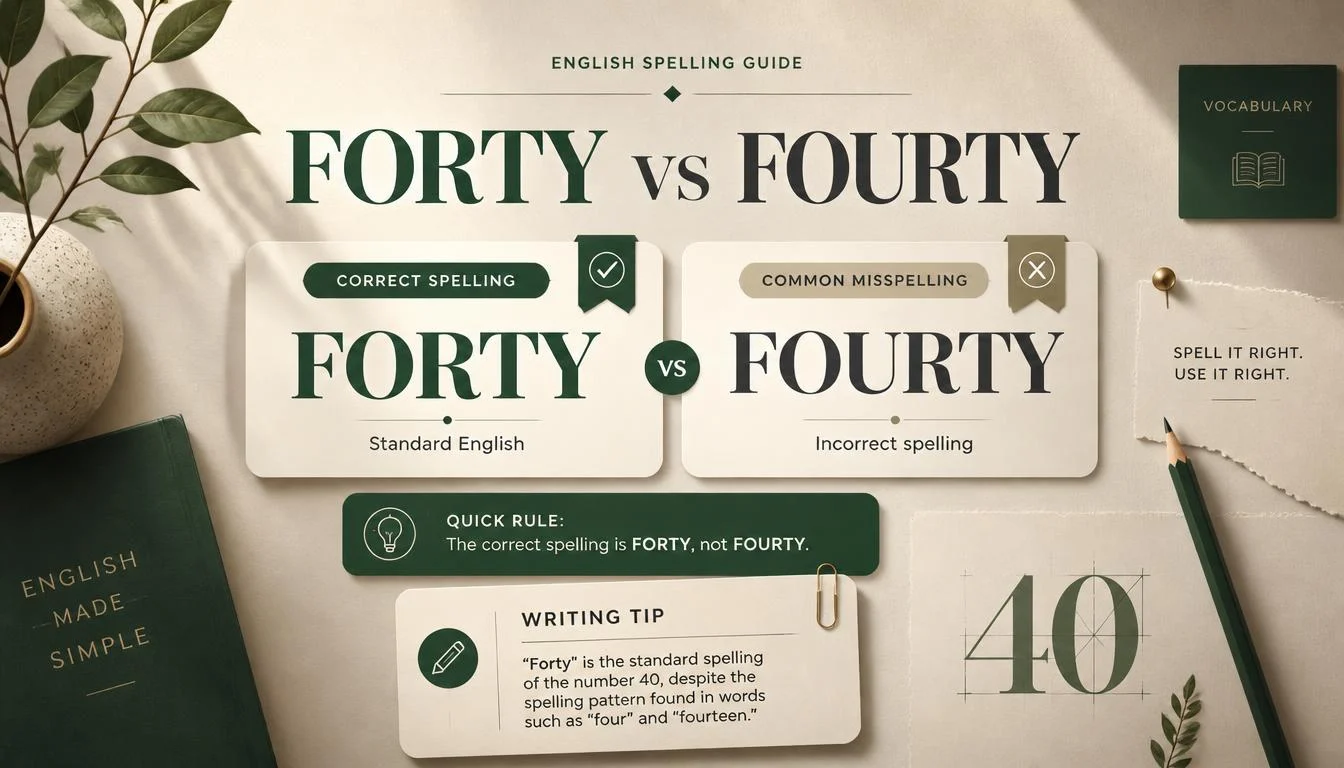
Quick Answer:
The correct spelling is forty, not fourty. Even though the number four contains a “u,” forty drops it completely. Fourty is one of the most common spelling mistakes in English, showing up in emails, resumes, invoices, and even printed signs. Learning this one exception will save you from a small error that instantly makes writing look careless.
When writing the number 40, many people hesitate between “forty” and “fourty.” The confusion is understandable because the spelling of “four” makes “fourty” look logical, but only one form is correct.
In this guide, we’ll explain the difference between forty vs fourty, show you the correct spelling, and share a simple memory trick. Whether you’re writing an email, academic paper, or everyday message, you’ll know which form to use.
Why This Small Word Trips Up So Many Writers
Picture this. You’re typing a business proposal, and you need to spell out the number 40. Your fingers move fast, your brain pulls up the word “four,” and somehow an extra “u” sneaks into the word. You end up typing “fourty” instead of “forty,” and you don’t even notice until someone points it out or worse, until a client does.
This isn’t a rare slip. It’s one of the most searched spelling questions in English, sitting right alongside “definitely vs definately” and “separate vs seperate.” The confusion makes sense once you understand where it comes from. Nearly every number in the forty family keeps the “u” from four: fourteen, fourth, four hundred, fourfold. So why does forty break the pattern?
That question is exactly what this guide answers. You’ll learn the real reason forty lost its “u,” how to remember the correct spelling permanently, where this mistake shows up most often in real writing, and how professionals, students, and non-native speakers can avoid it for good. By the end, you won’t just know the answer you’ll understand it well enough to explain it confidently to someone else.
Forty vs Fourty: What’s the Difference?
There is no real difference in meaning between forty and fourty, because only one of these spellings actually exists in standard English. Forty is correct. Fourty is a spelling error, not an alternate British spelling, not an older form, and not an informal shortcut.
This surprises a lot of learners because English does have genuine spelling splits between American and British English think “color” versus “colour,” or “organize” versus “organise.” Naturally, people assume forty and fourty might follow that same regional pattern. They don’t. Every major dictionary, style guide, and English-speaking country uses forty, without exception. There’s no hidden regional variant waiting to justify the other spelling.
| Meaning | Part of Speech | Refers To | Typical Usage | Example | Common Confusion |
|---|---|---|---|---|---|
| The number 40 | Adjective / Noun | A quantity, age, or numeral | Counting, dates, math, measurements | “She turned forty last week.” | Frequently misspelled as “fourty” |
| Not a recognized word | “He is fourty years old.” (incorrect) | Mistaken for a valid alternate spelling |
So here’s the recap. Forty is the only accepted spelling of the number 40 in English, used consistently across casual conversation, business writing, legal contracts, and academic papers. Fourty isn’t a British spelling, an archaic spelling, or an informal spelling it’s simply incorrect. Once that settles in, most of the confusion disappears, because there’s nothing to genuinely “choose” between. There’s one correct word and one extremely common typo that happens to look logical on the surface.
Is Forty a Grammar, Vocabulary, or Spelling Issue?
This is purely a spelling issue, not a grammar or vocabulary problem. Grammar deals with how words function together inside a sentence verb tense, word order, subject-verb agreement, and so on. Vocabulary deals with word choice and meaning, like choosing between “big” and “large.” Spelling deals with how a word is physically written, and that’s exactly where forty and fourty diverge.
Because this is strictly a spelling issue, the two forms aren’t interchangeable in any context whatsoever. You won’t find a single situation in formal English, business writing, academic papers, or casual texting where “fourty” becomes acceptable. Some spelling variants genuinely shift depending on formality or geography, but this isn’t one of them. Forty stays forty whether you’re sending a quick text to a friend or drafting a formal legal document that a lawyer will review line by line.
The practical takeaway here is simple: treat “fourty” the way you’d treat “recieve” instead of “receive,” or “definately” instead of “definitely.” It isn’t a stylistic option sitting on the table. It’s a mistake to correct, every single time, in every type of writing, regardless of audience or tone.
Forty: Meaning, Usage, and Examples
Meaning
Forty refers to the number 40. It is used to count objects, describe someone’s age, indicate quantity, or express measurements of time, distance, and money.
Part of Speech
Forty functions as both an adjective and a noun. As an adjective, it appears before a noun, as in “forty dollars” or “forty employees.” As a noun, it can refer to a decade or age range, as in “the roaring forties” or “she’s in her forties now.”
Pronunciation
Forty is pronounced FOR-tee, with stress on the first syllable. The pronunciation does not contain a “u” sound, which can serve as a useful reminder that the spelling is forty, not “fourty.”
Common Collocations
Some common expressions and collocations with forty include:
- forty years old
- forty percent
- forty minutes
- in her forties
- forty acres
- a forty-hour workweek
- forty winks
- forty-something
Typical Sentence Patterns
Forty usually appears directly before a noun, such as “forty employees” or “forty dollars.” When referring to someone’s age range, it commonly follows the preposition “in,” as in “in his forties” or “she’s in her early forties.”
Real-World Examples
Workplace Example: “We’re expecting forty new hires by the end of the quarter, so HR needs the paperwork ready.”
Academic Example: “The research team surveyed forty participants over a six-month period to track long-term behavioral changes.”
Technology Example: “The latest software update reduced page-loading time by forty percent, according to internal testing.”
Email Example: “Please confirm the meeting for forty minutes starting at 10 a.m. sharp on Thursday.”
Daily Conversation Example: “My uncle just turned forty, and he’s already talking about buying a motorcycle for a midlife crisis.”
One Learner Mistake to Avoid
Many learners write “The company hired fourty people” because they mentally construct the word from “four” plus “ty.” Forty does not follow that visual pattern. The correct spelling is forty, so it is best to memorize the word rather than try to build its spelling from “four.”
Mini Recap
Forty is the only correct spelling for the number 40. It is used consistently when talking about age, percentages, time, distance, money, and quantity, with no alternative spelling based on region or formality.
Fourty: Why This Spelling Doesn’t Exist
Meaning
Fourty has no accepted meaning in standard English. It is not an informal, dated, or regional word. Instead, it is a misspelling of forty that looks logical because it closely resembles the spelling of “four.”
Part of Speech
“Fourty” has no grammatical function of its own because it is not a recognized standard English word. The correct form is forty.
Why People Write “Fourty”
The word four keeps its “u” in many related words, including “fourteen,” “fourth,” “fourfold,” and “foursome.” Because of this pattern, writers may naturally expect the “u” to appear in forty as well. English spelling, however, does not always follow a predictable pattern, making forty an exception that needs to be memorized.
Common Examples of the Mistake
Workplace Example: Incorrect: “We need fourty units delivered by Friday afternoon.”
Correct: “We need forty units delivered by Friday afternoon.”
Academic Example: Incorrect: “The experiment included fourty separate trials across two labs.”
Correct: “The experiment included forty separate trials across two labs.”
Technology Example: Incorrect: “Battery life improved by fourty percent after the firmware update.”
Correct: “Battery life improved by forty percent after the firmware update.”
Email Example: Incorrect: “I’ll be out of the office for fourty minutes this afternoon.”
Correct: “I’ll be out of the office for forty minutes this afternoon.”
Daily Conversation Example: Incorrect: “She’s turning fourty next month, and we’re planning a surprise party.”
Correct: “She’s turning forty next month, and we’re planning a surprise party.”
One Learner Mistake to Avoid
Some non-native speakers assume that “fourty” might be an older or more formal British spelling, similar to how “colour” is standard in British English while “color” is standard in American English. That assumption is incorrect. Fourty is not an accepted standard spelling in British, American, Australian, or Canadian English.
Mini Recap
Fourty is not a standard English word. It is simply a misspelling of forty, usually caused by the strong influence of the word “four.”
When Writers Commonly Choose the Wrong Spelling
Understanding when this mistake tends to occur can make it easier to catch before submitting an important document.
1. Writing Quickly Without Proofreading
Fast typing can cause your brain to rely on familiar spelling patterns rather than accuracy. Since “fourty” looks logical, it can easily slip through when you’re writing quickly.
2. Relying Heavily on the Spelling of “Four”
Because forty represents the tens form associated with four, writers may assume that the spelling should carry over. This feels natural because words such as “six” and “sixty” or “seven” and “seventy” have more predictable relationships.
3. Learning Numbers Through Speech First
If you learned English numbers primarily by listening before seeing them in writing, you may have developed an incorrect spelling based on pronunciation and familiar patterns.
4. Autocorrect Gaps on Certain Devices or Apps
Not every text field or application catches every spelling error. Messaging apps, comment sections, and older software may have limited spell-checking capabilities, allowing “fourty” to remain unnoticed.
5. Confusing Forty With Fourteen or Fourth
Words such as “fourteen” and “fourth” genuinely retain the “u” from “four.” This can lead writers to assume that forty should follow the same pattern.
6. Writing Numbers on Autopilot
Numbers are often typed without much conscious attention, particularly in repetitive documents such as invoices, spreadsheets, reports, and recurring emails. This makes spelling mistakes easier to overlook.
7. Second-Language Interference
Learners whose first language follows highly predictable spelling patterns may naturally expect English number words to follow the same logic. The unusual spelling of forty can therefore be especially confusing.
8. Copying an Error From Another Document
If a template, form, spreadsheet, or previous email contains “fourty,” writers may copy the error into new documents without realizing that the original spelling was incorrect.
The Simple Fix
Regardless of why the mistake happens, the solution is straightforward: forty is correct, while fourty is not. Remembering the correct spelling and taking a moment to proofread can help prevent this common error.
Common Mistakes Table
| Correct Sentence | Incorrect Sentence | Explanation |
|---|---|---|
| “The invoice totals forty dollars.” | “The invoice totals fourty dollars.” | Fourty is never a valid spelling in financial or business writing, regardless of context. |
| “She has worked here for forty years.” | “She has worked here for fourty years.” | The “u” from “four” simply does not carry over into forty. |
| “Please arrive within forty minutes.” | “Please arrive within fourty minutes.” | Time expressions follow the exact same spelling rule as every other use. |
| “The class has forty students.” | “The class has fourty students.” | Even in casual academic writing, fourty remains incorrect. |
| “He is turning forty this year.” | “He is turning fourty this year.” | Age references require the standard spelling, with absolutely no exceptions. |
Quick Decision Box
If you’re writing the number 40 in any context, use forty. There is no situation formal, informal, British, American, academic, or casual where fourty becomes acceptable. If you’re ever unsure in the moment, remember this simple anchor: forty is spelled the way it sounds, without the “u” borrowed from “four.
Forty in Real-World Communication
Office communication: A manager writing a staffing update types, “We’re bringing on forty seasonal employees for the holiday rush, starting next Monday,” and gets it right because the number appears inside a professional document reviewed by multiple people before it goes out.
Business email: A vendor confirms an order with, “Please process payment for forty units at the agreed rate by the fifteenth,” where a misspelling could quietly look unprofessional to a client or long-term business partner.
School or university: A student writing a lab report notes, “The sample size included forty participants recruited through the psychology department,” a phrasing you’ll see constantly across academic research summaries.
Customer support: A support agent tells a frustrated customer, “Your refund will be processed within forty business hours, and you’ll get a confirmation email once it clears,” where clarity and correctness both matter directly for building trust.
Technology: A product update announcement reads, “This version improves battery efficiency by forty percent compared to the previous release,” a phrase that shows up regularly in tech marketing copy and press releases.
Artificial intelligence: An AI-generated report might state, “The model achieved forty percent accuracy during early testing before fine-tuning began,” showing that even automated systems are expected to spell basic numbers correctly.
Daily conversation: A friend texts, “I’ll be there in forty minutes, traffic is rough today,” a phrase so common in everyday messaging that getting the spelling wrong tends to stand out immediately to anyone reading it closely.
Forty in Modern Technology
Numbers like forty show up constantly across artificial intelligence, virtual assistants, and everyday software, far more often than most people realize. Voice assistants like Siri or Alexa convert spoken numbers into written text, and when they generate written responses or transcriptions, correct spelling matters directly for readability and overall professionalism.
Chatbots handling customer service tickets frequently reference percentages, wait times, and quantities using written-out numbers, and a misspelled “fourty” tucked into an automated response can quietly chip away at a brand’s credibility without anyone immediately noticing why.
Business software, especially reporting tools and analytics dashboards, often converts raw numeric data into written summaries for presentations or client-facing emails. If a template or auto-generated report contains the “fourty” error even once, it can spread silently across dozens of documents before anyone actually catches it. This is one of the quieter, less obvious reasons professionals still double-check number spellings in AI-generated content, rather than assuming automated tools always get simple things right by default.
Even spell-checking tools built into word processors sometimes behave inconsistently depending on the language settings or dictionary version installed, which means relying entirely on software isn’t always a safe bet for catching this particular error.
A Bit of Word History
Forty comes from the Old English word “feowertig,” which combined “feower” (meaning four) with “tig” (representing a group of ten). Over centuries of gradual language evolution, English spelling simplified many number words, and forty ended up losing the “u” that its root word “four” managed to keep intact.
This is actually one of the few genuinely irregular spellings among the English tens. Twenty, thirty, fifty, sixty, seventy, eighty, and ninety all logically match their root numbers in a fairly predictable way, while forty stands alone as the clear odd one out. Linguists sometimes point to forty as a small but memorable example of how spoken language and written language don’t always evolve in perfect sync with each other. Knowing this bit of history won’t change how you spell the word today, but it does explain why the exception feels so genuinely unexpected the first time someone points it out.
Expert Insight
As a language instructor, I tell students that forty is a perfect example of why English spelling can’t always be reasoned out through logic alone sometimes you simply have to memorize the exception and move forward. The trick that tends to work best for most learners isn’t grammar rules at all; it’s a simple visual anchor instead. Picture the word “fort” hiding inside forty, like a small fort standing at the very core of the number. Fort has no “u,” and neither does forty. That tiny mental image tends to stick in memory far longer than any explanation involving Old English roots or historical spelling drift ever could.
I’ve also noticed that students who write the number out by hand a few times, slowly and deliberately, tend to internalize the correct spelling faster than students who only see it typed on a screen. There’s something about the physical act of writing “forty” without that extra “u” that reinforces the correct pattern more effectively than passive reading alone.
Error Prevention Checklist
- Always use forty when writing the number 40, in any context, formal or informal, spoken or written.
- Always double-check number spellings inside business documents, since small typos there tend to feel more costly professionally than they would in a casual text.
- Never confuse forty with fourteen or fourth simply because all three share the root word “four.”
- Quick memory tip: picture the word “fort” living inside forty no “u,” no problem, no confusion.
Related Grammar Confusions Worth Learning
- Ninety vs Ninty: Another commonly misspelled number that trips up writers who lean on sound-based spelling instincts rather than memorized rules.
- Definitely vs Definately: A classic misspelling caused largely by mispronunciation quietly influencing the written form of the word.
- Separate vs Seperate: One of the most heavily searched spelling errors in English, driven by how the word sounds when spoken quickly in casual conversation.
- Affect vs Effect: A genuine grammar and vocabulary distinction, unlike forty vs fourty, since both of these words actually exist with clearly different meanings and uses.
- Its vs It’s: A foundational grammar mistake involving possession versus contraction, frequently confused even by confident native speakers.
- Their vs There vs They’re: Three words that sound completely identical but serve entirely different grammatical roles inside a sentence.
- Fourteen vs Fourty: Worth studying side by side, since both words come from “four” but behave very differently once spelled out.
- Loose vs Lose: A spelling mix-up caused by similar letters paired with very different pronunciations and meanings entirely.
- Compliment vs Complement: A vocabulary distinction that changes a sentence’s entire meaning depending on which spelling you choose to use.
- Principal vs Principle: A classic homophone confusion that stays especially relevant for students, teachers, and workplace professionals alike.
FAQs
Is “fourty” ever correct in British English?
No. “Fourty” is not a correct British spelling, an older spelling, or a regional variant. Forty is the standard spelling in British, American, Australian, and Canadian English. It is correct regardless of dialect or level of formality.
Why does forty not have a “u” like four does?
The spelling of forty developed differently from four. Over time, the word underwent spelling changes and lost the “u,” while related words such as “fourteen” and “fourth” retained it. Today, forty is considered an irregular spelling among English number words.
Is “fourty” a typo or a real spelling mistake?
“Fourty” is generally considered a spelling mistake. It often happens because writers naturally assume that the “u” in four should also appear in forty. However, the correct spelling is always forty.
Does spell-check always catch fourty?
Most modern spell-checkers flag fourty as incorrect, but this is not guaranteed. Basic text fields, older software, and some chat applications may not catch every spelling error. Manual proofreading is still important, especially in professional or published writing.
How can I remember the correct spelling permanently?
A simple memory trick is to picture the word “fort” inside forty. Neither “fort” nor “forty” contains a “u.” This visual association can make the unusual spelling easier to remember than relying on a spelling rule alone.
Are there other numbers commonly misspelled like forty?
Yes. For example, ninety is sometimes misspelled as “ninty.” However, forty is especially prone to misspelling because its spelling does not closely match the word “four.” Remember that the correct form is always forty, not “fourty.”
Does the mistake happen more often in speech or in writing?
The mistake occurs almost exclusively in writing because forty and the incorrect “fourty” are pronounced the same. Since there is no difference in pronunciation, the error only becomes noticeable when the word is written down and reviewed by the writer, reader, or editor.
Conclusion
The difference between forty and fourty really comes down to one simple fact: only forty exists as a genuinely correct, dictionary-approved word in English. Fourty isn’t a stylistic variation, a British alternative, or some old-fashioned spelling choice from an earlier era it’s a mistake that happens because the number four keeps its “u” almost everywhere else except in this one specific, memorable case.
Once you understand exactly why the exception exists, it becomes far easier to remember going forward. Picture “fort” quietly hiding inside forty, and there’s a strong chance you’ll never make this particular mistake again. Whether you’re writing a business email, finishing a school assignment, or sending a quick text to a friend, sticking consistently with forty keeps your writing accurate, polished, and professional every single time you use it.
Read More Related Articles
- Happened or Happend | Master the Correct Usage in Minutes In 2026
- Anual or Annual | Simple Grammar Guide For Error-Free Writing In 2026
- Successfully or Succesfully | Easy Trick to Remember the Correct Spelling Forever In 2026

Caleb Dawson is a content writer at synoseek.com, where he works on simple, reader-focused articles across a range of everyday topics. His writing style is practical and grounded, aiming to present information in a clear and relatable way without unnecessary complexity.
2 thoughts on “Forty vs Fourty | Simple Rule to Remember In 2026”