Quick Answer
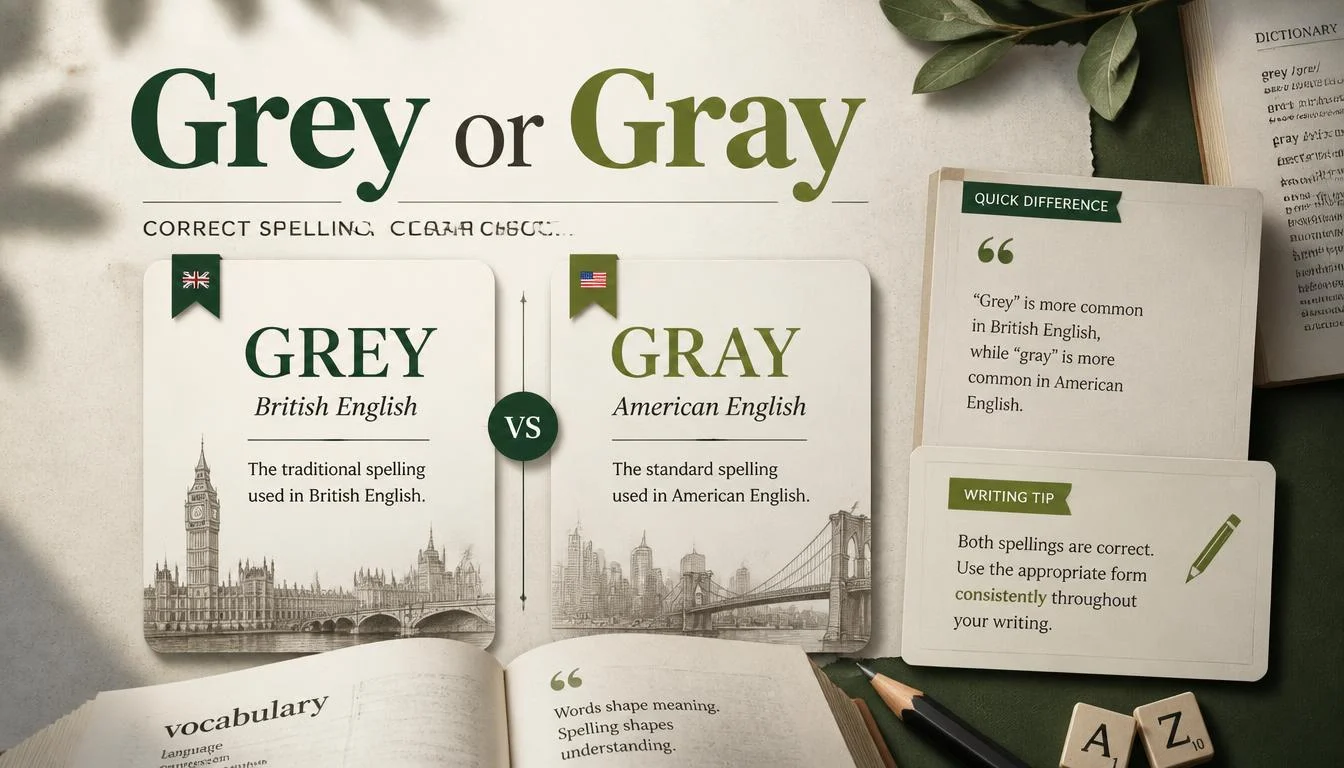
The difference between grey and gray is purely regional. Gray is the standard American English spelling, while grey is the standard British English spelling . Both spellings are correct, refer to the same neutral color, and share the same pronunciation and definitions. Your choice depends on your audience.
If you’ve ever paused while writing to question whether you should describe a cloudy sky as “grey” or “gray,” you are not alone. It’s a tiny distinction that can cause an outsized amount of doubt, even for native speakers. At first glance, it might seem like one is a typo, but the reality is far more interesting. You are actually facing one of the most common dilemmas in English: the regional spelling variation.
This isn’t a case of one being right and the other wrong. Instead, the choice hinges on a simple matter of geography and audience. In this guide, we’ll cut through the confusion and provide you with a clear, practical rule for when to use “grey” and when “gray” is the better choice. By the end, you will know exactly which one to use for your readers, and you’ll have a few memory tricks to ensure you never get it wrong again.
What’s the Difference Between Grey and Gray?
To put it simply, there is no difference in meaning, definition, or pronunciation between “grey” and “gray.” Both words describe the color that sits between black and white on the spectrum, often associated with overcast skies, silver hair, or concrete. The only real difference is where you are in the world or more accurately, which version of English you are using.
Here is a quick comparison to clarify the core distinction:
| Feature | Gray | Grey |
|---|---|---|
| Meaning | A neutral color between black and white | A neutral color between black and white |
| Part of Speech | Adjective, Noun, Verb | Adjective, Noun, Verb |
| Refers To | The color; dull or unclear situations | The color; dull or unclear situations |
| Typical Usage | American English | British English and Commonwealth countries |
| Example | “The gray sky threatened rain.” | “The grey sky threatened rain.” |
| Common Confusion | Mistaking it for a typo in American contexts. | Mistaking it for a typo in British contexts. |
In recap, think of it like the difference between “color” and “colour.” Both are correct; the choice is a matter of style, not substance. If you are writing for an American audience, you will use “gray.” If your audience is in the UK, Australia, Canada, or other Commonwealth nations, “grey” is the preferred spelling .
Is ‘Grey or Gray’ a Grammar, Vocabulary, or Usage Issue?
This distinction falls squarely into the category of a usage issue. It is not a grammar rule (there are no rules being broken here) and it is not a difference in vocabulary (the word means the same thing). It is purely about the conventions of different English dialects.
- Grammar Classification: The word functions as an adjective (“a gray car”), a noun (“Gray is a popular color”), and a verb (“His hair began to gray”). Its grammatical function does not change based on spelling.
- Vocabulary Difference: There is no vocabulary difference. Both spellings represent the same word and concept. You don’t need to learn a new meaning for one over the other.
- Usage in Different Contexts: Both words are completely interchangeable in formal English, business writing, and academic writing, provided you are consistent with the regional standard your audience expects . For example, a British academic paper will be written in British English and use “grey,” while an American business report will use “gray.” Switching between them within the same document is the only true error.
Practical Takeaway: Focus on consistency. If you are writing for a US publication, you must use “gray.” For a UK publication, use “grey.” It’s about respecting your audience’s expectations and maintaining a professional standard in your writing.
A Comprehensive Guide to Using “Gray”
In American English, “gray” is the standard spelling. If you are in the United States or writing for a US-based audience, this is the spelling you will use in almost every situation. You should also use “gray” when following major US style guides such as the Chicago Manual of Style or APA Style.
Meaning, Pronunciation, and Part of Speech
- Meaning: A color intermediate between black and white; dull and lifeless; or an unclear situation, such as a “gray area.”
- Pronunciation: /ɡreɪ/ (rhymes with “day”).
- Part of Speech: Adjective, noun, and verb.
Common Uses of “Gray” in US English
- As an adjective: “She bought a gray suit for the interview.”
- As a noun: “The walls were painted a soft, soothing gray.”
- As a verb: “I can see my father’s hair starting to gray at the temples.”
Real-World Examples of “Gray”
Workplace Example: “The quarterly report showed that the market was in a gray zone, requiring us to make a cautious decision.”
Academic Example: “The student presented a graph with gray bars to represent the control group data.”
Technology Example: “The UI designer chose a dark gray for the sidebar to create a clear contrast.”
Email Example: “Please review the document I’ve attached; the sections I’m unsure about are highlighted in gray.”
Daily Conversation Example: “I couldn’t tell if the cat was gray or blue in the dim light.”
One Learner Mistake to Avoid
A common mistake is assuming that “gray” and “grey” refer to two different colors. You might see descriptions such as “blue-gray” and “warm gray,” but these refer to different shades or tones, not different spellings of the color itself. The spelling does not determine a specific shade, so don’t use “gray” or “grey” to imply a particular color tone.
Quick Recap
For US readers, gray with an “A” is the standard spelling. It is the preferred choice for professional, academic, and personal writing in American English.
A Comprehensive Guide to Using ‘Grey’
Across the Atlantic, “grey” takes center stage. This is the standard spelling in British English and is also used in countries like Australia, New Zealand, Canada, and South Africa. If you are following UK style guides, this is the spelling you need to use.
- Meaning: A color intermediate between black and white; dreary or overcast; something that is not clearly defined.
- Pronunciation: /ɡreɪ/ (identical to “gray”).
- Part of Speech: Adjective, noun, verb.
Common Collocations and Sentence Patterns in UK English:
- Adjective: “He wore a smart grey suit to the meeting.”
- Noun: “The bathroom was decorated in a calming shade of grey.”
- Verb: “The old building is starting to grey with the city’s pollution.”
Real-World Examples:
- Workplace Example: “We need to address the grey areas in the contract before we sign anything.”
- Academic Example: “The researcher’s findings were published in the ‘Grey Literature’ database, which includes non-commercial reports.”
- Technology Example: “The app’s icon is a simple, clean grey circle.”
- Email Example: “I hope you’re well. I’ve attached the grey literature review for your feedback.”
- Daily Conversation Example: “It’s been so grey and gloomy outside all week; I miss the sun.”
One Learner Mistake to Avoid:
A common mistake is to use “grey” when writing for an American audience, thinking it looks more sophisticated or “proper.” While it’s not incorrect globally, it can appear as a spelling error in US contexts. Always tailor your spelling to your intended audience. Using “color” and “grey” in the same piece, for example, would signal a lack of consistency.
Mini Recap: For UK, Australian, and other international audiences, “grey” with an “E” is correct. It is the standard and expected spelling in those regions.
When Not to Use Each Word and How to Remember
Avoiding mistakes is all about remembering the “A” for America and “E” for England rule. Here are common situations where writers choose the wrong spelling:
- Writing for an American Website: You should use “gray.” Using “grey” can look like a typo and undermine the professionalism of your writing.
- Writing for a British Publication: You should use “grey.” Using “gray” will be seen as an Americanism and may be flagged by editors.
- In Proper Nouns and Names: You cannot change the spelling in proper nouns. For example, Earl Grey tea is always “grey” , while the medical textbook Gray’s Anatomy is always “gray” .
- When You Need Consistency: Do not switch between “gray” and “grey” in the same document or email. This is the most obvious sign of a lack of attention to detail.
Common Mistakes Table
Decision Box: A Quick Callout
If you are writing for an American audience, your choice is gray. It’s as simple as remembering that “A” is for America.
If you are writing for a British, Australian, or Canadian audience, your choice is grey. Just remember that “E” is for England.
You can understand the difference in just a few seconds by identifying who will be reading your text. When in doubt, choose the spelling that matches the primary English dialect you are using.
Real-World Examples of Grey and Gray in Action
Seeing these words in their natural habitats can help solidify the difference.
- Office Communication (US): “The new color palette for the website uses a light gray background with dark gray text for readability.”
- Business Email (UK): “Could you please send over the grey literature from the market research? I’m particularly interested in the competitor analysis.”
- School or University (US): “The professor asked us to use a gray pencil for the multiple-choice answer sheet.”
- Customer Support (UK): “We’ve dispatched your new grey sofa. You should receive it within 3-5 business days.”
- Technology (US): “The software has a grayed-out button that becomes active only after you have filled in all the required fields.”
- Artificial Intelligence (UK): “The AI system generated a plausible but ultimately incorrect answer, highlighting a grey area in its training data that needs to be addressed.”
- Daily Conversation (US): “I’m looking for a pair of comfortable gray sweatpants.” (UK) “I’m looking for a pair of comfortable grey joggers.”
Grey and Gray in Modern Technology
Even in the rapidly evolving world of technology, the regional distinction remains. Software and applications often adapt their language based on the user’s location. For example, an American user will see “gray” in their settings, while a British user will see “grey.” This extends to:
- Artificial Intelligence: AI models trained on diverse datasets will recognize and produce both spellings, demonstrating their regional awareness.
- Virtual Assistants: Voice assistants like Siri and Alexa will display the spelling based on the language and region settings of the device.
- Software: Design software like Figma or Adobe products will use the spelling that matches the user’s chosen language preference.
- Business Tools: Project management software might use the term “gray area” to describe tasks that don’t fit neatly into “in progress” or “complete,” using the spelling relevant to the user.
Word Origin
The dual spelling has historical roots. Both “grey” and “gray” evolved from the Old English word grǣg . Interestingly, both forms have been used for centuries, with examples of both “greye” and “graye” appearing in literature as far back as the 14th century . The spelling solidified regionally over time, with Noah Webster’s 19th-century dictionary reforms promoting the simpler “gray” in the United States, while “grey” remained the standard in Britain .
Expert Insight on Choosing the Right Word
As an experienced language instructor, the most common mistake I see is students overthinking this. The best way to choose is to imagine your reader. If you are writing a report for a client in New York, a fast Google search for “color spelling” might save you from a silly mistake, but the simple rule is reliable. The difference is not about intelligence or correctness but about cultural awareness. Knowing your audience and adapting your language is a sign of a skilled and considerate communicator. It’s a small detail that shows you understand the context and purpose of your writing.
Error Prevention Checklist
Use this checklist to ensure you never confuse them again:
- □ Always use “gray” when… your audience is primarily American or you are following US English conventions.
- □ Always use “grey” when… your audience is primarily British, Australian, Canadian, or you are following UK English conventions.
- □ Never confuse them if… you are writing a proper name (e.g., “Earl Grey tea,” “Zane Grey,” “Gray’s Anatomy”). Always use the original spelling.
- □ Quick Memory Tip: “America = Gray” and “England = Grey.”
Related Grammar Confusions
- “Color” vs. “Colour”: The classic American vs. British spelling difference.
- “Theater” vs. “Theatre”: Another regional spelling variation.
- “Traveled” vs. “Travelled”: The difference in doubling consonants in US vs. UK English.
- “Center” vs. “Centre”: A spelling difference reflecting the same regional split.
- “Organize” vs. “Organise”: A difference in using ‘z’ vs. ‘s’ in US and UK English.
- “Judgment” vs. “Judgement”: The dropping of the ‘e’ in US English.
- “Enroll” vs. “Enrol”: The doubling of the ‘l’ in US English.
- “Fulfill” vs. “Fulfil”: The doubling of the ‘l’ in US English.
- “Glamor” vs. “Glamour”: A difference in spelling for a word of Scottish origin.
- “Catalog” vs. “Catalogue”: The shortening of the word in US English.
FAQs
Is it “grey” or “gray” in Canada?
In Canada, both spellings are technically accepted, but “grey” is the more common and traditional preference, influenced by British English. However, “gray” is also frequently seen due to proximity to the United States. It is best to be consistent with the style guide you are following.
Is “gray” or “grey” correct for the color?
Both are entirely correct. There is no difference in their meaning or the color they describe. The choice between them is based solely on where you are or who you are writing for. “Gray” is American, and “grey” is British.
Why is “gray” sometimes spelled with an “e” in names?
Proper names, like people’s names (e.g., Earl Grey) or place names, have a fixed spelling that must be respected. These spellings often reflect the historical origin of the name, which might predate the regional standardization of the color’s spelling.
What is the “gray area” spelling?
There is no difference. Both “gray area” (American) and “grey area” (British) are used to describe a situation that is not clear-cut or falls outside standard rules. The spelling simply follows the regional convention.
How do you pronounce “grey” and “gray”?
They are pronounced identically: /ɡreɪ/. The pronunciation rhymes with words like “day,” “play,” and “say.” The spelling difference does not affect the way the word sounds.
Conclusion
The choice between “grey” and “gray” is a great example of how language adapts to geography. They are, in essence, the same word, but their spelling signals to your reader which side of the Atlantic your linguistic habits lie. The only real mistake you can make is being inconsistent or forgetting the proper spelling of a well-known proper noun.
Ultimately, the rule is straightforward and easy to remember. Use “gray” with an “A” for America. Use “grey” with an “E” for England. Keep this simple tip in mind, and you will always be able to write with confidence, showing that you’re aware of the small but significant details that make writing polished and professional.
Read More Related Articles:
- Lier or Liar | Easy Way to Get This Word Right In 2026
- Layed or Laid | Stop Making This Common Spelling Mistake In 2026
- Ballon or Balloon | Avoid This Common Spelling Error In 2026

Caleb Dawson is a content writer at synoseek.com, where he works on simple, reader-focused articles across a range of everyday topics. His writing style is practical and grounded, aiming to present information in a clear and relatable way without unnecessary complexity.
6 thoughts on “Grey or Gray | Difference Every English Learner Should Know In 2026”