Quick Answer
“Right” is one of the most overused agreement words in English, used to confirm accuracy, show understanding, or back someone up in conversation. The five best alternatives are correct, exactly, that’s true, spot on, and absolutely. Depending on the setting, you can swap “right” for something warmer, more professional, or more natural sounding without losing the original meaning.
Looking for different ways to say right without repeating the same word? The best alternative depends on what you mean, such as being correct, agreeing with someone, describing direction, or showing that something is appropriate.
In this guide, you’ll find 30+ natural alternatives to right with clear examples and practical usage tips. Whether you’re writing a professional email or having a casual conversation, these options can help you choose the most suitable expression.
Why People Search for Other Ways to Say Right
Most people searching this phrase are not confused about what “right” means. They already know the word, but they’ve noticed it shows up in almost every sentence they speak or type, and it starts to sound flat, repetitive, or even a little lazy. So the real question behind the search is usually something like: how do I agree with someone without sounding like a broken record, or how do I sound more polished in an email instead of casually typing “right, got it.”
There’s also a clear split between spoken and written usage. In speech, “right” often works as a filler or a quick nod of agreement, something you barely think about before it leaves your mouth. In writing, especially in emails, reports, or professional messages, that same word can feel underwhelming or too casual, which is why people look for alternatives to right that carry more weight or a more deliberate tone.
Formality plays a big role too. A casual conversation with a friend calls for something loose and natural, while a job interview or client email calls for professional English phrases that sound intentional rather than automatic. Throughout this guide, you’ll find informal expressions in English for everyday chats, along with more polished conversational English improvements for situations where first impressions matter.
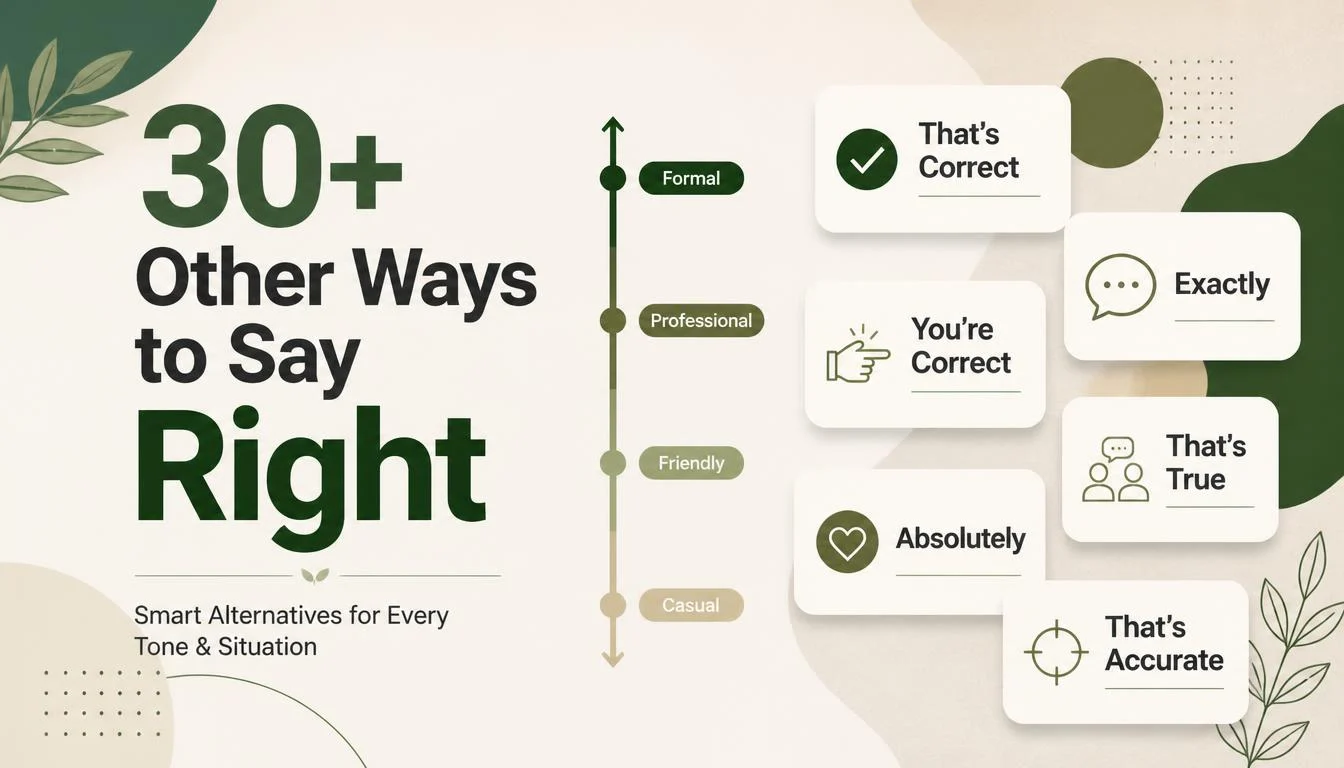
Tone Ladder and Classification Table
Not every alternative to “right” carries the same weight. Some sound stiff and formal, others sound relaxed and friendly, and picking the wrong one for the wrong room can make you sound either overly rigid or a little too casual. Here’s how the main alternatives rank on the formality scale, from most formal to most relaxed.
Very formal options work best in written correspondence, official statements, or high stakes professional settings. Formal alternatives are safe for most workplace conversations and client facing emails. Neutral phrases sit comfortably in almost any setting without drawing attention to themselves. Casual alternatives are great for coworkers you’re comfortable with or friendly small talk. Informal expressions are reserved for close friends, family, or relaxed group chats where nobody is grading your grammar.
| Phrase | Tone Level | Formality | Best Situation |
|---|---|---|---|
| That is correct | Very Formal | High | Written reports, official responses |
| Indeed | Very Formal | High | Formal writing, academic or legal tone |
| That is accurate | Formal | High | Business emails, presentations |
| Precisely | Formal | Medium-High | Meetings, professional discussions |
| Exactly | Neutral | Medium | Everyday conversation, emails |
| That’s true | Neutral | Medium | Casual and professional mix |
| Spot on | Casual | Medium-Low | Friendly chats, informal emails |
| You got it | Casual | Low | Team chats, relaxed workplaces |
| Yup, that’s it | Informal | Very Low | Texting, close friends |
| Bingo | Informal | Very Low | Playful, casual banter |
Quick Selection Guide
If you’re short on time and just need the fastest answer, here’s a simple breakdown of which phrase fits which situation without overthinking it.
| Situation | Best Phrase to Use |
|---|---|
| Job Interview | That is correct, or precisely |
| Professional Email | That is accurate, or noted with thanks |
| Networking Event | Exactly, or that’s a great point |
| Casual Conversation | Totally, or you got it |
Real Life Conversation Transformations
Seeing the word swapped into an actual sentence makes the difference far more obvious than a plain list of synonyms ever could. Here’s how a few common scenarios change when you move away from repeating “right” over and over.
Job Interview Scenario
Before: “Right, so you’re saying the role involves managing a small team, right?”
After: “That’s correct, so if I understand it well, the role involves managing a small team.”
The revised version removes the redundant repetition and replaces it with a confident, professional confirmation that sounds far more polished under interview pressure.
Networking Event Scenario
Before: “Right, that makes sense, I’ve run into that same problem before.”
After: “That’s a great point, I’ve actually run into that exact problem before.”
Swapping “right” for a warmer acknowledgment makes the exchange feel more like a genuine connection rather than a quick, distracted nod.
Email Scenario
Before: “Right, I’ll get the report done by Friday.”
After: “Understood, I’ll have the report completed by Friday.”
Emails read better without conversational filler words, and “understood” signals clear, professional intent without sounding cold.
Casual Conversation Scenario
Before: “Right, let’s just grab food after the movie.”
After: “Cool, let’s just grab food after the movie.”
In relaxed settings, small casual swaps like this keep the tone light and natural, exactly how people actually talk.
Other Ways to Say Right
Below is a full breakdown of strong alternatives, each with its meaning, an example sentence, its tone, and when to use or avoid it.
Correct
Correct means the statement matches the facts. Example: “You’re correct, the meeting was moved to Thursday.” Tone: neutral to formal. Best used in professional or academic settings. Avoid in casual texting, where it can sound stiff.
Exactly
Exactly emphasizes full agreement with precision. Example: “Exactly, that’s the point I was trying to make.” Tone: neutral. Works well in both spoken and written English. It can feel slightly overused in fast paced conversations if repeated too often.
Precisely
Precisely is a more formal version of exactly. Example: “Precisely, the numbers confirm what we suspected.” Tone: formal. Best in business meetings or academic discussions. It can sound overly stiff in casual chats.
That’s True
That’s true softly confirms accuracy while sounding conversational. Example: “That’s true, I hadn’t thought of it that way.” Tone: neutral. Great for both writing and speech. Less suitable for strictly formal documents.
Absolutely
Absolutely shows strong, enthusiastic agreement. Example: “Absolutely, I completely agree with your approach.” Tone: casual to neutral. Works well in emails and conversation. It can feel excessive if used with a low energy topic.
Spot On
Spot on is a British leaning phrase meaning perfectly accurate. Example: “Spot on, that’s exactly what happened.” Tone: casual. Ideal for friendly conversations and informal writing. Avoid it in very formal reports.
You Got It
You got it confirms understanding in a relaxed, friendly way. Example: “You got it, I’ll send that file over shortly.” Tone: casual. Common in workplace chats among familiar coworkers. Not ideal for first time client interactions.
Indeed
Indeed is a formal way to affirm something confidently. Example: “Indeed, the results support that theory.” Tone: formal. Common in academic and business writing. It can sound unnatural in everyday texting.
No Doubt
No doubt confirms certainty with a hint of emphasis. Example: “No doubt, that was the right call.” Tone: neutral to casual. Works in both speech and writing. It can feel dramatic in strictly formal contexts.
Bingo
Bingo signals excited, informal agreement, especially when someone guesses correctly. Example: “Bingo, that’s exactly the issue we found.” Tone: informal. Great for playful conversations. Never appropriate in professional writing.
That’s Accurate
That’s accurate is a polished, professional confirmation. Example: “That’s accurate based on the latest data.” Tone: formal. Ideal for reports, emails, and presentations. It feels overly formal in casual texting.
Understood
Understood shows clear acknowledgment without extra commentary. Example: “Understood, I’ll adjust the schedule accordingly.” Tone: formal to neutral. Perfect for professional emails. Rarely used in casual speech.
Got It
Got it is the relaxed, everyday version of understood. Example: “Got it, I’ll see you at three.” Tone: casual. Ideal for texting and quick replies. Too informal for official communication.
Sounds Good
Sounds good confirms agreement while sounding approachable. Example: “Sounds good, let’s move forward with that plan.” Tone: neutral to casual. Common in workplace messaging. Slightly too relaxed for formal proposals.
Fair Enough
Fair enough shows acceptance, often after a compromise. Example: “Fair enough, that’s a reasonable point.” Tone: neutral. Works well in debates or discussions. Less suitable when full agreement, rather than simple acceptance, is intended.
Roger That
Roger that is a playful, borrowed military phrase for confirmation. Example: “Roger that, I’ll take care of it now.” Tone: informal. Common among friends or relaxed teams. Never used in formal writing.
Copy That
Copy that is similar to roger that, confirming that a message was received. Example: “Copy that, I’ll update the file right away.” Tone: informal. Works in casual team chats. Avoid it in client facing communication.
Noted
Noted confirms something has been registered or understood. Example: “Noted, I’ll make sure to include that detail.” Tone: formal to neutral. Extremely common in professional emails. It can feel too short for warm conversations.
True That
True that is a casual affirmation often used among friends. Example: “True that, I couldn’t agree more.” Tone: informal. Best for spoken conversation. It sounds out of place in professional writing.
Nailed It
Nailed it celebrates getting something exactly right. Example: “You nailed it, that’s precisely the answer.” Tone: casual. Great for encouragement in relaxed settings. Too playful for serious business contexts.
Affirmative
Affirmative is a formal, almost technical way of saying yes or correct. Example: “Affirmative, the shipment has been confirmed.” Tone: very formal. Common in technical or official communication. It feels robotic in everyday conversation.
For Sure
For sure casually confirms agreement or certainty. Example: “For sure, that’s exactly what I meant.” Tone: casual. Common in spoken English among peers. Avoid it in formal documents.
Works for Me
Works for me confirms agreement, especially about plans or logistics. Example: “That time works for me, let’s confirm the meeting.” Tone: neutral to casual. Great for scheduling emails. Slightly too casual for legal or academic writing.
That Checks Out
That checks out confirms that something matches expectations. Example: “That checks out based on what I reviewed.” Tone: neutral. Useful in professional verification contexts. Less common in casual small talk.
You’re On the Money
You’re on the money is an idiomatic way of saying someone is exactly correct. Example: “You’re on the money with that estimate.” Tone: casual to neutral. Works well in relaxed professional settings. It can sound unfamiliar to non native speakers.
Usage Comparison Table
| Phrase | Spoken Use | Written Use | Context |
|---|---|---|---|
| Correct | Common | Common | Neutral, professional |
| Exactly | Very Common | Common | Everyday, versatile |
| Precisely | Occasional | Common | Formal, academic |
| Spot on | Common | Occasional | Casual, friendly |
| Understood | Occasional | Very Common | Professional emails |
| Got it | Very Common | Common | Casual, quick replies |
| Affirmative | Rare | Occasional | Technical, official |
| Roger that | Occasional | Rare | Informal, playful |
| Noted | Occasional | Very Common | Professional acknowledgment |
| For sure | Very Common | Occasional | Casual conversation |
Email and LinkedIn Ready Expressions
For emails, opening a reply with “Understood, thank you for clarifying” keeps things professional without sounding cold. When confirming a plan, “That works well on my end” sounds warmer than a plain “right” while still being efficient.
On LinkedIn, when responding to a connection’s comment, something like “That’s a great point, I completely agree” builds rapport far better than a flat “right.” For follow up messages, “Noted, I’ll circle back with an update soon” signals reliability and keeps the conversation professional and forward moving.
Native Speaker Insight
Native English speakers rarely say “right” in isolation during real conversation. It’s almost always shortened, blended into filler, or paired with a nod, something closer to “right, right” or a quick “mhm, exactly” rather than a full, deliberate sentence. In fast paced speech, “exactly” and “totally” tend to replace “right” naturally without anyone thinking twice about it.
What sounds unnatural is overusing very formal alternatives like “indeed” or “affirmative” in casual daily speech. These words exist and are correct, but stacking them into ordinary conversation makes a speaker sound scripted rather than natural. The preferred professional alternative in most workplace settings is simply “understood” or “noted,” since both are short, clear, and universally accepted.
Common Mistakes and What Not to Say
One common mistake is repeating “right” as a question tag at the end of nearly every sentence, which can come across as seeking constant reassurance rather than confidently stating a point. Another mistake is using overly formal phrases like “indeed” in texting or casual chats, which creates a strange tone mismatch that feels forced rather than natural.
Grammar issues also show up when people try to combine confirmations awkwardly, such as saying “that’s rightly correct,” which is redundant and unnecessary. Similarly, using “affirmative” outside of technical or military style contexts can sound overly stiff and out of place in a normal office conversation.
Expansion Phrases
Beyond direct alternatives to “right,” a few related expressions round out natural conversational flow. Greeting variations like “good to hear that” or “great, thanks for confirming” pair naturally with agreement phrases. Polite communication alternatives such as “I appreciate you clarifying that” work well after receiving confirmation from someone else. For general conversational English improvements, phrases like “makes sense” or “that lines up” add variety without ever needing to reach for “right” again.
Decision Making Table
| Situation | Best Phrase | Why It Works |
|---|---|---|
| Formal report | That is accurate | Sounds objective and professional |
| Team meeting | Exactly | Clear, confident, and versatile |
| Client email | Understood | Polished without sounding cold |
| Friendly chat | Spot on | Warm and natural sounding |
| Text message | Got it | Quick, casual, and efficient |
Quick Fast List
- Correct
- Exactly
- Precisely
- Spot on
- Understood
- Got it
- Absolutely
- That’s true
- Noted
- Fair enough
Mini Quiz
1. Which phrase fits best in a formal business report?
A) Bingo
B) That is accurate
C) Roger that
Answer: B
2. Which phrase is most natural in a casual text message?
A) Affirmative
B) Got it
C) Indeed
Answer: B
3. Which phrase works best after a great point in a networking conversation?
A) That’s a great point
B) Copy that
C) True that
Answer: A
4. Which phrase should be avoided in a professional email?
A) Understood
B) Noted
C) Bingo
Answer: C
5. Which phrase best fits a quick agreement between coworkers on a relaxed team?
A) You got it
B) Affirmative
C) Indeed
Answer: A
Answer Key
- A
- B
- B
- A
- C
FAQs
Is It Polite to Say “Right” Repeatedly in Conversation?
It’s not necessarily impolite, but using “right” too often can sound repetitive or even dismissive. Mixing in alternatives such as “exactly” or “that’s true” can make the conversation feel more natural and engaged.
What Is More Professional Than Saying “Right” in an Email?
“Understood” and “noted” are cleaner and more polished choices for professional email communication. They usually sound more appropriate than the casual “right.”
Can I Use “Spot On” in a Work Email?
Yes, especially in informal or friendly workplace cultures. However, “spot on” is better suited to internal messages than formal communication with clients or business partners.
What Do Native Speakers Say Instead of “Right” in Casual Talk?
Native speakers often use expressions such as “exactly,” “totally,” or “for sure” in relaxed everyday conversations. The best choice depends on the context and the level of agreement you want to express.
What Is the Best Alternative for “Right” in a Job Interview?
“That is correct” and “precisely” are both strong choices. They sound confident and professional without being overly casual.
Conclusion
Swapping out “right” doesn’t require memorizing dozens of new words, it simply means paying attention to tone and setting. A formal email calls for something like “understood” or “that is accurate,” while a relaxed chat with a friend fits naturally with “spot on” or “got it.” Once you start noticing the pattern, choosing the right alternative becomes second nature.
The real value here isn’t just sounding different, it’s sounding intentional. Every time you replace a repeated “right” with a phrase that actually matches the moment, your communication feels sharper, warmer, or more professional, exactly as the situation demands. With a little practice, these alternatives will start showing up naturally in your own conversations and writing.
Read More Related Articles:
- 30+ Other Ways to Say Happy 4th of July | Professional, Casual & Patriotic Greetings In 2026
- 35+ Other Ways to Say Happy Birthday in Advance | Creative Wishes for Every Relationship In 2026
- 35+ Other Ways to Say “Thank You for the Information” | For Modern Professionals In 2026

Zoe Chambers works as a content writer at synoseek.com, contributing thoughtful pieces on everyday subjects and ideas. She writes in a simple, grounded way, often drawing from real-world experiences. Her focus is on keeping content natural, clear and easy for readers to connect with.
13 thoughts on “30+ Other Ways to Say Right | Natural Synonyms for Everyday Conversations In 2026”