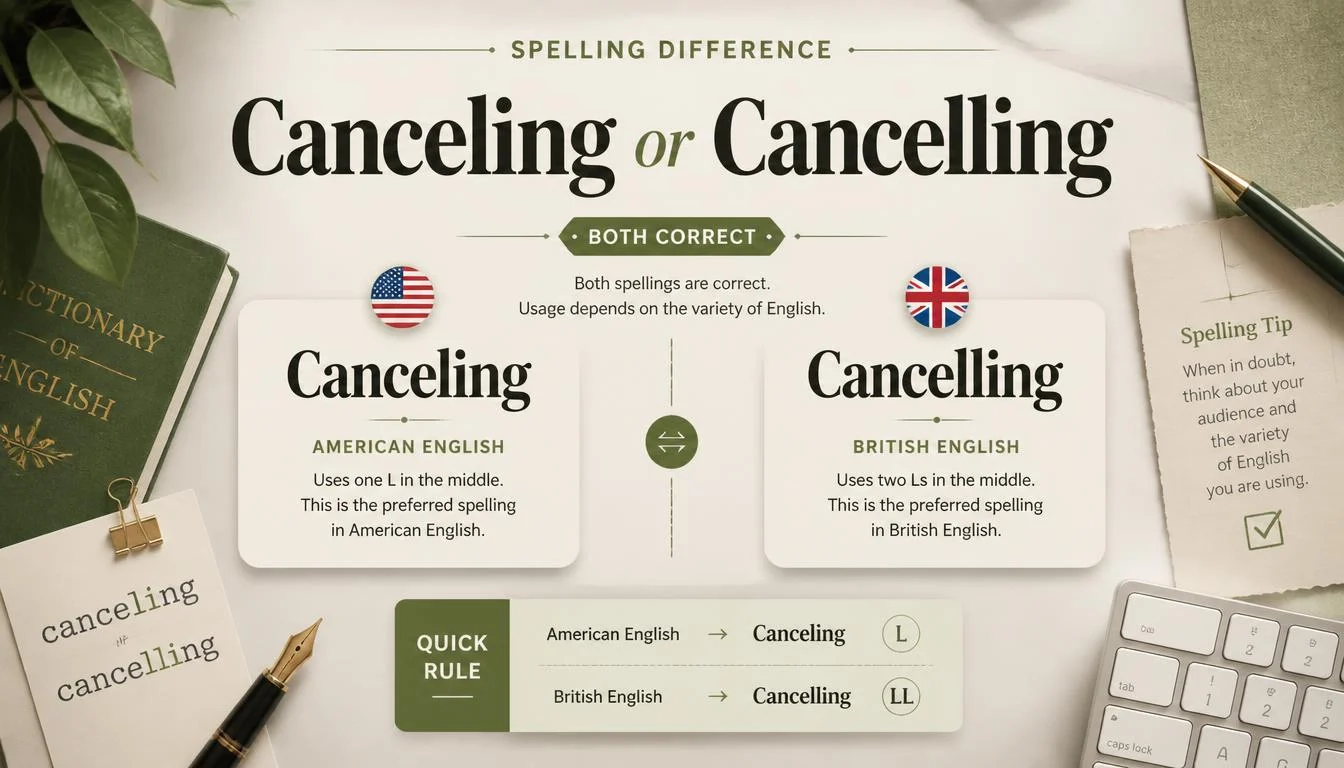
Quick Answer
Both spellings are correct. Canceling is the American English spelling, while cancelling is used in British, Australian, and Canadian English. The difference comes down to a spelling rule about doubling the final consonant before adding “-ing.” Neither version is a grammar mistake the correct choice depends on your audience and location.
You’re typing an email, you type the word out, and suddenly it looks wrong. One L or two? Autocorrect flags it, a coworker “corrects” you, and now you’re stuck wondering if you’ve been spelling it incorrectly your whole life. This happens to writers, students, and professionals constantly, and it’s one of the most searched spelling questions in the English language for a simple reason: the answer isn’t about right versus wrong. It’s about which country’s spelling rules you’re following.
Canceling and cancelling both come from the base verb “cancel,” meaning to call something off, void it, or stop it from happening. The confusion exists because American English and British English follow different rules for doubling consonants when adding suffixes like “-ing” or “-ed.” Neither group is technically breaking a rule. They’re just following two different rulebooks.
Getting this wrong doesn’t just look sloppy it can make your writing feel inconsistent, especially in professional documents, academic papers, or content meant for an international audience. In this guide, you’ll learn exactly which spelling to use, why the rule exists, how to avoid mixing the two, and how this same pattern shows up in dozens of other English words.
Canceling or Cancelling: What’s the Difference?
The core difference between canceling and cancelling is regional spelling convention, not meaning. Both words function identically as the present participle or gerund form of “cancel.”
In American English, the rule for adding “-ing” to a word ending in a single consonant depends on where the stress falls in the word. Since “cancel” is stressed on the first syllable (CAN-cel), American style guides say you don’t double the final “L” giving you canceling. British English, on the other hand, doubles the final consonant regardless of stress when the word ends in a single “L,” producing cancelling.
| Feature | Canceling | Cancelling |
|---|---|---|
| Meaning | To stop or void something | To stop or void something |
| Part of Speech | Verb (present participle/gerund) | Verb (present participle/gerund) |
| Refers To | Same action, American spelling | Same action, British spelling |
| Typical Usage | US, and increasingly Canada in casual writing | UK, Australia, New Zealand, formal Canadian English |
| Example | “The airline is canceling all flights.” | “The airline is cancelling all flights.” |
| Common Confusion | Assumed to be a typo or error | Assumed to be “extra” or old-fashioned |
So if you’re writing for a US-based company, a Google Doc for an American client, or a college paper in the United States, “canceling” is your safer bet. If you’re writing for a UK publication, an Australian business, or following British academic conventions, “cancelling” is correct. Neither spelling is inherently more proper consistency within a single document matters more than which one you pick.
Is Canceling a Grammar, Vocabulary, or Usage Issue?
This is a spelling and regional usage issue, not a grammar problem. Grammar concerns sentence structure, verb tense, and word order. Vocabulary concerns word choice and meaning. Spelling conventions like this one sit in a separate category entirely: orthography, or the accepted way of writing a word within a particular dialect.
Both words are 100% interchangeable in meaning. There’s no formal versus informal distinction, and no academic writing rule that favors one over the other outside of matching your target dialect. What actually matters is consistency:
- In formal English writing (reports, contracts, theses), pick one spelling based on your audience’s country and use it throughout the entire document.
- In business English, match your client or company’s location. A US-based SaaS company writing to American users should use “canceling.”
- In academic writing, follow whatever style guide your institution uses APA and Chicago Manual of Style both default to American spelling unless instructed otherwise.
- In everyday conversation or casual writing, either spelling is fine, though your phone’s autocorrect will likely nudge you toward whichever region your device is set to.
The practical takeaway: this isn’t a mistake to fix, it’s a dialect to choose. Pick one and stay consistent for the length of the piece you’re writing.
Canceling: Full Word Guide
Meaning: To stop something from happening, to void an agreement, or to call off a planned event or subscription.
Pronunciation: /ˈkæn.səl.ɪŋ/ stress falls on the first syllable, “CAN.”
Part of Speech: Verb, present participle/gerund form of “cancel.”
Common Collocations: canceling a subscription, canceling a meeting, canceling an order, canceling a flight, canceling plans.
Typical Sentence Pattern: [Subject] + is/are + canceling + [object].
Workplace Example: “We’re canceling tomorrow’s stand-up since half the team is out sick.”
Academic Example: “The professor announced she was canceling the exam due to a scheduling conflict.”
Technology Example: “The app sends a confirmation email after canceling your free trial.”
Email Example: “I’m writing to confirm that we are canceling our order #4521 due to a change in project scope.”
Daily Conversation Example: “He kept canceling on me, so I stopped making plans with him.”
One Learner Mistake: Many non-native English speakers double the “L” out of habit, writing “cancelling” even in American-style writing, then get corrected by spell-check tools set to US English. This isn’t wrong globally, but it can look inconsistent in an otherwise American document.
Mini Recap: “Canceling” is the single-L, American English spelling of the same verb form used everywhere else in the world just adjusted for US spelling conventions.
Cancelling: Full Word Guide
Meaning: Identical to “canceling” to stop, void, or call off something.
Pronunciation: /ˈkæn.səl.ɪŋ/ same pronunciation as the American version; the extra letter doesn’t change how it sounds.
Part of Speech: Verb, present participle/gerund form of “cancel.”
Common Collocations: cancelling a reservation, cancelling a contract, cancelling a trip, cancelling a membership, cancelling an appointment.
Typical Sentence Pattern: [Subject] + is/are + cancelling + [object].
Workplace Example: “The team is cancelling the client call until next week.”
Academic Example: “Cancelling the field trip disappointed several students who had already paid the deposit.”
Technology Example: “Users in the UK reported issues cancelling their subscriptions through the mobile app.”
Email Example: “We regret to inform you that we are cancelling the scheduled maintenance window.”
Daily Conversation Example: “She’s always cancelling last minute, so I’ve stopped counting on her.”
One Learner Mistake: Learners studying British English sometimes assume the double-L rule applies to every word ending in a consonant, which leads to errors like “openning” or “happenning.” The rule only applies to words like “cancel,” “travel,” and “model,” where the stress falls on the first syllable in British English’s doubling convention.
Mini Recap: “Cancelling” follows the British consonant-doubling rule and is the standard spelling across the UK, Australia, New Zealand, and much of the Commonwealth.
When Not to Use Each Spelling
Mistake 1: Mixing Spellings Within the Same Document
Writers often start with “cancelling” and switch to “canceling” halfway through a document, especially after copying text from different sources. This can look careless to readers and editors. Pick one spelling in your first paragraph and search the entire document for the other before submitting it.
Mistake 2: Using British Spelling in US Academic Papers
If you’re an international student submitting an essay to a US university, professors following APA or Chicago style will generally expect “canceling.” Using “cancelling” is not a grammar error, but it may be flagged as inconsistent with the required style guide.
Mistake 3: Assuming Autocorrect Is Always Right
Phone keyboards and word processors often use a specific regional dictionary. They may automatically “correct” one spelling to another. If your document is meant for a British audience but your device is set to US English, it may quietly change “cancelling” to “canceling” without you noticing.
Mistake 4: Overcorrecting Other “-el” Words
Because “cancel” becomes “cancelling” in British English, learners sometimes assume every similar word follows the same pattern. However, spelling changes vary between words. For example, “travel” becomes “travelling” in British English, while “reveal” becomes “revealing” in both dialects because of its stress pattern.
Mistake 5: Treating One Spelling as More Formal
Neither spelling is more authoritative or professional than the other. A business email using “canceling” can be just as formal as one using “cancelling.” The important thing is to follow the appropriate regional spelling consistently.
Mistake 6: Ignoring Company Style Guides
Many organizations, especially international companies, have internal style guides that specify which English variant to use in customer communications, marketing copy, and legal documents. Ignoring these guidelines can create inconsistency across a brand’s content.
Mistake 7: Forgetting Related Word Forms
If you write “cancelling,” the past tense should generally be “cancelled,” not “canceled.” Mixing “canceling” with “cancelled” in the same paragraph is a common slip-up, even among fluent writers.
Mistake 8: Assuming Spell Check Catches Everything
Some writing tools default to US English even when users believe they are set to another regional variant. Automated tools can therefore change your spelling without making the difference obvious. Always check your language settings before relying on spell check for content intended for a British or Australian audience.
Common Mistakes Table
| Correct Sentence | Incorrect Sentence | Explanation |
|---|---|---|
| “We are canceling the event.” (US) | “We are canceling the event, which was cancelled last year.” | Mixes “canceling” and “cancelled” in the same sentence pick one dialect and match the past tense. |
| “She’s cancelling her subscription.” (UK) | “She’s canceling her subscription, and it’s cancelling now.” | Both spellings used in one sentence looks like an editing error. |
| “The meeting was canceled.” (US past tense) | “The meeting was canceled twice, so we’re cancelling the whole project.” | Even correct within each sentence individually, combining dialects across a document is inconsistent. |
| “Please confirm the cancellation.” | “Please confirm the cancelation.” | “Cancellation” is spelled with double L in both American and British English this is one exception worth memorizing. |
Quick Decision Box
- If you’re writing for a US audience, textbook, or American company: use canceling and canceled.
- If you’re writing for a UK, Australian, or Commonwealth audience: use cancelling and cancelled.
- If you’re unsure: check your audience’s location first, then stay consistent for the entire piece. When in doubt, American spelling is the more common default in global business software and international SEO content.
Real-World Examples
Office communication: A project manager in New York emails the team: “Due to the storm, we’re canceling the in-office requirement for Friday.” Nobody blinks at the single L because the audience is domestic.
Business email: A London-based agency writes to a client: “We’re cancelling the scheduled photoshoot due to weather conditions and will reschedule for next week.” The double L fits naturally with British corporate tone.
School or university: An American professor posts on the class portal: “Office hours are canceled this Thursday.” A British lecturer might instead write: “Office hours are cancelled this Thursday” same meaning, different spelling convention.
Customer support: A US-based subscription service sends an automated message: “Your subscription is currently being canceled per your request.” An Australian company might phrase the identical message as “cancelling” instead.
Technology: App store reviews often reveal the mismatch a UK user might complain, “I keep cancelling my trial but it still charges me,” while a US reviewer writes the same complaint with a single L.
Artificial Intelligence: AI writing assistants often default to American spelling unless you specify your regional preference, which is why many users notice their chatbot suggesting “canceling” even when writing to UK clients.
Daily conversation: Texting a friend, “Sorry, cancelling dinner tonight” or “Sorry, canceling dinner tonight” reads identically in speech the spelling only matters once it’s written down.
Canceling in Modern Technology
Modern software has quietly standardized much of this debate, and it’s worth understanding how. Most artificial intelligence writing tools, including grammar checkers and AI chat assistants, default to American English spelling unless a user manually selects a different regional dictionary. This means “canceling” appears far more often in AI-generated text simply because American spelling is the default setting in most global tech products.
Virtual assistants and voice assistants like Siri, Alexa, and Google Assistant don’t actually display spelling when responding verbally, so the distinction disappears entirely in spoken interactions “Hey Siri, cancel my alarm” sounds the same regardless of dialect. It only resurfaces when these systems generate written confirmations or transcripts, where the assistant’s regional settings determine which spelling shows up.
Chatbots used in customer service, especially those built on US-based platforms, tend to default to “canceling” and “canceled” in automated responses, even for companies serving international customers. This has led some UK and Australian businesses to specifically configure their chatbot scripts to use “cancelling” to match their brand voice.
Software and business tools like Microsoft Word and Google Docs allow users to set their language preference, which changes not only spell-check behavior but also autocomplete suggestions. A document set to “English (United Kingdom)” will flag “canceling” as a possible error, while one set to “English (United States)” does the reverse.
Word Origin
The word “cancel” comes from the Latin word “cancellare,” meaning to cross out or make into a lattice pattern originally referring to the act of crossing out text with lines, similar to how you might cross out a mistake on paper. It entered English through Old French in the 14th century, and the meaning gradually shifted from “to cross out” to the broader modern sense of voiding or stopping something.
The spelling split between “canceling” and “cancelling” is much more recent, tracing back to 19th-century American spelling reforms led by lexicographer Noah Webster. Webster intentionally simplified many British spelling conventions to create a distinct American standard, and the consonant-doubling rule was one of the patterns he adjusted. British English retained the older doubling convention, which is why the split exists today.
Expert Insight
As a language instructor, I tell students not to think of this as a “correct versus incorrect” situation, but as a “which room am I speaking in” situation. English has regional dialects the same way it has regional accents. Just as you wouldn’t correct someone’s British accent as “wrong” for sounding different from an American one, you shouldn’t treat “cancelling” as a misspelling of “canceling,” or vice versa. The real skill isn’t memorizing one version it’s recognizing your audience and staying consistent once you’ve chosen a side.
Error Prevention Checklist
- Always use canceling and canceled when writing for an American audience, US-based company, or APA/Chicago style documents.
- Always use cancelling and cancelled when writing for a British, Australian, or Commonwealth audience.
- Never confuse them if you remember this: American English simplifies, British English doubles.
- Quick memory tip: “Cancelling” has more letters, just like “Britain” has more history with double consonants a simple visual trick to recall which version belongs to British English.
Related Grammar Confusions
- Traveling vs. Travelling follows the exact same American versus British doubling rule as “canceling.”
- Modeling vs. Modelling another common example of the same spelling split.
- Labeling vs. Labelling useful for writers working with product descriptions or packaging copy.
- Fueling vs. Fuelling frequently appears in news writing about energy and transportation.
- Color vs. Colour a broader American versus British spelling pattern unrelated to doubling, but equally confusing for learners.
- Practice vs. Practise a different kind of British-American split involving noun versus verb spelling.
- Realize vs. Realise shows the American “-ize” versus British “-ise” ending pattern.
- Gray vs. Grey a simple vocabulary spelling difference worth knowing alongside regional grammar rules.
- Canceled vs. Cancelled (past tense) directly tied to this topic and essential for consistency.
- Affect vs. Effect not a regional issue, but one of the most searched grammar confusions worth learning alongside spelling variants.
FAQs
Is “Cancelling” a Typo?
No, “cancelling” is not a typo. It is the correct British English spelling used in the UK, Australia and much of the Commonwealth. It may only look incorrect to readers who are more familiar with American spelling conventions.
Which Spelling Does Microsoft Word Prefer?
It depends on your language settings. If your document is set to English (United States), Word may flag “cancelling” as a spelling error. If it is set to English (United Kingdom), it may flag “canceling” instead.
Do Canadians Use “Canceling” or “Cancelling”?
Canadian English includes both American and British spelling conventions, so both forms appear. However, “cancelling” is generally more common in formal Canadian writing and government documents.
What About “Cancellation”? Does the Spelling Change Too?
No. “Cancellation” is spelled with a double L in both American and British English. This is one of the forms where American and British English use the same spelling.
Is One Spelling More Modern Than the Other?
Neither spelling is more modern. Both forms have existed alongside each other for a long time. The difference mainly reflects regional spelling conventions rather than a change in the English language.
Should I Switch Spellings Depending on Who I’m Emailing?
Yes. If you know your recipient’s location, matching their regional spelling can make your writing feel more natural. This is especially useful in international business communication where spelling conventions can vary between countries.
Conclusion
The choice between canceling and cancelling isn’t a matter of correctness it’s a matter of geography. American English drops the second “L” because of its stress-based spelling rules, while British English keeps the doubled consonant as part of its older spelling tradition. Both are fully accepted, professional, and grammatically sound.
The one rule that actually matters is consistency. Pick the spelling that matches your audience, your company’s style guide, or your assignment’s required dialect, and use it throughout the entire piece. If you remember nothing else, remember this: American simplifies, British doubles and either way, your writing will be correct as long as you don’t mix the two.
Read More Related Articles:
- Address or Adress | Learn the Right Spelling in Seconds In 2026
- Dog or Cat | Which Pet Actually Fits Your Life Better In 2026
- Drank or Drunk | Grammar Rule Made Easy In 2026

Caleb Dawson is a content writer at synoseek.com, where he works on simple, reader-focused articles across a range of everyday topics. His writing style is practical and grounded, aiming to present information in a clear and relatable way without unnecessary complexity.