Quick Answer:
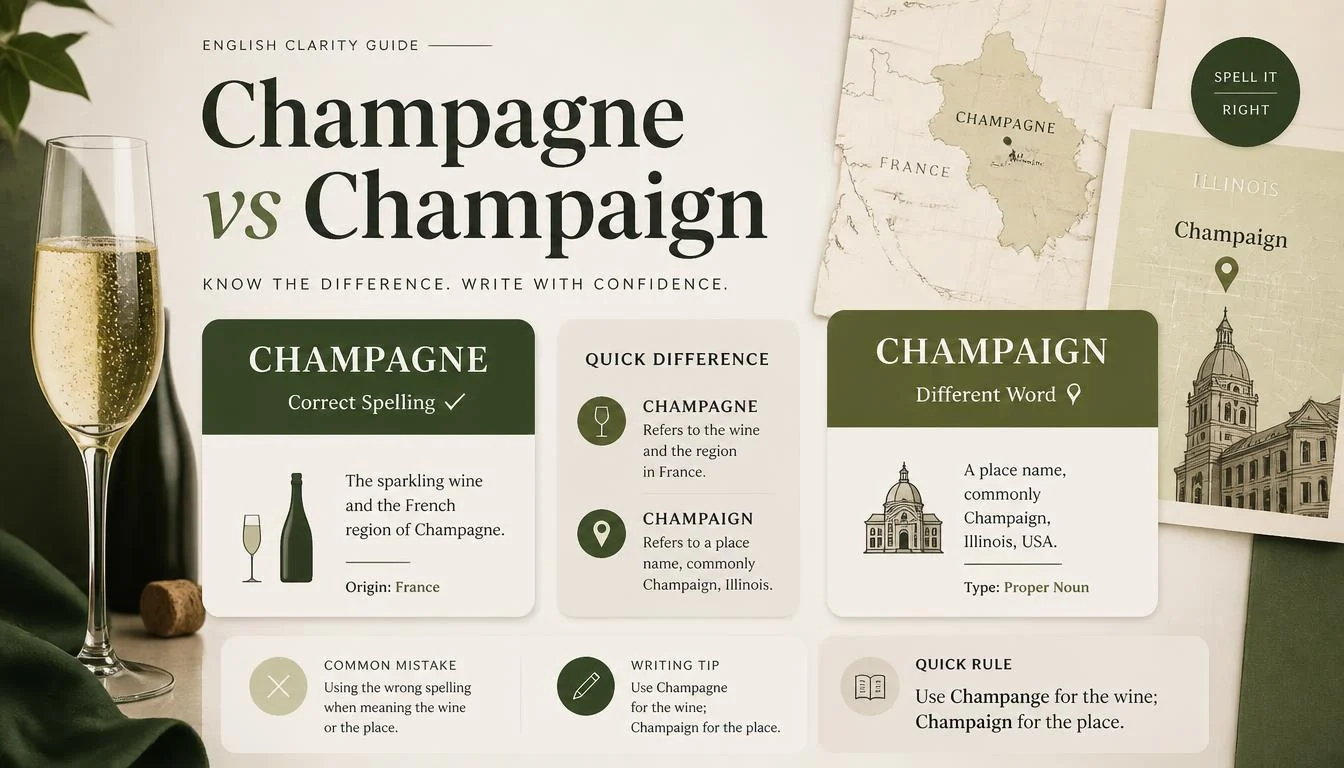
Champagne is a sparkling wine made in the Champagne region of France, while Champaign is the name of a city in Illinois. The confusion happens because the two words look and sound almost identical, but Champagne refers to a drink and a place in France, and Champaign refers only to a city in the United States. They are never interchangeable.
If you’ve ever wondered about Champagne vs Champaign, you’re not alone. These words look and sound similar, but they refer to completely different things. Champagne is associated with the famous sparkling wine, while Champaign is a place name.
Understanding Champagne vs Champaign can help you avoid spelling mistakes and use each word correctly. Whether you’re writing about wine, geography, or the city in Illinois, knowing the difference makes your writing more accurate and clear.
Why People Keep Mixing Up These Two Words
Picture this: someone types “Champaign toast” into a work email meant for a client dinner, hits send, and only notices the typo after the reply comes back. It happens more often than you’d think, and it’s not really about intelligence or carelessness. It’s about how our brains process words that look nearly the same on a page but come from completely different worlds.
Champagne and Champaign share almost every letter. The pronunciation overlaps just enough to trick the ear, especially for non-native speakers who learned both words by sound before ever seeing them spelled out. One word belongs to a bottle of celebratory wine from France. The other belongs to a college town in the American Midwest, home to the University of Illinois. Mixing them up isn’t just an awkward typo in a business email, a menu, or a wedding invitation, it can genuinely confuse the reader about what you actually meant.
This guide breaks down exactly where these words diverge, why the spelling trap exists in the first place, and how you can stop second-guessing yourself every time you reach for one of them.
Champagne vs Champaign: What’s the Difference?
The core difference is simple: Champagne is a drink and a French region, while Champaign is an American city. One word lives in a wine glass. The other lives on a map of Illinois.
Champagne refers to two connected things. First, it’s a historic region in northeastern France known for its chalky soil and cool climate, ideal for growing grapes used in sparkling wine. Second, and more commonly in everyday speech, “champagne” refers to the sparkling wine itself, made using a specific method called méthode champenoise. True Champagne, by French and EU law, can only carry that name if it’s produced within the designated region using approved grape varieties.
Champaign, on the other hand, has nothing to do with wine or France. It’s a city in Champaign County, Illinois, best known as one half of the “Champaign-Urbana” metro area and the home of the University of Illinois at Urbana-Champaign. The word functions purely as a proper noun a place name and has no other meaning in standard English.
| Meaning | Part of Speech | Refers To | Typical Usage | Example | Common Confusion |
|---|---|---|---|---|---|
| Champagne | Noun | Sparkling wine / French region | Toasts, celebrations, formal events | “They popped a bottle of champagne at midnight.” | Misspelled as “Champaign” |
| Champaign | Proper Noun | City in Illinois, USA | Addresses, university references, travel | “She studies at the University of Illinois in Champaign.” | Misspelled as “Champagne” |
Once you see them side by side like this, the difference stops feeling confusing. Champagne is something you drink or a region you might visit in France. Champaign is somewhere you might live, study, or fly into if you’re heading to central Illinois. The words simply don’t overlap in meaning, even though they overlap almost completely in spelling.
Is This a Grammar Issue, a Vocabulary Issue, or a Spelling Issue?
This is primarily a vocabulary and spelling issue, not a grammar problem. Both words are nouns, so there’s no verb conjugation or sentence structure to worry about. The real danger is purely orthographic one letter’s worth of difference (an “e” versus an “i” in the middle syllable) separates a wine reference from a city name.
Because both words are proper-noun-adjacent (Champagne functions partly as a brand-protected term, Champaign is always a proper noun), capitalization matters more here than in most vocabulary pairs. “Champagne” is capitalized when referring to the French region or the legally protected wine name, though many English speakers lowercase it when using it loosely for any sparkling wine. “Champaign” is always capitalized, since it’s strictly a place name.
In formal writing legal documents, academic papers, business correspondence, or anything referencing the University of Illinois getting the spelling right isn’t optional. A misspelled city name on a resume or shipping address can cause real logistical headaches. In casual conversation, most listeners won’t notice the difference because the words sound so similar when spoken quickly, but the written form is where mistakes actually cause problems.
The takeaway here is straightforward: treat this as a spelling checkpoint, not a grammar rule. If you’re writing about wine, drinks, or France, the “e” ending version is correct. If you’re writing about the Illinois city, the “i” ending version is correct.
Champagne: Meaning, Usage, and Examples
Champagne is a sparkling wine traditionally produced in the Champagne region of northeastern France, made through a secondary fermentation process that creates its signature bubbles. Pronounced “sham-PAYN,” it’s a noun that can refer to the beverage itself, the wine-producing region, or, informally, to any similar sparkling wine (though wine purists will point out that only bottles from the actual French region can legally use the name in the EU).
Common collocations include “a glass of champagne,” “champagne flute,” “champagne toast,” “champagne brunch,” and “champagne colored” (used as a shade of pale gold or cream in fashion and design). It frequently pairs with celebration-related vocabulary: weddings, New Year’s Eve, anniversaries, promotions, and grand openings.
Workplace example: “The team ordered champagne for the office after closing the biggest deal of the quarter.”
Academic example: “Her thesis examined the economic history of champagne exports from France to the United Kingdom during the 19th century.”
Technology example: “The startup’s investor pitch deck used a champagne-colored background to convey luxury and sophistication.”
Email example: “We’d love to celebrate the launch with a bit of champagne join us Friday at 5 PM in the main conference room.”
Daily conversation example: “Should we get champagne or just stick with wine for the anniversary dinner?”
Common learner mistake: Many English learners drop the silent letters or misplace the “g,” writing it as “champain” or “shampagne.” Remembering the French origin helps the word keeps its French spelling pattern, including the “gn” combination that produces the “ny” sound found in words like “lasagna.
Mini recap: Champagne is the drink, the region, and sometimes a color never a place in America.
Champaign: Meaning, Usage, and Examples
Champaign is the name of a city located in east-central Illinois, forming part of the twin-city area known as Champaign-Urbana. Pronounced the same way as “champagne” “sham-PAYN” it functions strictly as a proper noun referring to this specific location and has no other standard meaning in English.
Because it’s a place name, Champaign doesn’t have “collocations” in the traditional sense, but it does appear regularly alongside certain words: “Champaign County,” “Champaign-Urbana,” “downtown Champaign,” “Champaign, Illinois,” and “University of Illinois Urbana-Champaign” (often abbreviated UIUC).
Workplace example: “Our regional office is relocating from Chicago to Champaign next spring.”
Academic example: “He earned his engineering degree from the University of Illinois in Champaign before joining a robotics research lab.”
Technology example: “The tech incubator based in Champaign has helped launch several agricultural software startups.”
Email example: “I’ll be flying into Champaign on Thursday for the conference can someone arrange a shuttle from Willard Airport?”
Daily conversation example: “My cousin moved to Champaign for grad school and says the town is smaller than she expected.”
Common learner mistake: Because Champaign sounds exactly like Champagne, many learners (and even native speakers typing quickly) default to the wine spelling out of habit, especially in autocorrect-heavy environments where the food-and-drink word appears more frequently in everyday text. The fix is to consciously associate the “i” spelling with a place think “Champaign, Illinois” as a fixed phrase you memorize as a unit.
Mini recap: Champaign is a city name only it never refers to a drink, a color, or anything related to celebration.
When Not to Use Each Word
Mistake 1: Writing “Champaign” when referring to a drink. This happens most often in casual texting or social media captions, where people type quickly and rely on autocorrect. If you’re describing a beverage, sparkling wine, or a toast, the correct word is always Champagne. Remember: drinks end in “-agne,” matching the French spelling.
Mistake 2: Writing “Champagne” when referring to the Illinois city. This is common among people unfamiliar with the Midwest or those who’ve only ever encountered the wine spelling in daily life. If you mean the city, county, or university location, the correct word is Champaign, spelled with an “i.
Mistake 3: Assuming both spellings are acceptable variants. Some learners think this is like “color” versus “colour” a regional spelling difference. It isn’t. These are two entirely separate words referring to two entirely separate things, and neither spelling is interchangeable with the other.
Mistake 4: Relying on pronunciation alone to guess the spelling. Since both words sound identical when spoken, listening isn’t a reliable strategy for choosing the correct written form. You have to know the context wine or place before you can spell it correctly.
Mistake 5: Autocorrect substitution in professional documents. Word processors and phones often default to “Champagne” because it’s the more commonly typed word overall. If you’re addressing mail, filling out forms, or writing a resume mentioning the university, always double-check that autocorrect hasn’t quietly swapped your spelling.
Mistake 6: Using “Champaign” in a metaphorical or celebratory sense. Some writers try to use Champaign poetically, assuming it carries the same festive connotation as Champagne. It doesn’t. Champaign has no metaphorical meaning at all it’s purely geographic.
Mistake 7: Confusing the region of France with the city in Illinois when researching either topic. Search engines sometimes surface mixed results for shared root words. If you’re researching wine history, make sure you’re not accidentally reading about Illinois zoning laws, and vice versa.
Mistake 8: Assuming capitalization rules are optional for Champaign. Since it’s a proper noun, Champaign should always be capitalized, in every context, with no exceptions. Champagne, when used generically for any sparkling wine, is sometimes lowercased, but Champaign never is.
Common Mistakes Table
| Correct Sentence | Incorrect Sentence | Explanation |
|---|---|---|
| We toasted with champagne at the wedding. | We toasted with champaign at the wedding. | The drink is spelled with a final “e,” matching its French origin. |
| She’s attending grad school in Champaign, Illinois. | She’s attending grad school in Champagne, Illinois. | The city name uses an “i,” not an “e.” |
| The champagne region of France produces the world’s finest sparkling wines. | The champaign region of France produces the world’s finest sparkling wines. | The wine-producing region shares its name with the drink, spelled with an “e.” |
| His flight lands at Willard Airport in Champaign. | His flight lands at Willard Airport in Champagne. | Willard Airport is located in the Illinois city, not in France. |
| They served champagne flutes at the anniversary party. | They served champaign flutes at the anniversary party. | “Champagne flute” is a fixed phrase referring to the tall glass used for the wine. |
Decision Box: Which One Should You Use?
- If you’re talking about a bottle, a toast, or a drink use Champagne.
- If you’re talking about the city in Illinois or the University of Illinois campus use Champaign.
- If you’re still unsure, ask yourself: “Am I drinking this or driving to it?” Drinks get the “e.” Destinations get the “i.”
Real-World Examples Across Different Situations
Office communication: A manager planning a company milestone might write, “Let’s celebrate with champagne once the quarterly numbers are finalized,” while an HR coordinator scheduling a recruiting trip might write, “Our team will be visiting the University of Illinois campus in Champaign next month.”
Business email: “Attached is the itinerary for the Champaign site visit flights, hotel, and the campus tour schedule are all confirmed.” Compare that to: “We’re sending a bottle of champagne to the client’s office as a thank-you gesture.”
School or university: Students applying to UIUC often write things like, “I’m excited to start my freshman year in Champaign this fall,” while an alumni newsletter might mention, “Graduates gathered for a champagne reception before the commencement ceremony.”
Customer support: A shipping confirmation email might read, “Your package is scheduled for delivery to Champaign, IL, within three business days,” entirely unrelated to any beverage.
Technology: A logistics company’s internal tracking system might auto-populate “Champaign, IL” as a delivery hub, while a marketing team building a luxury product page might describe packaging using “a champagne-gold finish.”
Artificial intelligence: AI writing assistants and autocorrect tools frequently flag or auto-swap these two words because Champagne appears far more often in general text, which means Champaign sometimes gets silently “corrected” into the wrong spelling a good reason to proofread AI-generated content referencing Illinois locations.
Daily conversation: “Are we still meeting up in Champaign this weekend, or did the plans change?” versus “Do you want champagne or wine for dinner tonight?”
Champagne and Champaign in Modern Technology
Modern spell-checkers and predictive text systems tend to favor Champagne over Champaign simply because the wine-related word appears more frequently across everyday digital communication social media captions, product descriptions, and celebratory messages. This creates a subtle but real problem: virtual assistants, chatbots, and voice-to-text tools sometimes autocorrect “Champaign” into “Champagne” without the user noticing, especially in address fields or travel bookings.
Voice assistants like Siri, Alexa, and Google Assistant rely on context clues to differentiate the two words when transcribing speech, since they sound identical. If you say “book a flight to Champaign,” a voice assistant with strong contextual training will usually get it right by recognizing the travel-booking context, but weaker systems sometimes misfire, especially with less common city names.
Software used by logistics companies, university admissions systems, and airline booking platforms often includes custom dictionaries or validation rules specifically to prevent this swap, since incorrect city spelling can cause shipping delays or booking errors. If you work in e-commerce or customer service and regularly type addresses, it’s worth manually checking any address containing “Champa-something” before submitting a form.
Where These Words Come From
Champagne traces its name directly to the French region, which itself derives from the Latin word “campania,” meaning “flat countryside” or “plain” a reference to the region’s rolling, open landscape ideal for vineyards. Over centuries, the wine produced there simply took on the region’s name.
Champaign, Illinois, actually shares this same linguistic root. The city was named with a deliberate nod to the French word for open, flat countryside, reflecting the flat prairie landscape of central Illinois when it was settled in the 1800s. So while the two words look like a simple spelling coincidence, they’re actually etymological cousins both ultimately pointing back to the idea of open, level land, even though one became a wine and the other became a town.
Expert Insight
As a language instructor, this is one of my favorite pairs to teach precisely because the confusion isn’t really a grammar failure it’s a visual memory problem. Students who struggle with this pair usually benefit from creating a strong mental image rather than memorizing a spelling rule. I often tell learners to picture the French flag next to a champagne bottle for the “e” spelling, and a cornfield or a college campus for the “i” spelling in Champaign. Once you attach a physical image to each word, the correct spelling tends to surface automatically, even under time pressure.
Error Prevention Checklist
- Always use Champagne when referring to the sparkling wine, the French region, or the color.
- Always use Champaign when referring to the city in Illinois or the University of Illinois campus.
- Never assume the two spellings are interchangeable they represent entirely different concepts.
- Quick memory tip: “Champagne” ends like “cologne” (a French-style ending), while “Champaign” ends like “campaign” (an English word for a planned effort, minus one letter) separating them by their nearest English look-alike can help lock in the correct spelling.
Related Grammar and Vocabulary Confusions Worth Learning
- Affect vs Effect one of the most common grammar confusions in English, since they sound almost identical but serve different grammatical roles.
- Complement vs Compliment a classic vocabulary trap that changes meaning entirely with a single vowel swap.
- Stationary vs Stationery another spelling pair where the meaning shifts completely depending on one letter.
- Principal vs Principle frequently confused in academic and professional writing, much like Champagne and Champaign.
- Discreet vs Discrete both correct spellings, but with completely unrelated meanings.
- Capital vs Capitol a place-name confusion that mirrors the Champagne-Champaign pattern closely.
- Bazaar vs Bizarre a fun example of how pronunciation similarity can create spelling chaos.
- Elicit vs Illicit a favorite among advanced learners because the words sound nearly identical but come from different roots.
- Peak vs Peek vs Pique a three-way homophone trap that trips up even confident writers.
- Emigrate vs Immigrate a meaningful distinction tied to direction, much like how Champagne and Champaign are tied to origin.
FAQs
Is Champaign a real place or just a spelling variant of Champagne?
Champaign is a real and distinct city in Illinois, home to the University of Illinois. It is not a spelling variant of Champagne. The two words have different meanings and should not be used interchangeably.
Why do Champagne and Champaign sound exactly the same?
Champagne and Champaign are pronounced the same in standard English. Although their spellings are different, both names have French linguistic roots, which helps explain their similar pronunciation.
Can “champagne” ever refer to something other than the drink?
Yes. Champagne can refer to the sparkling wine associated with France’s Champagne region. It can also describe a pale gold or cream color, particularly in fashion, interior design, cosmetics, and product descriptions.
Is it offensive to call any sparkling wine “champagne” if it isn’t from France?
It isn’t generally considered offensive, but it is technically inaccurate. Champagne is a protected geographical name for qualifying sparkling wine produced in the Champagne region of France under its specific production rules. Other sparkling wines should generally be described by their appropriate regional or product name.
How can I remember which spelling to use when writing quickly?
Try connecting Champaign with campaign, since the two words have a similar spelling pattern. For the wine, remember Champagne with its French -agne ending. This simple association can help you distinguish the city from the drink.
Does autocorrect usually get this pair right?
Not always. Because Champagne is much more common in everyday writing, autocorrect may suggest or replace Champaign when you’re referring to the Illinois city. It’s especially helpful to double-check the spelling when writing addresses, locations, or travel information.
Conclusion
The difference between Champagne and Champaign comes down to one simple mental shortcut: a drink versus a destination. Champagne belongs in a wine glass or a French vineyard, while Champaign belongs on a map of Illinois, right alongside the University of Illinois campus.
Next time you’re typing quickly and pause on that middle syllable, remember the rule that ties both words together and separates them at the same time: if you can toast with it, it’s Champagne; if you can fly into it, it’s Champaign.
Read More Related Articles:
- Totaling or Totalling | American vs British English In 2026
- Hoodie or Hoody | Easy Way to Remember the Difference In 2026
- Truly or Truely | Simple Guide to Getting It Right In 2026

Caleb Dawson is a content writer at synoseek.com, where he works on simple, reader-focused articles across a range of everyday topics. His writing style is practical and grounded, aiming to present information in a clear and relatable way without unnecessary complexity.
5 thoughts on “Champagne vs Champaign | Don’t Confuse These Two Words In 2026”