Quick Answer:
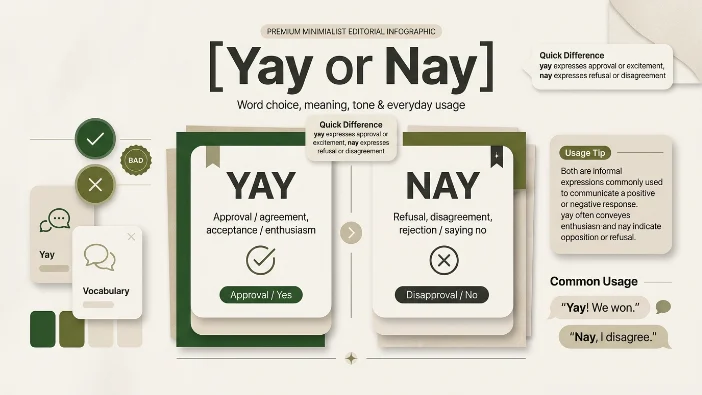
Yay or nay means “yes or no” and is used to ask for a quick opinion or decision. “Yay” shows approval or excitement, while “nay” shows disapproval or refusal. The phrase works in casual chats, polls, and even informal voting, but it isn’t appropriate for formal writing.
Wondering whether to say “Yay or Nay” when expressing approval or disapproval? These two short expressions are common in informal English, but they have different meanings and uses. “Yay” generally shows excitement or approval, while “nay” means no or expresses opposition.
In this guide, you’ll learn how to use “Yay or Nay” naturally in conversations, messages, and informal writing. We’ll also look at the difference between the two words, examples, and situations where each one fits best.
The Confusion Starts With a Simple Question
Someone drops a message in your group chat: “New restaurant downtown yay or nay?” You know exactly what they’re asking, but if you stopped to explain it to someone learning English, you might freeze. Is “yay” the same as “yea”? Does “nay” only belong in old movies about parliament? And why does this two-word phrase show up everywhere from office Slack channels to Instagram polls?
The truth is that yay and nay are two small words carrying a lot of communication weight. People mix them up with their lookalikes “yea,” “nah,” “aye” more often than you’d expect, and using the wrong one can make a message look sloppy or, in formal settings, genuinely confusing. A workplace survey asking for “yea or nay” votes on a policy reads very differently from a friend texting “yay or nay” about pizza toppings.
By the end of this guide, you’ll know exactly when each word belongs, how they differ in tone and grammar, and how to avoid the mix-ups that trip up even confident English speakers.
Yay or Nay: What’s the Difference?
The core difference is emotional direction: “yay” signals excitement or approval, while “nay” signals rejection or a negative answer.
Both words function as interjections short expressions that convey a reaction rather than build a full sentence. “Yay” is the informal cousin of “yes,” often paired with celebration, cheering, or enthusiasm. Nay” is older and more formal in its roots, historically used as the negative counterpart to “yea” in voting, though today it also appears casually as a playful way to say no.
| Meaning | Part of Speech | Refers To | Typical Usage | Example | Common Confusion |
|---|---|---|---|---|---|
| Yay | Interjection | Approval, excitement, “yes” | Casual conversation, social media, polls | “Yay, we got the tickets!” | Confused with “yea” |
| Nay | Interjection | Disapproval, refusal, “no” | Casual polls, playful refusals, formal voting | “Nay, I’ll pass on that one.” | Confused with “nah” |
So when someone asks “yay or nay?”, they’re really asking “yes or no?” but with a slightly more playful, opinion-seeking tone than a plain yes/no question would carry. It invites a quick gut reaction rather than a lengthy explanation.
Is “Yay or Nay” a Grammar, Vocabulary, or Usage Issue?
This is mostly a vocabulary and usage issue rather than a strict grammar rule. Both “yay” and “nay” are interjections, so neither one changes a sentence’s grammatical structure you’re not conjugating them or worrying about subject-verb agreement.
The real challenge is knowing which context each word fits. In everyday conversation, “yay or nay” is a friendly, low-stakes way to gather opinions. In business English, it can still work in casual internal messages (“Team, pizza for Friday yay or nay?”), but it should be avoided in formal reports, client emails, or academic writing, where “yes or no,” “approve or reject,” or “in favor or opposed” sound more professional.
Academic writing avoids the phrase almost entirely, since interjections rarely belong in formal argumentation. In everyday speech, though, the phrase is completely natural and widely understood across age groups.
Takeaway: Save “yay or nay” for informal or semi-casual settings, and switch to more neutral phrasing when the context calls for professionalism.
Yay: Meaning, Usage, and Examples
“Yay” is an informal interjection that expresses joy, excitement, or agreement. It’s the verbal equivalent of a fist pump short, energetic, and emotionally loaded.
Part of speech: Interjection Common collocations: “yay for,” “yay, finally,” “big yay,” “yay or nay” Typical sentence pattern: Usually stands alone or opens a sentence, often followed by an exclamation point.
Here’s how “yay” shows up in real situations:
- Workplace example: “Yay, the client approved the new design!”
- Academic example: A student texting a friend after finishing a thesis: “Yay, I finally submitted it.”
- Technology example: A notification reply in a team app: “Yay, the bug is fixed.”
- Email example: Even in a lightly informal internal email: “Yay the budget got approved for next quarter.”
- Daily conversation example: “Yay, it’s finally Friday!”
Common learner mistake: Non-native speakers sometimes confuse “yay” with “yea,” assuming they’re interchangeable spellings. They’re not. “Yea” is the traditional, more formal affirmative used in voting (“all in favor say yea”), while “yay” is the casual expression of excitement. Mixing them up in writing can look like a typo rather than a stylistic choice.
Mini recap: Use “yay” when you want to express happiness or approval in a casual, energetic way never in formal writing.
Nay: Meaning, Usage, and Examples
“Nay” is an interjection expressing disapproval, refusal, or a negative vote. It carries a slightly more formal or old-fashioned tone than casual alternatives like “nah,” which makes it feel a bit more deliberate when used in everyday speech.
Part of speech: Interjection Common collocations: “nay, I don’t think so,” “yay or nay,” “nay-sayer” (informal noun form) Typical sentence pattern: Often stands alone as a short reply or opens a sentence before an explanation.
Real-world examples:
- Workplace example: “Nay, I don’t think we have the budget for that this quarter.”
- Academic example: In a mock debate class, a student might say, “Nay the evidence doesn’t support that claim.”
- Technology example: Replying to a feature poll in a product forum: “Nay, that update would slow things down.”
- Email example: “Nay on the Friday meeting can we push it to Monday?”
- Daily conversation example: “New haircut? Nay, I liked the old one better.”
Common learner mistake: Learners often assume “nay” is simply a formal version of “no” that fits everywhere. In reality, using it in serious professional writing (like a legal document or formal report) can sound oddly theatrical rather than professional. It fits best in casual polls, playful refusals, or genuinely formal voting contexts the middle ground is where it gets tricky.
Mini recap: Use “nay” for a quick, slightly playful or classic-sounding “no,” especially in polls, casual debates, or informal group decisions.
When Not to Use “Yay” or “Nay”
Even confident speakers stumble here. Below are the situations where writers most often pick the wrong word or use either word when neither one fits.
1. Formal business proposals. Writing “yay or nay on this contract?” in a client-facing email undercuts your professionalism. Use “Please confirm your approval or rejection” instead.
2. Legal or academic documents. Neither word belongs in formal argumentation. Readers expect “affirmative” and “negative,” or simply “yes” and “no.”
3. Confusing “yea” with “yay.” “Yea” is the traditional affirmative used in formal voting (“the yeas have it”), while “yay” is purely about excitement. Swapping them in writing changes the tone entirely.
4. Using “nay” when you mean a soft, casual “no.” “Nay” can sound a little theatrical for everyday refusals. “Nah” often fits better in relaxed texting.
5. Overusing “yay or nay” in professional surveys. It works fine for internal team polls about lunch, but a customer satisfaction survey should use clearer, neutral language like “yes or no” or a rating scale.
6. Assuming “nay” is rude. Some learners avoid “nay” thinking it sounds harsh. It’s actually neutral to playful the tone comes from context, not the word itself.
7. Writing “yay/nay” without commas or spacing in formal contexts. Even in casual use, “yay or nay” (not “yay/nay”) reads more naturally in conversational writing.
8. Forgetting regional familiarity gaps. Not every English speaker recognizes “nay” instantly, especially non-native speakers. In international business communication, a plainer phrase avoids confusion.
Common Mistakes Table
| Correct Sentence | Incorrect Sentence | Explanation |
|---|---|---|
| “Team, yay or nay on the new logo?” | “Team, yay or nah on the new logo?” | Mixing casual “nah” into the set phrase breaks the parallel structure. |
| “All in favor say yea.” | “All in favor say yay.” | Formal voting uses “yea,” not “yay.” |
| “Please confirm your approval by Friday.” | “Yay or nay this contract by Friday?” | Formal business writing should avoid the casual phrase entirely. |
| “Nay, I’d rather stay in tonight.” | “Nay, I’d rather stay in tonight, sir.” | Combining “nay” with formal address feels mismatched in tone. |
| “New menu yay or nay?” | “New menu yay or nay on it?” | Adding “on it” is redundant since the phrase already implies a decision. |
Quick Decision Box
If you mean excitement or approval, use “yay.” If you mean disapproval or a playful refusal, use “nay.” If you’re voting formally, use “yea” and “nay” instead of “yay.”
That last distinction is the one that trips people up most, so it’s worth reading twice.
Real World Examples
Office communication: A manager posts in the team channel, “Should we move the Monday meeting to Tuesday? Yay or nay?” Everyone reacts with a quick emoji instead of writing a full sentence this is exactly the casual, fast-decision context the phrase was built for.
Business email: An internal (not client-facing) email between coworkers: “Happy hour this Friday yay or nay, let me know by lunch.”
School or university: A student council poll reads: “New vending machine snacks yay or nay?” Students vote informally, showing how the phrase fits casual group decisions even in academic settings.
Customer support: A support agent might avoid it, choosing instead, “Could you confirm yes or no on the refund request?” proof that formality shifts the word choice even when the meaning stays the same.
Technology: App developers sometimes build simple “yay or nay” swipe polls into apps, letting users vote instantly on features or content.
Artificial Intelligence: Chatbots and AI assistants sometimes phrase quick confirmation prompts as “Yay or nay on this suggestion?” to keep interactions feeling human and conversational rather than robotic.
Daily conversation: “I’m thinking of dyeing my hair blue. Yay or nay?”
“Yay or Nay” in Modern Technology
The phrase has found a comfortable home in digital spaces because it’s short, expressive, and instantly understood. Polling features on social media platforms often use “yay or nay” style prompts because they invite a fast emotional reaction rather than a considered essay-length response.
Virtual assistants and chatbots increasingly borrow casual phrasing like this to sound less mechanical. A voice assistant confirming a calendar change might say, “Move your 3 PM meeting? Yay or nay?” instead of a stiffer “Please confirm yes or no,” because casual phrasing builds a friendlier user experience.
In software design, especially onboarding flows and in-app surveys, teams often A/B test “yay or nay” style prompts against plain “yes or no” buttons because the playful phrasing can boost engagement people respond faster to language that feels conversational rather than transactional.
Where “Nay” and “Yea” Came From
“Nay” and “yea” both trace back to Old English, where they functioned as the original affirmative and negative responses long before “yes” and “no” became dominant. “Yea” comes from the Old English “gēa,” while “nay” developed from “nā,” a combination meaning “no, ever.” Both survived for centuries in formal contexts, especially legislative voting, which is why you still hear “the yeas and nays” in parliamentary procedure today.
“Yay,” on the other hand, is a much newer, informal invention a playful offshoot of “yea” that took on its own identity as an expression of celebration rather than a formal vote. It didn’t need centuries of legal use to catch on; it spread through casual speech and, later, internet culture.
Expert Insight
Here’s something worth remembering as a language learner or writer: the words we use to express agreement and disagreement often carry more emotional information than the actual “yes” or “no” content. When you choose “yay” over a plain “yes,” you’re not just answering you’re adding enthusiasm. When you choose “nay” over “nah,” you’re softening a refusal with a touch of playfulness instead of bluntness. Paying attention to that emotional layer, not just the dictionary meaning, is what separates fluent, natural-sounding English from technically correct but flat-sounding English.
Error Prevention Checklist
- Always use “yay” when expressing excitement, celebration, or informal approval.
- Always use “nay” for a quick, slightly playful refusal or in genuinely formal voting contexts.
- Never confuse them if you remember: “yay” has extra energy (and an extra letter compared to “yea”), while “nay” and “yea” belong together as a formal voting pair.
- Quick memory tip: Think of “yay” with a cheer it even looks like it’s celebrating with that double vowel. “Nay” rhymes with “way,” as in “no way.”
Related Grammar Confusions
- Yea vs. Yay These look almost identical but serve completely different tones, making them one of the most commonly confused word pairs online.
- Nay vs. Nah Knowing when “nay” sounds intentional versus when “nah” sounds more natural can sharpen your casual writing.
- Aye vs. Yes “Aye” carries its own formal and regional flavor, especially in nautical and Scottish English.
- Affect vs. Effect A classic grammar mix-up that trips up even advanced writers.
- Farther vs. Further Understanding distance versus degree clears up a common writing error.
- Fewer vs. Less Countable versus uncountable nouns explain this frequent mistake.
- Whom vs. Who A grammar rule tied to sentence roles that many writers avoid entirely.
- Assure vs. Ensure vs. Insure Three similar-sounding words with very different jobs.
- Its vs. It’s One of the most searched grammar questions in English.
- Complement vs. Compliment A spelling mix-up with real meaning consequences.
FAQs
Is “yay or nay” grammatically correct?
Yes. “Yay or nay” is a widely understood informal expression used to ask whether someone agrees with, approves of, or rejects something. It works well in casual conversation and informal messages, but more formal alternatives are better suited to professional or academic writing.
What’s the difference between “yay” and “yea”?
Yay expresses excitement, enthusiasm, or informal approval, while yea is a traditional word meaning yes, especially in voting or formal expressions. Although they sound similar, they have different meanings and uses.
Can I use “yay or nay” in a professional email?
You can use it in a casual workplace message, especially when communicating with familiar colleagues. For client emails, formal requests, or official communication, clearer alternatives such as “yes or no,” “approve or decline,” or “in favor or against” are more appropriate.
Why do people confuse “nay” with “nah”?
Both words can express disagreement or refusal, but their tone differs. Nay sounds more traditional or formal, while nah is distinctly casual and conversational. Choosing between them depends largely on the tone you want to convey.
Is “nay” considered rude?
No. Nay is not inherently rude. It can sound formal, old-fashioned, or playful depending on the context, but the word itself does not carry a negative or disrespectful meaning.
Where did the phrase “yay or nay” come from?
The expression follows the structure of the older phrase “yea or nay,” which was traditionally associated with voting and formal expressions of agreement or disagreement. “Yay or nay” developed as a more casual, modern variation, using yay to add an informal and enthusiastic tone.
Conclusion
The difference between “yay” and “nay” comes down to emotional direction and formality level. “Yay” carries excitement and approval, while “nay” carries refusal, sometimes with a playful or slightly old-fashioned edge. Neither word belongs in formal writing, but both are perfectly natural even useful in everyday conversation, casual polls, and quick group decisions.
If you remember one rule from this guide, make it this: save “yay or nay” for moments that call for a quick, honest gut reaction, and reach for more formal alternatives whenever the stakes or the setting call for professionalism.