Quick Answer
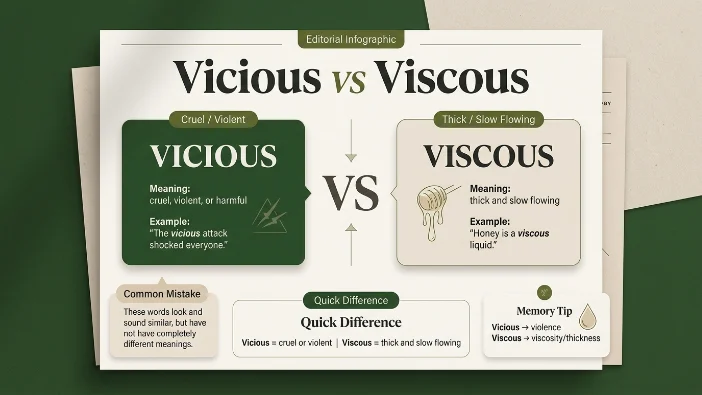
The difference between vicious and viscous is significant: vicious (VIH-shuhs) describes something cruel, violent, or deliberately harmful, while viscous (VIHS-kuhs) describes a thick, sticky liquid that flows slowly. Choosing the wrong word can make your writing confusing or even unintentionally humorous, so understanding this distinction is essential for clear communication .
You’re writing an important email and describe a difficult client’s feedback as “viscous” when you mean “vicious.” Or you’re drafting a recipe and call the sauce “vicious” instead of “viscous.” These mistakes happen more often than you might think, and they can completely change the meaning of your message.
While vicious and viscous look similar and share a Latin root, they describe entirely different things. Vicious relates to cruelty, aggression, and harm. Viscous describes physical stickiness and thickness think honey, molasses, or engine oil . The confusion is understandable given their similar spelling, but using the wrong word can make you sound unprofessional or create confusing imagery (a “vicious syrup” sounds like a horror movie, not breakfast).
In this guide, you’ll learn exactly how to distinguish between these two words, when to use each one correctly, and how to avoid common mistakes. By the end, you’ll never confuse vicious and viscous again.
What’s the Difference?
At their core, these words are both adjectives, but they belong to completely different categories of meaning. Vicious describes behavior, character, or conditions involving cruelty, violence, or malice. Viscous describes a physical property the thickness and stickiness of a liquid .
The confusion primarily arises from their visual similarity. Both start with “vi” and end with “ous,” and both have a “c” in the middle. However, their pronunciations are distinct: vicious is pronounced “VIH-shuhs,” while viscous is pronounced “VIHS-kuhs” . In speech, the difference is clear, but in writing, people often mix them up.
Comparison Table
| Feature | Vicious | Viscous |
|---|---|---|
| Meaning | Cruel, violent, or deliberately harmful | Thick, sticky, and slow-flowing |
| Part of Speech | Adjective | Adjective |
| Refers To | Behavior, character, actions, conditions | Physical consistency of liquids |
| Typical Usage | “vicious attack,” “vicious rumor,” “vicious cycle” | “viscous liquid,” “viscous honey,” “viscous lava” |
| Example | The dog launched a vicious attack. | The honey was too viscous to pour. |
| Common Confusion | Mistakenly used to describe textures | Mistakenly used to describe behavior |
Recap: If you’re talking about meanness, cruelty, or danger, use vicious. If you’re talking about stickiness, thickness, or gooeyness, use viscous. They are not interchangeable under any circumstances .
Is This a Grammar, Vocabulary, or Usage Issue?
This confusion sits at the intersection of vocabulary and usage rather than strict grammar. Both words are grammatically correct adjectives they function the same way in a sentence, modifying nouns. The issue is entirely about choosing the correct word based on meaning and context.
Vocabulary Classification: Vicious and viscous are distinct vocabulary items with no semantic overlap. They are not synonyms, nor are they interchangeable in any context. This is a vocabulary error, similar to confusing “affect” and “effect” .
Usage Classification: The error arises from misuse based on visual similarity rather than meaning. Writers often type one word when they mean the other simply because they look alike. This is a usage issue knowing which word fits the context.
Are they interchangeable? No, absolutely not. Using vicious when you mean viscous (or vice versa) will change your meaning completely and likely confuse your reader .
Formal English: In academic writing, precision matters. Scientists discuss viscous fluids; historians describe vicious regimes. In business English, you might describe a vicious competitive environment or a viscous chemical compound. In everyday conversation, you’ll hear about vicious gossip or viscous sauce .
Practical Takeaway: Always consider the noun you’re modifying. If it’s a person, animal, action, or situation with negative intent, choose vicious. If it’s a liquid or substance with a thick consistency, choose viscous.
Understanding “Vicious”
Meaning
Vicious means deliberately cruel, violent, or aggressive. It can also describe something extremely severe, harmful, or characterized by malice. The word carries a consistently negative connotation, implying danger, meanness, or destructiveness .
Pronunciation
VIH-shuhs (/’vɪʃəs/), with the emphasis on the first syllable and a soft “sh” sound.
Part of Speech
Adjective. Forms include:
- Viciously (adverb): “She viciously attacked his reputation.”
- Viciousness (noun): “The viciousness of the crime shocked the community.”
Common Collocations
- Vicious attack
- Vicious rumor
- Vicious cycle / vicious circle
- Vicious dog
- Vicious temper
- Vicious gossip
- Vicious blow
- Vicious criticism
Typical Sentence Patterns
- “[Subject] was vicious to [object].”
- “The [noun] launched a vicious [action].”
- “She found herself in a vicious cycle of [problem].”
Natural Workplace Example
“The manager’s vicious criticism of the junior employee created a toxic work environment.”
Academic Example
“The study examined the vicious cycle of poverty and how it perpetuates inequality across generations.”
Technology Example
“The company faced a vicious cyberattack that compromised customer data and damaged its reputation.”
Email Example
“I need to address the vicious rumors circulating about our department. Please refrain from spreading unverified information.”
Daily Conversation Example
“Did you hear about that vicious dog in the neighborhood? It bit three people last week.”
One Learner Mistake
❌ “The sauce was so vicious it wouldn’t pour.”
✅ “The sauce was so viscous it wouldn’t pour.”
Mini Recap: Vicious is always negative. It describes intentional cruelty, violence, or harm. If you can’t imagine the word having anything to do with liquids, you’re on the right track.
Understanding “Viscous”
Meaning
Viscous describes a liquid that is thick, sticky, and flows slowly due to high internal friction or resistance to flow. It’s a scientific and everyday term for substances like honey, molasses, syrup, or lava that don’t pour easily .
Pronunciation
VIHS-kuhs (/’vɪskəs/), with a hard “k” sound in the middle. This is the key difference from vicious remember the “k” sound for “sticky” .
Part of Speech
Adjective. Forms include:
- Viscosity (noun): “The viscosity of the oil made it difficult to pump.”
- Viscously (adverb): less commonly used but grammatically correct.
Common Collocations
- Viscous liquid
- Viscous fluid
- Viscous syrup
- Viscous honey
- Viscous lava
- Viscous oil
- Viscous consistency
- Highly viscous
Typical Sentence Patterns
- “The [substance] was too viscous to [action].”
- “[Liquid] becomes more viscous when [condition].”
- “The mixture had a viscous, [adjective] texture.”
Natural Workplace Example
“The chemist measured the viscous fluid’s flow rate through the narrow tube.”
Academic Example
“Magma with high silica content is extremely viscous, which contributes to explosive volcanic eruptions.”
Technology Example
“The 3D printer uses a viscous resin that hardens when exposed to ultraviolet light.”
Email Example
“We need to order more viscous ink for the industrial printers the current batch is too thin and smearing.”
Daily Conversation Example
“This honey is so viscous it’s practically solid I can barely get it out of the jar.”
One Learner Mistake
❌ “He was a viscous man who enjoyed hurting others.”
✅ “He was a vicious man who enjoyed hurting others.”
Mini Recap: Viscous is a physical description. It applies to liquids and has nothing to do with behavior or intent. If you’re describing something you can pour (even slowly), viscous is likely the word you need.
When NOT to Use Each Word
Situations Where Writers Choose the Wrong Word
1. Describing a Person’s Behavior
- Mistake: “She gave him a viscous glare.”
- Why it happens: The writer confuses the spelling of the two words.
- Correct word: Vicious glances and glares are behavioral, not physical textures.
2. Describing a Thick Liquid
- Mistake: “The vicious syrup dripped slowly from the jar.”
- Why it happens: The writer thinks the words are similar enough to be interchangeable.
- Correct word: Viscous syrup is a liquid with a physical property.
3. Describing a Harmful Situation
- Mistake: “They were trapped in a viscous cycle of debt.”
- Why it happens: The writer confuses the spelling.
- Correct word: Vicious this is an idiom for a harmful, self-perpetuating problem.
4. Describing a Substance in a Recipe
- Mistake: “Reduce the sauce until it becomes vicious.”
- Why it happens: Misremembering the word due to visual similarity.
- Correct word: Viscous you’re describing consistency.
5. Discussing an Aggressive Animal
- Mistake: “That viscous dog has bitten three people.”
- Why it happens: The writer reaches for the more familiar-sounding word.
- Correct word: Vicious animals can be dangerous; they aren’t sticky.
6. Writing About Physics or Chemistry
- Mistake: “The vicious properties of the fluid affected its flow rate.”
- Why it happens: Confusing the vocabulary.
- Correct word: Viscous this is about fluid dynamics.
Memory Tip: If it hurts, it’s vicious. If it sticks, it’s viscous. The hard “k” sound in viscous can remind you of “thick” or “sticky.”
Common Mistakes Table
| Correct Sentence | Incorrect Sentence | Explanation |
|---|---|---|
| The viscous honey dripped slowly from the spoon. | The vicious honey dripped slowly from the spoon. | Honey is a liquid with physical thickness viscous is the right word. Vicious would imply the honey is cruel. |
| He was known for his vicious temper. | He was known for his viscous temper. | Temper is behavioral vicious describes cruelty, while viscous describes stickiness. |
| The researcher measured the viscous fluid’s flow rate. | The researcher measured the vicious fluid’s flow rate. | Fluids have viscosity viscous is the correct scientific term. |
| She spread vicious rumors about her coworkers. | She spread viscous rumors about her coworkers. | Rumors are harmful, not sticky vicious is correct. |
| The cold weather made the oil more viscous. | The cold weather made the oil more vicious. | Temperature affects physical properties like viscosity, not behavior. |
| The dog’s vicious bite required stitches. | The dog’s viscous bite required stitches. | Dog bites involve danger, not stickiness vicious is correct. |
Quick Decision Box
If you mean something is…
☑️ Cruel, violent, or harmful → VICIOUS
☑️ Thick, sticky, and slow-flowing → VISCOUS
Remember: Vicious describes behavior (it’s mean). Viscous describes texture (it’s sticky). One has a “sh” sound; the other has a hard “k” sound.
Real-World Examples
Office Communication
“The feedback from the client was unexpectedly vicious they questioned the team’s competence without offering constructive criticism.”
“The adhesive used in the office labels was too viscous, making the dispenser difficult to use.”
Business Email
“I’m concerned about the vicious cycle of missed deadlines and rushed work. Let’s find a sustainable solution.”
“Please ensure the printer ink isn’t too viscous it should flow smoothly through the cartridge.”
School or University
“The professor gave a vicious critique of the student’s thesis, dismissing months of research with harsh comments.”
“In the chemistry lab, we studied how temperature affects viscous liquids like glycerol.”
Customer Support
“We’ve received vicious complaints from several customers about the shipping delays.”
“The cleaning solution is highly viscous, so we recommend using a spray bottle for even application.”
Technology
“The software update was met with vicious backlash from users who found the new interface confusing.”
“The thermal paste is a viscous compound that helps conduct heat away from the processor.”
Artificial Intelligence
“The AI chatbot received vicious feedback after its responses became inconsistent and unhelpful.”
“The machine learning algorithm processes data by passing it through layers of viscous computation thick with parameters but flowing toward a result.”
Daily Conversation
“I can’t believe she said that it was such a vicious thing to say!”
“This glue is so viscous it’s like rubber it won’t spread evenly.”
Modern Technology
In the world of technology and artificial intelligence, both words find distinct applications. Understanding the distinction helps professionals communicate precisely in technical contexts.
Artificial Intelligence and Machine Learning: The term vicious cycle often appears in discussions of algorithmic bias. When AI systems learn from flawed data, they can create a vicious cycle where biased outputs reinforce biased inputs. The word vicious captures the harmful, self-perpetuating nature of this problem .
Virtual and Voice Assistants: Viscous appears in technical documentation for voice assistant hardware microphones may be coated with viscous materials to reduce vibration, or screen protectors may use viscous adhesives. However, the assistants themselves are never viscous they might be vicious if they give harmful advice, but that’s not recommended.
Software and Business Tools: In software development, vicious describes harmful patterns like “vicious cycles” in project management delays that lead to rushed work that leads to more delays. Viscous describes physical properties in manufacturing software (like viscosity calculations for chemical engineering tools).
Chatbots: Chatbots receive vicious feedback from frustrated users, but they process language without any physical viscosity. If someone describes a chatbot as viscous, they likely mean its responses are slow or sticky but the correct word is vicious if it’s being unhelpful or harmful.
Word Origin
Both words have Latin origins, but their roots point in completely different directions.
Vicious comes from the Latin vitium, meaning “fault” or “vice.” Through Old French, the word entered English as vicious, carrying the sense of moral fault, corruption, or wickedness. The connection to vice is clear vicious behavior is vice-like . In Middle English, the word could mean “corrupt,” “unwholesome,” or “morally flawed” .
Viscous comes from the Late Latin viscosus, meaning “sticky,” which derives from the Latin viscum a sticky substance made from mistletoe berries used as birdlime for catching birds. The physical property of stickiness has remained the core meaning for centuries .
Interesting Connection: Viscum in Latin also refers to mistletoe, and the word is related to virus (sap or slimy liquid) and visceral (internal organs). So viscous shares unexpected linguistic relatives with words like virus and visceral, while vicious connects to vice .
Expert Insight
Here’s a teaching secret that helps students remember this distinction instantly: associate the hard “k” sound in viscous with the word “sticky.” Both have a sharp, abrupt sound that mimics the resistance of thick liquids. By contrast, vicious has a soft “sh” sound like a hiss or whisper which fits the sneaky, harmful nature of cruel behavior. When you’re unsure, say both words aloud. If it has the “k,” it’s sticky. If it has the “sh,” it’s mean. This simple auditory trick works for learners of all levels.
Error Prevention Checklist
✔️ Always use VICIOUS when describing cruelty, violence, or harm people, animals, actions, or situations with negative intent.
✔️ Always use VISCOUS when describing thickness, stickiness, or slow-flowing liquids substances you can pour or measure.
✔️ Never confuse them if you’re writing about behavior (use vicious) versus physical properties (use viscous).
✔️ Quick memory tip: “Vicious has an ‘sh’ for ‘sharp’ and ‘harsh.’ Viscous has a ‘k’ for ‘ketchup’ and ‘thick’ think of the ‘k’ as ‘sticky’!”
Related Grammar Confusions
- Affect vs. Effect Another common word pair with very different meanings. Affect is usually a verb (to influence), while effect is usually a noun (a result).
- Discreet vs. Discrete Discreet means careful or subtle; discrete means separate or distinct. The “e” placement changes everything.
- Stationary vs. Stationery Stationary means not moving; stationery refers to paper and writing supplies. One has an “a” for “at rest.”
- Principal vs. Principle Principal as a noun means a school head (or main thing); principle means a rule or belief. The “pal” in principal can help.
- Complement vs. Compliment Complement means something that completes; compliment means praise. The “e” vs. “i” matters.
- Imply vs. Infer Imply means to suggest; infer means to draw a conclusion. Speakers imply; listeners infer.
- Lie vs. Lay Lie means to recline (no object); lay means to place something (requires an object). A classic source of confusion.
- Its vs. It’s Its is possessive; it’s is a contraction for “it is.” Apostrophe usage creates the difference.
- Then vs. Than Then relates to time; than is used for comparisons. The context determines which you need.
- Your vs. You’re Your is possessive; you’re is a contraction for “you are.” Similar to its/it’s in pattern.
FAQs
Is it “vicious cycle” or “viscous cycle”?
The correct phrase is “vicious cycle” (also “vicious circle”). This idiom describes a harmful situation in which one problem causes another, making the original problem worse. The word vicious here means “harmful” or “malignant.” Viscous would describe a sticky physical substance, which doesn’t make sense in this context .
Can food be “viscous”?
Yes! Food can definitely be viscous. Many foods have a thick, sticky consistency honey, syrup, molasses, melted cheese, and certain sauces are all viscous. However, food is never vicious unless it’s somehow harmful (which is unlikely in a culinary context). Use viscous for texture and consistency in cooking .
What’s the noun form of “viscous”?
The noun form of viscous is viscosity. It refers to the property of being thick, sticky, or having resistance to flow. For example, “The viscosity of the oil affects engine performance.” There’s no commonly used noun form for vicious that directly parallels viscosity, though viciousness means cruelty or malice .
Are “vicious” and “viscous” pronounced differently?
Yes, they have distinct pronunciations. Vicious is pronounced “VIH-shuhs” with a soft “sh” sound (/’vɪʃəs/). Viscous is pronounced “VIHS-kuhs” with a hard “k” sound in the middle (/’vɪskəs/). The pronunciation difference is clear in speech, making confusion less common in conversation than in writing .
Why do writers confuse these words?
The confusion stems from visual similarity both words start with “vi,” end in “ous,” and contain the letter “c.” Spellcheckers often accept both words as correct, so they won’t flag an error. Additionally, many people rely on visual memory rather than phonetic memory when typing, leading to mix-ups. The pronunciation difference (sh vs. k) isn’t reflected in spelling, making the written confusion more common .
Can “vicious” describe non-living things?
Yes, vicious can describe non-living things in metaphorical contexts. For example, “a vicious rumor,” “vicious gossip,” or “vicious weather” can all be correct. In these cases, the word conveys severity, harm, or destructiveness, even though the subject isn’t alive. The common thread is negativity and harm, not intentionality .
What is the difference between “vicious” and “violent”?
While related, vicious and violent are not identical. Violent describes physical force or aggression. Vicious adds a layer of deliberate cruelty, savagery, or malice. A violent act might be accidental or instinctive; a vicious act is intentionally brutal and cruel. All vicious acts are violent (or at least harmful), but not all violence is vicious .
Conclusion
The distinction between vicious and viscous is clear once you understand their core meanings. Vicious is about cruelty, violence, and harm it’s the word you use when describing mean behavior, dangerous animals, or harmful situations like the “vicious cycle.” Viscous is about physical thickness and stickiness it’s the word for honey, molasses, lava, or any liquid that flows slowly .
Remember the key difference: if it’s mean, it’s vicious. If it’s sticky, it’s viscous. The hard “k” sound in viscous can remind you of “sticky.” The soft “sh” in vicious might make you think of a snake silent, sneaky, and harmful.
By keeping these distinctions in mind, you’ll avoid common errors and communicate with greater precision. Whether you’re writing a business email, an academic paper, or a simple recipe, choosing the right word matters. And now you know exactly which one to use.