Quick Answer
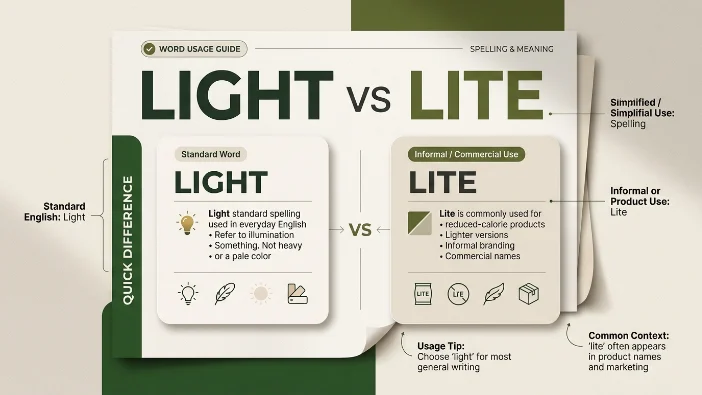
Light describes brightness, low weight, or pale color, and works as a noun, adjective, or verb. Lite is an informal marketing spelling used mainly for low-calorie or low-fat products, like “lite yogurt” or “lite beer.” Outside branding and casual writing, light is almost always the correct choice.
You’re writing a product label, a text message, or maybe a school assignment, and you pause on a single letter. Should it be “light” or “lite”? This tiny spelling choice trips up more writers than you’d expect, because both words sound identical and both show up constantly in everyday life on cereal boxes, in gym conversations, and in casual texts.
Light is the original English word, tracing back centuries, and it covers a huge range of meanings: sunlight, a lamp, low weight, pale color, and even the verb for starting a fire. Lite, on the other hand, is a much newer invention. It’s a deliberately simplified spelling that food and beverage companies started using in the twentieth century to signal “reduced calorie” or “reduced fat” versions of a product.
Mixing them up isn’t usually a grammar catastrophe, but it does send the wrong signal. Using “lite” in a formal report or academic paper can make writing look careless or overly casual, while using “light” on a product label misses the specific marketing connotation that “lite” carries. By the end of this guide, you’ll know exactly which word fits your sentence, your email, or your next grocery list.
Light vs Lite: What’s the Difference?
The core difference comes down to formality and function: light is a standard English word with dozens of legitimate uses, while lite is an informal, trademark-style spelling limited almost entirely to describing low-calorie food and drink or simplified versions of products.
Light functions as a noun (turn on the light), an adjective (a light jacket), and a verb (light the candle). It describes physical brightness, weight, color intensity, and even emotional ease, as in “a light mood.” This versatility is exactly why light appears in nearly every type of writing, from poetry to physics textbooks.
Lite, by contrast, only works as an adjective, and its meaning is narrow. It almost always signals that something has been reduced fewer calories, less fat, less alcohol, or a stripped-down version of software or a service. You’ll rarely see lite used to describe sunlight or the weight of a suitcase, because that usage would look like a typo rather than an intentional stylistic choice.
| Meaning | Part of Speech | Refers To | Typical Usage | Example | Common Confusion |
|---|---|---|---|---|---|
| Light | Noun, adjective, verb | Brightness, weight, color, action | Formal and everyday writing | “The room needed more light.” | Written as “lite” by mistake |
| Lite | Adjective only | Reduced calories, fat, or complexity | Marketing, branding, casual speech | “She bought the lite version of the dressing.” | Used outside food/product contexts |
So if you’re writing a sentence about the sun, a lamp, or something that doesn’t weigh much, light is your word every time. If you’re specifically talking about a low-calorie snack or a stripped-down app, lite fits the branding tone people expect.
Is Light vs Lite a Grammar, Vocabulary, or Usage Issue?
This is primarily a usage and vocabulary issue rather than a strict grammar rule, since both spellings are pronounced the same way and neither breaks sentence structure when swapped in casually.
From a vocabulary standpoint, light is the standard, dictionary-recognized spelling for every meaning related to brightness, weight, and color. Lite is considered a nonstandard variant spelling you won’t find it defined the same way in most traditional dictionaries, because it exists primarily as a commercial convention rather than a core English word.
In formal English, academic writing, and business communication, light is the only acceptable choice. Style guides like the Chicago Manual of Style treat lite as informal or trademark-related language, not standard vocabulary. In everyday conversation and advertising, though, lite has become so common that most readers instantly recognize it as shorthand for “reduced” rather than reading it as a spelling mistake.
The practical takeaway: reach for light in essays, emails, reports, and anything you want to look polished, and save lite for situations where you’re deliberately mimicking product packaging or casual brand language.
Understanding Light
Meaning: Light refers to the natural or artificial brightness that lets us see, to something that doesn’t weigh much, to pale coloring, or to the act of igniting something.
Part of speech: Noun, adjective, and verb.
Common collocations: natural light, light bulb, light rain, light sleeper, light meal, traveling light, light up.
Typical sentence patterns: Light usually appears after articles like “the” or “a” when used as a noun (“turn on the light”), before nouns when used as an adjective (“a light breeze”), and after subjects when used as a verb (“light the stove”).
Here’s how light shows up across different settings:
- Workplace example: “Can someone dim the light in the conference room before the presentation starts?”
- Academic example: “The physics lecture covered how light bends when it passes through water.”
- Technology example: “The new laptop is impressively light, weighing under two pounds.”
- Email example: “Just a light reminder that the invoice is due Friday.”
- Daily conversation example: “I packed light for the trip since we’re only gone three days.”
One learner mistake: Non-native speakers sometimes write “lite” when describing brightness or weight, likely because they’ve seen “lite” so often on food packaging that it starts to feel like a normal spelling. Remember, when you mean brightness, weight, or color, light is always correct.
Mini recap: Light is the flexible, all-purpose word. If your sentence involves brightness, low weight, pale color, or the act of igniting something, light is what you need.
Understanding Lite
Meaning: Lite is an informal adjective meaning “reduced” fewer calories, less fat, lower alcohol content, or a simplified version of a product or service.
Pronunciation: Identical to light, which is exactly why the confusion happens so often in speech.
Part of speech: Adjective only.
Common collocations: lite beer, lite yogurt, lite dressing, lite version, lite mode, diet-lite.
Typical sentence patterns: Lite almost always sits directly before the noun it modifies, functioning like a product descriptor rather than a general adjective: “lite mayo,” “lite software,” “lite plan.”
Real-world uses of lite:
- Workplace example: “The team switched to the lite version of the project management tool to cut costs.”
- Academic example: Rarely appears in academic writing, since lite is considered informal; students should default to standard vocabulary instead.
- Technology example: “You can download the lite version of the app if your phone has limited storage.”
- Email example: “We’re offering a lite membership tier starting next month.”
- Daily conversation example: “I’ll grab the lite salad dressing since I’m watching my sodium intake.”
One learner mistake: Writers sometimes use “lite” to mean physically light in weight, such as writing “a lite jacket.” This is incorrect lite never refers to physical weight, only to reduced calories, fat, or complexity.
Mini recap: Lite is a narrow, branding-driven word. Use it only when describing reduced-calorie food, reduced-fat products, or simplified digital tools.
When Not to Use Each Word
Mistake 1: Writing “lite” to describe sunlight or brightness. This happens because lite looks like a shortcut spelling. The correct word is light, and you can remember it by thinking of “light” as connected to “lamp” both start with the same sound pattern in your memory.
Mistake 2: Writing “lite” to describe something that doesn’t weigh much. People confuse this because lite products are often marketed as feeling “lighter” in some vague sense. Stick with light for anything related to physical weight, like a light suitcase or light fabric.
Mistake 3: Using “light” in a brand name or product label when the company’s official spelling is “lite.” If a specific product is officially branded as “Lite,” you should match their spelling exactly, even though it breaks standard rules, because you’re referencing a proper noun.
Mistake 4: Using “lite” in academic or professional writing. This makes text look unpolished. Formal writing should stick to light unless you’re directly quoting a product name.
Mistake 5: Assuming “lite” is simply a shorter version of “light” that can be used interchangeably. They aren’t interchangeable. Lite carries a specific commercial meaning that light does not automatically carry.
Mistake 6: Confusing “light” the adjective for color with “lite” when writing about pale shades. Color descriptions like “light blue” or “light gray” always use light, never lite.
Mistake 7: Using “lite” to describe an easy task or light workload. Expressions like “a light day at work” require light, since this refers to reduced difficulty, not reduced calories or fat.
Mistake 8: Forgetting that “lite” doesn’t function as a verb or noun. You can’t “lite a candle” only light works as a verb.
Common Mistakes Table
| Correct Sentence | Incorrect Sentence | Explanation |
|---|---|---|
| “Please light the candles before dinner.” | “Please lite the candles before dinner.” | Lite cannot function as a verb. |
| “This backpack is surprisingly light.” | “This backpack is surprisingly lite.” | Physical weight always requires light. |
| “She prefers lite salad dressing.” | “She prefers light salad dressing.” (when referring to the reduced-calorie product) | Lite specifically signals reduced calories in branding contexts. |
| “The room needs more natural light.” | “The room needs more natural lite.” | Brightness always requires light. |
| “He wore a light gray suit.” | “He wore a lite gray suit.” | Color descriptions use light, not lite. |
| “I downloaded the lite version of the app.” | “I downloaded the light version of the app.” | App branding commonly uses lite for simplified versions. |
Quick Decision Box
If you mean brightness, weight, color, or the action of igniting something, use Light.
If you mean a specific low-calorie, low-fat, or simplified product version, use Lite.
When in doubt, choose light. It’s the safer, more standard choice in almost every writing situation.
Real-World Examples
Office communication: “Can we schedule the meeting for later in the afternoon? The morning light through those windows makes the screen hard to see.”
Business email: “Our new lite subscription plan removes advanced features but keeps the price lower for smaller teams.”
School or university: “The essay explained how light travels faster than sound, which explains why we see lightning before we hear thunder.”
Customer support: “If the full software is running slowly on your device, try switching to lite mode for better performance.”
Technology: “The lite version of the browser uses less memory, which helps older phones run smoother.”
Daily conversation: “It’s getting dark early now mind turning on the porch light?”
Light vs Lite in Modern Technology
Lite shows up constantly in modern technology, especially in apps and platforms designed for users with limited storage, slower internet connections, or older devices. Facebook Lite, Messenger Lite, and various “Lite” versions of banking and shopping apps all strip down features to save space and improve speed, while keeping core functionality intact.
Light, meanwhile, appears in technology contexts related to actual illumination or weight, such as “light sensor,” “backlight,” or describing a laptop as “impressively light.” Virtual assistants and chatbots don’t typically use either word as part of their core function, but you’ll often see companies release a “lite” chatbot experience that offers fewer features than the full AI assistant.
The distinction stays consistent even in tech: lite means “simplified,” and light means “bright” or “low weight.
Word Origin
Light comes from Old English “leoht,” rooted in ancient Germanic language families, and has referred to brightness for well over a thousand years. Its meaning naturally expanded over centuries to include weight and color, since something “light” in weight was originally associated with ease and lack of burden, much like brightness represents clarity.
Lite is a much newer, artificial spelling. It emerged in the twentieth century as a marketing tool, first gaining traction with “lite beer” campaigns in the 1970s. Companies intentionally chose the simplified spelling to stand out visually on packaging and to create a distinct brand identity separate from the standard word light.
Expert Insight
As a language instructor, I tell students to think of lite as a costume that light wears only for marketing purposes. The moment you’re writing anything outside of food packaging, fitness branding, or simplified software, that costume needs to come off, and standard light takes over. This mental habit prevents almost every common mixup between the two words.
Error Prevention Checklist
- Always use Light when describing brightness, weight, color, or the act of igniting something.
- Always use Lite when referring to a specifically branded low-calorie, low-fat, or simplified product.
- Never confuse them if you remember that lite cannot function as a verb or general noun.
- Quick memory tip: If you can replace the word with “bright” or “not heavy,” use light. If you can replace it with “reduced” or “simplified,” use lite.
Related Grammar Confusions
- Effect vs Affect One of the most common grammar mixups in English, especially in written business communication.
- Its vs It’s A classic apostrophe confusion that trips up even experienced writers.
- Compliment vs Complement Two words that sound alike but carry completely different meanings.
- Advice vs Advise Understanding the noun-verb distinction here sharpens overall writing precision.
- Farther vs Further A subtle but useful distinction between physical and figurative distance.
- Loose vs Lose A frequent typo that can completely change a sentence’s meaning.
- Principal vs Principle Important for anyone writing in academic or professional settings.
- Stationary vs Stationery A spelling distinction that often confuses office and business writers.
- Who vs Whom A grammar rule that even native speakers frequently get wrong.
- Elicit vs Illicit Two words that look similar but belong to entirely different contexts.
FAQs
Is “lite” a real word in the dictionary?
Yes. Lite is recognized as an informal variant of light in modern dictionaries. It is most commonly used in product names, advertising, and commercial contexts rather than standard formal writing.
Can I use “lite” in a formal essay?
Generally, no. In formal, academic, or professional writing, light is the safer and standard choice. Use lite only when quoting an official product name, brand, or title that uses that spelling.
Why do companies use “lite” instead of “light” on packaging?
Companies often use lite as a marketing term to suggest that a product is lighter, reduced, simplified, or lower in calories. The alternative spelling can also help create a distinctive brand identity while keeping the familiar pronunciation of light.
Does “lite” always mean low calorie?
No. Although lite is commonly associated with reduced-calorie food and drinks, it can also describe a simplified or reduced-feature version of a product or service, especially in technology. For example, a lite version of an app may have fewer features.
Is there a difference in pronunciation between light and lite?
No. Light and lite are pronounced exactly the same way. The difference is in spelling, usage, and context rather than pronunciation.
Which spelling should I use for a school assignment about physics?
Always use light when discussing physics, such as light waves, the speed of light, or visible light. Lite has no standard scientific meaning and would be incorrect in this context.
Conclusion
The difference between light and lite ultimately comes down to context and formality. Light is the standard, versatile English word covering brightness, weight, color, and the act of igniting something, while lite is a narrow, informal spelling reserved for branding around reduced-calorie products and simplified technology.
When you’re unsure which one to use, default to light it’s correct in nearly every situation except specific product or brand references. Keep this simple rule in mind: if you can’t replace the word with “reduced” or “simplified,” you need light, not lite.
Read More Related Articles:
- Potatoes or Potatos | Don’t Let This Simple Spelling Error Hold You Back In 2026
- Challenge or Challange | Learn the Right Spelling Once and for All In 2026
- Forty or Fourty | Right Way to Spell the Number 40 In 2026

Lucas Mitchell is a content writer at synoseek.com. He writes simple, thoughtful pieces that focus on everyday ideas, observations and general knowledge topics. His work is shaped by a calm, realistic tone that keeps the reader engaged without overstatement.
1 thought on “Light vs Lite | Know the Difference Before You Write In 2026”