Quick Answer
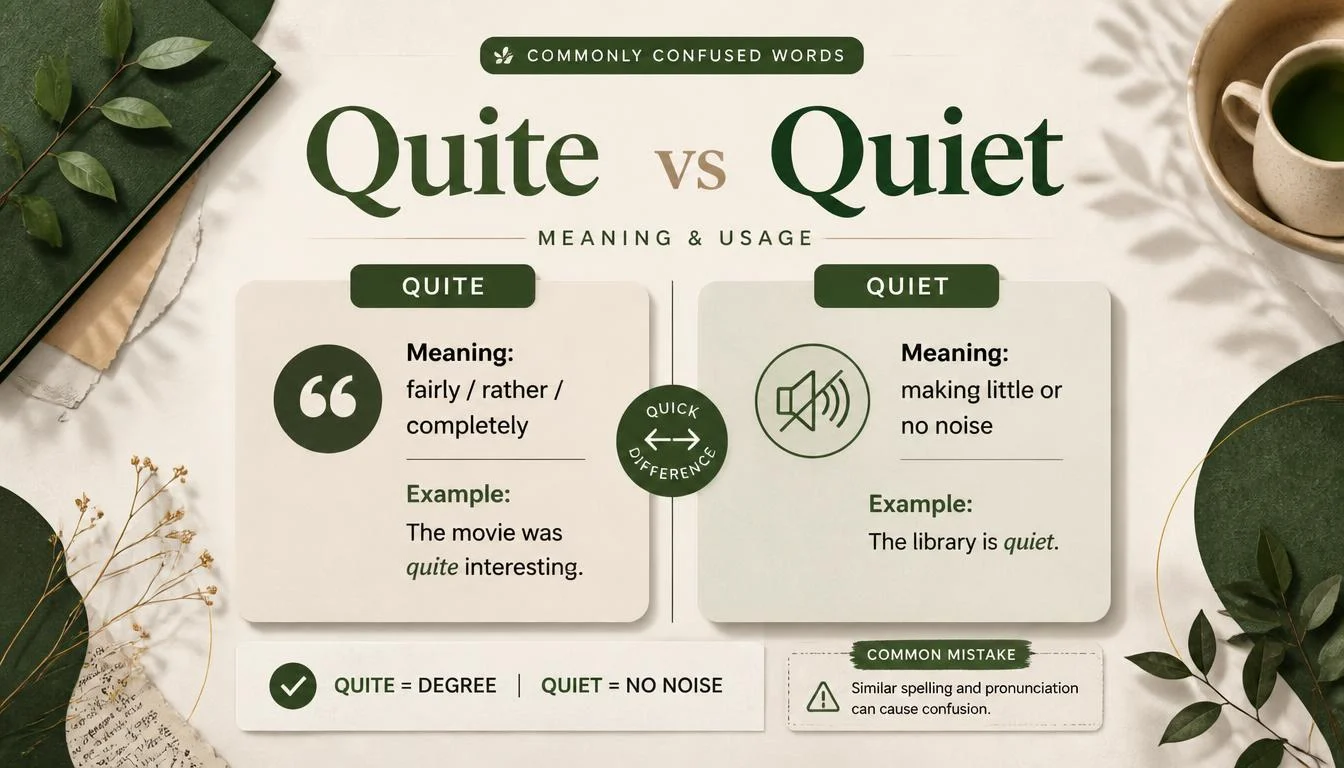
Quite is an adverb that shows degree, meaning “to a certain extent” or “completely,” as in quite tired. Quiet is an adjective describing low noise or a calm state, as in a quiet room. They sound alike but serve completely different grammatical jobs, so mixing them up changes both the meaning and the sound of a sentence.
You’re typing an email, and your fingers move faster than your brain checks them. You mean to write “the office was quiet today,” but “quite” slips out instead. Spellcheck says nothing, because both words are spelled correctly just not for what you meant. This is one of the most common typing slips in English, and it trips up native speakers just as often as learners.
The confusion isn’t really about grammar rules. It’s about how similar these two words look and how differently they behave. Quite intensifies or softens another word (“quite good,” “quite difficult”). Quiet describes an absence of noise or a state of calm (“a quiet street,” “please be quiet”). One is an adverb; the other is an adjective. One modifies strength; the other describes sound.
Getting this wrong doesn’t just look like a typo it can genuinely confuse a reader mid-sentence. “The meeting was quite” reads like an unfinished thought, while “the meeting was quiet” paints a clear picture. By the end of this guide, you’ll know exactly which word fits which sentence, why the mix-up happens so easily, and how to catch it before you hit send.
Quite vs Quiet: What’s the Difference?
The core difference is simple: quite measures intensity, while quiet describes sound level or calmness.
“Quite” is an adverb of degree. It tells you how much of something there is how tired, how expensive, how surprising. It never stands alone as a description of a person, place, or object. It always needs another word to modify, usually an adjective or another adverb: quite happy, quite quickly, quite a lot.
“Quiet,” on the other hand, is an adjective. It stands directly next to a noun or completes a sentence about that noun: a quiet neighborhood, the baby is quiet, keep your voice quiet. It describes an actual quality the absence of loud noise, or sometimes a peaceful, undisturbed atmosphere.
The confusion often comes from how the words are pronounced quickly in casual speech, plus the shared letters at the start. But once you notice that “quite” always attaches to another descriptive word, and “quiet” always describes the noun itself, the pattern becomes easy to spot.
| Meaning | Part of Speech | Refers To | Typical Usage | Example | Common Confusion |
|---|---|---|---|---|---|
| To a certain degree; fairly or completely | Adverb | Intensity of another word | Modifying adjectives/adverbs | “It was quite cold last night.” | Used where an adjective was needed |
| Free from noise; calm | Adjective | State of sound or atmosphere | Describing people, places, situations | “The library was quiet all afternoon.” | Used where an intensifier was needed |
In short: if the word right after it is doing the describing, you probably need “quite.” If the word itself is the description, you need “quiet.”
Is Quite vs Quiet a Grammar, Vocabulary, or Usage Issue?
This mix-up sits mainly in the grammar category, though it touches vocabulary and spelling too. “Quite” and “quiet” are not interchangeable in any register of English not in casual texting, not in business writing, and definitely not in academic papers.
Grammatically, “quite” functions as a degree adverb, similar to “very,” “fairly,” or “rather.” It modifies adjectives and adverbs but cannot describe a noun on its own. “Quiet” is a standard adjective that behaves like “loud,” “calm,” or “silent” it can sit before a noun (“a quiet room”) or after a linking verb (“the room is quiet”).
Vocabulary-wise, the two words have entirely unrelated meanings, which is part of why the error stands out so much once a reader notices it. It’s not a subtle shade-of-meaning issue like “affect” and “effect.” It’s closer to a spelling slip that happens to produce a real word, which is exactly why spellcheckers miss it.
In formal writing reports, academic essays, professional emails this distinction matters even more, since a misplaced “quite” or “quiet” can make a sentence look careless even if the rest of the writing is polished. In casual conversation, the two words are rarely confused out loud because they’re pronounced differently enough; the error is almost entirely a written one.
Practical takeaway: if you’re describing noise or calm, reach for “quiet.” If you’re describing the strength or extent of something else, reach for “quite.”
Understanding “Quite”
Meaning: to a certain extent; fairly; or, in some uses, completely and totally.
Pronunciation: rhymes with “light” one syllable, ending in a sharp “t” sound.
Part of speech: adverb.
Common collocations: quite good, quite a while, quite honestly, quite different, quite frankly, quite a few.
Typical sentence pattern: quite + adjective/adverb, or quite + a/an + noun phrase.
Workplace example: “The client was quite impressed with the new proposal, so we should schedule a follow-up soon.”
Academic example: “The results were quite consistent with the hypothesis, though the sample size was small.”
Technology example: “The new update made the app quite a bit faster on older devices.”
Email example: “I’m quite happy with how the draft turned out let me know if you’d like any changes.”
Daily conversation example: “That movie was quite long, but I enjoyed most of it.”
One learner mistake: Many learners use “quite” as if it means “very” in every context, but in British English especially, “quite” can also mean “somewhat” or “only moderately” so “quite good” can sound like faint praise rather than strong approval, depending on tone and context.
There’s also a second, less common learner mistake worth flagging: placing “quite” directly before a plain noun without “a” or “an.” Native speakers rarely say “quite house” or “quite car” the pattern almost always requires the article, as in “quite a house” or “quite a car,” because the phrase is signaling that the noun stands out in some way. Dropping the article makes the sentence sound foreign even when every individual word is correct.
Mini recap: “Quite” adds strength (or sometimes gentle qualification) to another descriptive word. It never describes a noun by itself, and it usually needs an article when it appears directly before one.
Understanding “Quiet”
Meaning: making little or no noise; calm, still, or undisturbed.
Pronunciation: two syllables “KWY-it.”
Part of speech: adjective (it can also work as a noun, as in “the quiet of the countryside,” or a verb, as in “quiet the children down”).
Common collocations: quiet room, quiet night, stay quiet, quiet moment, quiet voice, quiet neighborhood.
Typical sentence pattern: quiet + noun, or subject + be + quiet.
Workplace example: “The office is unusually quiet this week since half the team is on leave.”
Academic example: “Students are expected to remain quiet during the exam, except to ask the proctor a question.”
Technology example: “The new laptop fan is much quieter than the previous model, even under heavy load.”
Email example: “Things have been quiet on our end this month, but we expect a busier schedule in October.”
Daily conversation example: “Can you keep it quiet? The baby just fell asleep.”
One learner mistake: Some learners write “the room was quite” when they mean the room had no noise, forgetting the adjective entirely and leaving the sentence grammatically incomplete.
A second common slip happens when learners try to use “quiet” as an intensifier, writing something like “the food was quiet delicious.” Since “quiet” is an adjective, it cannot modify another adjective the way “quite” does. If you catch yourself wanting to strengthen a description, that’s the signal you actually need “quite,” not “quiet,” even though the words feel visually similar on the page.
Mini recap: “Quiet” describes an actual state low noise or calm and it can stand directly next to the noun it describes. It never works as an intensifier for another adjective.
When Not to Use Each Word
1. Don’t use “quite” to describe a noun directly. “The room was quite” is incomplete. You need an adjective after it, or you need “quiet” instead.
2. Don’t use “quiet” to intensify another adjective. “The soup was quiet spicy” makes no sense. “Quiet” cannot modify “spicy” only “quite” can.
3. Don’t assume “quite” always means “very.” In many contexts, especially British English, “quite” can mean “somewhat,” so “quite tired” might mean only mildly tired, not exhausted. Context and tone decide the strength.
4. Don’t drop the second syllable of “quiet” when writing. The written slip usually happens because “quiet” gets shortened in the writer’s head to sound like “quite,” especially when typing fast.
5. Don’t use “quite” before a plain noun without “a” or “an.” “Quite car” is wrong; “quite a car” works because it implies a noteworthy quality.
6. Don’t confuse “quiet” with “quit.” These two also get mixed up in fast typing “quiet” describes calm, while “quit” means to stop or resign.
7. Don’t use “quiet” when you mean “entirely” or “completely.” “The project was quiet finished” should be “quite finished,” since you’re describing the extent of completion, not a lack of noise.
8. Don’t forget that “quite” can flip meaning with negatives. “Not quite ready” means almost ready, not the opposite of ready a subtlety many learners miss.
Common Mistakes Table
| Correct Sentence | Incorrect Sentence | Explanation |
|---|---|---|
| “The house was quiet after the guests left.” | “The house was quite after the guests left.” | “Quite” needs an adjective after it; “quiet” describes the house directly. |
| “I’m quite sure we locked the door.” | “I’m quiet sure we locked the door.” | “Sure” needs an intensifier, so “quite” is correct here. |
| “Please keep your voice quiet in the library.” | “Please keep your voice quite in the library.” | The sentence is describing volume, which calls for “quiet.” |
| “That was quite an achievement.” | “That was quiet an achievement.” | “Quite a/an + noun” is a fixed pattern showing degree. |
| “The engine runs quietly at night.” | “The engine runs quitely at night.” | The adverb form of “quiet” is “quietly,” not “quitely.” |
Decision Box
If you’re describing how much or how strongly something is true, use “quite.” If you’re describing an absence of noise or a calm state, use “quiet.” A quick trick: try replacing the word with “very.” If the sentence still makes sense, “quite” is likely correct. If it doesn’t, you probably need “quiet.”
Real World Examples
Office communication: “It’s been quite a busy quarter, but the office has been surprisingly quiet since most people are working remotely on Fridays.”
Business email: “We’re quite pleased with the results of the campaign and would like to schedule a quiet, distraction-free session to plan the next phase.”
School or university: “The professor asked the class to stay quiet during the presentation, even though the topic was quite controversial.”
Customer support: “I understand your frustration, and I’m quite confident we can resolve this quickly thank you for your patience during this quiet period on our end.”
Technology: “The new noise-cancelling headphones make even a loud train ride feel quite peaceful, almost like sitting in a quiet room.”
Artificial Intelligence: “The chatbot gave quite a detailed answer, and it did so without any of the lag users complained about a quiet improvement that made a big difference.”
Daily conversation: “It’s been quite a day. I just want a quiet evening at home.”
Notice how naturally both words can appear in the same sentence once you understand their separate jobs. “Quite” is doing the work of intensity showing how busy, how pleased, how confident someone feels while “quiet” is doing the work of description, painting a picture of low noise or a calm setting. Once you see this pattern repeated across different situations, the words stop feeling interchangeable and start feeling like two completely different tools in your writing toolbox.
Quite and Quiet in Modern Technology
Quite shows up constantly in AI-generated writing and virtual assistant responses, usually as a softening or intensifying word: “That’s quite an interesting question,” or “This approach is quite effective for most use cases.” Voice assistants and chatbots use it to sound conversational rather than robotic, since flat statements without any degree words can feel stiff.
Quiet, meanwhile, appears more often in product descriptions and reviews especially for devices where noise level matters, like laptops, fans, electric vehicles, and smart home speakers. Marketing copy frequently highlights how “quiet” a product is as a selling point, since consumers associate low noise with better engineering.
Interestingly, both words appear together often in tech reviews: “The device is quite quiet compared to its predecessor,” a sentence that looks odd on paper but is grammatically correct and increasingly common as more gadgets compete on noise reduction.
Word Origin
Quite” comes from Middle English “quite” or “quyte,” related to “quit,” originally meaning “completely” or “entirely free.” Over time, its meaning softened from “completely” to also include “fairly” or “somewhat,” which is why the word can express two different strengths depending on context.
“Quiet” traces back to the Latin “quietus,” meaning “calm” or “at rest,” through Old French “quiete.” Its meaning has stayed remarkably stable for centuries it has always pointed toward stillness, silence, or peace, unlike “quite,” whose meaning has drifted more over time.
Expert Insight
As a language instructor, I tell students to picture “quite” as a volume knob for other words it turns their strength up or down, but it never stands as the picture itself. “Quiet,” by contrast, is the picture: a still room, a hushed voice, a calm evening. When you catch yourself unsure which one fits, ask whether you’re describing a feeling of sound or silence (quiet) or amplifying another word’s meaning (quite). That single question resolves the confusion almost every time.
Error Prevention Checklist
- Always use quite when the next word is an adjective or adverb you want to strengthen or soften.
- Always use quiet when describing an absence of noise or a calm, still state.
- Never confuse them if you remember: quite needs a partner word; quiet can stand alone next to a noun.
- Quick memory tip: “Quiet” has an extra syllable, just like a quiet room has extra stillness. “Quite” is short and sharp, just like it sharpens the word beside it.
Related Grammar Confusions
- Quit vs Quiet worth learning because typing speed often turns “quiet” into “quit” by accident.
- Very vs Quite both are intensifiers, but they carry different levels of strength and formality.
- Rather vs Quite useful for understanding British versus American shades of degree.
- Calm vs Quiet helps clarify the difference between emotional stillness and literal silence.
- Silent vs Quiet a subtle distinction between total absence of sound and low-level noise.
- Fairly vs Quite both soften adjectives, but their strength and tone differ slightly.
- Quiet vs Quietly clarifies when to use the adjective versus the adverb form.
- Affect vs Effect another classic pair that trips up writers due to similar spelling.
- Then vs Than a common typing slip that changes meaning just like quite and quiet.
- Its vs It’s worth reviewing alongside quite/quiet since both errors often slip past spellcheck.
- Loose vs Lose another pair where a single letter changes meaning entirely, much like quite and quiet.
- Accept vs Except commonly confused in professional emails, similar to how quite and quiet trip up formal writing.
FAQs
Is It “Quite” or “Quiet” When Describing a Place With No Noise?
Use “quiet.” It is the adjective used to describe a place with little or no noise, as in “a quiet park.” “Quite” cannot describe a quiet place on its own because it functions as an adverb.
Can “Quite” Mean Both “Very” and “Somewhat”?
Yes. In American English, “quite” often means “very,” as in “quite amazing.” In British English, it can also mean “somewhat” or “fairly.” So “quite good” may express moderate rather than strong praise.
What Is the Adverb Form of “Quiet”?
The adverb form is “quietly,” not “quitely.” For example, “She closed the door quietly” describes an action performed with little noise.
Why Do Spellcheckers Not Catch Quite and Quiet Mistakes?
Both “quite” and “quiet” are correctly spelled words. Spellcheckers usually flag misspellings rather than incorrect word choices. Context based grammar and writing tools are more likely to identify this type of mistake.
Is “Quite a Bit” Correct Grammar?
Yes. “Quite a bit” is a common idiomatic phrase meaning “a considerable amount.” For example, “We saved quite a bit of time.” It follows the standard “quite + a/an + noun” pattern.
Does “Quite” Ever Function as an Adjective?
No. “Quite” functions as an adverb. It does not directly describe a noun. Instead, it modifies or intensifies an adjective or another adverb.
Conclusion
The difference between “quite” and “quiet” comes down to one simple test: does the word need a partner to describe, or does it describe something by itself? “Quite” always leans on another adjective or adverb to show degree, while “quiet” stands confidently next to a noun to describe silence or calm.
Next time your fingers try to type one instead of the other, pause and ask what you’re really describing the strength of another word, or the absence of noise. If it’s strength, go with “quite.” If it’s stillness, go with “quiet.” That one habit will end this mix-up for good.
Read More Related Articles:
- 35+ Other Ways to Say Happy Thursday | Make Your Greetings More Engaging In 2026
- 35+ Other Ways to Say “Nice to Meet You” | Formal to Casual In 2026
- 35+ Other Ways to Say “Did You Sleep Well” | For Better Communication In 2026

Lucas Mitchell is a content writer at synoseek.com. He writes simple, thoughtful pieces that focus on everyday ideas, observations and general knowledge topics. His work is shaped by a calm, realistic tone that keeps the reader engaged without overstatement.
1 thought on “Quite vs Quiet | Stop Mixing Up These Two Words In 2026”