Quick Answer
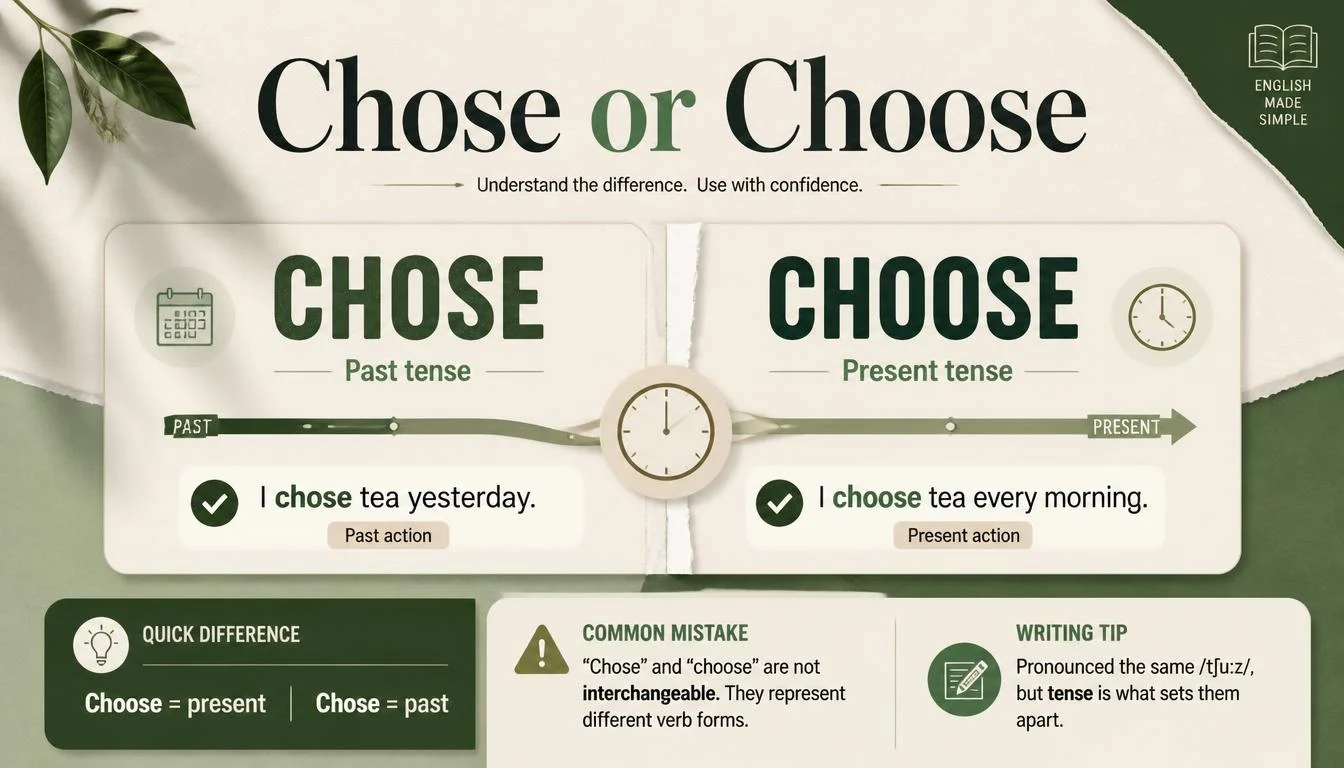
Choose is the present tense verb meaning to select or decide between options, while chose is the simple past tense form of the same verb. Understanding when to use choose vs chose is essential for clear communication. This guide explains their grammar, provides usage examples, and helps you confidently select the correct word every time.
Choosing the right word can be confusing when two spellings look almost identical. Chose or Choose is a common English question because both words are forms of the same verb but they refer to different times.
Understanding when to use chose and choose will help you avoid common grammar mistakes. In this guide, we’ll explain the difference with simple examples so you can use each word confidently in everyday and professional writing.
Choose vs Chose: What’s the Difference?
The fundamental distinction between choose and chose comes down to time. Choose is the present tense form, while chose is the past tense form both mean to select or decide between options.
Understanding Both Words
| Aspect | Choose | Chose |
|---|---|---|
| Meaning | To select or decide | Selected or decided (already done) |
| Part of Speech | Verb (present tense) | Verb (past tense) |
| Refers To | Present or future actions | Past actions |
| Typical Usage | Decisions happening now, habitual choices, or future plans | Decisions already completed |
| Example | I always choose the window seat. | Yesterday, I chose the window seat. |
| Common Confusion | People use it when describing past events | People use it when describing present or habitual actions |
The Core Difference
Think of it this way: if you’re making a decision at this moment, you’re using “choose.” If you’ve already made that decision at some point in the past, you’re using “chose.” It’s really that simple but simple doesn’t always mean easy to remember in the moment.
Is This a Grammar, Vocabulary, or Usage Issue?
Understanding whether choose/chose is a grammar problem or a vocabulary problem helps you approach it correctly. This is primarily a grammar issue involving verb tense, specifically the simple present versus the simple past.
From a vocabulary standpoint, both words share the same core meaning. The distinction isn’t about having two different definitions but rather understanding how the same word functions differently across time.
Classification Breakdown
- Grammar Classification: This is a matter of verb conjugation and tense agreement. English requires that verbs match the time frame of the action they describe.
- Vocabulary Difference: Both words share the same fundamental meaning (to select). The difference lies in time, not meaning.
- Interchangeability: The words are not interchangeable. Using the wrong tense creates a clear error that readers will notice.
Across Different English Contexts
| Context | Usage Note |
|---|---|
| Formal English | Correct tense usage is essential. Errors appear unprofessional. |
| Business English | Mistakes in emails or reports can damage credibility. |
| Academic Writing | Proper verb tense is expected. Past events require “chose.” |
| Everyday Conversation | While spoken errors are less noticeable, correct usage still matters. |
Practical Takeaway
The distinction isn’t about choosing one word over the other because one is “better” it’s about knowing which form fits the timeline of your sentence. Choose belongs to the present and future. Chose belongs to the past.
The Complete Guide to “Choose”
Let’s explore everything you need to know about using “choose” correctly.
Meaning and Definition
Choose (pronounced /tʃuːz/) is a verb that means to select from a range of possibilities, to make a decision, or to prefer one option over others. It’s an irregular verb that follows the pattern: choose (present) – chose (past) – chosen (past participle).
Part of Speech
Verb – specifically, an irregular verb used in the present tense.
Common Collocations
- choose carefully
- choose wisely
- choose between
- choose from
- choose to do something
- choose not to do something
- choose your words
Typical Sentence Patterns
- Subject + choose + noun: “I choose the red one.”
- Subject + choose + infinitive: “We choose to stay home tonight.”
- Subject + choose + between + options: “You must choose between the two offers.”
Natural Workplace Example
“Every morning, our team manager asks us to choose our priority tasks for the day before we check our emails. This helps us stay focused on what matters most.”
Academic Example
“In this experiment, participants were asked to choose whether to cooperate with their partner or compete against them based on the instructions they received.”
Technology Example
“Most software applications let you choose the default language during the initial setup process, making the tools accessible to users worldwide.”
Email Example
“Hi Sarah, Please choose a time slot that works best for your schedule next week. I’ve attached a list of available meeting times for your reference.”
Daily Conversation Example
“I can never choose what to order at this restaurant because everything on the menu looks delicious. What do you recommend?”
One Common Learner Mistake
Many learners incorrectly use “choose” when describing past decisions, especially in spoken English. For example: “I choose the blue car last year” should be “I chose the blue car last year.”
Mini Recap
Use “choose” when describing decisions you’re making now, habitual choices, or future intentions. It’s the present-tense form and pairs with time markers like “always,” “often,” “today,” and “tomorrow.”
The Complete Guide to “Chose”
Now let’s dive into everything you need to know about “chose.”
Meaning and Definition
Chose (pronounced /tʃəʊz/) is the simple past tense form of the verb choose. It means that you selected or made a decision at some point in the past. The action is complete and finished.
Part of Speech
Verb – simple past tense of choose.
Common Collocations
- chose carefully
- chose wisely
- chose between
- chose from
- chose to do something
- chose not to do something
- chose instead
Typical Sentence Patterns
- Subject + chose + noun: “She chose the blue one.”
- Subject + chose + infinitive: “They chose to leave early.”
- Subject + chose + between + options: “He chose between the two candidates.”
Natural Workplace Example
“During yesterday’s meeting, our director chose to postpone the product launch until the development team had resolved several technical issues. It was the right decision.”
Academic Example
“The research team chose to focus exclusively on participants between the ages of 25 and 40 because previous studies had already covered other demographics extensively.”
Technology Example
“When we updated our database system last quarter, we chose a cloud-based solution over an on-premise alternative to improve accessibility for remote workers.”
Email Example
“Dear Team, As discussed in our Monday meeting, I chose to approve the revised budget proposal. We’ll begin implementation next month.”
Daily Conversation Example
“My friend chose the Italian restaurant for her birthday dinner, and honestly, the food was outstanding. I’m glad she made that decision.”
One Common Learner Mistake
Some learners use “chose” in combination with words like “am” or “is,” producing errors like “I am chose” instead of “I chose” or “I have chosen.”
Mini Recap
Use “chose” when referring to decisions or selections made in the past. It’s always accompanied by past time markers like “yesterday,” “last week,” “in 2020,” or “when I was younger.”
When NOT to Use Each Word
Understanding when to avoid each word can be just as important as knowing when to use them.
Situations Where “Choose” Is Incorrect
- When describing decisions made in the past: If the decision happened yesterday, last month, or ten years ago, you need “chose,” not “choose.”
- When using past time markers: Any phrase like “last week,” “in 2020,” or “three days ago” requires “chose.
- After words like “already” or “never”: “I never chose” is correct; “I never choose” refers to a present habit.
Situations Where “Chose” Is Incorrect
- When describing current decisions: If you’re deciding right now, use “choose.” “I choose this one” (present) vs. “I chose this one” (past).
- When describing habitual actions: “I always choose chocolate” is correct; “I always chose” implies the habit is no longer happening.
- When discussing future plans: Use “choose” for future intentions, not “chose.” “I will choose” or “I’m going to choose.”
Memory Tip
Ask yourself: “Is this decision happening now or in the future?” If yes, use choose. “Is this decision already in the past?” If yes, use chose.
Common Mistakes Table
| Correct Sentence | Incorrect Sentence | Explanation |
|---|---|---|
| Yesterday, I chose to stay home. | Yesterday, I choose to stay home. | Past time marker “yesterday” requires past tense “chose.” |
| Please choose your favorite color. | Please chose your favorite color. | Present instruction requires present tense “choose.” |
| She chose the best option available. | She choose the best option available. | Completed action in the past needs “chose.” |
| I always choose the healthy option. | I always chose the healthy option. | Habitual action (always) uses present tense. |
| They chose not to attend. | They choose not to attend. | Past event requires past tense. |
| We’ll choose a new direction tomorrow. | We’ll chose a new direction tomorrow. | Future action uses “choose.” |
Quick Decision Box
If you mean: A decision happening now, a regular habit, or a future plan → Use CHOOSE
If you mean: A decision that already happened in the past → Use CHOSE
Remember: The “oo” in “choose” sounds like the “oo” in “now” but it’s for n-o-w decisions. The “o” in “chose” sounds like the “o” in “gone” decisions that are already g-o-n-e.
Real-World Examples Across Situations
Office Communication
“You need to choose which software tool we should adopt for project management. But remember, when we chose the previous system, we didn’t consider the integration costs properly.”
Business Email Context
“I’m writing to confirm that we chose to move forward with your proposal after careful evaluation. Please let us know when you’re ready to begin the implementation phase.”
University Context
“During my undergraduate studies, I chose to major in economics, but if I were starting now, I might choose computer science instead.”
Customer Support Context
“Based on your feedback, we chose to extend the warranty period for all new products. Our team will always choose customer satisfaction over short-term profits.”
Technology Context
“Users can choose between three interface modes. We chose to implement these options after analyzing usage patterns from our beta testers.”
Artificial Intelligence Context
“When training the language model, developers chose a dataset of over 1 trillion words. They had to choose carefully to ensure the model learned appropriate language patterns.”
Daily Conversation Context
“A: What did you order? B: I chose the pasta. What about you? A: I can’t decide. I’ll choose something in a minute.”
The Relationship Between Tense and Meaning
What makes choose and chose particularly tricky is that they share the same root meaning. The difference isn’t about what the word means but about when the action happened.
Why This Matters
Using the wrong tense can confuse your reader about timing. If you write “I choose to accept the offer” when the decision was made yesterday, your reader might think you’re making the decision right now. This kind of confusion can be problematic in professional, academic, or legal contexts where timing matters.
The Broader Principle
Understanding the choose/chose difference helps you master other irregular verbs too. Once you grasp that “choose” is to present what “chose” is to past, you can apply similar thinking to other pairs like “break” and “broke,” “speak” and “spoke,” or “steal” and “stole.”
Expert Insight
Understanding the difference between present and past tense isn’t just about following grammar rules it’s about helping your reader understand exactly when something happened. I’ve worked with countless students who memorize the definitions but still make errors because they’re thinking about meaning rather than time.
Here’s a practical approach I always share: when you’re writing, pause for a moment and ask yourself, “When did this decision take place?” If you can answer with any past time marker (yesterday, last week, previously, already), you need “chose.” If the decision is happening in your present or future, you need “choose.” Once you connect the word choice to the actual time on your mental calendar, the error disappears.
Another helpful technique is to read your sentence aloud and listen to how it sounds. “I choose yesterday” sounds wrong to a native English ear. Trust your ear, and if something feels off, check the timing.
Error Prevention Checklist
- Always use CHOOSE when: The decision is happening now, the action is habitual, or the decision will happen in the future.
- Always use CHOSE when: The decision is already in the past, the action is completed, or time markers indicate past events.
- Never confuse them if: You pay attention to time markers in your sentence.
- Quick Memory Tip: “Chose” has one “o” because the action is over. “Choose” has two “o’s” because it’s happening now or later.
Related Grammar Confusions Worth Learning
- Lay vs. Lie – Understanding transitive and intransitive verbs
- Accept vs. Except – Commonly confused words with different parts of speech
- Affect vs. Effect – The classic verb/noun confusion
- Principal vs. Principle – One refers to a person or main thing, the other to a rule
- Compliment vs. Complement – Saying something nice vs. completing something
- Stationary vs. Stationery – Not moving vs. writing supplies
- Than vs. Then – Comparison vs. time sequence
- Your vs. You’re – Possession vs. contraction
- Its vs. It’s – Possession vs. contraction
- There vs. Their vs. They’re – Three completely different uses
FAQs
Is it “I chose” or “I choose”?
Use “I chose” when referring to a decision you made in the past. Use “I choose” when you’re making a decision now, describing a habit, or talking about a future choice. Example: “Yesterday, I chose the red one” vs. “Today, I choose the blue one.”
What is the rule for choose and chose?
The rule is simple: “choose” is present tense and “chose” is past tense. Use “choose” for decisions happening now, habitual selections, or future choices. Use “chose” for decisions already completed in the past. Time markers often signal which one you need.
Can I say “have chose”?
No, the correct form is “have chosen.” “Chose” is the simple past tense and cannot be used with auxiliary verbs like “have,” “has,” or “had.” When you need the past participle, use “chosen.” Example: “I have chosen the best option.”
Why do people confuse choose and chose?
People confuse these words primarily because they look similar and share the same meaning (to select or decide). The only difference is timing, but when you’re writing quickly, it’s easy to ignore time markers. Additionally, many irregular verbs don’t change as dramatically, so this one trips people up.
What is the past tense of choose?
The past tense of “choose” is “chose.” This is the simple past form used when describing a completed decision. For example: “She chose the most expensive option.” The past participle is “chosen,” used with auxiliary verbs: “She has chosen the most expensive option.”
Which is correct: “choose to” or “chose to”?
Both are correct depending on when the decision happened. “Choose to” is present or future: “I choose to ignore that comment.” “Chose to” is past: “I chose to ignore that comment yesterday.” They function identically except for tense.
Is “chosen” the same as “chose”?
No. “Chose” is the simple past tense used alone: “I chose it.” “Chosen” is the past participle used with auxiliary verbs: “I have chosen it,” “it was chosen by me.” They serve different grammatical purposes.
What is the difference between “choose from” and “choose between”?
“Choose from” is used when you have multiple options: “Choose from 20 different designs.” “Choose between” is used when you have two specific options: “Choose between the red and the blue.” Both are grammatically correct but used in different contexts.
Conclusion
The difference between choose and chose is fundamentally about time. “Choose” is your present-tense option for decisions you’re making now, habits you maintain, or choices you’ll make in the future. “Chose” is your past-tense option for decisions already completed and in the history books.
Remember this simple rule: if you’re deciding right now, reach for “choose.” If you’ve already decided, “chose” is your word. This distinction matters because using the wrong tense can confuse your reader about when an action took place, creating misunderstandings in both professional and personal communication.
Keep this practical tip handy: “Chose” has one “o” because the action is over. “Choose” has two “o’s” because it’s for now (or later). With this framework, you’ll never hesitate again when choosing between “choose” and “chose.”
Read More Related Articles:
- Totaling or Totalling | American vs British English In 2026
- Hoodie or Hoody | Easy Way to Remember the Difference In 2026
- Truly or Truely | Simple Guide to Getting It Right In 2026

Lucas Mitchell is a content writer at synoseek.com. He writes simple, thoughtful pieces that focus on everyday ideas, observations and general knowledge topics. His work is shaped by a calm, realistic tone that keeps the reader engaged without overstatement.
7 thoughts on “Chose or Choose | Grammar Guide to Mastering Their Correct Usage In 2026”