Quick Answer
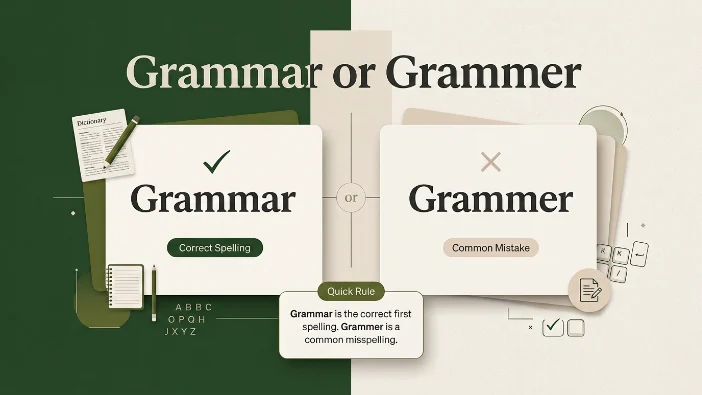
Grammar is the only correct spelling in standard English. “Grammer” is a common misspelling with no valid meaning in any English dictionary. Whether you’re writing an email, an essay, or a resume, always use grammar the word that describes the structural rules governing how a language works.
You’ve probably typed a sentence, paused, and stared at the word until it stopped looking like a real word at all. That strange moment happens to almost everyone, and it happens especially often with this exact term. Some people genuinely wonder if “grammer” might be a British variant, an old-fashioned spelling, or maybe a specialized term used in linguistics. It isn’t. It’s simply a spelling mistake, though an understandable one.
The confusion usually comes from how the word sounds when spoken quickly. The unstressed second syllable blends into something that could plausibly end in either “-ar” or “-er,” and English is full of words that end both ways consider “calendar” next to “teacher,” or “similar” next to “member.” Your ear genuinely can’t tell you which one applies here, so your fingers guess, and sometimes they guess wrong.
This matters more than it might seem. A misspelled word in a job application, a school essay, or a professional email can quietly damage your credibility, especially in a piece of writing that’s supposed to demonstrate strong language skills in the first place. There’s a certain irony in misspelling the very word that means “the rules of correct language use.” By the end of this guide, you’ll know exactly why grammar is spelled the way it is, how to remember it permanently, and which related words trip people up in similar ways.
Grammar vs Grammer: What’s Actually Going On
There isn’t a real comparison to make here, because only one of these two spellings exists as an actual English word. “Grammar” refers to the system of rules that governs how words combine into phrases and sentences things like verb tense, subject-verb agreement, sentence structure, and word order. “Grammer,” on the other hand, isn’t recognized by Oxford Dictionary, Cambridge Dictionary, or Merriam-Webster. It’s simply an error, though it’s worth understanding why the error happens so often.
| Grammar | Grammer | |
|---|---|---|
| Meaning | Rules governing sentence and word structure | No meaning not a real word |
| Part of Speech | Noun | None |
| Refers To | Language structure, syntax, morphology | N/A |
| Typical Usage | “Her grammar was flawless in the interview.” | Not used correctly anywhere |
| Common Confusion | Mixed up due to pronunciation | Mistaken as an alternate spelling |
To recap: if you’re describing sentence structure, verb agreement, punctuation rules, or the mechanics of a language, “grammar” is the word you want every single time. There’s no formal, informal, regional, or historical context where “grammer” is acceptable. It’s not a variant spelling the way “colour” and “color” differ between British and American English it’s simply incorrect.
Is This a Grammar Issue, a Spelling Issue, or a Vocabulary Issue?
Interestingly, this mix-up isn’t a grammar problem in the traditional sense it’s purely a spelling issue. Grammar concerns things like sentence construction and word order; spelling concerns how individual words are written. Since “grammer” isn’t a word with its own meaning, there’s no vocabulary distinction to make either, unlike genuine word pairs such as “affect” and “effect,” which both carry real, separate meanings.
This distinction matters because it changes how you should think about fixing the mistake. You don’t need to learn a new definition or a new rule about when to use one term over another. You need to fix a spelling habit, which is a much simpler task once you understand the pattern behind it.
In formal writing academic papers, business reports, cover letters a spelling mistake like this one stands out more than it might in a casual text message to a friend. Readers in professional and academic settings often use spelling accuracy as a quick, if unfair, proxy for overall competence. In everyday conversation, nobody’s going to notice if you occasionally mistype it in a text. But in anything you intend to publish, submit, or send to someone evaluating your work, it’s worth getting right every time.
Understanding “Grammar” in Full
Meaning: The set of structural rules that governs how a language is put together covering sentence structure, verb tenses, punctuation, and word order.
Pronunciation: GRAM-er (the second syllable is unstressed, which is exactly why the spelling trips people up).
Part of Speech: Noun.
Common Collocations: “grammar rules,” “grammar check,” “poor grammar,” “correct grammar,” “English grammar,” “grammar mistakes.
Typical Sentence Patterns: Grammar usually appears as the subject or object of a sentence discussing language quality “Her grammar improved after the course,” or “The report had several grammar errors.”
Workplace Example: During the meeting, the manager mentioned that the client noticed inconsistent grammar in last month’s proposal, and asked the team to proofread more carefully before sending anything out.
Academic Example: The professor returned the essay with a note explaining that while the argument was strong, several grammar issues in the second paragraph needed correcting before the final submission.
Technology Example: Most word processors now include a built-in grammar checker that underlines potential errors in real time, though these tools still miss context-dependent mistakes a human editor would catch.
Email Example: “Just a heads-up I ran your draft through a grammar tool before sending it to the client, and I fixed a couple of small tense issues.”
Daily Conversation Example: “Honestly, my grammar gets worse the more tired I am. I start dropping articles and mixing up tenses without even noticing.”
One Learner Mistake: Many learners, especially those whose native language pronounces word endings more distinctly, write “grammer” because they’re spelling the word the way it sounds rather than the way it’s actually written. English spelling frequently doesn’t match pronunciation exactly, and this is one of the clearest examples of that gap.
Mini Recap: Grammar is a real, well-defined word describing the rules of language. It’s spelled with an “-ar” ending, not “-er,” despite how it sounds when spoken.
Understanding “Grammer”
There isn’t a genuine definition to give here, because “grammer” isn’t a word in standard English. It doesn’t appear in any major dictionary, it isn’t a regional variant, and it isn’t an older or archaic spelling that fell out of use. It exists only as a typo or a spelling error.
That said, it’s worth mentioning one exception: “Grammer” does show up as a surname in English-speaking countries. If you ever see “Grammer” capitalized in a sentence referring to a person, such as an actor or a historical figure with that last name that’s a completely separate case and not related to the language term at all. Outside of proper names, treat “grammer” as simply incorrect.
Learner Mistake to Avoid: Don’t assume that because a spelling looks plausible or sounds right, it must be a legitimate alternate form. English has plenty of near-homophones that aren’t interchangeable, and this is one of them.
When Writers Commonly Get This Wrong
1. Typing quickly without proofreading. When you’re rushing through an email or a social media post, your fingers often follow sound rather than spelling. Slowing down for even a few seconds before hitting send catches most of these errors.
2. Relying on pronunciation instead of visual memory. Because the ending syllable is unstressed, your ear doesn’t give you reliable information about which vowel comes next. Visual memorization works better than sounding the word out.
3. Confusing it with similar “-er” ending words. Words like “teacher,” “member,” and “computer” all end in “-er,” and if you’ve recently typed several of those, your brain can carry that pattern into the next word without you noticing.
4. Non-native speakers translating spelling patterns from another language. In some languages, similar-sounding words are spelled more phonetically and consistently, which doesn’t map onto English’s often irregular spelling system.
5. Autocorrect gaps on certain devices or browsers. Not every spell-checker catches every misspelling, especially on older software or minimal text fields like search bars and chat apps.
6. Muscle memory from a single early mistake. If you learned the word incorrectly once, perhaps from a handwritten note or an uncorrected school assignment, that first version can stick surprisingly long, even after you’ve seen the correct spelling many times since.
7. Confusing it with “grammer” as it appears in casual internet slang or memes. Occasionally, “grammer” shows up deliberately in jokes about bad grammar (“ur grammer is bad”), which paradoxically reinforces the incorrect spelling through repeated exposure, even in a joking context.
8. Assuming British and American English spell it differently. Some learners assume every American-British spelling difference follows an “-or” versus “-our” or similar pattern, and mistakenly guess that grammar might have a British “-er” variant. It doesn’t both American and British English use “grammar.”
Common Mistakes in Real Sentences
| Correct Sentence | Incorrect Sentence | Explanation |
|---|---|---|
| Her grammar has improved a lot this semester. | Her grammer has improved a lot this semester. | “Grammer” is never correct, regardless of context. |
| Please check the grammar before submitting the report. | Please check the grammer before submitting the report. | The rules-of-language sense always uses “-ar.” |
| The app flagged three grammar errors in my essay. | The app flagged three grammer errors in my essay. | Even casual writing should use the correct spelling. |
| I studied English grammar in college. | I studied English grammer in college. | Academic contexts especially call for accuracy. |
| His grammar sounded a bit formal for a text message. | His grammer sounded a bit formal for a text message. | Informal tone doesn’t change correct spelling. |
Quick Decision Box
If you’re referring to the rules that govern sentence structure, word order, or verb usage, the word you want is grammar every single time, in every context. There is no situation, formal or informal, where “grammer” is the correct choice. If you ever type “grammer,” treat it as a typo to fix, not a valid alternative spelling.
Real World Examples
Office Communication: A team lead reviewing a colleague’s draft press release might jot in the margin, “Just a couple of grammar tweaks needed here before we send this to legal.”
Business Email: “Attached is the revised proposal. I had a colleague check the grammar and tone before sending it your way.”
School or University: A writing center tutor might tell a student, “Your ideas are strong let’s spend the last ten minutes just tightening up grammar and punctuation.”
Customer Support: A support agent training new hires might note, “Even in live chat, keep an eye on grammar. Customers notice more than you’d think.”
Technology: A product manager reviewing app copy might say, “Run this through the grammar checker one more time before we push it live.”
Artificial Intelligence: When someone asks an AI writing tool to “fix the grammar” in a paragraph, they’re asking it to correct sentence structure, verb tense, and word order not spelling alone, though most tools handle both.
Daily Conversation: “I know my grammar isn’t perfect when I text, but I try to clean it up for anything official.”
Grammar in Modern Technology
Grammar checking has become one of the most common features built into everyday software. Word processors, email clients, and browser extensions now scan text in real time, flagging subject-verb disagreement, misplaced modifiers, and awkward sentence construction. Virtual assistants and voice-to-text tools rely on grammar models to interpret spoken commands correctly, since natural speech often skips words that written grammar requires.
Chatbots and AI writing assistants are trained on enormous volumes of correctly written text, which is part of why they rarely produce spelling errors like “grammer” themselves the correct spelling appears far more often in training data than the incorrect one. Business tools built around content creation, from marketing platforms to customer service software, often include grammar-scoring features that rate the professionalism of outgoing messages before they’re sent. In each of these cases, the underlying word is always spelled the same way: grammar.
Where the Word Comes From
Grammar” traces back to the Old French word “gramaire,” which itself came from the Latin “grammatica,” rooted in the Greek word for “letter” or “that which pertains to letters.” Originally, the term referred broadly to the study of literature and language in general, and only later narrowed to mean specifically the structural rules of a language. Understanding this origin helps explain the “-ar” ending: it was inherited through Latin and French, not shaped by how the word sounds when spoken aloud in modern English. That history is part of why the spelling doesn’t match pronunciation as neatly as some learners expect.
Expert Insight
As a language instructor would put it: spelling mistakes rooted in pronunciation are some of the hardest to unlearn, precisely because your ear keeps reinforcing the wrong pattern every time you say the word out loud. The fix isn’t to sound the word out more carefully it’s to build a strong visual memory of the correct spelling through repeated, deliberate exposure. Writing the correct form a few times by hand, or simply pausing to look at it closely the next few times you type it, tends to work better than any memory trick involving pronunciation.
Error Prevention Checklist
- Always use grammar when referring to the rules of sentence structure, word order, or verb usage.
- Never use grammer it isn’t a recognized word in any standard English dictionary.
- Remember: it’s spelled with an “-ar” ending, inherited from Latin and French, not based on how it sounds.
- Quick memory tip: think of “grammar” and “similar” both end in “-ar,” and pairing them can help the spelling stick.
Related Grammar and Spelling Confusions
Affect vs Effect Two words that sound similar but serve entirely different grammatical roles, one usually a verb and the other usually a noun.
Then vs Than A classic mix-up between a time-related word and a comparison word that changes sentence meaning entirely.
Its vs It’s One of the most common punctuation-driven confusions in English, hinging on possession versus contraction.
Definitely vs Definately Another frequently misspelled word where the incorrect version has become oddly common in casual writing.
Separate vs Seperate A near-identical situation to grammar versus grammer, where only one spelling is actually correct.
Which vs Witch A pair that sounds identical but means something completely different depending on context.
Loose vs Lose A spelling and meaning mix-up that changes a sentence from describing looseness to describing a loss.
Advice vs Advise A noun-verb pair often confused in professional writing and emails.
Complement vs Compliment Two words with different meanings that are frequently swapped in business and academic writing.
Principal vs Principle A classic confusion between a person or a primary quality and a fundamental rule or belief.
FAQs
Is “grammer” a British spelling of grammar?
No. Grammar is spelled the same way in both American and British English. Grammer is not a regional spelling variant, so it should not be used as an alternative to grammar.
Why do so many people misspell grammar as grammer?
The second syllable of grammar can sound unclear in natural speech, making it tempting to spell the word as grammer. The correct spelling comes from its historical Latin and Greek roots and ends in -ar, not -er.
Is “Grammer” ever a real word in any context?
Yes, Grammer can appear as a proper noun, particularly as a surname. However, outside of a person’s name or another proper noun, grammer is not the correct spelling of the English word grammar.
Does spellcheck always catch grammer as an error?
Most modern spellcheckers will flag grammer as a spelling error. However, some tools may overlook it, particularly if spellcheck is disabled or the word is recognized as a proper name. It’s still important to proofread manually.
What’s the easiest way to remember the correct spelling?
Remember that grammar ends in -ar. A useful approach is to memorize the word visually rather than relying on pronunciation, since the final sound doesn’t clearly distinguish -ar from -er.
Does this mistake affect how professional my writing looks?
Yes. Misspelling grammar as grammer can stand out in resumes, academic papers, professional emails, and other formal writing. Because grammar is directly associated with correct language use, the error may make the writing appear less carefully proofread.
Conclusion
The difference between grammar and grammer isn’t really a difference at all only one of them is an actual word. Grammar refers to the structural rules that shape how sentences and language function, while grammer is simply a common misspelling caused by the way the word sounds when spoken. Once you understand that the “-ar” ending comes from the word’s Latin and French roots rather than its pronunciation, the correct spelling becomes much easier to remember.
The next time you’re typing quickly and this word comes up, pause for half a second and picture it ending in “-ar,” the same way “similar” and “calendar” do. That small habit is often all it takes to stop the mistake for good.
Read More Related Articles:
- Usage vs Useage | Stop Making This Spelling Mistake in Your Writing In 2026
- Losing vs Loosing | How One Extra “O” Changes the Entire Meaning In 2026
- Successfully or Succesfully | Easy Trick to Remember the Correct Spelling Forever In 2026

Lucas Mitchell is a content writer at synoseek.com. He writes simple, thoughtful pieces that focus on everyday ideas, observations and general knowledge topics. His work is shaped by a calm, realistic tone that keeps the reader engaged without overstatement.