Quick Answer
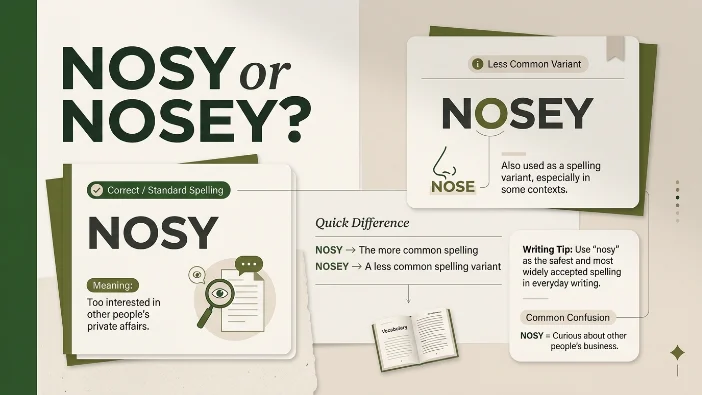
Nosy is the standard spelling in American English and the preferred form worldwide. Nosey is an acceptable variant, more common in British English, but nosy appears approximately four times more frequently in published writing. Both spellings mean the same thing excessively curious about other people’s private matters. For professional and academic writing, nosy is your safest choice.
Spelling an everyday word shouldn’t require a second guess, yet here you are, staring at your screen wondering whether your boss is nosy or nosey for asking about your weekend plans. Maybe you’re drafting an important email, writing a blog post, or completing a grammar exercise, and suddenly this tiny spelling decision stops you cold.
The truth is, you’re not alone in this confusion. Many English speakers including native writers, professionals, and students encounter this exact dilemma. The words look similar, sound identical, and both appear in dictionaries. So which one is correct? And does it even matter?
This guide will settle the nosy vs nosey debate once and for all. You’ll learn the standard spelling, understand when variants are acceptable, discover why the confusion exists, and get practical tips for using the right form in every writing situation. By the end, you’ll never second-guess this word again.
What’s the Difference Between Nosy and Nosey?
Here’s the straightforward answer: there is no difference in meaning between nosy and nosey. Both spellings refer to someone who shows excessive curiosity about others’ private affairs. The only difference lies in spelling preference and regional usage.
To understand why both spellings exist, let’s break down the word’s characteristics:
| Aspect | Nosy | Nosey |
|---|---|---|
| Meaning | Excessively curious about others’ private matters | Exactly the same |
| Part of Speech | Adjective | Adjective |
| Standard Status | Primary spelling in American English | Secondary variant |
| Regional Preference | US, Canada, international | UK, Australia (sometimes) |
| Dictionary Status | Merriam-Webster primary | Oxford Dictionary variant |
| Usage Frequency | About 80% of occurrences | About 20% of occurrences |
| Professional Writing | Preferred | Acceptable but less common |
| Example | She’s so nosy about her neighbors. | She’s so nosey about her neighbors. |
Nosy is the more common spelling in all English varieties, appearing roughly four times more frequently in published texts according to corpus data. It follows a predictable pattern where adjectives ending in *-y* drop the final *e* of the root word (nose → nosy), similar to wheeze → wheezy, cheese → cheesy, and sneeze → sneezy.
Nosey retains the root word’s *e*, making it visually connected to nose. This spelling appears more frequently in British English publications, though even there, nosy remains the dominant form.
In practice, if you’re writing for American audiences, academic publications, or professional contexts, use nosy. If you’re writing informally for British readers, nosey won’t raise eyebrows, but nosy remains equally acceptable.
Is “Nosy” a Grammar, Vocabulary, or Usage Issue?
This question touches on something linguists call orthographic variation the acceptable difference in how words are spelled. Understanding the classification helps you know exactly what you’re dealing with.
Grammar Classification: This is not a grammar issue. Grammar concerns sentence structure, word order, and how words function together. Using nosy or nosey doesn’t change the grammar of your sentence.
Vocabulary Classification: Both spellings represent the same vocabulary item. They have identical meanings and usage patterns. Think of them like color and colour same word, different spelling.
Usage Classification: This is primarily a usage and convention issue. Usage refers to the accepted practices within different English-speaking communities and writing contexts.
Are Both Words Interchangeable?
Yes, nosy and nosey are completely interchangeable in meaning. However, they are not equally suitable in all contexts:
- Formal Writing (academic papers, business reports, professional publications): Use nosy exclusively. It’s the standardized form in American English and the preferred form globally.
- Business English (emails, memos, corporate communications): Nosy is the safer choice, especially in international business contexts where American English dominates.
- Academic Writing (essays, research papers, student work): Nosy follows standard American academic style guides like APA and Chicago Manual of Style.
- Everyday Conversation (texts, social media, casual emails): Either spelling works, though nosy appears more frequently online.
Practical Takeaway: Unless you have a specific reason to use nosey (like following British style guides or personal preference), always choose nosy. It’s correct everywhere, while nosey carries regional limitations.
Nosy: Complete Usage Guide
Pronunciation: /ˈnoʊ.zi/ (NOH-zee)
Part of Speech: Adjective (can also function as a noun in informal contexts: a nosy referring to a nosy person)
Meaning: Showing excessive or offensive curiosity about other people’s private lives, affairs, or personal matters. Nosy behavior often involves asking intrusive questions, eavesdropping, or monitoring others without invitation.
Common Collocations
Collocations are words that naturally pair with nosy:
- Nosy neighbor: “The nosy neighbor watched through her curtains all afternoon.”
- Nosy coworker: “My nosy coworker keeps asking about my salary.”
- Nosy reporter: “The nosy reporter wouldn’t stop questioning the celebrity.”
- Nosy questions: “Stop asking such nosy questions about my divorce.”
- Nosy about: “He’s always so nosy about other people’s relationships.”
- Terribly nosy: “Our new boss is terribly nosy about our personal lives.”
Typical Sentence Patterns
- Subject + be + nosy (describing a person)
- “Your sister is incredibly nosy about our relationship.”
- Subject + be + nosy + about + noun (specifying what someone is nosy about)
- “Why are you so nosy about my weekend plans?”
- It + be + nosy + of + person + to + verb (commenting on behavior)
- “It was nosy of her to ask about your medical history.”
- Noun + be + nosy + question/comment (describing language)
- “That’s a nosy question for someone you just met.”
Workplace Example
“Management has noticed that some employees are becoming increasingly nosy about salary information shared during private meetings. Please respect your colleagues’ privacy and avoid asking about compensation packages.”
Academic Example
“Researchers must be careful not to appear nosy when surveying participants about sensitive topics like income or health conditions, as this perception can significantly affect response rates and data validity.”
Technology Example
“The new software update includes a ‘privacy mode’ that blocks nosy applications from accessing your location data without explicit permission.”
Email Example
“Hi Priya, I noticed you asked about Sarah’s project budget yesterday. I completely understand your curiosity, but please be careful that question came across as a bit nosy, and Sarah seemed uncomfortable. Perhaps you could discuss it with your team lead instead?”
Daily Conversation Example
“Mom, stop being so nosy about who I’m texting! I’m twenty-five years old and can manage my own friendships.”
Common Learner Mistake
Incorrect: “She asked me a nosey questions about my wedding.”
Correct: “She asked me a nosy question about my wedding.”
Why it happens: Learners often treat nosy as a singular noun requiring plural agreement, or they confuse the plural spelling with the singular form. Remember that nosy is an adjective and doesn’t change form regardless of what it describes.
Mini Recap
Nosy is the standard American spelling, pronounced NOH-zee, meaning excessively curious about others’ private matters. Use it to describe people, questions, or behavior that invades privacy. It’s always an adjective and doesn’t change form for plural subjects.
Nosey: Complete Usage Guide
Pronunciation: Identical to nosy /ˈnoʊ.zi/ (NOH-zee)
Part of Speech: Adjective (same as nosy)
Meaning: Exactly the same as nosy. There is absolutely no difference in definition.
Common Collocations
- Nosey parker (chiefly British): A term for an excessively curious person
- Nosey neighbors (British spelling)
- Nosey questions (British variant)
- Nosey about (same usage)
Typical Sentence Patterns
Nosey follows identical sentence patterns to nosy:
- Subject + be + nosey (describing a person)
- “Our landlord is terribly nosey about our visitors.”
- Subject + be + nosey + about + noun
- “Don’t be so nosey about their financial situation.”
Workplace Example (British English context)
“The new office layout has sparked complaints about colleagues being overly nosey about each other’s screen activity. Please position your monitors to respect privacy.”
Academic Example
“In ethnographic research, the line between thorough investigation and being nosey can become blurred. Ethical guidelines help researchers maintain appropriate boundaries.”
Technology Example
“The browser extension detects and blocks scripts from nosey advertising networks that track your browsing history across multiple sites.”
Email Example
“I know you’re curious about the merger details, but please don’t be nosey with the finance team they’re under strict confidentiality agreements.”
Daily Conversation Example
“Gran, you’re being so nosey about my dating life. When I have news to share, I’ll tell you!”
Common Learner Mistake
Incorrect: “The nosey man next door always looking from his window.”
Correct: “The nosey man next door is always looking from his window.”
Why it happens: Learners often omit the verb be when using adjectives, directly translating from languages where adjectives can function as main verbs. Remember that adjectives in English require a linking verb like be, seem, or appear.
Mini Recap
Nosey is a valid variant spelling, more common in British English, with identical meaning and usage to nosy. While acceptable, it appears less frequently in global publishing and may seem old-fashioned or regional to some readers.
When NOT to Use Nosy or Nosey
Using the wrong spelling isn’t usually a problem they’re both valid. However, these words can be the wrong choice conceptually in several situations. Here are eight scenarios where writers commonly choose nosy/nosey incorrectly:
1. When You Mean “Inquisitive” in a Positive Way
Why the mistake happens: Both words describe curiosity, so writers assume they’re interchangeable.
Which word is correct: Inquisitive (neutral/positive), curious (neutral), or interested (positive).
How to remember: Nosy always carries negative judgment. If the curiosity is healthy or intellectual, nosy is the wrong word.
Correct example: “The students showed an inquisitive interest in astrophysics.
Incorrect example: “The students showed a nosy interest in astrophysics.”
2. When Describing Research or Academic Investigation
Why the mistake happens: Both involve finding information about people or topics.
Which word is correct: Investigative, probing, thorough, or detailed.
How to remember: Research has permission and purpose. Nosy implies intrusion without justification.
Correct example: “The investigative journalist uncovered government corruption.
Incorrect example: “The nosy journalist uncovered government corruption.”
3. When Describing Professional Curiosity
Why the mistake happens: Professionals often need to ask personal questions for legitimate reasons.
Which word is correct: Detailed, thorough, background, or necessary.
How to remember: Medical history intake forms aren’t nosy; they’re necessary for treatment.
Correct example: “The doctor asked thorough questions about my family history.”
Incorrect example: “The doctor asked nosy questions about my family history.”
4. When You Mean “Meddlesome” or “Interfering”
Why the mistake happens: The meanings overlap, but nosy specifically refers to curiosity.
Which word is correct: Meddlesome, interfering, or officious.
How to remember: You can be nosy without interfering, and interfere without being nosy.
Correct example: “My interfering mother-in-law rearranged our kitchen cabinets.”
Incorrect example: “My nosy mother-in-law rearranged our kitchen cabinets.”
5. When Describing Snooping Behavior (Not Curiosity)
Why the mistake happens: Nosy people snoop, but snooping is the action.
Which word is correct: Snooping, prying, or eavesdropping.
How to remember: Nosy describes a personality trait; snooping describes an action.
Correct example: “I caught my roommate snooping through my mail.”
Incorrect example: “I caught my roommate nosy through my mail.”
6. When Describing Yourself
Why the mistake happens: People sometimes use nosy self-deprecatingly.
Which word is correct: Curious or inquisitive (more self-flattering options).
How to remember: Calling yourself nosy usually sounds self-critical or overly familiar. Unless you’re being deliberately humble, choose a neutral term.
Correct example: “I’m naturally curious about how things work.”
Incorrect example: “I’m naturally nosy about how things work.”
7. In Formal or Legal Contexts
Why the mistake happens: Writers want to describe intrusive behavior but need formal language.
Which word is correct: Intrusive, prying, or inappropriate questioning.
How to remember: Legal documents need precise, formal vocabulary, not casual judgment.
Correct example: “The witness found the attorney’s questioning intrusive and unnecessary.”
Incorrect example: “The witness found the attorney’s questioning nosy.”
8. When You’re Being Playful or Flirtatious
Why the mistake happens: In casual contexts, nosy seems harmless.
Which word is correct: Curious or interested (more flattering).
How to remember: If you’d be offended if someone called you nosy, don’t use it to describe curiosity you want to seem positive.
Correct example: “I’m just curious about where you grew up.”
Incorrect example: “I’m just nosy about where you grew up.”
Common Mistakes Table
| Correct Sentence | Incorrect Sentence | Explanation |
|---|---|---|
| “My nosy neighbor asked about my salary.” | “My nosey neighbor asked about my salary.” | Nosey is a valid variant, but nosy is more standard. |
| “She asked a nosy question about my divorce.” | “She asked a nosey questions about my divorce.” | Question is singular, so the adjective form remains the same. |
| “Stop being so nosy about my relationships!” | “Stop being so nosey about my relation ship!” | Relationship is one word, not two. |
| “It’s nosy of you to read my journal.” | “It’s nosey of you reading my journal.” | Use the infinitive to read after “of you” to describe an action. |
| “The reporter seemed overly nosy.” | “The reporter seemed overly nosey.” | Either is acceptable, but nosy is more common globally. |
| “Don’t be nosy about things that don’t concern you.” | “Don’t be nosey at things that don’t concern you.” | About is the correct preposition after nosy/nosey, not at. |
Decision Box
If you’re writing for American audiences or global readers: → Use nosy
If you’re writing for British publications or prefer British spelling: → Nosey is acceptable
If you’re writing a formal document, academic paper, or business report: → Use nosy
If you’re writing informally anywhere except the UK: → Use nosy
If you want to sound most natural in modern English: → Use nosy
Remember: You can never go wrong with nosy it’s accepted everywhere. Nosey is regional and less common.
Real-World Examples
Office Communication
“During the team meeting, James asked several nosy questions about Sarah’s upcoming maternity leave policy, making everyone feel awkward and uncomfortable.”
Business Email
“Dear Team, I appreciate your enthusiasm about the promotion process, but please avoid asking nosy questions about candidates’ personal lives. Human Resources will share all relevant information when appropriate.”
School or University
“Professor Chen noticed that some students were being unusually nosy about exam grades posted on the noticeboard. She reminded everyone that grade inquiries should follow the official appeals procedure.”
Customer Support
“We had to explain to the customer that our support team isn’t being nosy we need basic personal information to verify account security before addressing their technical problem.”
Technology
“iPhone users who choose ‘Ask App Not to Track’ are actively blocking nosy advertisers from collecting their behavioral data across different applications.”
Artificial Intelligence
“AI systems that monitor employee productivity walk a fine line between optimizing performance and being overly nosy. Best practices suggest transparency and limited data collection.”
Daily Conversation
“My sister-in-law is so nosy that she actually called my dentist to ask about my last appointment. I nearly lost it when I found out!”
Text Message
“Lol my mom just asked who I’m dating again. She’s so nosy, I’m not telling her anything!”
Nosy/Nosey in Modern Technology
The concept of nosiness has taken on new relevance in the age of digital surveillance, data collection, and artificial intelligence. Understanding the word helps us discuss important privacy issues:
Artificial Intelligence: AI systems designed to analyze user behavior are sometimes criticized for being “nosy” when they collect more data than necessary. The AI ethics debate frequently references “nosy algorithms” that intrude on user privacy.
Virtual Assistants (Siri, Alexa, Google Assistant): Many users worry about these assistants being “nosy” because they’re always listening for wake words. Companies address this by emphasizing that recordings are encrypted and not shared.
Voice Assistants: Privacy advocates warn that voice-activated devices can become “nosy” if they accidentally record conversations or capture commands unintentionally.
Chatbots: When chatbots ask for personal information to provide relevant responses, they risk being perceived as nosy. Effective design balances personalization with privacy respect.
Software: Productivity software that tracks employees’ screen time, application usage, and work patterns has been labeled “nosy” by worker advocates. Companies implement such tracking for performance monitoring but must address privacy concerns.
Business Tools: Customer Relationship Management (CRM) software collects extensive client data. Sales professionals sometimes complain that CRM systems ask “nosy” questions about client interactions but in business, this information serves legitimate purposes for relationship management and forecasting.
Technology Example in Context
“The new project management software raised concerns when employees realized it tracked not just tasks but also idle time and email response rates. While management insisted this data helps optimize workflow, staff openly called it nosy and demanded greater transparency about data collection.”
Word Origin
Understanding where nosy comes from helps explain why two spellings exist:
Origin: Nosy (and its variant nosey) derives from the word nose, combined with the suffix *-y*, meaning “having the quality of.”
Language History: The word first appeared in the early 17th century, originally meaning “having a prominent nose.” By the 1800s, the meaning shifted to “poking one’s nose into others’ affairs” using the nose as a metaphor for curiosity and intrusion.
Meaning Development: The figurative sense likely evolved from the physical act of “poking your nose” into something. If you’re literally poking your nose into a room, you’re being physically curious. Over time, the phrase extended to metaphorical snooping.
Spelling Development: The variation between nosy and nosey reflects typical English spelling inconsistencies. When adding *-y* to nose, standard English spelling rules suggest dropping the final *e* (nose → nosy) similar to shine → shiny and wave → wavy. However, some writers kept the *e* to preserve the visual connection to the root word. Both spellings persisted, neither dominating completely until nosy gained prominence in American English.
Dictionary Recognition: Nosy appears as the primary spelling in American dictionaries (Merriam-Webster, American Heritage), while the Oxford English Dictionary lists both forms, with nosey appearing as a variant used in British English.
Expert Insight
Here’s something most grammar guides won’t tell you: the nosy vs nosey debate reveals more about human psychology than language rules. When writers choose nosey, they’re often making a subconscious decision to keep the word visually connected to its origin nose. It feels more literal, more connected to the physical image of someone literally “sticking their nose” into your business. Writers who choose nosy follow the abstract rule of dropping the *e*, making the word feel more established and standardized.
Neither choice is wrong but your choice signals something about your writing identity. American professionals choose nosy because it aligns with standardized spelling conventions. British traditionalists might choose nosey because it preserves the word’s visual heritage. Global writers choose nosy because it’s the most recognizable form worldwide.
The real lesson? Language rules exist to serve communication, not the other way around. If you’re writing for a global audience, choose the spelling that’s most widely understood that’s nosy. But if you’re writing a novel set in 1950s London, nosey might fit your characters perfectly. Understanding the difference isn’t about finding a “correct” answer it’s about knowing your audience and making intentional choices.
Error Prevention Checklist
✅ Always use nosy when:
- Writing for American, Canadian, or international audiences
- Submitting academic papers or professional documents
- Writing business emails or corporate communications
- Following style guides like APA, Chicago, or MLA
- You want the universally accepted spelling
✅ Use nosey when:
- Following British English style conventions
- Writing specifically for UK audiences
- Your organization’s style guide prefers it
- You’re writing dialogue for British characters in creative writing
❌ Never confuse them if:
- You’re trying to be more formal (nosy is more standard)
- You want maximum reader comprehension (nosy is more widely recognized)
- You’re writing for an international audience (nosy avoids confusion)
Quick Memory Tip:
Nose + y = Nosy (dropping the *e* follows standard English patterns)
Think: Nosy is not-e the *e* is missing, just like privacy goes missing when someone is nosy!
Related Grammar Confusions
Here are eight similar vocabulary comparisons worth learning they represent common spelling and usage questions that frequently confuse English learners and native speakers alike:
- Adviser vs Adviso Both are acceptable, but advisor is more common in American English and professional titles (Financial Advisor).
- Focused vs Focussed Focused is standard in American English; focussed appears in British English but is less common.
- Traveling vs Travelling American English uses one *l*, British English uses two (travelling). Same rule applies to traveled/travelled.
- Canceled vs Cancelled American spelling uses one *l*, British uses two. Both are correct in their respective regions.
- Forward vs Forwards Both adverbs exist; forward is more common globally and preferred in American English.
- Among vs Amongst Among is standard in American English; amongst appears more in British English and sounds slightly formal or literary.
- While vs Whilst While is standard in American English; whilst is distinctly British, formal, or literary.
- Toward vs Towards Toward is standard in American English; towards is more common in British English and considered nonstandard in American writing.
Each of these comparisons follows a similar pattern American English vs British English spelling variants with identical meanings. Understanding one helps you understand them all.
FAQs
Is “nosey” a misspelling?
No. Nosey is a valid spelling variant of nosy. However, nosy is generally the more common and widely preferred spelling, especially in modern American English. Both forms describe someone who is overly interested in other people’s private affairs.
Which spelling is more common: nosy or nosey?
Nosy is more common in modern English. It is the spelling most readers are familiar with and is widely used in American and British English. Nosey is also correct, but it appears less frequently.
Is it spelled nosey or nosy in British English?
Both spellings can be used in British English. Nosy is common and widely accepted, while nosey is also recognized as a variant. For consistency and broader familiarity, nosy is usually the safer choice.
What does nosy mean?
Nosy describes someone who takes an unwanted or excessive interest in other people’s private lives or personal matters. For example, a nosy neighbor might ask intrusive questions or try to discover information that does not concern them.
Can “nosy” be used as a noun?
Usually, nosy is used as an adjective, as in “a nosy person.” In informal speech, some speakers may use it as a noun-like label, but busybody, snoop, or nosy person are clearer choices in standard writing.
Are “nosy” and “inquisitive” the same?
Not exactly. Nosy usually has a negative meaning because it suggests intrusive or unwelcome curiosity. Inquisitive, on the other hand, is often neutral or positive and describes someone who is eager to learn, ask questions, or understand something better.
Conclusion
By now, the nosy vs nosey debate should feel thoroughly settled. Here’s the bottom line: both spellings are correct, but nosy is the standard, preferred, and more common form worldwide. Nosey is an acceptable variant, primarily associated with British English, but even in the UK, nosy dominates usage.
The key difference isn’t meaning it’s context. For professional writing, academic work, business communication, and most everyday situations, nosy is the safe, natural, and widely recognized choice. Save nosey for British audiences, creative writing, or when following specific style preferences, knowing that it’s never incorrect but always less common.
Remember the memory trick: Nosy is “not-e” dropping the *e* from nose makes the spelling cleaner and more consistent with standard English rules. This isn’t about being “right” but about being intentional and informed in your writing choices.
The next time you’re writing about someone’s excessive curiosity, you’ll know exactly which spelling to choose and why. This understanding transforms you from someone who guesses about spelling to someone who makes confident, educated language decisions.
1 thought on “Nosy or Nosey | Simple Guide to Getting the Spelling Right In 2026”