Quick Answer
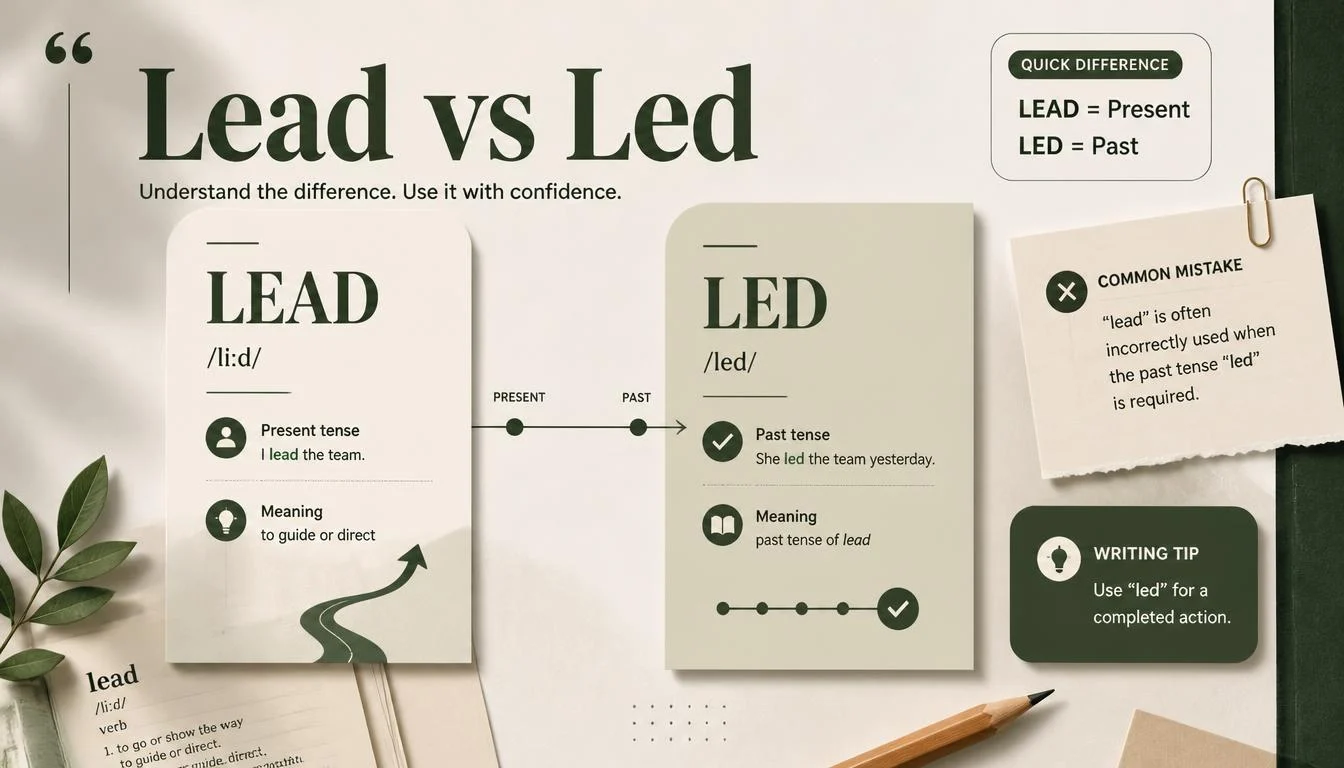
“Lead” is the present tense of the verb meaning to guide or direct, while “led” is its past tense and past participle.
Example: “She leads the team” but “She led the team yesterday.”
Remember: for a completed action in the past, use “led,” not “lead.”
Understanding the difference between Lead vs Led can be tricky because these words are closely related but serve different grammatical purposes. While “lead” is commonly used as a present tense verb, “led” is the correct past tense and past participle of “lead.”
In this guide, we’ll explain Lead vs Led with simple definitions and examples. You’ll learn when to use each word so you can avoid common spelling and grammar mistakes in everyday and professional writing.
This guide will explain everything you need to know about lead vs. led. We’ll explore their meanings, provide clear examples, and give you easy memory tricks to ensure you never make this mistake again.
What’s the Difference Between Lead and Led?
The core difference between lead and led is tense. Lead (pronounced “leed”) is the present tense of the verb, while led (pronounced “led”) is the past tense and past participle. However, the situation is complicated by the existence of a noun, lead (pronounced “led”), which refers to a heavy metal element.
Here’s a breakdown of the key differences:
| Feature | Lead (Verb) | Led (Verb) | Lead (Noun/Metal) |
|---|---|---|---|
| Meaning | To guide, direct, or be in charge. | Past tense of lead (to guide). | A soft, heavy, toxic metallic element. |
| Part of Speech | Verb (present tense) | Verb (past tense & past participle) | Noun |
| Pronunciation | /liːd/ (rhymes with need) | /lɛd/ (rhymes with bed) | /lɛd/ (rhymes with bed) |
| Typical Usage | “I will lead the team.” | “She led the team.” | “The pipes are made of lead.” |
| Example | “Successful managers lead by example.” | “He led us to the conference room.” | “Exposure to lead can cause health problems.” |
In short, if you are referring to guiding or directing and the action is happening now or in the future, use lead. If the action already happened, use led. The noun lead has the same pronunciation as the past-tense verb led, which is a major source of the confusion .
Is Lead vs Led a Grammar, Vocabulary, or Usage Issue?
The confusion between lead and led is primarily a grammar and usage issue . It’s not a vocabulary problem people usually know what both words mean. The problem lies in applying the correct grammar rule for forming the past tense of an irregular verb.
- Grammar Classification: The error is a verb tense mistake. You are using the present tense verb form (lead) in a context that requires the past tense or past participle (led).
- Vocabulary Difference: Both words are not synonyms; they are different grammatical forms of the same verb. The only vocabulary difference is that lead also serves as a noun for the metal, which has a different meaning entirely.
- Usage Difference: Lead is used in the present or future. For example, “She will lead the training session.” Led is used for completed actions, such as, “She led the training session last week.”
- Formal vs. Informal English: This rule applies across all registers of English, from academic writing to casual conversation. Using lead when you mean led is a clear grammatical error in any context .
Practical Takeaway: Remember that using the incorrect spelling signals a lack of attention to detail. In professional writing, getting this right shows competence.
Understanding “Lead” (Present Tense)
Meaning and Usage
When you use lead (pronounced “leed”), you are referring to the action of guiding, directing, or showing the way and you are doing it in the present or future tense. It’s a verb that implies taking charge or being in a position of authority .
Examples in Context
- Workplace: “A good project manager doesn’t just assign tasks; they lead by example.” (Present tense)
- Academic: “The professor’s research will lead to new discoveries.” (Future tense)
- Email: “The new initiative will lead to increased sales.” (Future tense)
- Daily Conversation: “If you lead the way, I will follow.
- Technology: “Automation will lead the next industrial revolution.”
Common Collocations and Patterns
- Lead the way: To go first and show the path.
- Lead a team: To be in charge of a group.
- Lead to: To cause or result in something.
- Lead by example: To show others how to behave through your own actions.
- Lead the charge: To be at the forefront of a movement or effort.
A Learner’s Mistake
Incorrect: “Yesterday, I lead the meeting.” (Using the present tense spelling for a past event.)
Correct: “Yesterday, I led the meeting.”
Mini-Recap: Use lead (“leed”) when your action of guiding or directing is happening now or will happen in the future.
Understanding “Led”
Meaning and Usage
Led is the simple past tense and past participle form of the verb lead (to guide). It is used to describe an action of guiding or directing that has already been completed. It is always pronounced the same as the metal “lead” (/lɛd/), which is a common source of mix-ups .
Examples in Context
- Workplace: “Our VP led the company through a difficult merger last year.” (Past action)
- Academic: “The research team led a study on the effects of the new drug.” (Past action)
- Email: “The marketing campaign has led to a significant increase in website traffic.” (Past participle)
- Daily Conversation: “He led us on a tour of the historic district.” (Past action)
- Technology: “Developments in AI have led to breakthroughs in medicine.” (Past participle)
Common Collocations and Patterns
- Led the team to victory: Guided a group to success.
- Has led to: Has resulted in.
- Was led by: Was guided or directed by someone.
- Led astray: To be misled or guided in the wrong direction.
- Led a campaign: Directed a concerted effort.
A Learner’s Mistake
Incorrect: “The screen was lead by the touch interface.” (Using the noun/metal spelling for the past participle.)
Correct: “The screen was led by the touch interface.”
Mini-Recap: Led is always the past tense. If the guiding or directing happened yesterday, last week, or in the past, use led.
When Not to Use Each Word
Here are common situations where writers choose the wrong word, along with memory tricks to avoid them.
- When describing a past event:
- Why the mistake happens: Because the metal “lead” and the past tense “led” sound the same, writers default to the more familiar spelling.
- Correct: “The director led the actors through the final scene.”
- Memory Trick: Think of “yesterday” has a y, but “yesterday” is in the past, and the correct word for the past has an ‘e’ in it: led.
- When using a helping verb (has/have/had):
- When using the passive voice:
- Why the mistake happens: The passive voice changes the verb form, and writers may not recognize they need a past participle.
- Correct: “The crowd was led by the parade marshal.”
- Memory Trick: Any form of “to be” (is, was, were, have been) signals you need a past participle, which is led.
- When “lead” is the metal element:
- Why the mistake happens: “Lead” the metal and “led” the verb are pronounced identically, making it easy to confuse the spelling in your mind.
- Correct: “The paint contains harmful amounts of lead.”
- Memory Trick: The metal lead is an element, and elements are nouns, not verbs. The verb is led.
- In compound modifiers:
Common Mistakes Table
Lead or Led: A Quick Decision Guide
- If you mean the action of guiding or directing that is happening now or in the future, use Lead.
- If you mean the action of guiding or directing that happened in the past, use Led.
- If you mean the heavy, metallic element (chemical symbol Pb), use Lead.
Real-World Examples
Here are practical examples from a variety of professional and casual contexts:
- Office Communication: “On the project, Sarah led the design team and I led the marketing team. We both report to the VP.”
- Business Email: “Subject: Q4 Performance. Dear Team, I am confident our new approach will lead the market.”
- School/University: “The professor led the discussion on postmodern literature, but next week, the students will lead the seminar.”
- Customer Support: “The chatbot is designed to lead users to the most relevant help articles.”
- Technology: “The new features led to a surge in user engagement across the platform.”
- Artificial Intelligence: “AIs are not designed to lead, but to assist human decision-making.”
- Daily Conversation: “He led the group to the restaurant, but he forgot the way.”
Lead vs Led in Modern Technology
The terms lead and led are frequently used in technology in ways that reflect both their base and past-tense forms.
- Artificial Intelligence (AI): Companies often aim to lead in AI innovation. For example, “Advances in AI have led to more intuitive chatbots.”
- Virtual Assistants (VA): Marketing materials may say, “Our new VA will lead you through the process of setting up your account.”
- Chatbots: “Chatbots are designed to lead users down a path to a solution.” In the past tense, “The support bot led the customer to the correct answer.”
- Software Development: “The team led the development cycle.” “Their agile methodology will lead the next project.”
- Business Tools: “Using this CRM will lead to better sales data.” “The new software update has led to a 20% increase in productivity.”
Word Origin
Understanding the history of these words can help solidify their meanings. The verb lead comes from Old English lædan, meaning “to cause to go with oneself.” It shares an origin with the word “load” and carries the sense of carrying or bearing something forward. The metal lead has a different history, coming from Old English lēad, which may be of Celtic origin. The fact that these two words share a spelling is a historical accident, but their identical pronunciation is what causes so much confusion today .
Expert Insight
From an educator’s perspective, the lead vs. led mistake is one of the most common in English, and it’s often rooted in a simple misunderstanding of verb tenses. The verb “read” is a common trap; its spelling is the same in both the present and past tense, leading people to believe the same rule applies to “lead.” Here’s a key insight: if you remember that “lead” rhymes with “feed,” then its past tense should rhyme with “fed.” The past tense of “feed” is “fed,” not “feed.” Similarly, the past tense of “lead” (leed) is “led” (led), not “lead” (leed). This simple rhyming logic is the easiest way to break the habit of using the wrong word.
Error Prevention Checklist
- □ Always use Lead when…
- The action is in the present or future.
- You are talking about the heavy metal.
- □ Always use Led when…
- The action is in the past.
- You are using the past participle with has, have, or had.
- You are using the passive voice (e.g., “was led by”).
- □ Never confuse them if…
- You remember that “lead” in the present tense is the longer word with the long “e” sound (“leed”), and “led” is the past tense.
- □ Quick Memory Tip:
Related Grammar Confusions
Here are some other commonly confused words worth learning:
- Effect vs. Effect: One is usually a noun (result), the other a verb (to cause).
- Affect vs. Effect: Similar to “effect,” “effect” is often a noun; “affect” is usually a verb.
- Its vs. It’s: “Its” is possessive; “it’s” is a contraction for “it is.”
- Your vs. You’re: “Your” is possessive; “you’re” is a contraction for “you are.”
- There, Their, and They’re: There = a place; Their = belonging to them; They’re = they are.
- To vs. Too vs. Two: To = preposition/infinitive; Too = also; Two = the number.
- Than vs. Then: Than = comparison; Then = next in time.
- Complement vs. Compliment: Complement = something that completes; Compliment = praise.
FAQs
Is it “lead” or “led” in the past tense?
The past tense of the verb lead is led. For example, “Last week, he led the meeting.” Lead, when it means to guide or direct, is the present tense and is pronounced like “leed.
Is “lead” pronounced like “led” or “leed”?
It depends on the meaning.
- When lead is a verb meaning “to guide,” it is pronounced like “leed,” which rhymes with “need.
- When lead refers to the heavy metal, it is pronounced like “led,” which rhymes with “bed.”
When should you use “lead” and “led” in a sentence?
Use lead for the present or future tense, such as “I will lead the team.” Use led for the past tense, as in “She led the team to victory.”
What is the difference between “lead” and “led”?
The main difference is grammatical tense. Lead is the present tense of the verb meaning “to guide,” while led is its past tense. Lead can also refer to a type of metal, in which case it is pronounced the same as led.
Why do people confuse “lead” and “led”?
People often confuse these words because lead has two different pronunciations. The metal lead is pronounced the same as led, while the verb lead is pronounced differently. The confusion can also come from comparing it with read, whose spelling stays the same but whose pronunciation changes between present and past tense.
Conclusion
The distinction between lead and led is a classic grammar pitfall, but it’s easy to master with a little practice. The core rule to remember is that lead is the present tense verb for guiding or directing, and led is its past tense and past participle. The confusion is understandable due to the homophone lead, the metal element, but don’t let it trip you up.
A memorable practical rule to remember is: “Lead today, led yesterday.” . By applying this simple logic, you can confidently use the correct word every time and ensure your writing is clear, professional, and accurate.
Read More Related Articles:
- Ladder or Latter | Master the Difference With Easy Examples In 2026
- Salvadoran or Salvadorian | Understanding the Difference In 2026
- Plushy or Plushie | Simple Guide to the Difference In 2026

Zoe Chambers works as a content writer at synoseek.com, contributing thoughtful pieces on everyday subjects and ideas. She writes in a simple, grounded way, often drawing from real-world experiences. Her focus is on keeping content natural, clear and easy for readers to connect with.
3 thoughts on “Lead vs Led | Complete Difference Explained in Plain English In 2026”