Quick Answer
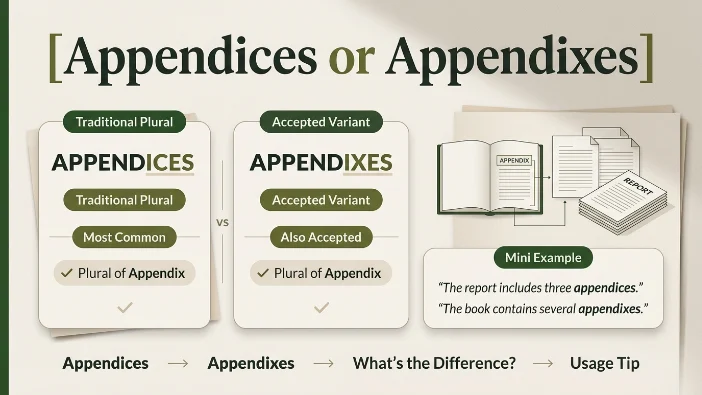
Both appendices and appendixes are correct plurals of “appendix,” but they aren’t used the same way. Appendices is the preferred plural in academic writing, formal reports, and legal or medical documents. Appendixes is more common when referring to the body organ, especially in everyday or medical speech. Neither form is wrong; the difference comes down to context and tradition.
When referring to the supplementary sections at the end of a book, report, or academic paper, you may wonder whether Appendices or Appendixes is the correct spelling. Both forms are accepted English plurals of “appendix,” but their usage varies by region and writing style.
Understanding the difference between Appendices or Appendixes can help you choose the spelling that fits your audience. Appendices is more common in British English and formal writing, while appendixes is also accepted, particularly in American English.
Why This Word Trips Up So Many Writers
If you’ve ever paused halfway through typing a research paper, wondering whether to write “see appendices” or “see appendixes,” you’re in good company. This is one of those rare English words that genuinely has two accepted plural forms, and dictionaries won’t scold you for picking either one. The confusion usually starts because most nouns in English only get one plural, so when a word offers two, writers assume one of them must be a mistake.
The word appendix comes from Latin, and Latin-based nouns often keep their original plural patterns even after entering English. That’s part of why appendices feels formal and academic, while appendixes feels more naturally English. Neither history lesson is required to use the word correctly, but understanding it does explain why style guides sometimes disagree.
Getting this choice right matters more than it might seem. In a medical chart, in a legal contract, or in a thesis submitted to a strict committee, using the “wrong” plural in that particular context can make writing look inconsistent or less polished, even though technically nothing is grammatically incorrect. By the end of this guide, you’ll know exactly which form to reach for depending on what you’re writing, who’s reading it, and what field you’re working in.
Appendices or Appendixes: What’s the Difference?
The core difference is not meaning but style. Appendices and appendixes both refer to more than one appendix, whether that’s a supplementary section at the end of a document or the small organ attached to the large intestine. The words mean the same thing; only the preferred usage context changes.
Appendices follows the Latin plural pattern, similar to how “index” becomes “indices” in formal or scientific writing. It shows up constantly in academic papers, business reports, legal filings, and technical manuals, largely because those fields tend to favor traditional, formal language.
Appendixes follows the regular English pattern of simply adding “-es” to the end of the word, the same way “box” becomes “boxes.” This version feels more natural in conversational writing and is the plural most style guides recommend when talking about the anatomical organ.
| Meaning | Part of Speech | Refers To | Typical Usage | Example | Common Confusion |
|---|---|---|---|---|---|
| Appendices | Noun (plural) | Supplementary document sections | Academic, legal, formal writing | “The report includes three appendices.” | Assumed to be the only correct plural |
| Appendixes | Noun (plural) | Body organ or general use | Medical, casual, everyday writing | “Both appendixes were removed during surgery.” | Assumed to be incorrect or informal slang |
So here’s the short version. If you’re writing a dissertation, a business proposal, or a technical document, appendices will almost always feel more at home. If you’re writing about human anatomy or keeping things casual and plain, appendixes tends to be the safer, more natural-sounding choice.
Is This a Grammar Issue, a Vocabulary Issue, or a Usage Issue?
This is primarily a usage issue, not a grammar error. Both plural forms are grammatically valid, so choosing one over the other won’t create a sentence structure problem. What changes is tone, formality, and field-specific convention.
From a vocabulary standpoint, appendices and appendixes are interchangeable. A dictionary will list both without marking either one as incorrect. The distinction only becomes meaningful once you consider audience and setting.
In formal English, particularly academic writing, appendices dominates. University style guides, publishing houses, and citation formats like APA and Chicago Manual of Style lean toward appendices because it matches long-established scholarly convention.
In business English, appendices still tends to win out for reports, contracts, and proposals, since these documents often mirror academic formatting. Appendixes shows up more in day-to-day business communication, particularly when discussing medical topics or writing for a general audience rather than a specialized one.
In academic writing specifically, appendices is close to a default. Professors and journal editors rarely question it, while appendixes might raise an eyebrow in a strict formal paper, even though it isn’t technically wrong.
In everyday conversation, people rarely think about which plural to use at all, and appendixes often slips out naturally because it follows the standard English pattern most speakers default to without thinking.
The practical takeaway here is simple: when doubt strikes, match your audience. Formal and academic settings call for appendices. Medical and casual conversation call for appendixes.
Appendices: A Closer Look
Appendices is the Latin-style plural of appendix, most often used to describe extra sections placed at the end of a formal document.
Pronunciation: uh-PEN-di-seez
Part of speech: Plural noun
Common collocations: “see appendices,” “listed in the appendices,” “refer to appendices A and B,” “additional appendices”
Typical sentence pattern: [Document type] + includes/contains + [number] + appendices
Workplace example: The quarterly report contains three appendices covering budget breakdowns, vendor contracts, and risk assessments.
Academic example: Students submitting a thesis are usually required to place raw data, survey questions, and consent forms in the appendices rather than the main body of the paper.
Technology example: The software documentation includes appendices listing every API error code alongside a short explanation of what triggers it.
Email example: “Please find the supporting data in the appendices attached to this proposal.”
Daily conversation example: Someone might casually say, “There are so many appendices in this manual, I don’t even know where to start,” even though this leans slightly formal for casual speech.
Learner mistake: Non-native speakers sometimes pluralize appendices again, writing “appendicess” or treating it as singular by saying “an appendices,” which is incorrect since appendices is already plural.
Mini recap: Appendices is your go-to plural for formal documents, academic papers, and professional reports. It signals structure and polish.
Appendixes: A Closer Look
Appendixes is the regular English plural of appendix, commonly used in medical, casual, and general contexts.
Pronunciation: uh-PEN-dik-siz
Part of speech: Plural noun
Common collocations: “removed appendixes,” “inflamed appendixes,” “burst appendixes,” “both appendixes”
Typical sentence pattern: [Subject] + has/had + [number] + appendixes + [condition or action]
Workplace example: In a workplace wellness newsletter, a writer might explain that appendixes rarely cause problems until they become inflamed, which is why sudden abdominal pain shouldn’t be ignored.
Academic example: A biology textbook chapter on the digestive system might describe how appendixes function in humans compared to other mammals.
Technology example: A health app’s symptom checker might list “pain near the appendixes” as a possible indicator worth flagging to a doctor, favoring the plain-language plural for accessibility.
Email example: “The patient education material explains what appendixes do and why removal doesn’t affect digestion long-term.”
Daily conversation example: “Did you know some people are actually born with two appendixes? That’s pretty rare, but it happens.”
Learner mistake: Some learners assume appendixes only applies to documents and mistakenly use it in academic writing, when appendices would be the stronger, more expected choice there.
Mini recap: Appendixes fits naturally into medical writing, casual speech, and any context where you want a straightforward, familiar-sounding plural.
When Not to Use Each Word
Mistake 1: Using appendixes in a formal academic paper. Writers sometimes default to appendixes simply because it sounds more natural. In academic writing, though, appendices is the expected standard. Remembering that scholarly work leans Latin-influenced can help lock this in.
Mistake 2: Using appendices when discussing the human body in casual writing. Saying “her appendices were fine” instead of “her appendixes were fine” can sound oddly formal or even slightly incorrect in a medical or conversational context. Appendixes reads more naturally here.
Mistake 3: Treating appendices as singular. Because it ends differently from “appendix,” some writers mistakenly use appendices to describe just one section. Remember that appendices is always plural; a single section is still called an appendix.
Mistake 4: Switching between both forms in the same document. Consistency matters. If a report uses appendices in the introduction, it should stick with appendices throughout rather than sliding into appendixes halfway through.
Mistake 5: Assuming one form is objectively wrong. Some writers insist appendixes isn’t a real word. It is. Major dictionaries confirm both plurals exist, so correcting someone for using appendixes is itself a mistake.
Mistake 6: Overcorrecting in casual speech. Using appendices in a relaxed, spoken conversation about health can sound stiff or overly formal. Appendixes usually fits better when speaking casually.
Mistake 7: Ignoring field-specific convention. Legal and academic fields strongly favor appendices, while medical contexts lean appendixes. Ignoring these unwritten norms can make writing feel slightly off to readers familiar with the field.
Mistake 8: Forgetting regional or publisher-specific style guides. Some publications have their own house style that overrides general convention. Always check specific style guidelines before assuming general rules apply universally.
Common Mistakes Table
| Correct Sentence | Incorrect Sentence | Explanation |
|---|---|---|
| “The dissertation included five appendices.” | “The dissertation included five appendixes.” | Academic writing conventionally favors appendices. |
| “Both of his appendixes were healthy.” | “Both of his appendices were healthy.” | Medical references to the organ typically use appendixes. |
| “Refer to Appendix B for details.” | “Refer to Appendices B for details.” | A single section is “Appendix,” not “Appendices.” |
| “The manual has three appendices.” | “The manual has three appendixe.” | Appendixe is not a valid plural form at all. |
| “Appendixes can become inflamed.” | “Appendices can become inflamed.” | The anatomical plural is appendixes, not appendices. |
Quick Decision Box
- If you’re writing about documents, reports, or academic papers, use appendices.
- If you’re writing about the human body or speaking casually, use appendixes.
- If you’re unsure, ask yourself: “Would a professor accept this?” If yes, appendices is probably the safer bet.
Real World Examples
Office communication: A project manager emailing a finished proposal might write, “I’ve attached the appendices with our full cost breakdown and timeline,” keeping the tone professional and structured.
Business email: A consultant closing out a client project could note, “You’ll find supporting research in the appendices section starting on page 42.”
School or university: A professor grading student papers might comment, “Move your raw survey data into the appendices rather than the main analysis section.”
Customer support: A support agent explaining a product manual might say, “The troubleshooting steps you’re looking for are listed in one of the appendixes sorry, appendices near the back,” a small slip that shows even native speakers sometimes hesitate mid-sentence.
Technology: A software engineer writing internal documentation might note, “All deprecated functions are archived in the appendices for reference.”
Artificial Intelligence: An AI-generated report summarizing research findings might automatically default to appendices, since most formal training data leans toward that form.
Daily conversation: A friend recovering from surgery might joke, “Guess I’m down to zero appendixes now,” a light, casual use that wouldn’t sound right with the formal plural.
Appendices in Modern Technology
Modern writing tools, AI assistants, and voice assistants generally default to appendices when generating formal content, since most training data comes from academic and professional sources where that form dominates.
In software and business tools, terms like “generate appendices” or “export appendices as PDF” appear frequently in document automation features, reinforcing appendices as the standard choice in professional software environments.
Chatbots and AI writing assistants tend to mirror whatever context they’re given. Ask an AI tool to write a business report, and it will likely produce appendices. Ask it to explain human anatomy, and appendixes becomes far more likely to appear instead.
Voice assistants rarely need to distinguish between the two, since spoken requests about “appendix information” don’t usually require pluralization at all. Still, when transcription software converts speech to text for medical or legal documentation, it typically follows the same field-based conventions described earlier in this guide.
A Brief Word Origin Note
Appendix comes from the Latin word “appendere,” meaning “to hang upon” or “to attach.” Latin nouns ending in “-ix” traditionally formed their plural with “-ices,” which is exactly why appendices developed as an early, formal plural in English.
Over time, English speakers began applying regular English pluralization rules to many borrowed words, which is how appendixes emerged as an equally valid alternative. This pattern isn’t unique to appendix. Words like “index” (indices or indexes) and “matrix” (matrices or matrixes) followed a similar path, ending up with two accepted plurals instead of one.
Expert Insight
As a language instructor, I always tell students that appendices and appendixes are proof English doesn’t always demand a single “correct” answer. What matters more than memorizing a rule is recognizing your audience. A formal report and a casual conversation about health call for different instincts, and once you internalize that distinction, choosing the right plural becomes automatic rather than something you have to consciously calculate every time.
Error Prevention Checklist
- Always use appendices when writing academic papers, business reports, or legal documents.
- Always use appendixes when discussing the human organ or writing casually.
- Never confuse either plural with the singular “appendix,” which refers to just one section or one organ.
- Quick memory tip: Academic and Appendices both start with a slightly formal tone; Anatomy and Appendixes both sound plain and everyday.
Related Grammar Confusions Worth Learning
- Index vs Indices vs Indexes Another Latin-origin word with two competing plural forms, useful for understanding this same pattern elsewhere.
- Criterion vs Criteria A common singular-plural mix-up that trips up even experienced writers.
- Datum vs Data Helps clarify whether “data” should be treated as singular or plural in formal writing.
- Cactus vs Cacti vs Cactuses Yet another word with multiple accepted plurals, similar to appendix.
- Formula vs Formulae vs Formulas Common in scientific and mathematical writing, following the same Latin-versus-English plural pattern.
- Syllabus vs Syllabi vs Syllabuses Frequently confused by students and teachers alike.
- Focus vs Foci vs Focuses A useful comparison for writers working in academic or technical fields.
- Curriculum vs Curricula vs Curriculums Common in education-related writing and reports.
- Bacterium vs Bacteria Helps reinforce the difference between singular and plural forms in scientific writing.
- Phenomenon vs Phenomena Another frequently misused singular-plural pair worth mastering.
FAQs
Is “appendixes” a real word?
Yes. “Appendixes” is a correct plural form of appendix and is recognized in major dictionaries. It is often used when referring to anatomical organs or in general writing, while “appendices” is especially common in academic and formal contexts.
Which plural form does APA style prefer?
For supplementary sections in academic papers, “appendices” is the preferred form in APA style. Using the traditional Latin plural fits the conventions commonly used in scholarly and research writing.
Can “appendices” and “appendixes” be used interchangeably?
Yes. Both forms are grammatically correct and refer to more than one appendix. However, it is best to choose one form and use it consistently throughout the same document.
Why does “appendix” have two plural forms?
The word “appendix” comes from Latin, where the traditional plural is “appendices.” English later developed the regular plural “appendixes” by applying its own pluralization pattern. Both forms have remained in use.
Which plural of “appendix” is used in medical writing?
“Appendixes” is often used when referring to the anatomical organs, particularly in general medical usage. However, medical publications may follow their own style guides, so the preferred form can vary by journal or institution.
Is it wrong to say “an appendices”?
Yes. “Appendices” is plural and cannot be used with the singular article “an.” For one supplementary section, write “an appendix.” For multiple sections, write “appendices” or “appendixes.”
Conclusion
The difference between appendices and appendixes ultimately comes down to context rather than correctness. Appendices fits naturally into academic, legal, and professional writing, while appendixes feels more at home in medical references and everyday conversation. Neither form outranks the other grammatically, but knowing which one your audience expects makes your writing feel more polished and intentional.
If you remember one simple rule, let it be this: formal documents lean toward appendices, while the human body and casual speech lean toward appendixes. Keep that distinction in mind, stay consistent within a single piece of writing, and you’ll never second-guess this word again.