Quick Answer:
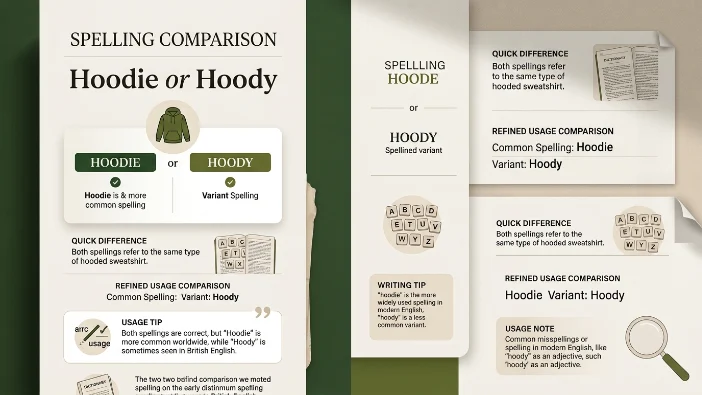
Hoodie is the correct and standard spelling in modern English. Hoody is an older, less common variant that still shows up in British English and casual writing, but hoodie is what you’ll find in dictionaries, on clothing labels, and in professional writing. If you’re unsure which one to use, hoodie is always the safer choice.
Wondering whether to write hoodie or hoody? Both spellings are recognized, but hoodie is by far the more common form in modern English. It refers to a sweatshirt, jacket, or similar garment with a hood and is widely used in everyday writing.
The spelling hoody is also used, especially in some British English contexts, but it is much less common. If you’re choosing one spelling for general writing, hoodie is the safer and more familiar choice.
Why This Little Word Trips So Many People Up
You’re typing a product description, a text to a friend, or maybe a school assignment, and suddenly you stop. Is it a hoodie or a hoody? Both look right. Both sound identical when spoken out loud. And if you’ve seen the word written both ways online, in stores, or in old magazines, your confusion makes complete sense.
Here’s the short version: hoodie refers to a casual pullover or zip-up sweatshirt with an attached hood, and hoody is simply an older spelling of the exact same word. They mean the same thing. They’re pronounced the same way. The only real difference is which spelling has stuck around in modern usage, and which one has quietly faded into the background.
This mix-up matters more than people realize. Use the wrong spelling in a resume, a business email, or a product listing, and readers might assume you made a typo. Get it right, and you sound polished without even trying. Below, you’ll learn exactly where each spelling came from, when (if ever) hoody is acceptable, and how to make sure you never second-guess yourself again.
Hoodie or Hoody: What’s the Difference?
The direct answer is this: there is no difference in meaning. Hoodie and hoody refer to the same garment, a sweatshirt or jacket with a built-in hood, usually featuring a front pocket and sometimes a zipper. The difference is purely spelling, not definition.
Hoodie is a noun formed by adding the informal suffix “-ie” to the word “hood,” a pattern common in casual English (think “movie,” “cookie,” or “selfie”). Hoody uses the older “-y” ending instead, which was actually the original spelling when the word first entered casual use in the mid-20th century.
Over time, English speakers gravitated toward “-ie” endings for this kind of informal noun, and hoodie became the dominant spelling almost everywhere, including in the United States, Canada, Australia, and increasingly in the UK as well.
| Feature | Hoodie | Hoody |
|---|---|---|
| Meaning | Hooded sweatshirt or jacket | Same garment, identical meaning |
| Part of Speech | Noun | Noun |
| Refers To | A pullover or zip-up top with a hood | Same |
| Typical Usage | Standard in US, UK, Canada, Australia | Rare, mostly older British texts |
| Example | “She wore a gray hoodie to the gym.” | “He pulled on his hoody before heading out.” |
| Common Confusion | Assumed to be the only correct spelling | Assumed to be a completely different item |
So if you’re comparing the two side by side, don’t expect to find a hidden distinction. Hoodie won the spelling battle, and hoody is now the exception rather than the rule. Most style guides, retailers, and dictionaries treat hoodie as the default entry, with hoody listed only as a secondary or historical variant.
Is Hoodie vs Hoody a Grammar Issue or a Spelling Issue?
This isn’t a grammar problem at all. It’s purely a spelling and usage question. Both words function identically as nouns, follow the same pluralization rules (hoodies, hoodys is actually incorrect more on that below), and behave the same way in a sentence.
From a vocabulary standpoint, think of hoody as a variant spelling rather than a separate word, similar to how “grey” and “gray” describe the same color but differ by region and personal preference. The words are interchangeable in meaning, but not equally accepted across writing contexts.
In formal English, academic writing, and business communication, hoodie is the expected spelling. You won’t see hoody used in a professional catalog, a corporate style guide, or an academic paper describing casual clothing trends. In everyday conversation and older British texts, hoody occasionally appears, but even there it’s becoming rarer as global English usage continues to standardize around hoodie.
The practical takeaway: when in doubt, always default to hoodie. It’s the version accepted everywhere, and it removes any risk of your writing looking outdated or inconsistent.
A Closer Look at “Hoodie”
Hoodie is a noun describing a hooded sweatshirt, typically made from cotton or a cotton-polyester blend, often featuring a kangaroo pocket in the front and either a pullover or zip-front design.
It’s pronounced HOOD-ee, with the stress on the first syllable, exactly the way it’s spelled.
Common collocations include “pullover hoodie,” “zip-up hoodie,” “graphic hoodie,” “oversized hoodie,” and “hoodie sweatshirt.” You’ll also see it paired with brand names constantly, like “Nike hoodie” or “vintage hoodie.
- In a workplace setting, someone might say, “Casual Fridays mean you can wear a hoodie as long as it doesn’t have any logos.
- In academic writing, a sociology paper might note that “the hoodie became a symbol of urban youth culture in the 1990s.”
- In a tech context, you might read, “Startup founders are known for wearing hoodies instead of suits to client meetings.”
An email between coworkers could include, “I left my hoodie in the conference room, has anyone seen it?” And in daily conversation, a friend might casually ask, “Can I borrow your hoodie, it’s freezing outside?”
One mistake learners often make is pluralizing it incorrectly as “hoodys.” Since hoodie already ends in “-ie,” the correct plural simply adds an “s,” giving you hoodies, not hoodys. This trips up a surprising number of writers, especially those more familiar with words that end in a consonant plus “y,” where you’d normally change the “y” to “ies” (like “baby” to “babies”). Hoodie doesn’t follow that pattern because it already ends in “ie.”
Quick recap: hoodie is the standard spelling, it’s pronounced HOOD-ee, and its plural form is hoodies, never hoodys.
A Closer Look at “Hoody”
Hoody is a variant spelling of the same word, referring to the identical garment: a hooded sweatshirt or jacket. It’s pronounced exactly the same way, HOOD-ee, and functions grammatically the same way as its more popular counterpart.
Historically, hoody actually predates the widespread use of hoodie. Early references to hooded sweatshirts in mid-20th-century America sometimes used the “-y” spelling before “-ie” gradually took over in mainstream usage during the 1990s and 2000s.
You’ll still encounter hoody in some older British publications, certain regional dialects, and in casual writing where a person simply prefers the shorter-looking spelling. It also occasionally shows up in youth slang or informal social media posts, though even there hoodie remains far more common today.
- In a workplace context, you might see an older internal memo state, “Employees should avoid wearing hoodys during client visits” (note: even in these rare cases, many writers still misspell the plural).
- In academic writing, hoody is essentially absent from modern scholarly work, since most style guides now favor hoodie exclusively.
- In technology contexts, you’re unlikely to see hoody at all, since tech companies and product listings almost universally use hoodie.
- In an email, someone from an older generation might write, “Don’t forget your hoody, it gets cold in the evenings.”
- In daily conversation, particularly among older British speakers, you might hear, “Grab your hoody before we head out.”
The most common mistake with hoody is assuming it’s a completely different garment or a more casual version of a hoodie. It isn’t. It’s simply an alternate spelling, and using it in modern professional writing can make your content look dated or inconsistent, especially if you switch between hoodie and hoody within the same piece.
Quick recap: hoody means the same thing as hoodie, it’s an older and less common spelling, and it’s best reserved for casual or regional writing rather than professional content.
When Not to Use Each Spelling
Mistake 1: Using hoody in professional or business writing. Most modern style guides and brand voice documents specify hoodie as the standard spelling. Using hoody in a business proposal or product description can look like an error rather than a stylistic choice.
Mistake 2: Switching between hoodie and hoody in the same document. Consistency matters. If you start an article with hoodie, stick with it throughout. Readers notice inconsistent spelling even if they can’t quite explain why something feels off.
Mistake 3: Assuming hoody is British and hoodie is American. This is a common myth. While hoody does appear more often in older British texts, hoodie is now the dominant spelling across the UK too, especially in retail, media, and younger generations.
Mistake 4: Writing “hoodys” as the plural of hoody. The correct plural is actually hoodies in modern usage, since most style guides have simply absorbed hoody into the hoodie spelling family. If you do use hoody, the plural would technically follow standard “-y to -ies” rules, becoming hoodies anyway, which adds to the overall confusion.
Mistake 5: Using hoody in SEO content or product listings. Search engines and shoppers overwhelmingly search for “hoodie,” not “hoody.” Using the less common spelling in e-commerce content can hurt discoverability and make your listing seem less trustworthy.
Mistake 6: Assuming hoody is slang and therefore incorrect. It’s not slang, it’s a legitimate variant spelling with real historical roots. It’s simply less common today, not wrong.
Mistake 7: Using hoody in academic papers describing fashion or sociology. Since academic style guides favor standardized spelling, hoodie is expected in scholarly writing, even when discussing historical clothing trends from decades when hoody was more common.
Mistake 8: Assuming younger readers will recognize hoody. Many younger English speakers have never encountered the hoody spelling at all, since hoodie has become so dominant globally. Using hoody with a younger audience risks looking like a typo rather than an intentional choice.
Common Mistakes Table
| Correct Sentence | Incorrect Sentence | Explanation |
|---|---|---|
| I bought three hoodies for winter. | I bought three hoodys for winter. | The plural of hoodie is hoodies, not hoodys. |
| She wore her favorite gray hoodie to class. | She wore her favorite gray hoody to class. | Hoodie is the standard spelling in modern writing. |
| The store sells hoodies in every color. | The store sells hoodys in every color. | Hoodys is not a recognized plural form. |
| His hoodie has a front pocket. | His hoody has a front pocket. | Both are technically valid, but hoodie is preferred. |
Quick Decision Box
- If you’re writing for a professional, academic, or business audience, use hoodie.
- If you’re writing casual, personal, or regional content and you specifically want an older-fashioned tone, hoody is acceptable, but not necessary.
- If you’re unsure at all, always default to hoodie. It’s the version recognized everywhere, understood by everyone, and searched for far more often online.
Real World Examples
Office communication: “Reminder: hoodies are allowed on Fridays, but please avoid any with graphics or slogans.”
Business email: “Attached is the updated product listing for our new fleece hoodie collection, launching next month.”
School or university: “Students wearing hoodies indoors should keep the hood down during lectures, per campus policy.”
Customer support: “I’m sorry to hear your hoodie arrived with a stain. We’ll send a replacement right away.”
Technology: “The startup’s dress code is simple: jeans, sneakers, and a hoodie, no exceptions.”
Artificial Intelligence: “AI-generated fashion trend reports consistently show hoodie as the preferred spelling across nearly all English-speaking markets.”
Daily conversation: “Have you seen my black hoodie? I swear I left it on the couch.”
Notice how every single example uses hoodie, not hoody. That’s not an accident. It reflects exactly how the word functions across real, modern communication.
Hoodie in Modern Technology
The word hoodie shows up constantly in tech culture, often symbolizing the casual, anti-corporate image associated with startups and software engineers. Founders in Silicon Valley have famously worn hoodies to investor meetings, turning the garment into an unofficial uniform for the tech industry.
Virtual assistants, voice assistants, and chatbots typically default to the hoodie spelling when generating responses about clothing, since it’s the standardized form recognized by most language models and search engines. If you ask a voice assistant to find “hoody deals,” it will almost always interpret and return results for “hoodie” instead, since that’s the spelling embedded in most retail databases and product catalogs.
Software companies designing branded merchandise, like company-logo hoodies for employees, also universally use the hoodie spelling in their internal ordering systems and design templates. This consistency across digital tools has only reinforced hoodie as the dominant global spelling.
Where Did These Spellings Come From?
The word hood comes from Old English “hod,” referring to a covering for the head. Adding “-ie” or “-y” created an informal, diminutive-style noun, a common pattern in English slang formation.
Hoody actually appeared first in casual American usage during the mid-1900s, describing hooded sweatshirts worn by athletes and laborers. Hoodie gained traction later, particularly through pop culture, music, and streetwear in the late 20th century, eventually overtaking hoody almost entirely by the early 2000s.
Understanding this origin explains why hoody isn’t wrong, it’s simply older. Language evolves, and spellings shift based on collective usage over time. Hoodie won that shift decisively.
Expert Insight
As a language instructor, I’d tell my students this: don’t think of hoodie and hoody as two different words competing for correctness. Think of hoody as a photograph from an earlier decade, still recognizable, still valid, but no longer how most people would frame the picture today. Hoodie is simply where the language settled. When you write hoodie, you’re writing with the current of modern English, not against it.
Error Prevention Checklist
Always use hoodie when writing for business, academic, retail, or general audiences.
Always use hoodie when writing plural forms (hoodies, never hoodys).
Only use hoody in casual, personal, or intentionally old-fashioned writing.
Never confuse them if you remember this: hoodie is the modern standard, hoody is the vintage alternative.
Quick memory tip: think “hoodie” like “movie” or “cookie,” both end in “-ie” and both are the modern, widely accepted spellings of their respective words.
Related Grammar Confusions Worth Learning
Grey vs Gray Another spelling variation based on regional preference, useful for understanding British versus American English patterns.
Sweater vs Jumper A vocabulary difference between American and British English that often confuses learners of both dialects.
Sneakers vs Trainers Similar to hoodie versus hoody, this pair reflects regional naming differences for the same item.
Advisor vs Adviser Both spellings are correct, much like hoodie and hoody, but one is far more common in modern writing.
Canceled vs Cancelled A classic American versus British spelling debate that trips up even experienced writers.
Judgment vs Judgement Another spelling variant issue where regional preference determines which version looks “correct.
T-shirt vs Tee A casual naming difference similar to hoodie versus hoody, worth understanding for fashion and retail writing.
Sweatshirt vs Hoodie Related but genuinely different garments, unlike hoodie and hoody, making this comparison worth exploring separately.
Pajamas vs Pyjamas Yet another American versus British spelling variation that follows a similar logic to hoodie and hoody.
Color vs Colour Perhaps the most well-known spelling variant pair in English, helpful for understanding why words like hoodie evolve differently across regions.
FAQs
Is hoody a real word? Yes, hoody is a legitimate, dictionary-recognized variant spelling of hoodie. It’s simply less common in modern usage and mostly appears in older or regional British writing rather than everyday American English.
Which spelling do dictionaries prefer, hoodie or hoody? Most major dictionaries, including Merriam-Webster and Cambridge Dictionary, list hoodie as the primary entry, with hoody noted as a secondary or alternate spelling in some editions.
Is hoody British and hoodie American? Not exactly. While hoody appears slightly more often in older British texts, hoodie has become the dominant spelling across both American and British English today, especially in retail and media.
What’s the plural of hoodie? The plural of hoodie is hoodies. Since the word already ends in “-ie,” you simply add an “s” rather than changing the ending, unlike words that end in a consonant plus “y.
Can I use hoody and hoodie interchangeably? Technically yes, since they share the same meaning, but for professional, academic, or SEO writing, hoodie is strongly preferred and instantly recognizable to modern readers.
Why do some people still spell it hoody? Personal habit, regional influence, or exposure to older texts all play a role. It’s not incorrect, just increasingly uncommon compared to hoodie.
Conclusion
At the end of the day, hoodie and hoody describe the exact same cozy, hooded sweatshirt sitting in your closet right now. The real difference isn’t meaning, it’s timing. Hoodie is where modern English landed, while hoody remains a quieter echo of how the word used to be written decades ago.
If you remember nothing else from this guide, remember this simple rule: when in doubt, choose hoodie. It’s recognized everywhere, searched for constantly, and it will never make your writing look outdated or inconsistent.
4 thoughts on “Hoodie or Hoody | Easy Way to Remember the Difference In 2026”