Quick Answer
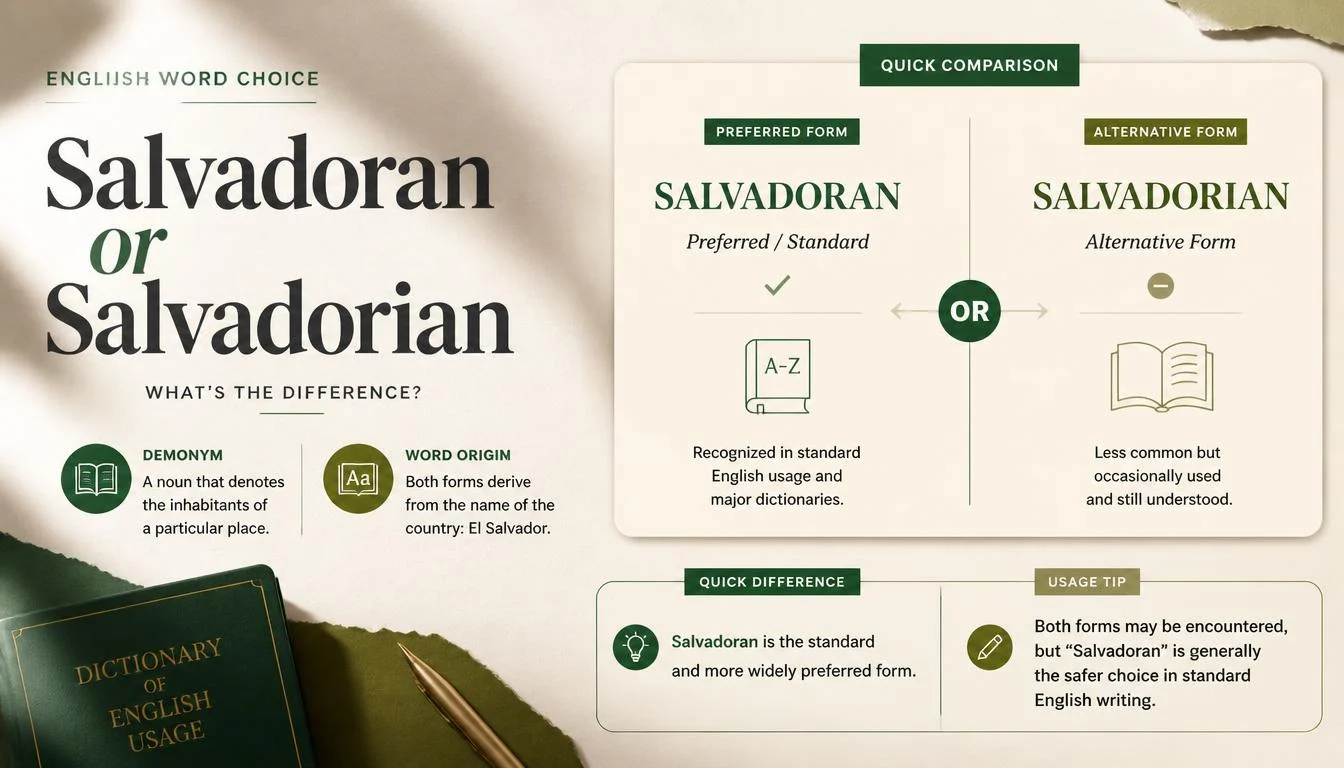
The correct term is Salvadoran when referring to people or things from El Salvador. While “Salvadorian” appears occasionally, it is considered nonstandard and less accepted in formal writing. Use “Salvadoran” for all contexts this is the preferred form in dictionaries, government publications, and by Salvadorans themselves.
If you have ever written about El Salvador and paused, wondering whether to call its people “Salvadoran” or “Salvadorian,” you are not alone. This confusion catches writers, students, and even professionals off guard more often than you might expect. The uncertainty stems from English patterns where both “‑an” and “‑ian” suffixes appear in demonyms, creating a gray area that leaves many people guessing.
Getting this distinction right matters more than you might think. Using the incorrect form in a business report, academic paper, or even a casual email can signal carelessness or lack of attention to detail. In professional writing, accuracy in demonyms reflects respect for the people and culture you are discussing. This guide will explain once and for all why “Salvadoran” is the correct choice, how to remember it, and why the variation exists in the first place.
What’s the Difference Between Salvadoran and Salvadorian?
The core difference is simple: Salvadoran is the standard, accepted demonym, while Salvadorian is a nonstandard variant that should be avoided in formal writing. Both words describe people from El Salvador or things relating to the country, but they are not equally correct in professional contexts.
| Aspect | Salvadoran | Salvadorian |
|---|---|---|
| Meaning | Relating to El Salvador or its people | Relating to El Salvador or its people |
| Part of Speech | Noun and adjective | Noun and adjective |
| Refers To | Native or inhabitant of El Salvador; characteristic of El Salvador | Same meaning, but nonstandard |
| Typical Usage | Official documents, journalism, academic writing, everyday conversation | Rare; occasionally appears in informal writing |
| Example | She is a Salvadoran artist from San Salvador. | She is a Salvadorian artist. (less accepted) |
| Common Confusion | None this is the preferred form | Confused as an alternative spelling variation |
To understand why “Salvadoran” is correct, look at the country’s name. The base word is “Salvador.” The standard English pattern for forming demonyms from place names ending in “or” or “ador” typically adds just “‑an.” Consider similar formations: “Ecuador” becomes “Ecuadoran” (though “Ecuadorian” is also accepted), and “Florida” becomes “Floridan.” The preference for “Salvadoran” is not arbitrary it follows established linguistic patterns and has the backing of major dictionaries.
In practice, you will rarely see “Salvadorian” used in respectable publications. The New York Times, BBC, and academic journals consistently use “Salvadoran.” Salvadorans themselves use “Salvadoran” in English and “salvadoreño” in Spanish. This alignment with native usage and professional standards makes the choice clear.
Is This a Grammar, Vocabulary, or Usage Issue?
This is primarily a usage issue with elements of vocabulary choice. The terms are not grammatically incorrect in the sense that they break English syntax rules both can function as adjectives or nouns without grammatical error. The distinction lies in what standard English practice considers acceptable.
From a grammar perspective, both words form correctly according to English morphological rules. Adding “‑an” or “‑ian” to a proper noun to create a demonym is a standard pattern. The question is not whether either form is grammatically possible but which one is conventionally correct.
Vocabulary-wise, these are denonyms words that identify people from a specific place. English has many such pairs where one form dominates. Consider “Canadian” versus “Canadan,” or “Brazilian” versus “Brazilean.” In each case, usage has settled on one standard form. “Salvadoran” has similarly become the established vocabulary choice in educated writing.
In terms of usage, this is where the distinction matters most. Usage determines what is correct in practice, not just what is theoretically possible. Dictionaries list “Salvadoran” as the primary term. Style guides favor it. Native speakers use it. “Salvadorian” appears only as a secondary variant, often marked as “less common” or “also.”
Both words are largely interchangeable in the sense that readers will understand what you mean either way. However, they are not interchangeable in professional contexts because one is accepted and the other is not.
- In formal English, “Salvadoran” is always preferred.
- In business writing, using the nonstandard form can undermine your credibility.
- In academic contexts, instructors and reviewers will correct “Salvadorian” to “Salvadoran.” Even in everyday conversation, “Salvadoran” sounds more natural and informed.
The practical takeaway is this: When writing about El Salvador in any professional capacity, always choose “Salvadoran.” The small effort required to remember this distinction pays dividends in perceived professionalism and accuracy.
Salvadoran Meaning and Usage
Salvadoran functions as both an adjective and a noun. As an adjective, it describes anything connected to El Salvador its people, culture, food, history, or geography. As a noun, it identifies a person who comes from El Salvador. The pronunciation is sal‑vuh‑DOR‑un, with stress on the third syllable.
This demonym appears in common collocations across many contexts. You might hear about “Salvadoran cuisine,” “Salvadoran artists,” “the Salvadoran government,” or “Salvadoran immigrants.” The word pairs naturally with terms like “culture,” “heritage,” “community,” and “history.” These combinations appear in news reports, academic writing, travel content, and everyday speech.
In professional settings, “Salvadoran” is the default choice. Consider this workplace example: “Our company has partnered with several Salvadoran suppliers to source organic coffee directly from the Santa Ana region.” This sentence uses the term correctly and naturally in a business context.
Academic writing requires the same precision: “The study examines Salvadoran migration patterns between 1980 and 2000, analyzing how civil conflict shaped settlement decisions in the United States.” Notice how the adjective describes the migration patterns being studied.
The word appears in technology contexts as well: “The development team worked with Salvadoran engineers to localize the software for Central American markets.” Here, “Salvadoran” properly identifies the nationality of the engineers.
Email communication offers another common context: “I would like to introduce our Salvadoran representative, Maria Flores, who will handle accounts in the region.” Professional correspondence demands accuracy in titles and nationalities.
In daily conversation, you might say, “My neighbor is Salvadoran she makes the most incredible pupusas for the block party every year.” This casual usage demonstrates that “Salvadoran” works comfortably in informal settings too.
One common learner mistake involves overcomplicating the word: “Salvadorean” sometimes appears as a variant, but this is also less common. Stick with “Salvadoran” for simplicity and correctness.
The mini recap: “Salvadoran” is the standard, accepted demonym for El Salvador. Use it confidently as both an adjective and noun in every context, from professional reports to casual conversations.
Salvadorian Meaning and Usage
Salvadorian means the same thing as Salvadoran it refers to people or things from El Salvador. However, it is widely considered a nonstandard variant. While you may occasionally encounter it in older texts or informal writing, major dictionaries list it as a secondary form at best. The pronunciation follows a similar pattern: sal‑vuh‑DOR‑ee‑un.
The word appears in some historical documents and older travel writing, but modern usage has firmly favored “Salvadoran.” You might still see “Salvadorian” in casual blog posts or social media, but professional writers avoid it. The variant persists largely because some English speakers assume that place names ending in “or” should take the “‑ian” suffix by analogy with words like “Canadian” or “Italian.”
Some common but nonstandard collocations include “Salvadorian cuisine,” “Salvadorian culture,” and “Salvadorian people.” While these are understandable, they mark the writer as someone unfamiliar with standard usage. In workplace writing, choose the standard form to maintain professionalism.
A business email example would not use “Salvadorian” in professional contexts: “Our Salvadorian partners have requested a meeting next week.” A reader would understand, but the writer would appear less polished than someone who used “Salvadoran.”
In academic writing, “Salvadorian” is similarly discouraged: “The Salvadorian diaspora has contributed significantly to the cultural landscape of Los Angeles.” Most professors or editors would correct this to “Salvadoran.”
For technology contexts: “We collaborated with Salvadorian developers on the open source project.” While the meaning is clear, standard usage would prefer “Salvadoran.
Even in daily conversation, “Salvadorian” sounds slightly off to native speakers familiar with the correct form. A sentence like “My friend is Salvadorian” would be understood but might prompt a mental correction.
The primary learner mistake is choosing “Salvadorian” because it seems more intuitive or because the writer has seen it used occasionally. Remember that frequency in informal contexts does not equal correctness in professional writing.
The mini recap: “Salvadorian” is a nonstandard variant that should be avoided. While you might see it occasionally, it is not accepted in formal writing or by major dictionaries. Stick with “Salvadoran” for all contexts.
When Not to Use Each Word
Understanding when to avoid each word is just as important as knowing which one to use. Many writers make predictable errors that are easily avoidable with clear guidance.
Mistake 1: Using “Salvadorian” in Formal Documents
The mistake happens because writers assume both forms are equally acceptable. The correct choice is always “Salvadoran” in resumes, cover letters, business reports, academic papers, and official correspondence. Remember that professional contexts demand standard usage. If you are writing for publication, government, or academic review, “Salvadoran” is your only choice.
Mistake 2: Using “Salvadorian” When Referencing Government or Official Sources
Official Salvadoran government publications in English use “Salvadoran.” Embassy websites, diplomatic communications, and official tourism materials follow this standard. Using “Salvadorian” in contexts referencing official sources signals inattention to detail. Check the sources themselves they consistently use the correct form.
Mistake 3: Using “Salvadorian” When Writing About Salvadoran Culture
Cultural writing, restaurant reviews, travel articles, and journalism require accuracy. Major publications have style guides that specify “Salvadoran.” When writing about Salvadoran food, art, music, or traditions, use the term respected professionals use. The New York Times style guide, for instance, specifies “Salvadoran.”
Mistake 4: Choosing “Salvadorian” Because It Sounds More Familiar
Some writers choose “Salvadorian” because they have heard terms like “Canadian” or “Norwegian.” This is an overgeneralization. English does not follow consistent rules for demonym formation. Each place name has an established form, and “Salvadoran” is the standard for El Salvador. Do not rely on intuition rely on dictionaries and usage guides.
Mistake 5: Using “Salvadorian” in Academic Citations
Academic writing demands precision. If you are citing Salvadoran authors, discussing Salvadoran history, or analyzing Salvadoran society, use the accepted term. Reviewers and instructors will notice incorrect usage. A quick check of academic databases shows that “Salvadoran” appears far more frequently in peer-reviewed literature.
Mistake 6: Assuming Both Forms Are Interchangeable in All Contexts
While both forms are understandable, they are not equally acceptable. Interchangeable” in casual conversation does not mean equally correct in professional writing. Always default to “Salvadoran” unless a specific context explicitly calls for the variant and such contexts are extremely rare.
| Correct Sentence | Incorrect Sentence | Explanation |
|---|---|---|
| The Salvadoran ambassador addressed the United Nations. | The Salvadorian ambassador addressed the United Nations. | Official diplomatic contexts require standard terminology. |
| Salvadoran cuisine features pupusas, tamales, and yuca frita. | Salvadorian cuisine features pupusas, tamales, and yuca frita. | Food writing in reputable publications uses the standard form. |
| She is a Salvadoran artist known for her murals. | She is a Salvadorian artist known for her murals. | Biographical and cultural references should use the accepted demonym. |
| The Salvadoran economy has grown steadily over the past decade. | The Salvadorian economy has grown steadily over the past decade. | Economic and academic analysis requires precise terminology. |
| Several Salvadoran organizations participated in the conference. | Several Salvadorian organizations participated in the conference. | Professional reporting uses standard forms for group references. |
Decision Box
If you are writing about anyone or anything from El Salvador:
- Use Salvadoran for all formal, professional, academic, and standard writing.
- Avoid Salvadorian entirely in professional contexts.
- When in doubt, consult a dictionary Merriam-Webster and Oxford both list “Salvadoran” as the primary term.
- Remember that Salvadorans themselves use “Salvadoran” in English translations of their own government and cultural materials.
- The choice is not a matter of personal preference it is a matter of following established professional standards.
Real-World Examples
Office Communication
“The marketing team is preparing a campaign targeting Salvadoran consumers in the United States, focusing on digital advertising channels popular within the community.”
Business Email
“Dear Team, I would like to introduce our new Salvadoran partner, Carlos Mendez, who will be joining the weekly strategy calls starting next Monday.”
School or University
“The anthropology department’s latest research project examines Salvadoran community organizations in Washington D.C. and their role in maintaining cultural traditions across generations.”
Customer Support
“We have received several inquiries from Salvadoran customers regarding shipping times to Central America, and we are updating our FAQ to address these questions.”
Technology
“The engineering team worked closely with Salvadoran developers in our San Salvador office to improve the mobile app’s performance for the Latin American market.”
Artificial Intelligence
“Our natural language processing team has incorporated Salvadoran Spanish dialect data into the training model to better serve users in El Salvador.”
Daily Conversation
“My new coworker is Salvadoran, and she invited the entire team to try her grandmother’s traditional pupusa recipe at the office potluck next week.”
Salvadoran in Modern Technology
In today’s interconnected world, the term “Salvadoran” appears in various technology contexts with increasing frequency. Tech companies operating in Central America, remote work platforms connecting businesses with Salvadoran professionals, and software localization efforts all use the term in professional documentation.
Artificial Intelligence systems now recognize “Salvadoran” as the standard demonym in their training data. AI writing tools and translation software default to this form because they draw from professional corpora and dictionaries. If you use AI tools to assist with writing, they will typically suggest “Salvadoran” over “Salvadorian.”
Virtual Assistants and Voice Assistants respond to queries about El Salvador using “Salvadoran.” Amazon’s Alexa, Google Assistant, and Apple’s Siri all use this standard form. When asking about demographics, travel information, or cultural facts, these systems consistently return results using the accepted demonym.
Chatbots in customer service applications must use correct terminology to maintain professionalism. Automated systems trained on standard English recognize “Salvadoran” as the proper form and flag “Salvadorian” as a potential error.
Software designed for international audiences often includes localization features that reference nationalities. These applications use standard demonyms from established databases, and “Salvadoran” is the default entry.
Business tools such as CRM systems, HR platforms, and market research software reference “Salvadoran” when categorizing leads, employees, or demographic data. Accurate classification depends on standard terminology.
Word Origin
The origin of “Salvadoran” lies in the country’s full name: El Salvador, meaning “The Savior” in Spanish. The Spanish name derives from the country’s colonial religious heritage, referencing Jesus Christ as the Savior.
When English speakers needed a demonym for people from El Salvador, they followed the common pattern of adding “‑an” to the base name “Salvador.” This pattern appears in numerous English demonyms: “American,” “Canadian,” “Egyptian,” and “Russian” all use variations of this suffix.
The variant “Salvadorian” likely emerged because some English speakers looked for a different pattern. Since “Salvador” ends in “or,” some incorrectly assumed it should follow the “‑ian” pattern seen in “Brazilian” or “Argentinian.” However, English demonym formation is notoriously inconsistent, and “Salvadoran” became the established form through usage.
Interestingly, in Spanish, the demonym is “salvadoreño” (masculine) or “salvadoreña” (feminine). This is the term Salvadorans use for themselves. The English “Salvadoran” more closely approximates the Spanish root while following English morphological patterns.
Expert Insight
As an experienced language instructor, I have observed that many students second-guess themselves on demonyms because English lacks consistent rules in this area. The key to mastering these terms is not memorizing arbitrary rules but understanding established usage.
When students ask me why “Salvadoran” is preferred over “Salvadorian,” I point them to a simple principle: language communities decide what is correct through collective usage. Dictionaries, style guides, and educated speakers have collectively chosen “Salvadoran.” This choice is not a decree from an authority but a reflection of how the language has developed.
I often tell my students that treating demonyms as vocabulary items rather than grammatical patterns makes them easier to learn. Instead of trying to deduce the rule for each country, simply learn the accepted form. This approach eliminates guesswork and builds confidence.
The “Salvadoran” versus “Salvadorian” example illustrates a broader pattern in English: when two forms compete, one eventually dominates through consistent use by careful writers and speakers. The variant form does not disappear entirely it may persist in informal contexts but it loses legitimacy in professional settings.
Error Prevention Checklist
- Always use Salvadoran when writing about people or things from El Salvador in professional, academic, or formal contexts.
- Always avoid Salvadorian in any writing that requires standard English usage.
- Never confuse the demonym with the country’s full name El Salvador is the country, and Salvadorans are its people.
- Quick memory tip: Think of “El Salvador” and simply add “an” the country’s name ends in “or,” but the demonym drops the extra “i” that some incorrectly add.
Related Grammar Confusions
If you find this distinction helpful, you may also want to explore these commonly confused terms:
- Nicaraguan vs. Nicaraguan (both refer to people from Nicaragua, with “Nicaraguan” being standard)
- Venezuelan vs. Venezuelian (the standard form is “Venezuelan”)
- Ecuadoran vs. Ecuadorian (both appear, with “Ecuadorian” being more common)
- Belizean vs. Belizian (standard is “Belizean”)
- Panamanian vs. Panaman (“Panamanian” is the standard form)
- Costa Rican vs. Costa Ric (“Costa Rican” is correct)
- Guatemalan vs. Guatemal (“Guatemalan” is the standard)
- Honduran vs. Honduranian (“Honduran” is correct)
- Argentine vs. Argentinian (both appear, with “Argentine” used more in British English)
- Chilean vs. Chilian (“Chilean” is the standard form)
FAQs
Is Salvadoran or Salvadorian correct?
Salvadoran is the standard and preferred English demonym for people or things from El Salvador. Salvadorian does appear in some usage, but Salvadoran is the more widely accepted form and is the safer choice for professional and academic writing.
Why do some people say Salvadorian instead of Salvadoran?
The variation may come from analogy with demonyms such as Canadian or Italian. However, English has no single rule for forming demonyms, so the expected form for El Salvador is Salvadoran.
Do Salvadorans prefer Salvadoran or Salvadorian?
Salvadoran is the standard English term used by people from El Salvador and in English language references to the country and its people. It is the best choice when referring to someone or something from El Salvador.
Is it offensive to use Salvadorian?
Generally, Salvadorian is not considered an offensive term. However, Salvadoran is the established and more widely preferred form, so it is the better choice in formal, professional, and academic writing.
Should I use Salvadoran or Salvadorian in an academic paper?
Use Salvadoran in an academic paper. It is the standard English demonym and is more likely to align with dictionaries, editorial standards, and scholarly usage.
What is the demonym for someone from El Salvador?
The standard English demonym is Salvadoran. A person from El Salvador is a Salvadoran, while Salvadoran can also describe anything associated with the country, such as Salvadoran culture or Salvadoran food.
Conclusion
The distinction between “Salvadoran” and “Salvadorian” is clear once you understand the context. “Salvadoran” is the established, standard demonym for people and things from El Salvador. It appears in dictionaries, official documents, journalism, and academic writing. “Salvadorian” is a nonstandard variant that, while occasionally seen, should be avoided in professional contexts.
Choosing the correct term demonstrates attention to detail and respect for standard English usage. Whether you are writing a business report, academic paper, or even a casual email, “Salvadoran” is always the right choice. The next time you write about El Salvador, remember that the people are Salvadorans, the culture is Salvadoran, and the proper term follows the country’s name with a simple “‑an” suffix.
The practical rule to remember: El Salvador gives us Salvadorans drop the extra “i” and write with confidence.
Read More Related Articles:
- Totaling or Totalling | American vs British English In 2026
- Hoodie or Hoody | Easy Way to Remember the Difference In 2026
- Truly or Truely | Simple Guide to Getting It Right In 2026

Lucas Mitchell is a content writer at synoseek.com. He writes simple, thoughtful pieces that focus on everyday ideas, observations and general knowledge topics. His work is shaped by a calm, realistic tone that keeps the reader engaged without overstatement.
1 thought on “Salvadoran or Salvadorian | Understanding the Difference In 2026”