Quick Answer:
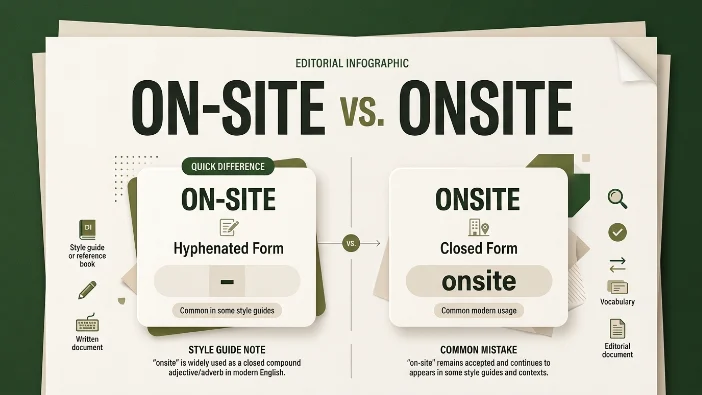
The correct answer depends on your context and style guide. On-site (with a hyphen) is the preferred spelling according to most authoritative dictionaries and style guides like Merriam-Webster, Oxford, and the Chicago Manual of Style . Onsite (without a hyphen) is increasingly accepted in casual and digital writing but is not yet universally recognized . On site (two words) is an adverb phrase used to describe a location after a verb . For professional and formal writing, on-site is the safest choice.
If you’ve ever stared at your screen wondering whether to write on-site, onsite, or on site, you are not alone. This small but persistent spelling puzzle trips up professionals, students, and native speakers alike. The confusion is entirely understandable English is full of compound words that seem to change their spelling rules depending on the decade, the dictionary, and sometimes the weather.
The core issue is that all three forms are technically used in the real world, but they are not always interchangeable. Your choice affects not just spelling, but grammar and professionalism. A hyphen can mean the difference between describing a location and describing a service. This guide will explain exactly when to use each form, teach you the grammar rules behind the choice, and help you never second-guess yourself again.
What’s the Difference Between On-Site, Onsite, and On Site?
At their heart, all three versions describe something happening at a particular physical location the opposite of working or happening off-site . However, the difference lies in their part of speech and grammatical function.
The hyphenated version “on-site” functions as an adjective or adverb. The one-word version “onsite” carries the same function and meaning but is a modern, closed compound. The two-word version “on site” functions as an adverbial phrase of location, typically placed after the verb.
| Form | Part of Speech | Refers To | Typical Usage | Example | Common Confusion |
|---|---|---|---|---|---|
| On-site | Adjective / Adverb | Describes a thing or action happening at a location | Before a noun (attributive) | “We offer on-site childcare.” | Using “on site” when you need an adjective |
| Onsite | Adjective / Adverb | Same as on-site | Modern, informal, or digital writing | “The onsite manager is available.” | Using “onsite” in formal publications |
| On site | Adverb Phrase | Describes where something is located or happening | After a verb (predicative) | “The equipment is stored on site.” | Using “on-site” to describe a location after a verb |
After breaking down the table, remember this simple rule: if the word appears before a noun (e.g., “on-site gym”), you almost always need the hyphen. If it appears after the verb (e.g., “the gym is on site”), two words are grammatically correct .
Is This a Grammar, Vocabulary, or Usage Issue?
This question touches on all three areas, which is exactly why it causes so much confusion.
From a vocabulary perspective, the core meaning is identical across all forms. From a grammar standpoint, the issue relates to how compound modifiers function in a sentence specifically, the grammatical rule that requires hyphenating compound adjectives when they precede a noun . And from a usage perspective, the spelling reflects a broader trend in the English language: the gradual elimination of hyphens from common compound words (“online” was once “on-line”) .
The three forms are not interchangeable grammatically. “We have an onsite gym” and “We have an on-site gym” are both grammatically acceptable, though one is more formal. However, “the gym is on-site” and “the gym is onsite” are both correct as adverbial uses. Crucially, “the gym is on site” is the most traditional and grammatically precise way to write that sentence. The practical takeaway is to treat “on-site” and “onsite” as adjectives that must go before the noun, and reserve “on site” for after the verb.
When and How to Use “On-Site” Correctly
On-site is the safest and most traditional choice, particularly in professional, academic, and formal contexts. It is the recommended spelling in the Merriam-Webster dictionary, the Oxford dictionary, and the Chicago Manual of Style . The hyphen clarifies that “on” and “site” act as a single idea, which is especially helpful in dense or technical writing .
Common Uses
You will typically use on-site as a descriptive adjective before a noun.
- Workplace Example: “All employees must complete the on-site safety training before their first day.”
- Academic Example: “The university provides on-site housing for graduate students.”
- Technology Example: “We have an on-site IT team to handle server maintenance.”
- Email Example: “I am writing to confirm the on-site meeting scheduled for 2:00 PM in Conference Room B.”
- Daily Conversation Example: “The apartment complex has an amazing on-site gym and pool.”
The Learner Mistake
A common error is using “on-site” after a verb where the two-word phrase is actually preferred. For example, writing “the training will be conducted on-site” is not grammatically incorrect, but many style guides prefer “on site” in this position .
When and How to Use “Onsite” Correctly
Onsite (one word) is the modern, streamlined alternative. While it is not yet the standard in formal dictionaries, it is increasingly common in digital spaces, business jargon, and informal communication . The trend follows the same path as “online,” which once required a hyphen.
Common Uses
This form works best in casual writing, internal communications, and when a more relaxed tone is appropriate.
- Workplace Example: “Our onsite support team will resolve your ticket within the hour.”
- Academic Example: “The symposium will feature onsite registration for all attendees.”
- Technology Example: “We offer onsite data recovery services for businesses.”
- Email Example (Casual): “Just a reminder that we have onsite parking available.”
- Daily Conversation Example: “Does the hotel have onsite dining?”
The Learner Mistake
The main mistake with “onsite” is using it in an overly formal document or publication where an editor is expecting “on-site.” Always check your organization’s style guide.
When and How to Use “On Site” Correctly
On site (two words) is an adverbial phrase. It describes a location or position and is used after a verb (predicatively). It is never used to describe a noun directly .
Common Uses
Use this form to describe where something is located or where an action is taking place.
- Workplace Example: “The documents you requested are stored on site.”
- Academic Example: “Students can purchase textbooks on site at the campus bookstore.”
- Technology Example: “A technician will be on site tomorrow to upgrade the servers.”
- Email Example: “Please let me know if you will be on site or working remotely today.”
- Daily Conversation Example: “The goods are produced on site to ensure freshness.”
The Learner Mistake
The classic mistake is using “on site” as an adjective before a noun, e.g., “on site gym” instead of “on-site gym.” If you can replace “on site” with “there” or “here,” you are using it correctly as an adverb . If it answers the question “which” (which gym?), you need the hyphen.
Common Mistakes: A Quick Reference Guide
| Correct Sentence | Incorrect Sentence | Explanation |
|---|---|---|
| “We have an on-site clinic.” | “We have an onsite clinic.” | Both are often accepted, but “on-site” is the more formally correct adjective. |
| “The meeting will be held on site.” | “The meeting will be held on-site.” | “On site” is the correct adverbial phrase following the verb “held.” |
| “The on-site manager approved the purchase.” | “The on site manager approved the purchase.” | You need the hyphen because “on site” is acting as an adjective before “manager.” |
The Decision Box
If you mean a service or thing that exists at a location (before the noun), use on-site in professional writing or onsite in informal writing.
If you mean a location where something is happening or where people are (after the verb), use on site.
On-Site vs. Onsite in the Real World
Real-world usage is changing, which adds to the confusion. A study of Google Books Ngram Viewer shows that “on-site” was the overwhelmingly dominant spelling for most of the 20th century. However, the use of “onsite” has been steadily rising since the year 2000 .
In the corporate world, many tech companies and startups have embraced “onsite” as the norm. For example, a popular hiring practice is the “onsite interview,” while a more traditional HR department might list an “on-site interview” in a job posting. Both are acceptable, but they reflect different levels of formality.
On-Site in the Age of Technology
The hyphenated form remains the standard in technical documentation and software development. For instance, “on-site search” refers to the internal search function on a website, which is distinct from search engine optimization (SEO) . Modern virtual assistants like Alexa and Siri have also made “onsite” a frequent term in our daily vocabulary.
Expert Insight
The hyphen is a powerful tool for clarity. When you write “on-site” before a noun, you are connecting “on” and “site” to form a single descriptive unit. This prevents the reader from momentarily misreading the sentence. As a language instructor, I often tell my students to think of the hyphen as a bridge that connects two words to act as one adjective.
Error Prevention Checklist
- Always use on-site when:
- You are writing formally for school or work.
- The word precedes a noun.
- You are following Merriam-Webster or Chicago style.
- Always use on site when:
- The word follows a verb.
- You are describing a location (e.g., “we are on site”).
- You mean “at the location” or “here.
- Never confuse them if:
- You are writing something important; choose “on-site” to be safe.
- Quick memory tip:
- On-site = One adjective, site next to the noun.
- On site = two words, it tells you where something is.
Related Grammar Confusions
The following comparisons often confuse writers for the same reasons:
- Off-site vs. Offsite vs. Off site: This follows the same rules.
- Online vs. On-line: A cautionary tale that shows how hyphens disappear over time.
- In-house vs. In house: Also uses hyphenation rules based on position in a sentence.
- Long-term vs. Long term: Another common hyphenated adjective.
- Full-time vs. Full time: Same rules apply.
- In-person vs. In person: This distinction is also worth learning.
- Make-up vs. Make up: A great example of the noun/verb hyphen distinction.
- Sign-up vs. Sign up: Yet another example of the same principle.
FAQs
Is “onsite” a real word?
Yes. Onsite is used as a standard word in modern English, particularly in workplace and business contexts. However, on-site is also widely accepted and remains the preferred form in many edited and formal styles. The choice can depend on the dictionary, style guide, or publication you’re following.
Should I use “onsite” or “on-site” for SEO?
SEO itself does not require one spelling over the other. Search engines can generally understand both onsite and on-site. For polished content, choose the form that matches your target audience and editorial style, then use it consistently throughout the page.
Is it “on site” or “in site”?
The standard expression is on site, meaning at a particular location where work or an activity is taking place. In site is not normally used with this meaning. Don’t confuse on site with in sight, which means visible or within view.
When did “onsite” become one word?
The closed form onsite has become increasingly common in modern English, particularly in business, technology, and workplace communication. English spelling often shifts over time as frequently used hyphenated compounds become established as single words.
Is “onsite” an adverb?
Yes. Onsite can function as an adverb when it describes where an activity takes place. For example: “The technicians are working onsite today.” It can also appear as a modifier in phrases such as onsite training or onsite support, depending on the style being followed.
Is it “on-site” or “onsite” in AP style?
The Associated Press style generally favors the hyphenated form on-site. If you’re writing content that follows AP style, use on-site and apply the same convention consistently throughout your work.
Conclusion
The difference between on-site and onsite is a practical lesson in how the English language evolves. While both forms are used and understood, the hyphenated on-site remains the gold standard for formal and professional writing. The one-word onsite is a streamlined option gaining ground in the digital age, and on site serves a distinct grammatical function as an adverb.
Ultimately, your choice depends on your audience and the context. When in doubt, choose the hyphen. It is a small mark that signals attention to detail and respect for the reader. Remember this simple rule: if you are describing something (adjective), use “on-site”; if you are locating something (adverb), use “on site.” You will always be correct.