Quick Answer
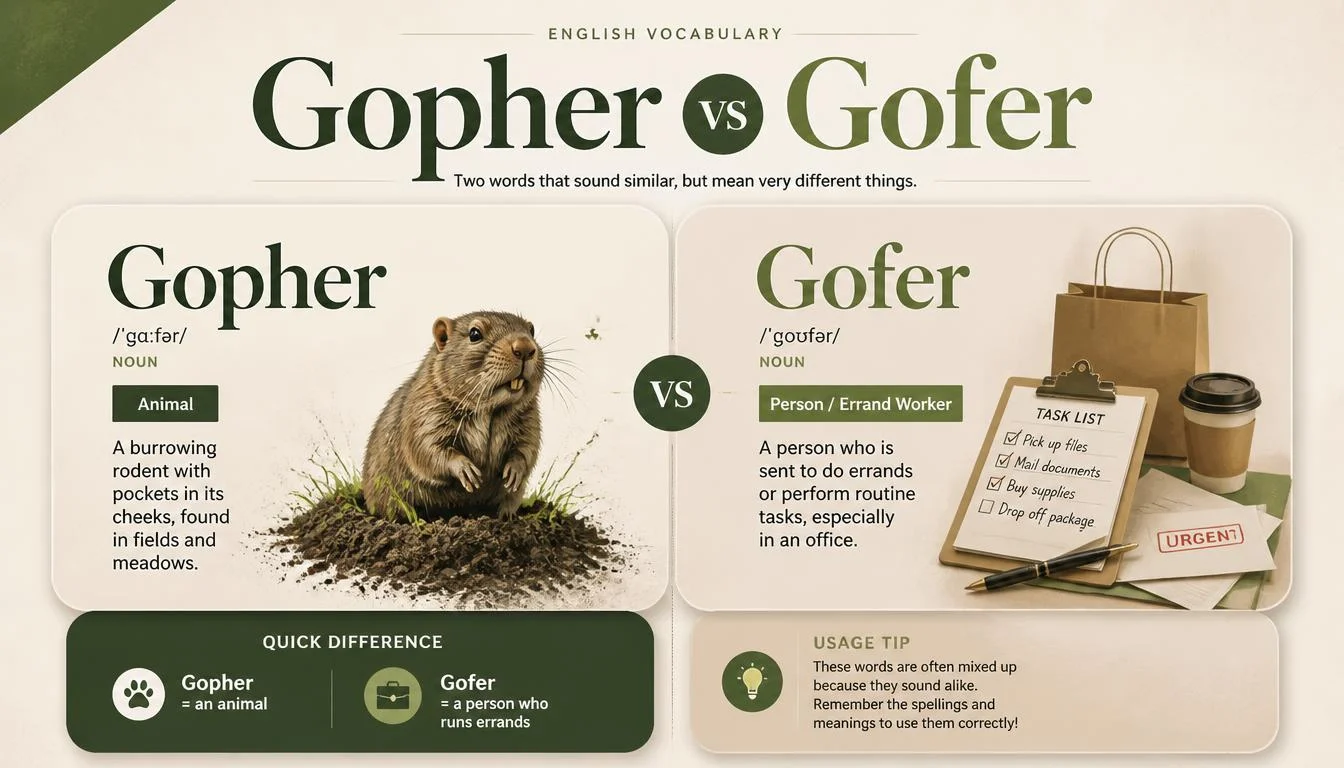
A gopher is a small burrowing rodent (and the name of an old internet protocol), while a gofer is a person who runs errands for others, usually at work. The words sound identical but mean completely different things. If you’re talking about an animal or software, use gopher. If you’re talking about a helpful employee or assistant, use gofer.
You’re writing an email, and you want to describe your new intern who keeps grabbing coffee and dropping off packages. Do you call her the office “gopher” or the office “gofer”? If you paused even for a second, you’re not alone. This is one of those English word pairs that trips up even confident writers, because the two words are pronounced exactly the same way but mean nothing alike.
A gopher is a burrowing animal found across North America, and in tech circles, it’s also the name of an early internet protocol that came before the modern web. A gofer, on the other hand, describes a person whose job is to run small errands, often the least glamorous tasks in an office, film set, or restaurant. The confusion exists purely because of pronunciation. Nothing about spelling gives you a clue when you’re only hearing the word spoken aloud.
Getting this wrong doesn’t just look like a typo. It can genuinely confuse your reader. Telling your coworker “I need a gopher for this task” instead of “gofer” might make them picture an actual rodent handling your paperwork, which is obviously not what you meant. In this guide, you’ll learn exactly when to use each word, how to remember the difference permanently, and how both terms show up in real workplace and everyday situations.
Gopher vs Gofer: What’s the Difference?
The core difference comes down to this: gopher refers to an animal or a computer protocol, while gofer refers to a person who does errands. They are unrelated words that simply happen to sound the same.
Gopher is a noun with two distinct uses. First, it names a small, thickset rodent known for digging extensive tunnel systems underground, often considered a nuisance by gardeners and farmers because of the damage it causes to lawns and crops. Second, in computing history, Gopher was a document retrieval protocol developed in the early 1990s at the University of Minnesota, used before the World Wide Web became dominant.
Gofer is also a noun, but it describes a human role, not an animal or a piece of technology. A gofer is someone, often junior or entry-level, assigned to run errands, fetch items, or complete small support tasks for a team. The word actually comes from the phrase “go for,” as in “go for coffee” or “go for supplies,” which eventually got smoothed into a single word.
| Meaning | Part of Speech | Refers To | Typical Usage | Example | Common Confusion |
|---|---|---|---|---|---|
| Gopher | Noun | Animal or internet protocol | Nature, wildlife, early tech history | “A gopher dug a hole in the backyard.” | Mistaken for the errand-runner word |
| Gofer | Noun | A person who runs errands | Workplace, film sets, casual jobs | “The new gofer picked up lunch for the whole team.” | Mistaken for the animal name |
Here’s the short recap you actually need. Gopher belongs to animals and old internet systems. Gofer belongs to people doing small tasks for others. If you remember that gofer literally started as “go for,” the spelling starts to make a lot more sense, and you’ll stop second-guessing yourself every time you type it.
Is Gopher vs Gofer a Grammar, Vocabulary, or Usage Issue?
This is purely a vocabulary issue, not a grammar problem. Both words are singular common nouns, both can be pluralized normally (gophers, gofers), and neither changes form based on tense or sentence structure. The confusion happens because the words are homophones, meaning they sound identical but carry completely different meanings.
They are not interchangeable in any context. Using “gopher” when you mean an errand-runner is a factual and vocabulary error, not a stylistic choice. Dictionaries treat them as entirely separate entries with separate origins, so there’s no gray area here the way there sometimes is with words like “further” and “farther.
In formal or academic writing, you’ll rarely need either word unless you’re specifically discussing wildlife biology, internet history, or workplace roles. In business English, “gofer” shows up more often, usually in casual internal communication rather than polished external documents. In everyday conversation, both words appear comfortably, but context almost always makes the intended meaning obvious to a listener, which is part of why the error slips past so easily in spoken English.
The practical takeaway: always check what the sentence is actually about. If there’s a task, errand, or person involved, you need gofer. If there’s an animal, burrow, or old computer network involved, you need gopher.
Understanding “Gopher”
Gopher is pronounced “GOH-fer,” with the emphasis on the first syllable. It functions as a noun and refers primarily to a small burrowing rodent native to North and Central America. These animals are known for creating extensive underground tunnel systems, which is why “gopher hole” is such a common phrase in gardening and landscaping conversations.
Common collocations include “gopher hole,” “gopher mound,” “gopher tunnel,” and “pocket gopher,” which refers to a specific family of these rodents. In sentences, gopher typically appears as the subject or object of actions related to digging, damage, or wildlife control.
Workplace example: “Maintenance found another gopher hole near the parking lot and had to patch the asphalt again.”
Academic example: “The biology students studied gopher burrowing patterns as part of their ecosystem research project.”
Technology example: “Before the web became popular, many universities used the Gopher protocol to organize and share documents online.”
Email example: “Just a heads-up, the landscaping crew mentioned a gopher problem near the west entrance, so watch your step out there.”
Daily conversation example: “We had a gopher tearing up the garden all summer, and we finally caught it last week.”
One common learner mistake is writing “gopher” when describing a person running errands, likely because they’ve heard the word “gofer” spoken and assumed it referred to the animal since the spelling felt familiar. Mini recap: gopher means animal or old internet protocol, never a person doing tasks.
Understanding “Gofer”
Gofer is also pronounced “GOH-fer,” identically to gopher, which is exactly why the confusion happens so often. It’s a noun describing a person assigned to run errands or handle small, often menial tasks for someone else, typically in a workplace or production setting.
Common collocations include “office gofer,” “production gofer,” “act as a gofer,” and “gofer work.” The word frequently appears in casual or informal writing, and it often carries a slightly dismissive tone, implying the tasks are simple or low-status.
Workplace example: “As the newest hire, Jake spent his first month basically working as the office gofer, grabbing coffee and dropping off mail.”
Academic example: “In her internship journal, she admitted that most of her first week felt like gofer duties rather than real research experience.”
Technology example: “Some startups jokingly call their junior assistants ‘gofers’ when they’re mostly handling scheduling and supply runs rather than coding.”
Email example: “I don’t mind being the gofer today, so just send me the list and I’ll pick everything up on my way in.”
Daily conversation example: “My brother worked as a gofer on a film set for a summer, mostly fetching coffee and running scripts between trailers.”
A frequent learner mistake is spelling this word “gopher,” probably because that spelling looks more familiar or dictionary-standard. Mini recap: gofer means a person doing errands, and it comes directly from the phrase “go for.
When Not to Use Each Word
Mistake one: Writing “gopher” in a job description meant to say “gofer.” This happens because spellcheck often won’t catch it, since gopher is a real word. Always reread errand-related job postings carefully.
Mistake two: Using “gofer” when discussing wildlife or pest control. If you’re talking about an actual animal digging in your yard, you need gopher, not gofer.
Mistake three: Referencing “the Gofer protocol” when discussing early internet history. The protocol is spelled Gopher, named after the University of Minnesota’s mascot, the Golden Gopher.
Mistake four: Assuming the words are interchangeable slang for the same thing. They are not slang variations of one word; they are two entirely separate words with separate meanings and origins.
Mistake five: Using “gopher” in casual speech about internships or entry-level jobs, when the intended meaning is someone running tasks. This is one of the most common spoken-to-written transfer errors.
Mistake six: Confusing pronunciation guides online, since some casual sources treat them as spelling variants rather than distinct words. Trusted dictionaries always separate the two entries clearly.
Mistake seven: Writing “gofer hole” instead of “gopher hole” when describing yard damage. This reversal happens often in informal writing and social media posts.
Mistake eight: Forgetting capitalization rules when referring to the internet protocol, since “Gopher” as a proper technology name is often capitalized, unlike the animal or the errand-runner, which stay lowercase.
Common Mistakes Table
| Correct Sentence | Incorrect Sentence | Explanation |
|---|---|---|
| “He worked as a gofer for the production company.” | “He worked as a gopher for the production company.” | The sentence describes a person doing tasks, so gofer is correct. |
| “A gopher dug through the flower bed overnight.” | “A gofer dug through the flower bed overnight.” | This describes an animal, so gopher is correct. |
| “The Gopher protocol predates the modern web browser.” | “The Gofer protocol predates the modern web browser.” | The technology’s official name uses the animal spelling. |
| “She’s basically the team’s gofer this week.” | “She’s basically the team’s gopher this week.” | The sentence refers to someone running errands, requiring gofer. |
| “We hired an exterminator for the gopher problem.” | “We hired an exterminator for the gofer problem.” | Exterminators deal with animals, meaning gopher is correct here. |
Decision Box
If you mean the small burrowing animal or the old internet protocol, use gopher.
If you mean a person running errands or handling small support tasks, use gofer.
Still unsure? Ask yourself: “Am I talking about a rodent or a helper?” That single question solves it almost every time.
Real World Examples
Office communication: A manager sends a message saying, “We need someone to act as a gofer for the client visit tomorrow, mostly grabbing supplies and coordinating parking.
Business email: “I know it’s not glamorous, but I’d appreciate you being our gofer for the conference setup on Friday morning.”
School or university: A professor jokes with a research assistant, “Today you’re my gofer, not my co-author, so I need those library books by noon.”
Customer support: A support lead tells a new hire, “Don’t worry, you won’t just be a gofer here, you’ll actually handle tickets from day one.”
Technology: A developer explains to a colleague, “Before Gopher and the web existed, people shared files through much clunkier file transfer systems.”
Artificial Intelligence: A team lead notes, “Our AI assistant handles the gofer-type tasks now, like scheduling and reminders, freeing up the human staff for bigger projects.”
Daily conversation: A friend complains, “I felt like a total gofer at that internship, just running coffee orders all summer long.”
Gopher and Gofer in Modern Technology
Interestingly, both words show up in modern technology conversations, though for very different reasons. Gopher refers to one of the earliest internet protocols, created before graphical web browsers existed, allowing users to browse hierarchical menus of documents stored on remote servers. While it’s largely obsolete today, tech historians and computer science courses still reference it when explaining how the internet evolved before HTML and hyperlinks took over.
Gofer, meanwhile, has found a strange new relevance in discussions about AI assistants and automation. Many people now describe basic AI tools, chatbots, and virtual assistants as handling “gofer work,” meaning repetitive, low-complexity tasks like scheduling, reminders, and simple data entry. As voice assistants and workplace automation tools take over these small jobs, the human “office gofer” role is gradually shifting toward supervising automation rather than doing errands manually.
Software teams sometimes use the term informally too, joking that a junior developer or an automation script is “just the gofer” of the team, running simple scripts while senior engineers handle complex architecture decisions. This shows how flexible language can be, borrowing an old workplace term to describe new technological roles.
Word Origin
Gopher’s origin traces back to French-Canadian settlers, likely derived from the French word “gaufre,” meaning honeycomb, referencing the animal’s tunnel systems that resemble honeycomb patterns underground. Over time, English speakers adapted the pronunciation and spelling into the modern “gopher.”
Gofer’s origin is much more recent and far simpler. It comes directly from the spoken phrase “go for,” as in “go for this” or “go for that,” which eventually became a standalone noun describing the person doing the fetching. This origin makes the spelling somewhat unusual, since it’s essentially a phonetic collapse of two separate words rather than a traditional root-based term.
Expert Insight
As a language instructor, I always tell students that homophone confusion like this rarely comes from laziness. It comes from how we learn language, mostly by hearing it before we ever see it written down. Gopher and gofer are a perfect example of why reading widely matters just as much as listening. When you only hear a word, your brain has to guess at the spelling, and guessing is exactly where these mix-ups start. The fix isn’t memorizing a rule; it’s simply noticing the word in context enough times that the correct spelling starts to feel automatic.
Error Prevention Checklist
- Always use gopher when referring to the animal or the internet protocol.
- Always use gofer when referring to a person completing errands or small tasks.
- Never confuse them if you remember that gofer comes from “go for.”
- Quick memory tip: rodents dig, gofers “go fetch.” If fetching is involved, it’s gofer.
Related Grammar Confusions
Farther vs Further: Useful for understanding physical distance versus figurative progress in writing.
Affect vs Effect: One of the most common grammar mix-ups in professional and academic writing.
Complement vs Compliment: Worth learning since both words appear frequently in workplace feedback.
Stationary vs Stationery: A classic spelling trap that shows up in office and school contexts.
Principal vs Principle: Important for anyone writing about leadership, ethics, or school administration.
Lose vs Loose: A frequent typing error that changes meaning entirely with one missing letter.
Advice vs Advise: Helpful for distinguishing between a noun and a verb that sound almost identical.
Elicit vs Illicit: Useful for formal writing where precision matters significantly.
Discreet vs Discrete: Commonly confused in professional and technical writing contexts.
Adverse vs Averse: Worth reviewing since both words often appear in business and legal documents.
FAQs
Is “gofer” a real word or just slang?
Yes, gofer is a real, dictionary-recognized word. It originated as informal slang from the phrase “go for,” but it has been used in English long enough to appear in standard dictionaries as an accepted noun.
Why do “gopher” and “gofer” sound exactly the same?
They sound the same purely by coincidence. Gopher comes from a French-influenced root associated with the animal, while gofer developed independently from the spoken phrase “go for.” Their identical pronunciation is accidental.
Can “gopher” ever mean a person?
No. Gopher refers to the animal or the Gopher internet protocol. If you’re describing a person who runs errands or handles simple tasks, the correct spelling is gofer, not gopher.
Is “gofer” considered rude or disrespectful to say about someone?
It can sound slightly dismissive depending on the context because it may imply that someone mainly performs simple or low-level tasks. In professional writing, terms such as assistant or support staff may be more appropriate.
Does the Gopher protocol still exist today?
A small number of enthusiasts and archival servers still use Gopher today, mainly for historical or nostalgic purposes. However, it has been largely replaced by the modern web since the mid-1990s.
How can I remember the spelling difference between “gopher” and “gofer”?
Connect gofer with its origin phrase, “go for,” and associate gopher with the animal that digs. Linking each spelling to its meaning can make the distinction easier to remember.
Conclusion
The difference between gopher and gofer ultimately comes down to one simple question: are you talking about an animal or a person? Gopher belongs to wildlife and early internet history, while gofer belongs to workplaces, errands, and the people who run them. Because they sound identical, this mix-up is completely understandable, but it’s also easy to fix once you know the trick.
Remember this one practical rule going forward: if it digs, it’s a gopher; if it fetches, it’s a gofer. Keep that phrase in mind, and you’ll never second-guess this word pair again.
Read More Related Articles
- Happened or Happend | Master the Correct Usage in Minutes In 2026
- Anual or Annual | Simple Grammar Guide For Error-Free Writing In 2026
- Successfully or Succesfully | Easy Trick to Remember the Correct Spelling Forever In 2026

Zoe Chambers works as a content writer at synoseek.com, contributing thoughtful pieces on everyday subjects and ideas. She writes in a simple, grounded way, often drawing from real-world experiences. Her focus is on keeping content natural, clear and easy for readers to connect with.