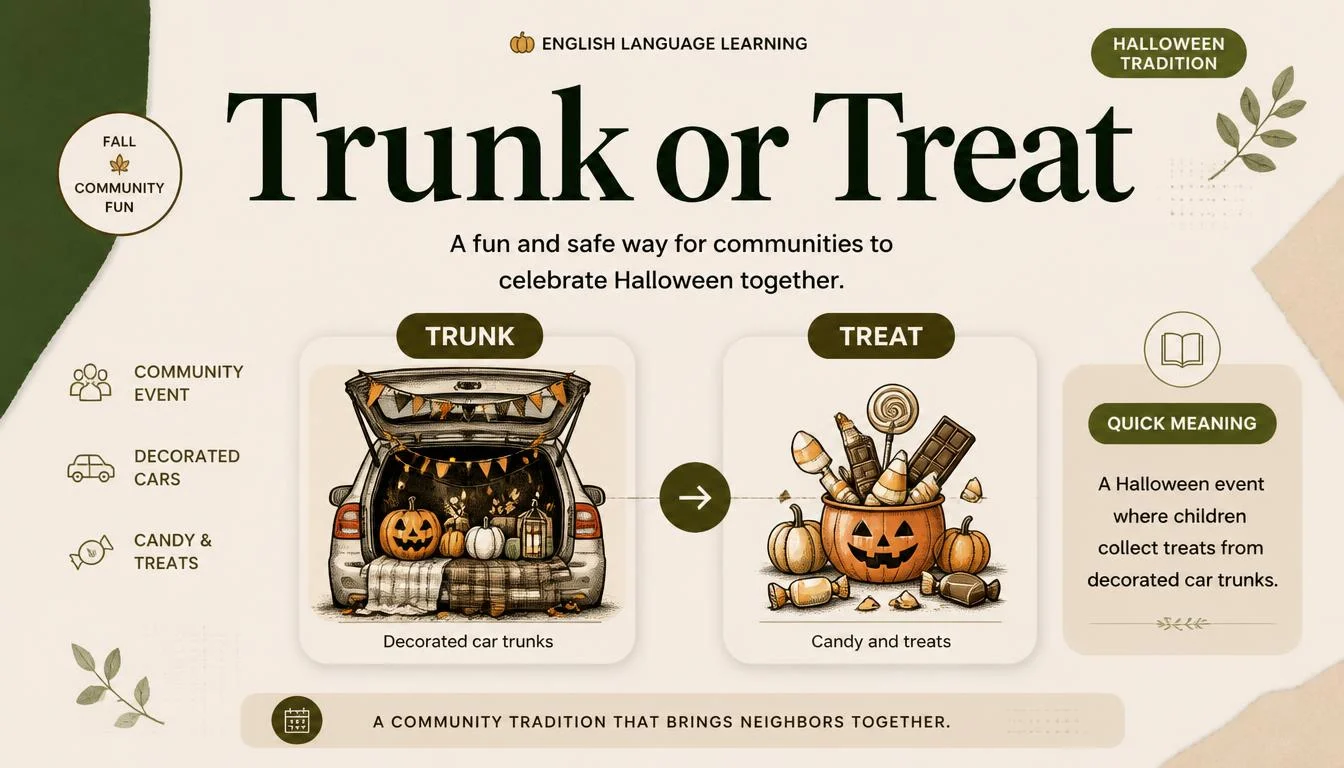
Quick Answer:
Trunk or treat is a community Halloween event where cars are decorated and parked together, often in a parking lot, so kids can collect candy from car trunks instead of walking door to door. Trick or treat, by contrast, is the traditional practice of children going house to house asking for candy. The two phrases describe different Halloween traditions, not the same activity with different wording.
Trunk or Treat is a fun Halloween tradition where children go from decorated car to decorated car to collect candy. Instead of visiting individual houses, families gather in a parking lot or community space for a safer, more organized celebration.
The idea behind Trunk or Treat is simple, but each event can have its own creative theme and activities. From spooky car decorations to costumes and games, this Halloween tradition offers an enjoyable way for families and communities to celebrate together.
Why People Mix These Two Phrases Up
Every October, someone posts a flyer for a “trick or treat event” that’s actually a trunk or treat, and confusion follows. Parents show up expecting a walkable neighborhood full of decorated porches, only to find a parking lot lined with open car trunks and candy bowls instead. It’s an honest mistake, and it happens because both phrases sound almost identical and both involve kids, costumes, and candy.
The confusion isn’t really about grammar. It’s about two Halloween customs that grew up side by side and started borrowing each other’s language. Trick or treat is the older, more universally known phrase. Trunk or treat came later, built specifically to sound like a cousin of the original so people would instantly understand the concept.
In this guide, you’ll learn exactly where each phrase comes from, how to use them correctly in conversation or writing, and why organizations, schools, and parents need to be precise about which one they’re advertising. By the end, you won’t just know the difference you’ll know why it actually matters.
Trunk or Treat: What’s the Difference?
The core difference is location and format: trick or treat happens at houses along a street, while trunk or treat happens in one shared space using car trunks as candy stations.
Trick or treat is a verb phrase turned tradition. Kids knock on a door, say “trick or treat,” and receive candy. It relies on walking, on porch lights being on, and on a whole neighborhood participating loosely and informally.
Trunk or treat is a noun phrase describing an organized event. A church, school, or neighborhood group picks a date, invites families to decorate their car trunks, and parks the cars in a lot. Children walk from trunk to trunk instead of house to house. It’s essentially trick or treating, condensed into one parking lot and usually scheduled ahead of time.
| Meaning | Part of Speech | Refers To | Typical Usage | Example | Common Confusion |
|---|---|---|---|---|---|
| Trick or treat | Interjection / noun phrase | The act of going door to door for candy | Said at doors, used to describe the tradition | “The kids went trick or treating around the block.” | Used to describe organized trunk events |
| Trunk or treat | Noun phrase | A scheduled group event using car trunks | Used to name or advertise an event | “Our church is hosting a trunk or treat on Saturday.” | Assumed to mean regular door to door candy collecting |
So here’s the short version: if children are walking a neighborhood street, you’re talking about trick or treat. If they’re walking between parked, decorated cars in one location, that’s a trunk or treat. Mixing the two up on a flyer can genuinely send families to the wrong kind of event.
Is This a Grammar Issue, a Vocabulary Issue, or a Usage Issue?
This is mostly a vocabulary and usage issue rather than a strict grammar problem, since both phrases are grammatically correct within their own context.
From a grammar standpoint, “trick or treat” functions as an interjection when spoken at a door (“Trick or treat!”) and as a compound noun when describing the activity (“We went trick or treating”). “Trunk or treat” only works as a compound noun or event name you wouldn’t shout “trunk or treat” at someone’s door, because nothing about the phrase makes sense as a greeting.
The vocabulary difference matters more. These are two distinct Halloween customs with their own histories, purposes, and settings. They are not interchangeable synonyms, even though they rhyme and share a structure.
In formal writing school newsletters, community bulletins, press releases precision matters. Calling a trunk or treat a “trick or treat event” in an official announcement can mislead families about logistics, parking, and what to expect. In casual conversation, people are more forgiving, but even then, saying “we’re doing trunk or treat this year” versus “we’re doing trick or treat this year” tells your listener something specific about your plans.
Practical takeaway: Treat these as two separate event names, not two ways of saying the same thing. Choose the one that actually describes what’s happening.
Trick or Treat: A Closer Look
Meaning: Trick or treat refers to the traditional Halloween custom of children visiting homes in costume, saying the phrase, and receiving candy or small treats.
Part of speech: It functions as an interjection when spoken aloud and as a compound noun or gerund (“trick-or-treating”) when describing the activity.
Common collocations: go trick or treating, trick or treat bag, trick or treat hours, safe trick or treating, trick or treat route.
Typical sentence pattern: Subject + go/went + trick or treating + (location/time).
Here’s how that plays out in real settings:
- Workplace example: “The office newsletter reminded parents that trick or treat hours in our neighborhood run from 5 to 8 PM.”
- Academic example: A sociology paper might note, “Trick or treating became widespread in American culture during the mid-twentieth century.”
- Technology example: “There’s an app now that maps out which streets have the best trick or treat turnout.”
- Email example: “Just a heads up we’re taking the kids trick or treating around 6, so we might miss the start of dinner.”
- Daily conversation example: “Are you guys still trick or treating this year, or are the kids too old for it?”
One learner mistake: Non-native speakers sometimes write “trick and treat,” swapping the “or” for “and.” The phrase is always “trick or treat” it originally implied a choice (give me a treat, or I’ll play a trick on you), even though nobody actually expects tricks anymore.
Mini recap: Trick or treat is the classic, decentralized tradition no sign-up sheet, no organizer, just kids walking a neighborhood in costume.
Trunk or Treat: A Closer Look
Meaning: Trunk or treat refers to an organized Halloween gathering where decorated car trunks, arranged in a parking lot or open area, serve as candy-giving stations.
Part of speech: It functions almost exclusively as a compound noun naming an event.
Common collocations: host a trunk or treat, trunk or treat decorations, trunk or treat theme, trunk or treat sign-up, church trunk or treat.
Typical sentence pattern: Organization + is hosting/organizing + a trunk or treat + (date/location).
Real-world uses look like this:
- Workplace example: “HR is organizing a trunk or treat in the parking garage for employees’ kids this Friday.”
- Academic example: A community studies report might mention, “Trunk or treat events have grown popular partly because they offer a controlled, well-lit alternative to door to door trick or treating.”
- Technology example: “The neighborhood Facebook group posted the trunk or treat sign-up form for families who want to decorate a car.”
- Email example: “Reminder: the trunk or treat starts at 6 PM sharp, and cars need to be parked and decorated by 5:30.”
- Daily conversation example: “We’re skipping regular trick or treating this year and just doing the trunk or treat at the school instead.”
One learner mistake: Some writers assume “trunk or treat” is simply a regional nickname for trick or treating. It isn’t a nickname it’s a genuinely different format, built around parked vehicles rather than houses.
Mini recap: Trunk or treat trades neighborhood streets for a single parking lot, trading spontaneity for organization and safety.
When Not to Use Each Word
Mistake 1: Calling a trunk or treat “trick or treating.” This happens because trick or treating is the more familiar phrase, so people default to it. The correct term is trunk or treat whenever the event happens in one location with parked cars. Remember it this way: no walking street to street means it’s not classic trick or treating.
Mistake 2: Using “trunk or treat” for a regular neighborhood outing. If kids are simply walking house to house on Halloween night, that’s trick or treating, full stop. Trunk or treat only applies to the organized, car-based version.
Mistake 3: Assuming the two events have identical safety considerations. Writers sometimes describe trunk or treat safety tips using language meant for street-based trick or treating (like reflective clothing for crossing streets), when parking lot safety concerns like reversing vehicles are actually more relevant.
Mistake 4: Advertising an event without specifying which type it is. A flyer that just says “Halloween Candy Event, 6 PM” leaves parents guessing whether to bring a wagon for walking or expect a parking lot layout.
Mistake 5: Treating “trunk or treat” as a verb. People don’t usually say “we trunk or treated last night” the way they say “we trick or treated.” It reads awkwardly because the phrase was built as an event name, not an action.
Mistake 6: Forgetting the hyphenation inconsistency. “Trick-or-treat” is often hyphenated when used as an adjective (“trick-or-treat bag”), while “trunk or treat” is more commonly left unhyphenated even in similar constructions. Style guides vary, so consistency within your own document matters more than picking a single universal rule.
Mistake 7: Assuming trunk or treat is a recent, made-up gimmick with no real purpose. In reality, it developed as a practical response to concerns about walking long distances, poorly lit streets, and homes that don’t participate.
Mistake 8: Using “trunk or treat” and “trick or treat” interchangeably in official school or church communications. Parents rely on that wording to know exactly what to prepare for, right down to whether they need a car.
Common Mistakes Table
| Correct Sentence | Incorrect Sentence | Explanation |
|---|---|---|
| “We’re hosting a trunk or treat in the church parking lot on Friday.” | “We’re hosting a trick or treat in the church parking lot on Friday.” | The event uses parked cars, so “trunk or treat” is the accurate term. |
| “The kids went trick or treating around our neighborhood.” | “The kids went trunk or treating around our neighborhood.” | Walking door to door describes trick or treating, not trunk or treat. |
| “Bring your kids’ candy bags to the trunk or treat at 5 PM.” | “Bring your kids’ candy bags to the trick or treat at 5 PM, we’ll be parked in the school lot.” | If it’s happening in a parking lot with parked cars, it’s a trunk or treat, and calling it otherwise contradicts the description. |
| “Trick or treat hours in our town are from 5 to 8 PM.” | “Trunk or treat hours in our town are from 5 to 8 PM.” | Town-wide hours for door to door candy collecting refer to trick or treat, not a single organized event. |
Quick Decision Box
- If kids are walking from house to house on a street, use trick or treat.
- If kids are walking between parked, decorated cars in one location, use trunk or treat.
- If you’re unsure which one you’re describing, ask: is there a street involved, or a parking lot? That single question settles it almost every time.
Real World Examples
Office communication: A company email might read, “Bring your kids to the office trunk or treat in the west parking lot decorated trunks start at 5:30.”
Business email: A property management company could send residents a note: “Reminder that trick or treat hours for the complex are 6 to 8 PM tonight.”
School or university: A school might announce, “The PTA’s annual trunk or treat fundraiser will be held in the front lot instead of the gym this year.”
Customer support: A theme park’s chatbot might respond to a guest question with, “Our Halloween event isn’t trick or treating in the traditional sense it’s closer to a trunk or treat setup near the main entrance.”
Technology: A neighborhood safety app might list, “Trick or treat safety map” as a feature, showing which streets have working streetlights.
Artificial Intelligence: A voice assistant asked “when does trick or treat start in my area” will typically pull local city guidelines, while a search for “trunk or treat near me” returns specific organized events with addresses and times.
Daily conversation: “Are you setting up a trunk for the church event, or are we just doing regular trick or treating this year?”
Trick or Treat and Trunk or Treat in Modern Technology
Search engines and voice assistants now treat these as two distinct queries, which shows how firmly the language has split. Ask a smart speaker, “When is trick or treat this year,” and it typically returns general Halloween date information. Ask instead, “Find a trunk or treat near me,” and mapping tools or event apps return specific addresses, dates, and sign-up links for organized gatherings.
Community apps built for neighborhoods often let organizers create event listings labeled specifically as “Trunk or Treat,” complete with a map pin for the parking lot, because attendees need that location detail in a way regular trick or treaters don’t. Meanwhile, city government websites frequently publish “recommended trick or treat hours” as general safety guidance, without any specific single location attached, since it’s assumed to happen across the whole neighborhood.
Even software categorization reflects the split: event ticketing and RSVP platforms list “Trunk or Treat” as its own event type, distinct from generic Halloween parties, because the format parked cars, walkable rows, assigned spots requires different planning tools than a costume party or a house-to-house tradition would.
Where the Phrase Trunk or Treat Came From
Trick or treat has roots going back decades, tied to the broader history of Halloween begging traditions brought over and adapted in North America. Trunk or treat is much newer. It grew out of church and community groups looking for a safer, more controlled alternative sometime in the 1990s and 2000s, as concerns grew about walking unfamiliar streets after dark. The phrase itself was clearly built to echo “trick or treat,” swapping “trick” for “trunk” so the concept would be instantly recognizable to anyone already familiar with Halloween traditions.
Expert Insight
Here’s something worth remembering as a language teacher: phrases that rhyme or share a structure often get treated as synonyms by learners, even when they describe completely different things. Trick or treat and trunk or treat are a perfect example. The safest habit is to picture the actual scene each phrase describes a street full of houses, or a parking lot full of cars before choosing which one to use. When the mental picture is clear, the word choice usually takes care of itself.
Error Prevention Checklist
- Always use trick or treat when describing children walking door to door on a street.
- Always use trunk or treat when describing an organized event with parked, decorated cars in one location.
- Never confuse them if you remember: trick or treat has no organizer, trunk or treat almost always does.
- Quick memory tip: no trunk, no cars it’s trick or treat. Cars parked in rows it’s trunk or treat.
Related Grammar Confusions Worth Learning
- Trick or treat vs. Halloween party a party doesn’t involve going anywhere for candy, while trick or treat is specifically about the door-to-door custom.
- Effect vs. affect one of English’s most common mix-ups, worth mastering for clear writing.
- Its vs. it’s a classic confusion that trips up even experienced writers.
- Costume vs. custom easy to mix up in speech, but they mean completely different things.
- Candy vs. sweets largely a regional vocabulary difference between American and British English.
- Neighborhood vs. community often used interchangeably, though they carry slightly different scopes.
- Fundraiser vs. charity event useful to distinguish when writing school or church announcements.
- Decorate vs. adorn a good example of formal versus everyday word choice.
- Host vs. organize subtle differences in how each verb implies responsibility for an event.
- Safe vs. secure commonly confused in safety-related writing, including Halloween safety guides.
FAQs
Is “trunk or treat” the same as trick or treating?
No. Trick or treating typically involves going door to door through a neighborhood, while trunk or treat is an organized event where children collect treats from decorated cars parked in one location, usually a school, church, or community parking lot.
Why do churches and schools host trunk or treat events?
Churches and schools often host trunk or treat events because they provide a controlled, well lit environment where parents can supervise children more easily. They can also be a practical option for communities where traditional door to door trick or treating is less convenient or safe.
Can you say “trunk or treating” as a verb like “trick or treating”?
It is uncommon. “Trick or treating” is a natural and widely used expression for the Halloween activity, but “trunk or treating” sounds less natural to most native speakers and is rarely used in the same way.
Do trunk or treat events replace trick or treating entirely?
Not usually. Many families participate in a trunk or treat event earlier in the evening and then go trick or treating afterward. The two activities are often treated as separate parts of the same Halloween celebration.
Is “trick or treat” always hyphenated?
Not always. It is often hyphenated when used as a compound adjective, such as “trick or treat bag.” When used as a phrase, it is generally written without hyphens, as in “we went trick or treat.” Exact style preferences can vary.
What should I write on a flyer to avoid confusing the two events?
Clearly explain how the event works. State whether children will be visiting homes along a neighborhood street or collecting treats from decorated cars in a specific parking lot. This helps families understand what to expect before attending.
Conclusion
The difference between trick or treat and trunk or treat comes down to setting and structure. Trick or treat is the classic, informal tradition of walking door to door through a neighborhood. Trunk or treat is a planned, organized gathering built around parked, decorated cars in one shared space.
Next time you’re writing an invitation, a school newsletter, or even just a text to a friend, picture the actual scene before choosing your words. If there’s a street and houses involved, it’s trick or treat. If there’s a parking lot full of decorated trunks, it’s trunk or treat. Getting that one detail right saves everyone a confused Halloween evening.
Read More Related Articles
- Happened or Happend | Master the Correct Usage in Minutes In 2026
- Anual or Annual | Simple Grammar Guide For Error-Free Writing In 2026
- Successfully or Succesfully | Easy Trick to Remember the Correct Spelling Forever In 2026

Caleb Dawson is a content writer at synoseek.com, where he works on simple, reader-focused articles across a range of everyday topics. His writing style is practical and grounded, aiming to present information in a clear and relatable way without unnecessary complexity.
1 thought on “Trunk or Treat | Fun Guide to This Halloween Tradition In 2026”