Quick Answer:
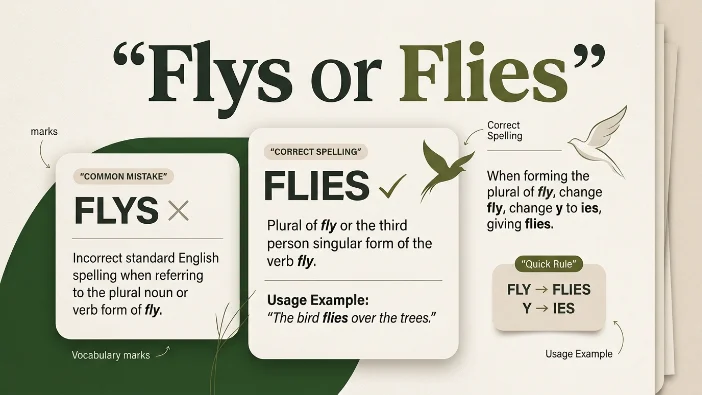
The correct plural form is flies in nearly all cases. “Flys” is a common misspelling and is only acceptable when referring to the zipper on a pair of pants (a “fly”). For the insect, the verb meaning to move through the air, or baseball’s “fly ball,” always use flies. This comprehensive guide explains every usage, provides memory tricks, and ensures you never confuse these words again.
If you’re unsure whether to write “Flys or Flies,” you’re not alone. These words look similar, but only one is the standard spelling when you’re talking about more than one fly or describing what someone does while flying.
Understanding the difference between “Flys or Flies” can help you avoid spelling mistakes in everyday writing. In this guide, we’ll explain which form is correct, what each word means, and how to use it naturally in a sentence.
By the end of this article, you will know exactly which spelling to use in every situation, understand why the rule works the way it does, and have practical memory tricks to ensure you never second-guess yourself again. Let’s clear up the flys vs flies confusion once and for all.
What’s the Difference Between Flys and Flies?
The core difference is simple: “flies” is the correct spelling for virtually every use, while “flys” is almost always a spelling error. Think of “flys” as the wrong way to pluralize or conjugate the word “fly” in standard English writing.
Here’s what each form means:
Flies serves multiple grammatical functions. As a plural noun, it refers to more than one flying insect. As a verb, it’s the third-person singular present tense of “to fly” so you’d write “she flies” or “the plane flies.” It’s also the plural of “fly” when referring to baseball’s fly balls or the zipper on clothing.
Flys appears almost exclusively as a misspelling. The only legitimate use is as the plural of “fly” when referring specifically to the zippered opening on pants or tents though even here, “flies” is becoming more common.
| Word | Part of Speech | Refers To | Typical Usage | Example | Common Confusion |
|---|---|---|---|---|---|
| Flies | Plural noun | Multiple flying insects | “The flies gathered around the picnic.” | “Flies buzzed near the window.” | People confuse this with “flys” due to the Y-to-IES rule |
| Flies | Verb (third person) | Action of moving through air | “He flies to Chicago every week.” | “The bird flies south for winter.” | Some think verbs ending in Y add just S |
| Flies | Plural noun | Baseball fly balls | “He hits flies to the outfield.” | “The batter popped up two flies.” | Rare usage, but follows same rule |
| Flys | Plural noun | Zipper openings (rare) | “The pants have two flys.” | “The flys on these trousers are different.” | This is the only accepted exception |
Here’s the bottom line: when in doubt, write “flies.” Whether you’re a student writing an essay, a professional sending an email, or a content creator publishing online, “flies” will be correct in more than 99% of situations. The rare “flys” exception is so specific that most style guides recommend avoiding it altogether.
Is This a Grammar, Vocabulary, or Usage Issue?
Understanding whether “flys or flies” is a grammar, vocabulary, or usage question helps you approach it correctly. This is primarily a spelling and grammar issue with roots in English’s inflection rules, though it also touches on vocabulary and usage conventions.
Grammar classification: This falls under English morphology how words change form to show plurality or tense. When a noun ends in “y” with a consonant before it, the standard rule says we change “y” to “i” and add “es” to make it plural. For verbs, we also follow the Y-to-IES rule for third-person singular present tense. “Fly” follows this pattern perfectly, which is why “flies” is grammatically correct.
Vocabulary distinction: There’s no vocabulary difference between “flys” and “flies” in meaning they refer to the same concepts. The distinction is purely about correctness. “Flies” is the established dictionary spelling, while “flys” simply isn’t recognized in standard vocabulary references like Oxford, Cambridge, or Merriam-Webster.
Usage in different contexts: The Y-to-IES rule applies across all English varieties. Whether you’re writing:
- Formal English: Always use “flies.” Academic papers, business reports, and professional correspondence require the standard spelling.
- Business English: Use “flies” in all communications. Using “flys” would be seen as an unprofessional error.
- Academic writing: Strictly use “flies.” Most style guides, including APA and Chicago, follow the Y-to-IES rule.
- Everyday conversation: Even in casual texts and social media, “flies” is correct. “Flys” appears as a typo, not an accepted variant.
The interchangeability question: “Flys” and “flies” are not interchangeable in standard English. Flies” is the only correct spelling for insects, the verb “to fly,” and baseball terms. The sole exception referring to zippers is so rare and contested that it’s safer to use “flies” there too.
The practical takeaway: This is a straightforward spelling rule with very few exceptions. Once you understand the Y-to-IES pattern, you can apply it confidently to all similar words, from “try” (tries) to “carry” (carries). The rule is consistent, and the exception is negligible.
When to Use Flies (The Correct Choice)
Meaning and Usage
Flies” is the correct plural form of “fly” in almost every context. You’ll use it constantly in everyday English, from describing insects to talking about travel. This single spelling covers multiple meanings, making it one of those versatile words you’ll encounter in virtually every type of writing.
Pronunciation
“Flies” is pronounced as /flaɪz/ (rhymes with “eyes,” “size,” and “prize”). The “i” makes a long sound, and the “es” creates a soft “z” sound at the end. Some learners mistakenly pronounce it as “fleeze,” but the correct pronunciation is distinctly “fl-eye-z.”
Common Collocations and Phrases
| Collocation/Phrase | Meaning | Example in Context |
|---|---|---|
| Time flies | Time passes quickly | “Time flies when you’re having fun.” |
| Fruit flies | Small insects attracted to fruit | “Fruit flies appeared around the ripe bananas.” |
| Fly in the ointment | A small problem that spoils something | “The only fly in the ointment was the weather.” |
| Fly on the wall | An unnoticed observer | “I wish I could be a fly on the wall during that meeting.” |
| Drop like flies | People falling or failing in large numbers | “Competitors were dropping like flies.” |
| Fly ball | A baseball hit high into the air | “The outfielder caught the fly ball.” |
Typical Sentence Patterns
- As a noun (subject): “The flies are everywhere this summer.”
- As a noun (object): “She swatted the flies away from the food.”
- As a verb: “The pilot flies commercial aircraft for Delta.”
- In prepositional phrases: “The room was full of flies.”
Real-World Examples
Workplace Example:
“Marcus flies to our New York office every other week, so he’s familiar with this route. The flies near the river have been terrible this year, though.”
Academic Example:
In our biology experiment, we observed that fruit flies demonstrated a clear preference for fermented substances, which aligns with previous research on Drosophila behavior.
Technology Example:
“The drone flies autonomously for up to 45 minutes, and its advanced sensors prevent collisions. However, no one told the software engineers about the flies in the server room.”
Email Example:
“Dear Team, I hope this email flies to your inbox at a good time. Regarding our project timeline, time certainly flies, and we’re already at the midpoint. Let’s schedule a review meeting.”
Daily Conversation Example:
“Look at those flies buzzing around the compost bin! And time flies so fast I can’t believe it’s already September.”
One Common Learner Mistake
Incorrect: “The flys are bothering us.”
Correct: “The flies are bothering us.”
The mistake happens because learners see the word “fly,” think “I’ll just add S,” and forget the Y-to-IES rule. The key is remembering that when a word ends in “y” with a consonant before it, you change “y” to “i” before adding “es.” This applies to nouns and verbs alike.
Mini Recap
“Flies” is your default choice. It handles insects, flying actions, and baseball terms. It’s the dictionary-approved spelling you’ll see everywhere from news articles to academic papers. When you write “flies,” you’re correct every time.
The Exception: When Flys Is Used
Understanding the Exception
“Flys” has only one legitimate use in modern English: as the plural of “fly” when referring to a zippered opening on pants, trousers, or tents. This usage is rare, archaic, and increasingly falling out of favor. You might encounter it in fashion catalogues, tailoring discussions, or older texts.
Real-World Example:
“The tailor examined both flys on the pants and noted they needed reinforcement.” This is correct but uncommon.
However, style guides like Chicago Manual of Style now recommend using “flies” in all contexts, including zipper references. The trend toward simplification means even this tiny exception is fading.
Why This Confuses People
The exception exists because “fly” in this specific meaning is treated as a different word than the insect or the verb. English has this quirk where the same spelling can have multiple meanings with slightly different rules. Add to this the natural human tendency to spell by analogy people see other words ending in “y” and think “just add S.”
Another mistake: Some writers think “flys” works for verb forms like “he flys.” It doesn’t. The verb “to fly” always becomes “flies” in third-person singular.
The Bottom Line on Flys
If you never use “flys,” you’ll almost certainly be right. The only time you need it is so rare that most professional writers avoid it entirely. Stick with “flies” and you can’t go wrong.
Comparison Table: Common Mistakes
| Correct Sentence | Incorrect Sentence | Explanation |
|---|---|---|
| The flies are attracted to the light. | The flys are attracted to the light. | Adding just “S” to words ending in consonant+Y is incorrect. Change Y to I and add ES. |
| She flies to London every month. | She flys to London every month. | Verbs in third-person singular need the Y-to-IES spelling. |
| The ballpark has seen many fly balls this season. | The ballpark has seen many flys balls this season. | Fly” as a noun meaning baseball hit still follows the Y-to-IES rule. |
| Time flies when we’re busy. | Time flys when we’re busy. | Common idiomatic expression always uses “flies.” |
| The pilot flies small aircraft. | The pilot flys small aircraft. | Same verb rule applies regardless of subject. |
| Check the flies on these trousers. | Check the flys on these trousers. | Even in this rare case, most authorities accept “flies” as correct. |
Real-World Application: When to Use Each
Decision Box
Use “flies” if you’re referring to:
- Any flying insect (house flies, fruit flies, horse flies)
- The verb meaning to move through air
- Third-person singular verb forms (“he flies,” “she flies”)
- Baseball’s high-hit balls
- Time passing (“time flies”)
- Any plural of “fly” in standard writing
Consider “flys” only if:
- You’re writing about zippered openings on clothing
- The context is extremely specific (tailoring, fashion)
- Your style guide explicitly allows it
How to remember:
Think of the rhyme: “For insects and the sky, write ‘flies’ no need to try. For zippers on pants, ‘flys’ gets a chance but even then, just pass it by!”
Practical Teaching Insight
One of the most effective ways to remember the Y-to-IES rule is to practice with similar words. Look at “sky” (skies), “cry” (cries), “try” (tries), and “supply” (supplies). They all follow the same pattern. Once you’ve trained yourself to expect the “ies” ending for consonant+Y words, “flys” will look obviously wrong every time.
Modern Technology and Vocabulary Usage
The Impact of Technology
In our digital age, spelling mistakes like “flys” are easier to make and also easier to catch. Spell-checkers in word processors, email clients, and web browsers will mark “flys” as an error in most contexts. Autocorrect often fixes it automatically.
Use in Artificial Intelligence and Tech
AI-powered writing assistants are particularly helpful with this distinction. Tools like Grammarly, Microsoft Editor, and Google Docs’ spell-checker will flag “flys” and suggest “flies.” If you’re using AI for writing, you’ll rarely make this mistake.
Common Technology Contexts
Software error: “The program flies through the data processing.” (Correct)
Spell-checker warning: “Flys is not recognized. Did you mean flies?
AI assistant: “Please correct ‘flys’ to ‘flies’ for proper grammar.”
Speech-to-text: Voice recognition might mishear “flies” as other words, but it’s less likely to confuse the spelling.
Word Origin: Understanding the History
Etymology of “Fly”
The word “fly” comes from Old English “fleoge” (meaning the insect) and “fleogan” (meaning to move through air). Both share Proto-Germanic roots with related words in German (fliegen), Dutch (vliegen), and Norse languages. The plural in Old English was “fleogan” or “fleogun,” which eventually simplified.
Why the Spelling Evolved
The Y-to-IES rule emerged in Middle English as a way to show plurality clearly. Words ending in “-y” with a preceding consonant needed a marker that maintained pronunciation. Changing “y” to “i” before adding “es” kept the final syllable pronounced correctly while signaling plurality.
This pattern was so consistent that “flys” simply never caught on except in the extremely specific tailoring context mentioned earlier. Even then, the spelling was never universally accepted, and modern usage has largely abandoned it.
What This History Tells Us
Language rules exist to make communication clearer, not more complicated. The Y-to-IES rule helps us pronounce and understand words more easily. “Flys” doesn’t follow the rule and doesn’t feel natural to native speakers hence its near-universal rejection.
Expert Insight: What Language Educators Say
As an English language instructor with over a decade of experience, I’ve seen this confusion countless times. Here’s what works with students:
The mental block comes from seeing the letter “Y” and thinking it’s just another consonant. But in English, “Y” acts as a vowel in this position. When you add an ending, you need to keep the vowel sound consistent.
Try this: say “fly” out loud. Now say “flies.” Notice how the vowel sound stays the same? That’s because the “Y” changes to “I” but keeps the long “I” sound. If we wrote “flys,” it would look like it should rhyme with “hiss,” not “eyes.” The spelling guides the pronunciation.
I tell my students: “Whenever you see a word ending in consonant+Y, imagine the Y turning into an I when you add any ending that starts with a vowel. It makes sense when you think about pronunciation.”
Error Prevention Checklist
Always use “flies” when:
- You’re referring to more than one insect
- You’re talking about the action of flying (third person)
- You’re writing the plural of “fly ball”
- You’re using common expressions like “time flies”
- You’re writing in any formal or professional context
Almost never use “flys” because:
- It’s only legitimate in one extremely rare context (zippers)
- Even most style guides recommend using “flies” there too
- Your spell-checker will flag it as an error
- Readers will assume it’s a mistake
Quick memory tip:
When in doubt, “flies” is always right. The only time you need “flys” is if you’re a tailor describing trousers and even then, most people use “flies.”
Related Grammar Confusions You Should Learn
Understanding “flys vs flies” is part of a broader pattern of English spelling rules. Here are similar confusions worth mastering:
- Lays vs Laid – Understanding transitive verb forms and past tense
- Pluralizing words ending in Y – General rule: change Y to I and add ES
- Verb conjugation in present tense – How third-person singular works
- Has vs Have – Subject-verb agreement basics
- Principal vs Principle – Common homophone confusion
- Affect vs Effect – One of the most common grammar mistakes
- Its vs It’s – Apostrophe usage in contractions
- There vs Their vs They’re – Fundamental homophone distinctions
Each of these topics builds your understanding of English’s consistent rules and occasional exceptions. When you master one, you’re on your way to mastering them all.
FAQs
What is the correct spelling: “flys” or “flies”?
Flies is the standard spelling in almost every context. It is the plural of fly and the third person singular form of the verb fly. Flys is generally considered incorrect, although it can occasionally appear as a specialized plural for the zipper opening on clothing.
Why do people confuse “flys” and “flies”?
The confusion comes from English plural spelling rules. When a word ends in y after a consonant, the y usually changes to ies, as in fly → flies. When y follows a vowel, the word generally keeps the y and adds s, as in day → days.
Is “flies” a real word?
Yes. Flies is a standard English word with several uses. It can be the plural of the noun fly, as in flies are common insects, or the third person singular form of the verb fly, as in the bird flies south.
Does “flies” refer to insects?
Yes. As a noun, flies is the plural of fly, referring to insects in the order Diptera. Examples include house flies, fruit flies, and horse flies.
Can “flies” be used as a verb?
Yes. Flies is the third person singular present tense of fly. For example, “She flies to London every month” and “The bird flies over the lake.”
What does “flies” mean in slang?
In some informal contexts, flies can mean cool, attractive, or stylish. For example, someone might say, “Those shoes are flies.” The word also appears in the familiar expression “time flies,” meaning that time passes quickly.
Is it “time flies” or “time flys”?
The correct expression is “time flies.” Here, flies is the third person singular form of the verb fly, so flys is incorrect.
What is the plural of “fly” when referring to zippers?
When fly refers to the zippered or buttoned opening of clothing, flys has occasionally been used as a specialized plural. However, this form is uncommon, and flies is much more widely recognized. For general writing, flies is the safer choice.
Conclusion
The distinction between “flys and flies” is remarkably simple once you understand the rule. “Flies” is almost always correct for insects, for the verb “to fly,” for baseball terms, and even for most zipper references. “Flys” is a spelling error in virtually every context, with only a tiny, outdated exception that most modern writers ignore.
The Y-to-IES rule is your friend here: when a word ends in a consonant plus “y,” change the “y” to “i” and add “es.” This rule works for “fly” (flies), “try” (tries), “cry” (cries), and countless other words. Once you internalize this pattern, you’ll never confuse these spellings again.
Remember: if you’re writing about anything other than tailoring, just write “flies.” It’s the professional, standard, and correct choice every time. Time flies, but the rules of English don’t have to be complicated. When you choose “flies,” you’re making the smart, educated, and thoroughly correct decision.
Read More Related Articles
- Happened or Happend | Master the Correct Usage in Minutes In 2026
- Anual or Annual | Simple Grammar Guide For Error-Free Writing In 2026
- Successfully or Succesfully | Easy Trick to Remember the Correct Spelling Forever In 2026

Zoe Chambers works as a content writer at synoseek.com, contributing thoughtful pieces on everyday subjects and ideas. She writes in a simple, grounded way, often drawing from real-world experiences. Her focus is on keeping content natural, clear and easy for readers to connect with.