Quick Answer
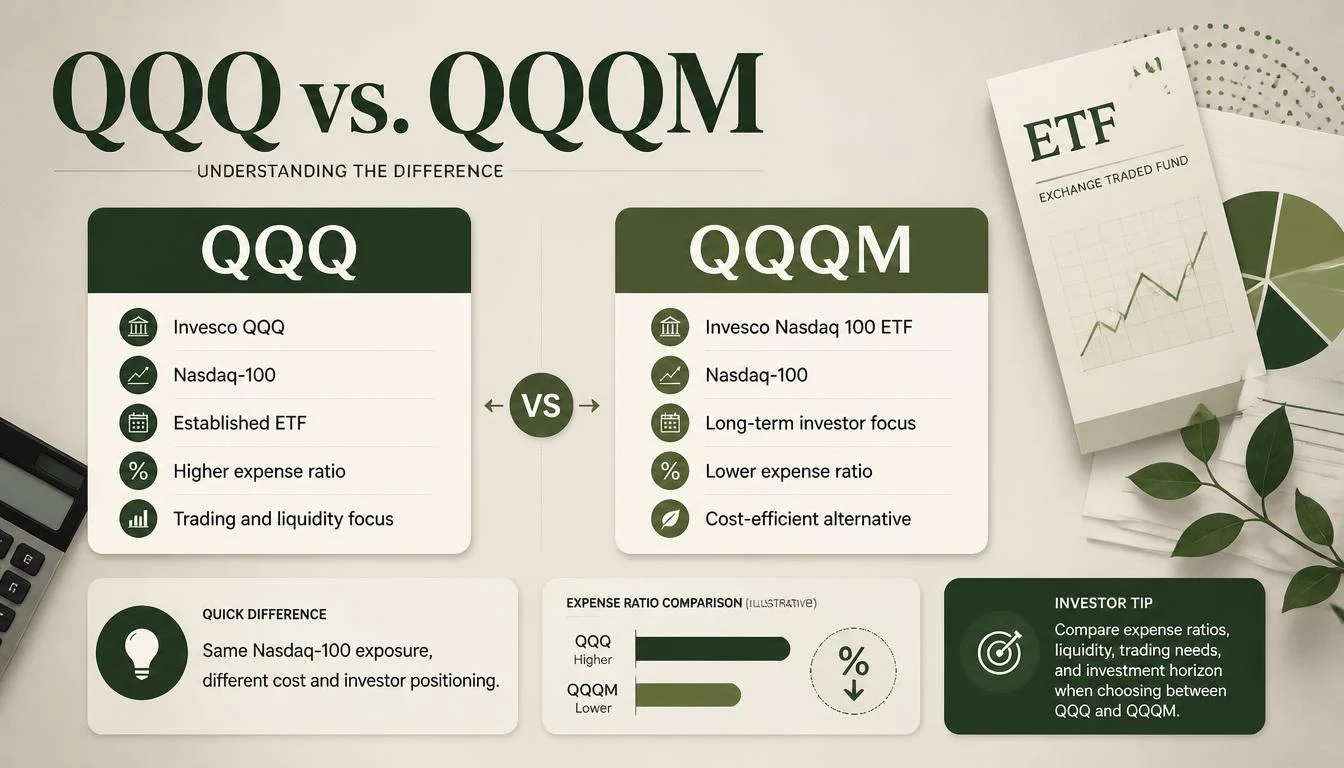
QQQ and QQQM are both exchange-traded funds that track the exact same Nasdaq-100 Index, holding the same stocks. The primary difference is that QQQM charges a lower expense ratio (0.15%) than QQQ (0.18%), making it more cost-efficient for buy-and-hold investors, while QQQ offers much greater liquidity for active traders.
If you’re researching Nasdaq-100 ETFs, you’ve probably come across two tickers that look remarkably similar: QQQ and QQQM. It’s a natural point of confusion. After all, both are offered by Invesco, both track the same index, and they even share many of the same top holdings. So why does one exist, and which one should you choose?
The answer is actually simpler than it seems. Understanding the small but meaningful differences can save you money and ensure your investment strategy is aligned with your goals. While the average daily returns for QQQ and QQQM are nearly identical within fractions of a percentage point their underlying structures and target audiences create a clear distinction. As one report puts it, “the real choice is structural: one fund is a 1999-vintage unit investment trust engineered for traders, and the other is a 2020-vintage open-end fund engineered to compound quietly in a retirement account”.
This guide breaks down the comparison between QQQ and QQQM, clarifies their respective advantages, and helps you decide which one belongs in your portfolio.
What’s the Difference Between QQQ and QQQM?
The core difference between QQQ and QQQM comes down to their purpose. QQQ is designed for active trading, while QQQM is designed for long-term buy-and-hold investors.
Both ETFs give you exposure to the Nasdaq-100 Index, a basket of the 100 largest non-financial companies listed on the Nasdaq stock exchange. This index is heavily weighted toward technology giants like Nvidia, Apple, Microsoft, and Amazon. However, the vehicles are optimized for different use cases.
Meaning and Part of Speech
- QQQ (Invesco QQQ Trust): An ETF launched in March 1999. It is one of the most heavily traded securities in the world.
- QQQM (Invesco Nasdaq-100 ETF): A newer ETF launched in October 2020 by the same company. It was created specifically to offer the same index exposure at a lower cost for everyday investors.
Recap: QQQ is the older, more heavily traded fund with a higher fee, preferred by traders. QQQM is the newer, cheaper clone created for long-term investors who don’t need QQQ’s extreme liquidity.
Is This a Grammar, Vocabulary, or Usage Issue?
This is not a grammar issue but a usage and semantic issue in the context of investing terminology. Both terms are proper nouns (ticker symbols) referring to financial products. While they are often used interchangeably in casual conversation to mean “exposure to the Nasdaq-100,” they are not interchangeable for a serious investor.
- Grammar Classification: Both are proper nouns.
- Vocabulary Difference: They refer to two specific and distinct financial products from the same provider.
- Usage Difference: In everyday conversation, you might say, “I own the Qs,” but a professional financial discussion requires specifying the ticker, as the choice affects net returns and trading strategy.
- Are They Interchangeable? In terms of holdings, yes, they are nearly identical. In terms of cost and trading capability, no, they are not.
Practical Takeaway: While both words mean “Nasdaq-100 ETF,” choosing the wrong one can cost you money over time.
QQQ vs. QQQM: A Detailed Guide
Understanding the details of each fund will help you make an informed choice.
What is QQQ (Invesco QQQ Trust)?
- Meaning: An iconic, highly liquid ETF that is one of the most traded instruments in the world.
- Part of Speech: Noun (Ticker Symbol).
- Common Collocations: “Trade the Qs,” “QQQ options chain,” “hedging with QQQ,” “active trading.”
- Typical Sentence Patterns: “Active traders favor QQQ for its deep liquidity.”
- Workplace Example (Trader): “I am using QQQ to hedge my long tech positions due to its liquid options market.”
- Academic Example: “A study on ETF liquidity would likely use QQQ as a primary example of a high-volume fund.”
- Technology Example: “We’re analyzing QQQ’s price action to gauge intraday sentiment in the tech sector.”
- Email Example (Portfolio Manager): “I’ve entered a short-term position in QQQ to capitalize on today’s expected volatility.”
- Daily Conversation: “QQQ is down 2% today, dragging the Nasdaq with it.”
- One Learner Mistake: Believing QQQ’s higher price means it is a better or “premium” investment compared to QQQM.
- Mini Recap: QQQ is the trader’s choice for its unparalleled liquidity and active options market.
What is QQQM (Invesco Nasdaq-100 ETF)?
- Meaning: A cost-efficient ETF that tracks the Nasdaq-100, designed for the long-term investor.
- Part of Speech: Noun (Ticker Symbol).
- Common Collocations: “Long-term holding,” “retirement account,” “cost-effective,” “buy and hold.”
- Typical Sentence Patterns: “Long-term investors should consider QQQM for its lower expense ratio.”
- Workplace Example (Financial Advisor): “For your Roth IRA, I recommend the low-cost QQQM for Nasdaq-100 exposure.”
- Academic Example: “The rise of products like QQQM demonstrates the industry’s trend toward fee compression for retail investors.”
- Technology Example: “This app helps you automate your investments, suggesting QQQM as a core holding for your tech allocation.”
- Email Example (Financial Advisor): “We will be switching your new contributions to QQQM, the lower-cost version of the same Nasdaq-100 fund.”
- Daily Conversation: “I just set up a monthly purchase of QQQM in my brokerage account.”
- One Learner Mistake: Thinking that because QQQM is cheaper and has lower volume, it is a “risky” investment.
- Mini Recap: QQQM is the investor’s choice for saving on fees over the long run.
When Not to Use QQQ and QQQM
Choosing the wrong fund can result in unnecessary costs, reduced trading efficiency, or avoidable tax consequences. Here are six common mistakes investors make when deciding between QQQ and QQQM, along with the better approach for each situation.
1. Using QQQ for Long-Term Buy-and-Hold Investing
Mistake: A long-term investor uses QQQ for regular dollar-cost averaging in a retirement account.
Why it happens: QQQ is the more established and recognizable ticker, so investors often choose it by default.
Better choice: QQQM. For a long-term investor who doesn’t need QQQ’s exceptional trading liquidity, QQQM’s lower expense ratio can make it the more cost-efficient option over time.
2. Using QQQM for Active Options Trading
Mistake: An active options trader chooses QQQM for strategies such as covered calls simply because it has a lower expense ratio.
Why it happens: The lower ongoing cost can look attractive, especially to investors focused on minimizing fees.
Better choice: QQQ. Its options market generally offers substantially greater trading volume and tighter bid-ask spreads, which can be important when frequently entering or exiting options positions.
3. Selling QQQ Just to Switch to QQQM
Mistake: An investor sells an existing QQQ position in a taxable account solely to move into QQQM and reduce fund expenses.
Why it happens: The investor wants to minimize fees but overlooks the potential tax consequences of selling a profitable position.
Better choice: Consider keeping QQQ and directing new contributions to QQQM. Realizing a capital gain just to capture a relatively small difference in expense ratios may not make financial sense. The tax cost could take years to offset the savings from the lower fee.
4. Avoiding QQQM Because of Its Lower Trading Volume
Mistake: A beginner with a relatively small account avoids QQQM because they believe its lower trading volume makes it difficult to buy or sell.
Why it happens: Investors sometimes confuse institutional-level liquidity with the liquidity required by ordinary retail investors.
Better choice: QQQM. Its trading activity is generally more than sufficient for typical individual investors. Its lower share price can also make it easier for investors with smaller accounts to build a position.
5. Assuming QQQ’s Higher Fee Means Better Returns
Mistake: An investor assumes that paying more for QQQ automatically provides better investment performance.
Why it happens: Some investors naturally associate higher fees with better products or superior management.
Better choice: QQQM for cost-conscious long-term investors. Both funds provide exposure to the Nasdaq-100, so QQQ’s higher expense ratio isn’t paying for superior stock selection. Its premium is primarily associated with the trading characteristics and liquidity that make QQQ attractive to active traders.
6. Ignoring the Structural Differences Between QQQ and QQQM
Mistake: An investor assumes that the expense ratio is the only meaningful difference between the two funds.
Why it happens: The funds have similar objectives and track the same underlying index, making their structural differences easy to overlook.
Better choice: It depends on your investment strategy. QQQ historically operated as a Unit Investment Trust, which created certain structural limitations, including the inability to reinvest dividends internally in the same way as an open-end fund. QQQ later converted to an open-end fund in December 2025, removing that historical structural distinction. However, QQQM’s lower expense ratio can still make it attractive for investors focused primarily on long-term cost efficiency.
Bottom Line
Neither QQQ nor QQQM is universally better. QQQM generally makes more sense for long-term, cost-conscious investors, while QQQ can be preferable for active traders who value its deep liquidity and robust options market. Before switching funds, consider not only the expense ratio but also trading needs, taxes, account type, and your investment horizon.
Decision Box: QQQ or QQQM?
Choose QQQ if you are an active day trader or options strategist who relies on deep liquidity.
Choose QQQM if you are a long-term buy-and-hold investor building wealth in a retirement account.
Real-World Examples of When to Use Each
- Office Communication: “The options desk is using QQQ to execute their weekly hedges.” (QQQ for its options liquidity)
- Business Email: “We are recommending QQQM for the tech allocation in the 401(k) plan due to its cost efficiency.” (QQQM for long-term retirement)
- School/University: “A savvy personal finance course would highlight QQQM as a prime example of how to avoid paying unnecessary fees.” (QQQM for financial literacy)
- Customer Support: “Our investment platform supports recurring buys for ETFs like QQQM to help you automate your investing.” (QQQM for dollar-cost averaging)
- Technology: “We utilize QQQ’s price as a key benchmark for our AI-driven, high-frequency trading algorithm.” (QQQ for algorithmic trading)
- Daily Conversation: “I just set up an automatic investment of $200 into QQQM every week. It’s the same as QQQ, but cheaper!” (QQQM for retail investors)
QQQ and QQQM in Modern Technology
The distinction between these two ETFs is especially relevant in the age of artificial intelligence and automation.
- Artificial Intelligence & Virtual Assistants: Platforms like Robinhood and Betterment often use algorithms to suggest investments. Many of these robo-advisors are more likely to recommend the lower-cost QQQM as a core holding for passive investors. The “assistant” in this case is the software guiding your portfolio, prioritizing efficiency.
- Software & Business Tools: Financial analytics software, like Bloomberg Terminal, is the primary domain for QQQ. Its deep liquidity and massive volume make it a benchmark for market sentiment and a primary trading vehicle for institutional algorithms.
Word Origin
While both are simply ticker symbols, the “QQQ” name has become so famous that it acts as a shorthand for the Nasdaq-100 itself. Investors often refer to the index as “the Qs.” QQQ was launched in 1999 at the height of the dot-com boom and quickly became a cultural touchstone for technology investing. QQQM was launched in 2020 to directly appeal to the new generation of retail investors who were looking for low-cost, long-term investment solutions.
Expert Insight
From the perspective of a senior language and finance instructor, the confusion between QQQ and QQQM is a classic example of a false synonym. To an untrained ear, both words sound like they refer to the same thing: “the Nasdaq 100.” However, in the professional world of investing, they represent distinct choices in strategy.
Think of QQQ as a commercial airliner and QQQM as a private jet that flies on the exact same route. The airliner (QQQ) has massive capacity and volume, making it the only practical choice for moving large groups of people (institutional money) quickly. The private jet (QQQM) is much more efficient and cost-effective for a single traveler (the individual investor). Choosing the wrong vehicle means either paying for seats you don’t need or having your flight canceled due to a lack of infrastructure.
Error Prevention Checklist
- Always use QQQM when:
- You are investing for the long term (10+ years).
- You are dollar-cost averaging into a retirement account.
- You are looking to minimize fees.
- Always use QQQ when:
- You are executing high-frequency trades.
- You are writing or trading options.
- You need to move large amounts of capital without any slippage.
- Never confuse them if:
- You think price equals value. A higher price for QQQ does not mean it is a better investment.
- Quick Memory Tip:
- QQQ = Quick trades.
- QQQM = Money saved.
Related Grammar Confusions (Investment Edition)
- ETF vs. Index Fund: Understanding the difference between a traded fund and a mutual fund.
- Expense Ratio vs. Management Fee: The true cost of owning a fund.
- Bid-Ask Spread vs. Commission: The cost of buying and selling.
- Stock vs. Bond: The fundamental choice of equity vs. debt.
- Large-Cap vs. Small-Cap: Understanding market capitalization.
- Growth vs. Value: Understanding different investment styles.
- Roth IRA vs. Traditional IRA: Tax implications for retirement.
- Capital Gains vs. Dividends: How you are taxed on your returns.
FAQs
Why are there two ETFs that track the same index?
Invesco launched QQQM in 2020 to cater to a different audience. QQQ was built for active traders, while QQQM was built for long-term investors seeking lower costs. They are designed for different investment strategies.
Is QQQM a better investment than QQQ?
For the majority of long-term investors, yes. It offers the exact same holdings at a lower expense ratio (0.15% vs. 0.18%). However, for active traders who need liquidity, QQQ is a better choice.
What are the tax implications of switching from QQQ to QQQM?
If your QQQ shares are in a taxable account, selling them triggers a capital gains event. The tax bill from this sale can often wipe out the benefits of the lower fees for many years. It is often better to keep your QQQ shares and invest new money into QQQM.
What is the difference in expense ratios?
QQQ has an expense ratio of 0.18%, while QQQM has an expense ratio of 0.15%. This is a 3-basis point difference, which means QQQM costs 17% less to own per year.
Does QQQ or QQQM have better liquidity?
QQQ has vastly superior liquidity. It has a three-month average daily volume in the tens of millions of shares, compared to a few million for QQQM. This makes it the preferred choice for institutional and active traders.
What is the difference in share price?
QQQ’s per-share price is significantly higher, trading around $700, while QQQM trades around $300. This is a major reason why QQQM is more accessible for beginners who may not have access to fractional shares.
Conclusion
When it comes to QQQ vs. QQQM, the choice is not about which fund performs better they own the same companies and have near-identical performance records. The choice is about your identity as an investor.
If you are an active trader, a professional who needs deep liquidity, or someone who relies on complex options strategies, QQQ is your tool. It provides the ecosystem you need to operate effectively.
However, if you are like most people saving for retirement, investing a monthly sum, and looking to build wealth over the long term, QQQM is the clear winner. It offers the exact same index exposure at a lower cost and with a more accessible share price. Remember the simple rule: QQQ for quick trades; QQQM for money saved.
Read More Related Articles:
- Happened or Happend | Master the Correct Usage in Minutes In 2026
- Anual or Annual | Simple Grammar Guide For Error-Free Writing In 2026
- Successfully or Succesfully | Easy Trick to Remember the Correct Spelling Forever In 2026

Zoe Chambers works as a content writer at synoseek.com, contributing thoughtful pieces on everyday subjects and ideas. She writes in a simple, grounded way, often drawing from real-world experiences. Her focus is on keeping content natural, clear and easy for readers to connect with.