Quick Answer
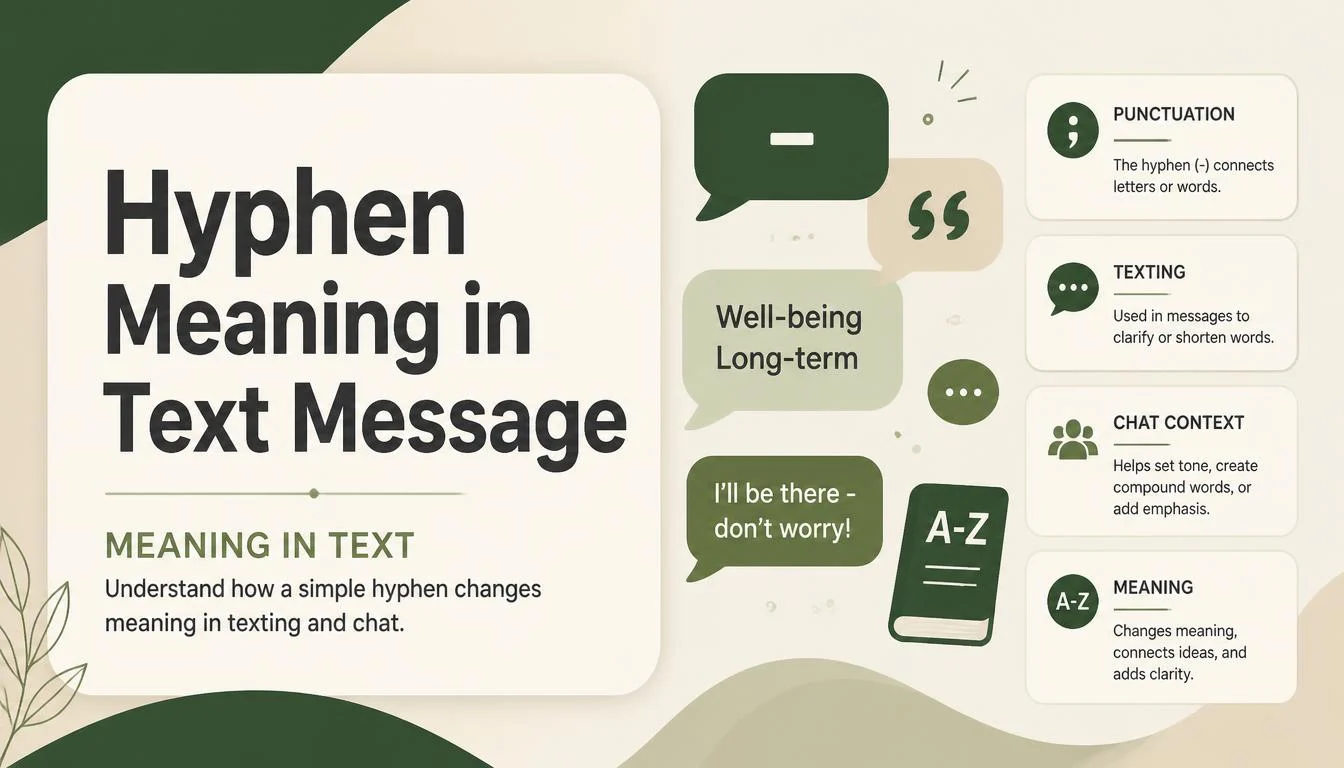
The – meaning in text message depends on how the symbol is being used. It can connect words, separate information, indicate a range, represent a pause, or simply act as a casual punctuation mark. In some messages, a single hyphen can also look like a short response or an unfinished thought. The surrounding text is the best clue.
The hyphen meaning in text message conversations can vary depending on how the symbol is used. A hyphen is usually a punctuation mark, but in texting it can also affect the tone, structure, or meaning of a message.
Understanding how hyphens work in texts can help you interpret messages more accurately. From connecting words to separating thoughts, the meaning often depends on the sentence and the way the sender uses the symbol.
What Does “-” Mean in Texting?
The character “-” is formally called a hyphen. However, people often use the same keyboard character in places where a dash would traditionally be more appropriate.
That happens because most phones make the hyphen easy to access. Many people do not stop to distinguish between a hyphen, en dash, and em dash when typing a quick message.
For example, someone might write:
“I’m free 3-5 today.”
Here, the symbol shows a range.
Someone else might write:
“Wait – what?”
In this case, the character creates a pause before the question.
Another person might use it like this:
“Meeting – 2 PM – Room 4”
Here, it separates pieces of information.
So the character itself does not automatically carry one emotional or conversational meaning. Its function comes from its position and the words around it.
Why Do People Use a Hyphen in Text Messages?
There are several common reasons.
1. To Connect Words
The traditional purpose of a hyphen is to join certain words or parts of words.
Examples include:
- well-known
- part-time
- self-care
- user-friendly
- twenty-one
In a text message, someone might write:
“She found a part-time job.”
The symbol simply connects the parts of the expression.
2. To Show a Range
A hyphen is frequently used informally to show a range of numbers, dates, or times.
For example:
“I’ll be there 6-8.”
This usually means from 6 to 8.
You may also see:
“Pages 20-25”
or:
“The course runs Monday-Friday.”
In formal writing, a range is often represented with an en dash rather than a hyphen. In ordinary texting, however, most people simply use the keyboard hyphen.
3. To Create a Pause
People sometimes use a hyphen where they might use a dash in more formal writing.
For example:
“I was going to call – but I got busy.”
The symbol creates a small visual break. The writer may be signaling that the second part is an interruption, clarification, or change in thought.
This use is especially common in casual online communication because people tend to reproduce speech patterns through punctuation.
4. To Separate Information
A hyphen can also work as a simple separator.
For example:
“Dinner – 7 PM – Italian restaurant”
The writer is not necessarily following formal punctuation rules. They are using the character to make the information easier to scan.
This is common in quick messages, notes, group chats, and informal announcements.
5. To Replace a Missing Part
In some contexts, a hyphen can represent something that has been intentionally left blank.
For example:
“Name: -”
This could mean that no name was provided.
The same idea appears in forms, lists, notes, and informal records. The exact interpretation depends on what information is expected.
Hyphen vs. Dash in Text Messages
One of the biggest sources of confusion is that hyphen and dash are not technically the same punctuation mark.
The three characters most people encounter are the hyphen, en dash, and em dash.
| Symbol | Name | Common purpose |
|---|---|---|
- | Hyphen | Connects words and parts of words |
– | En dash | Shows ranges or relationships |
— | Em dash | Creates a strong break or interruption |
− | Minus sign | Used in mathematical subtraction |
On a phone, these distinctions are often ignored.
A person may type:
“10-12”
instead of using an en dash:
“10–12”
Likewise, someone may type:
“I thought you were coming – but okay.”
instead of using an em dash.
That does not necessarily mean the sender is using punctuation incorrectly in a casual conversation. It often reflects the limitations and habits of everyday keyboard typing.
What Does a Single “-” Mean in a Text?
A single hyphen can be harder to interpret because there is less context.
Suppose you ask:
“Are you coming?”
and receive:
“-”
There is no universal dictionary definition for that response.
The sender might be indicating hesitation, leaving the response blank, separating a thought, or simply sending the wrong character accidentally.
Context matters more here than punctuation rules.
For example, if someone regularly responds with very short messages, the symbol may simply be part of their personal texting style. If the person normally writes complete sentences and suddenly sends only “-”, asking for clarification may be the only reliable way to understand it.
What Does “-” Mean at the End of a Message?
The position of the symbol can change how it feels.
Consider:
“Okay -”
This may look like an unfinished thought.
Compare it with:
“Okay.”
The period gives the message a finished appearance. The hyphen can make it feel visually incomplete.
However, this does not establish a fixed emotional meaning. Some people use unusual punctuation without intending irritation, sadness, hesitation, or sarcasm.
Texting habits vary from person to person.
A person who frequently leaves sentences unfinished may use a trailing hyphen simply because that is how they type. Another person might use it to create suspense or indicate that more information is coming.
Can “-” Mean a Pause?
Yes, particularly in informal writing.
Consider:
“I wanted to tell you something – actually, never mind.”
The hyphen creates a break between the two thoughts.
A similar example is:
“That was a good idea – until it stopped working.”
Here, the symbol helps create a conversational rhythm.
In formal typography, an em dash would usually be more appropriate for this function:
“That was a good idea — until it stopped working.”
But casual text messages are not always typed according to formal punctuation standards.
Hyphen vs. Underscore in Texting
The hyphen is sometimes confused with the underscore because both appear on a keyboard.
They are different characters.
| Symbol | Name | Example |
|---|---|---|
- | Hyphen | well-known |
_ | Underscore | user_name |
The underscore is often used in usernames, file names, programming, and online identifiers.
The hyphen is much more common in ordinary written language.
For example:
“It was a well-known place.”
uses a hyphen.
Meanwhile:
“my_user_name”
uses underscores to separate words in an identifier.
Hyphen vs. Minus Sign
The hyphen can also be confused with the mathematical minus sign.
In everyday typing, people frequently use - for both.
For example:
“10-3 = 7”
The intended meaning is mathematical subtraction.
Technically, the minus sign has a different character:
“10 − 3 = 7”
The distinction usually matters more in mathematics, publishing, typography, and digital formatting than in casual texting.
How Context Changes the Meaning
A punctuation symbol rarely tells the whole story.
Compare these examples:
“6-8 PM”
This most likely represents a time range.
“Well-known actor”
Symbol joins words.
“I was going to ask – never mind.”
Creates a conversational break.
“Name -”
Could indicate missing information or an unfinished entry.
“-”
By itself, it has no reliable universal interpretation.
This is why reading the entire message is more useful than assigning a fixed emotional meaning to the character.
Examples of “-” in Real Texting Situations
Example 1: Showing a Time Range
Person A: What time should I come?
Person B: 5-6 PM
Here, the hyphen represents a range.
Example 2: Connecting a Compound Word
Person A: What kind of position is it?
Person B: It’s a part-time role.
The symbol connects part and time.
Example 3: Creating a Pause
Person A: Are you sure about this?
Person B: I think so – actually, let me check.
The hyphen creates a break before the speaker changes direction.
Example 4: Separating Details
Person A: Send me the details.
Person B: Friday – 4 PM – Conference Room B
The symbols divide the pieces of information.
Example 5: An Unclear Standalone Reply
Person A: Did you decide?
Person B: –
There is not enough information to assign one definite meaning. The sender may be hesitating, leaving the answer blank, or using the character as a stylistic response.
Does a Hyphen Mean Someone Is Angry?
Not necessarily.
A hyphen by itself is not a reliable sign of anger.
People sometimes interpret unusual punctuation emotionally because text messages do not include voice tone, facial expressions, or body language. A short response can therefore feel ambiguous.
For instance:
“Fine -”
might feel different from:
“Fine.”
to the person reading it.
Yet that difference comes from interpretation rather than a universal rule. The sender’s usual communication style and the surrounding conversation provide better evidence.
If the emotional meaning matters, asking what the person meant is more reliable than interpreting the punctuation alone.
Does “-” Mean Silence or No Response?
It can sometimes be used that way, especially in lists, forms, notes, or casual exchanges.
For example:
“Favorite color: -”
may mean no answer was given.
But a standalone hyphen in a conversation does not automatically mean silence.
Some people use a dash-like symbol as a placeholder. Others may have sent it accidentally. Still others may use it as part of their personal texting style.
The context determines the most reasonable interpretation.
When Should You Use a Hyphen in a Text?
For ordinary messages, use a hyphen when it makes the meaning clearer.
Good examples include:
“It’s a long-term project.”
“I’m available 2-4 PM.”
“She works part-time.”
If you are using the symbol simply to create a dramatic pause, an em dash may be typographically more precise:
“I thought I understood — but I was wrong.”
Still, casual texting does not require perfect typography. Clarity should come first.
Common Mistakes With “-” in Messages
One common mistake is assuming every use of the symbol has the same meaning.
It does not.
Another is confusing the hyphen with an em dash. They look similar in casual text, but they have different grammatical functions.
A third issue is reading emotional meaning into punctuation without considering the sender’s normal style.
For example, one person may write:
“Okay -”
without any negative intention.
Another person may use the same format to show that they are trailing off.
The characters are identical. The intended meaning can be completely different.
Hyphen, Dash, and Slash: A Quick Comparison
These symbols can all separate information, but they are not interchangeable in every situation.
| Symbol | Common use | Example |
|---|---|---|
Hyphen - | Joining words or informal ranges | part-time, 4-6 |
En dash – | Formal ranges or relationships | 4–6 PM |
Em dash — | Strong break in a sentence | I agreed — eventually |
Slash / | Alternatives or compact divisions | and/or, 2026/2027 |
In casual texting, people often substitute one symbol for another because speed matters more than typographic precision.
FAQs
Is “-” a slang abbreviation?
No. The character itself is punctuation rather than a standard slang abbreviation. Its meaning comes from how it is placed in the message.
What does two hyphens “–” mean?
Two hyphens may be used informally in place of an em dash. Some people also use them to create a stronger pause or separation. The intended meaning depends on the sentence.
What does “—” mean in texting?
Three hyphens do not have one universal texting definition. They may create a visual break, indicate an unfinished thought, or act as a separator.
Is a hyphen the same as a dash?
No. A hyphen joins words, while different types of dashes serve other purposes. Casual typing often blurs the distinction because the hyphen is easier to enter.
Can “-” mean “nothing”?
Sometimes it can act as a placeholder for missing information. A standalone hyphen in a personal message does not automatically mean “nothing,” though.
Should I reply if someone sends only “-”?
There is no standard response. If the meaning is unclear and the conversation matters, a simple question such as “What do you mean?” can prevent misunderstanding.
Conclusion
The symbol “-” is deceptively simple. In a text message, it can connect words, show a range, separate details, create a pause, or act as a placeholder.
There is no single emotional or slang definition that applies every time. The surrounding words, the position of the symbol, and the sender’s normal texting habits provide the strongest clues.
When a standalone hyphen seems confusing, context is usually more useful than the punctuation mark itself.