Quick Answer
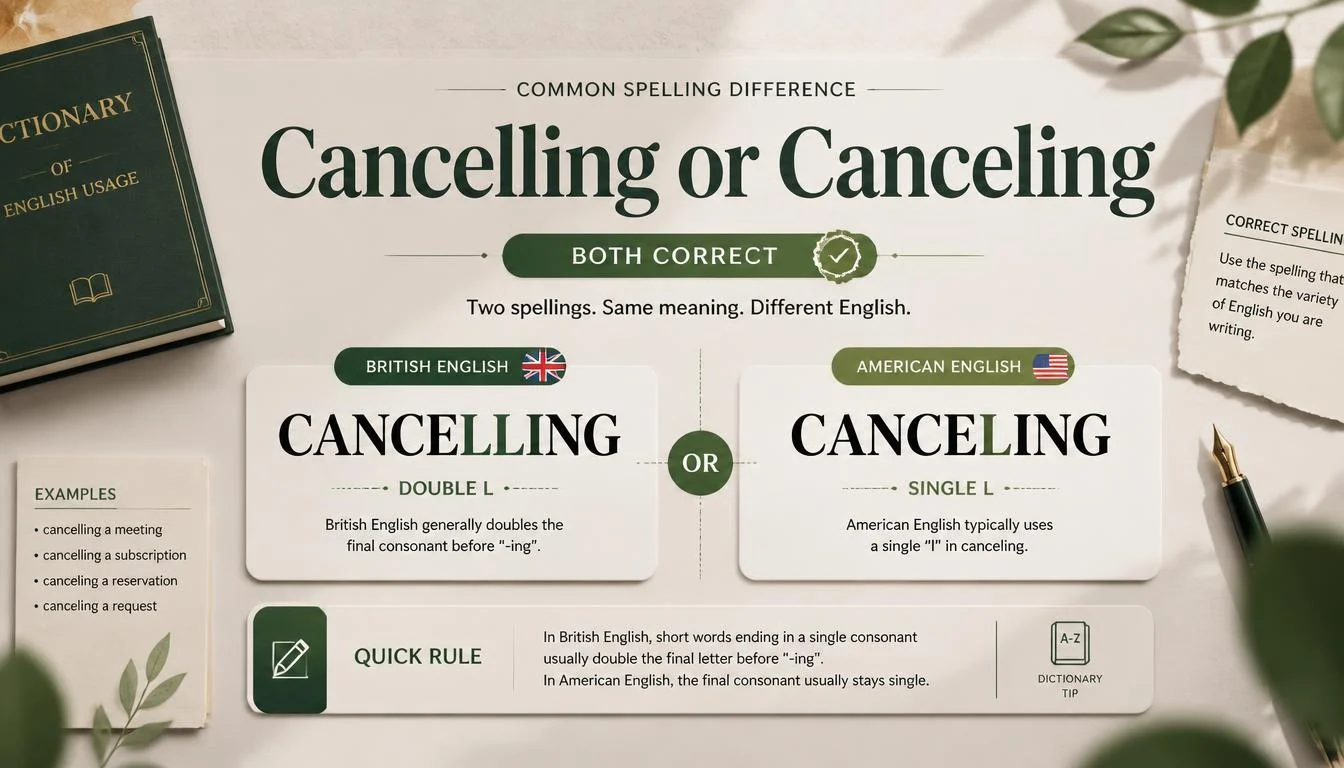
The difference between cancelling and canceling is purely regional. Canceling with one “l” is the standard spelling in American English, while cancelling with two “l’s” is preferred in British English and many other English-speaking countries. Both spellings are correct, and neither is a grammar error.
If you have ever paused while writing, unsure whether to type cancelling or canceling, you are not alone. This is one of the most common spelling questions in English. The confusion arises because both versions appear in published writing, and spell-checkers sometimes flag one as incorrect depending on your language settings.
The core of the issue is simple: both spellings represent the same word the present participle of the verb cancel. The difference is geographical, not grammatical. Canceling is the standard form in the United States, while cancelling is the standard form in the United Kingdom, Australia, Canada, and other Commonwealth countries.
This guide will explain exactly why this difference exists, show you how to choose the right spelling for your audience, and provide practical examples you can use in your own writing. By the end, you will never second-guess this spelling again.
What’s the Difference: Cancelling or Canceling?
The difference is simply a matter of spelling convention based on regional English variants. Both words are the present participle form of the verb cancel, meaning to call off, annul, or make something void.
| Aspect | Canceling (American) | Cancelling (British) |
|---|---|---|
| Spelling | One “l” | Two “l’s” |
| Primary Region | United States | United Kingdom, Australia, Canada, New Zealand |
| Part of Speech | Present participle / gerund | Present participle / gerund |
| Meaning | To call off or annul | To call off or annul |
| Common Context | Appointments, subscriptions, events, flights | Appointments, subscriptions, events, flights |
| Example | “I am canceling my appointment.” | “I am cancelling my appointment.” |
The takeaway: choose the spelling that matches your audience. If you are writing for an American audience, use canceling. If you are writing for a British or international audience, use cancelling. Consistency throughout your document is far more important than which spelling you choose.
Grammar and Usage: Is This a Grammar Issue?
This is not a grammar issue. It is a usage and spelling convention issue.
The verb cancel itself is the same in all varieties of English. The difference arises from how English spelling rules treat the final consonant when adding suffixes like -ing or *-ed*.
In American English, there is a general tendency to simplify spellings. When adding -ing to a verb with two syllables where the stress falls on the first syllable, Americans typically do not double the final consonant. So cancel becomes canceled and canceling.
In British English, the final consonant is more often doubled in these situations, even when the stress is on the first syllable. So cancel becomes cancelled and cancelling.
Both are correct within their respective systems. Neither is a grammatical error. Understanding this distinction helps you write appropriately for your intended audience.
The American Spelling: Canceling
Pronunciation: /ˈkænsəlɪŋ/ (KAN-suh-ling)
Part of Speech: Present participle of the verb cancel
Common Collocations:
- Canceling a subscription
- Canceling an appointment
- Canceling a flight
- Canceling a meeting
- Canceling a reservation
Typical Sentence Patterns:
- Subject + “am/is/are” + canceling + object
- Subject + “was/were” + canceling + object
Workplace Example: “The manager is canceling the team meeting because the client postponed their visit.”
Academic Example: “The professor is canceling Friday’s lecture due to illness.”
Technology Example: “I am canceling my streaming subscription before the free trial ends.”
Email Example: “I am canceling our lunch plans for tomorrow something urgent came up.”
Daily Conversation Example: “Are you really canceling on me again?”
Learner Mistake: Using “canceling” in a document intended for a British reader might appear inconsistent, though it would still be understood.
Mini Recap: Canceling with one “l” is the standard spelling in American English. It is used in all the same contexts as the British spelling.
The British Spelling: Cancelling
Pronunciation: /ˈkænsəlɪŋ/ (KAN-suh-ling) identical to the American pronunciation
Part of Speech: Present participle of the verb cancel
Common Collocations:
- Cancelling a subscription
- Cancelling an appointment
- Cancelling a flight
- Cancelling a meeting
- Cancelling a reservation
Typical Sentence Patterns:
- Subject + “am/is/are” + cancelling + object
- Subject + “was/were” + cancelling + object
Workplace Example: “The manager is cancelling the team meeting because the client postponed their visit.”
Academic Example: “The professor is cancelling Friday’s lecture due to illness.”
Technology Example: “I am cancelling my streaming subscription before the free trial ends.”
Email Example: “I am cancelling our lunch plans for tomorrow something urgent came up.”
Daily Conversation Example: “Are you really cancelling on me again?”
Learner Mistake: Many learners incorrectly assume one spelling is wrong. Neither is incorrect it is a matter of regional preference.
Mini Recap: Cancelling with two “l’s” is the standard spelling in British English and most English-speaking countries outside the United States.
When Not to Use Each Word
Here are common situations where writers mistakenly choose the wrong spelling.
1. Writing for an American Audience
Mistake: Using cancelling with two “l’s” in a document for American readers.
Why it happens: The writer learned British English or spent time in the UK.
Correct choice: Canceling
How to remember: American English tends to simplify one “l” is enough.
2. Writing for a British Audience
Mistake: Using canceling with one “l” in a document for British readers.
Why it happens: The writer is American or learned American English.
Correct choice: Cancelling
How to remember: British English preserves the double consonant pattern.
3. Mixing Spellings in One Document
Mistake: Using both canceling and cancelling in the same piece of writing.
Why it happens: Carelessness or using auto-correct in different settings.
Correct choice: Pick one spelling and use it consistently.
How to remember: Consistency looks professional. Pick your audience and stick to one variant.
4. Applying the Rule to “Cancellation”
Mistake: Writing cancelation with one “l.”
Why it happens: The writer assumes the same rule applies to the noun form.
Correct choice: Cancellation with two “l’s” is the standard spelling everywhere.
How to remember: The noun cancellation always has two “l’s,” regardless of your dialect.
Common Mistakes Table
| Correct Sentence | Incorrect Sentence | Explanation |
|---|---|---|
| “I am canceling my subscription.” (American) | “I am cancelling my subscription.” (American context) | Use one “l” in American writing. |
| “I am cancelling my subscription.” (British) | “I am canceling my subscription.” (British context) | Use two “l’s” in British writing. |
| “The cancellation was announced yesterday.” | “The cancelation was announced yesterday.” | The noun always has two “l’s.” |
Decision Box
- If you are writing for an American audience, use canceling with one “l.”
- If you are writing for a British, Australian, Canadian, or international audience, use cancelling with two “l’s.”
- If you are unsure about your audience, choose one spelling and remain consistent throughout your document.
Real-World Examples
Office Communication
“I am canceling the 3 PM status update. The project lead is out sick.” (American)
Business Email
“Please confirm that you are cancelling the order as discussed in our phone call.” (British)
University Setting
“The administration is canceling all evening classes due to the weather warning.” (American)
Customer Support
“We are cancelling your membership effective immediately, as per your request.” (British)
Technology
“Users are canceling their accounts at a higher rate this quarter.” (American)
Artificial Intelligence
“The AI is cancelling the scheduled update due to detected anomalies.” (British)
Daily Conversation
“I know you’re canceling on me, but I understand.” (American)
Canceling/Cancelling in Modern Technology
Modern technology has created more opportunities to use this verb than ever before. From streaming services to cloud storage, the ability to cancel subscriptions and digital services is part of daily life.
The rise of “cancel culture” has also introduced a new usage. The term refers to withdrawing support for public figures or companies due to objectionable behavior. This usage is spelled with the same regional differences as the traditional usage.
In software development, engineers might write “canceling” to describe stopping a process or operation. In AI development, models might be described as “cancelling” a planned action due to new data.
Word Origin
The word cancel comes from the Latin cancellare, meaning “to cross out.” This came from cancelli, which referred to the crossbars of a window or lattice. The original idea was of marking something with crossed lines to indicate it was void or invalid. The spelling differences emerged as English developed separate regional standards over centuries.
Expert Insight
As a language instructor, I often tell students that the most important thing is not which spelling you choose, but that you use it consistently. Whether you write canceling or cancelling, your reader will understand you. What creates confusion is switching between the two in the same document. Choose your audience, choose your spelling, and commit to it.
Error Prevention Checklist
- ✅ Always use canceling when writing for American readers.
- ✅ Always use cancelling when writing for British or Commonwealth readers.
- ✅ Always use cancellation with two “l’s” never cancelation.
- ✅ Never confuse them by mixing spellings in the same document.
- Quick memory tip: American English likes to keep things short one “l” is enough. British English preserves the pattern double the “l.”
Related Grammar Confusions
Here are some other common spelling and usage questions worth learning:
- Traveling vs. Travelling: Same rule one “l” in American, two in British.
- Modeling vs. Modelling: Same pattern as canceling and cancelling.
- Marvelous vs. Marvellous: American spelling uses one “l,” British uses two.
- Enrollment vs. Enrolment: American uses double “l,” British uses single.
- Fulfill vs. Fulfil: American uses double “l,” British uses single.
- Counseling vs. Counselling: Same doubling pattern as canceling.
- Labeled vs. Labelled: Same rule applies.
- Canceled vs. Cancelled: The past tense follows the same pattern.
- Equaling vs. Equalling: Another example of the same rule.
- Jewelry vs. Jewellery: Different pattern but common source of confusion.
FAQs
Is “canceling” or “cancelling” correct?
Both are correct. Canceling is the standard American spelling, while cancelling is the standard British spelling. Which one you should use depends entirely on your audience.
Why do Americans spell “canceling” with one “l”?
American English tends to simplify spellings. When adding -ing to two-syllable verbs with stress on the first syllable, Americans generally do not double the final consonant. British English follows different rules that preserve the double consonant.
Can I use both “canceling” and “cancelling” in the same document?
You should not. Mixing spellings in the same document looks unprofessional and creates confusion. Choose one spelling based on your audience and apply it consistently.
Is “cancelation” a correct spelling?
Cancelation is technically accepted in American English but is extremely rare. The standard spelling for the noun is cancellation with two “l’s” in all varieties of English.
Which countries use the British spelling?
The United Kingdom, Australia, New Zealand, South Africa, India, and most other Commonwealth countries use the British spelling cancelling. Canada also predominantly follows British spelling conventions.
Does “cancel culture” use the same spelling rules?
Yes. The spelling rules apply to all uses of cancel as a verb. In American English, the cultural phenomenon is referred to as canceling; in British English, it is cancelling.
Conclusion
The distinction between cancelling and canceling is simple once you understand the regional differences. There is no right or wrong spelling only American and British conventions. The key is to know your audience and stay consistent.
If you are writing for an American reader, use canceling with one “l.” If you are writing for a British or international audience, use cancelling with two “l’s.” And remember, the noun cancellation always has two “l’s,” regardless of your dialect.
Next time you need to use this word, pause, think about who is reading, and choose accordingly. That simple habit will keep your writing polished and professional.
Read More Related Articles:
- Shiny or Shiney | Avoid This Simple Spelling Error in English In 2026
- Occasion or Ocassion | Common Mistake Explained with Real-Life Examples In 2026
- Cacoon or Cocoon | Simple Rule You’ll Never Forget In 2026

Caleb Dawson is a content writer at synoseek.com, where he works on simple, reader-focused articles across a range of everyday topics. His writing style is practical and grounded, aiming to present information in a clear and relatable way without unnecessary complexity.
2 thoughts on “Cancelling or Canceling | Quick Guide to the Right Choice In 2026”