Quick Answer
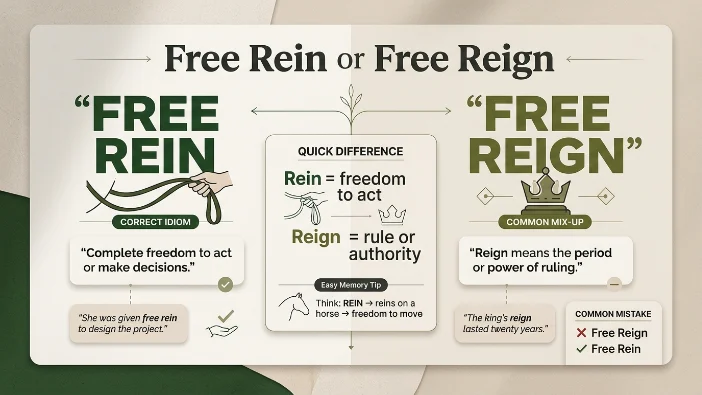
The correct phrase is free rein, not “free reign.” It comes from horseback riding, where loosening the reins lets a horse move freely. “Free reign” is a common misspelling based on confusion with royal power. Whenever you mean unrestricted freedom to act, choose free rein.
If you’re wondering whether the correct phrase is Free Rein or Free Reign, you’re not alone. These two words sound identical, but they have different meanings and uses. Understanding the difference can help you avoid a common spelling mistake in both casual and professional writing.
The correct expression is free rein, meaning complete freedom or unrestricted control to make decisions. Free reign is a common mistake caused by confusing rein, the strap used to control a horse, with reign, which refers to a period of ruling.
Why This Mix-Up Happens to So Many Writers
You’re drafting an email, and you want to tell your team they have complete freedom to run with a project. Your fingers pause. Is it “free rein” or “free reign”? Both look plausible. Both sound identical when spoken aloud. And honestly, both make a kind of intuitive sense once you think about it.
That’s exactly the problem. “Reign” belongs to kings, queens, and long historical eras of rule, so it feels like it should connect to power and freedom. Meanwhile, “rein” is the leather strap attached to a horse’s bridle, and most people today have never held one in their hands. When a word from everyday royal vocabulary competes with a word tied to an old-fashioned skill, the more familiar word usually wins the mental tug-of-war, even when it’s wrong.
This confusion isn’t a sign of poor grammar. It’s a sign that English recycles sound patterns in ways that trip up even careful writers. In this guide, you’ll learn exactly where the phrase came from, why “free reign” spread so widely despite being incorrect, and how to lock in the right choice permanently.
Free Rein: What’s the Difference?
The short answer: “free rein” is the only grammatically standard form of this expression, and “free reign” is a widespread but incorrect variant.
Rein refers to the long straps used to control a horse. When a rider gives a horse “free rein,” they loosen those straps, letting the animal move at its own pace and in its own direction. Over time, this literal action became a figurative expression for giving someone unrestricted freedom or authority.
Reign, on the other hand, refers to the period during which a monarch rules, or the act of ruling itself. You’d use it in sentences like “the reign of Queen Victoria” or “the company reigned over the market for a decade.” It has nothing to do with loosening controls; it’s about holding power.
| Meaning | Part of Speech | Refers To | Typical Usage | Example | Common Confusion |
|---|---|---|---|---|---|
| Rein | Noun | A strap controlling a horse | “Give free rein to” | She gave her team free rein on the redesign. | Confused with “reign” due to identical pronunciation |
| Reign | Noun/Verb | A monarch’s rule or period of power | “The reign of,” “to reign over” | The king’s reign lasted forty years. | Mistakenly paired with “free” instead of “rein” |
Here’s the short recap: only one of these words describes loosening restrictions, and it’s “rein.” “Reign” describes holding or exercising power, which is a completely different concept, even though the sound overlap makes them feel interchangeable. Once you separate the idea of “letting go of control” (rein) from “having control” (reign), the correct phrase becomes much easier to remember.
Is Free Rein a Grammar, Vocabulary, or Usage Issue?
This is fundamentally a vocabulary and usage issue rather than a grammar rule in the traditional sense. Both “rein” and “reign” are nouns, both are spelled and pronounced almost identically as homophones, and both can technically appear near the word “free” in a sentence. The problem is that only one combination is an established idiom recognized by dictionaries and style guides.
“Free rein” and “free reign” are not interchangeable, even in casual writing. Style authorities like Merriam-Webster and the Cambridge Dictionary list “free rein” as the standard idiomatic phrase, tracing it directly to horsemanship. “Free reign,” despite appearing frequently online and in casual speech, is treated as a usage error rather than an accepted variant.
In formal English, business writing, and academic work, “free rein” is the only acceptable choice. In everyday conversation, people say “free reign” so often that listeners rarely notice, but writing is unforgiving. Readers who know the correct form will notice the error immediately, and it can quietly undermine your credibility in professional documents, reports, or published content.
Practical takeaway: treat this like a spelling rule, not a flexible style choice. There is no context, formal or informal, where “free reign” is the recommended form.
Understanding Rein
Meaning: A rein is a long strap, usually made of leather, attached to a horse’s bridle and used by a rider to control direction and speed. In its figurative sense, “rein” represents restraint or control, and “giving rein” means loosening that restraint.
Part of Speech: Noun (also used as a verb, as in “to rein in spending”).
Common Collocations: free rein, tight rein, rein in, hold the reins, give rein to, keep a rein on.
Typical Sentence Patterns: “Give [someone] free rein to [do something],” “keep a tight rein on [something],” “rein in [an impulse or budget].”
Here’s how it shows up across different everyday situations:
Workplace example: The creative director told the design team she’d give them free rein on the new campaign, trusting their instincts over her own preferences.
Academic example: The professor gave students free rein to choose their own research topics, as long as they connected back to the semester’s core theme.
Technology example: The startup’s engineering lead gave the developers free rein to select whatever framework fit the project best, rather than mandating a single tech stack.
Email example: “Feel free to take creative rein on the presentation slides. I trust your judgment completely.”
Daily conversation example: “My parents used to give me free rein over what I wore to school, as long as it wasn’t inappropriate.”
One learner mistake: Non-native speakers frequently write “she gave him free reign to make decisions,” swapping in the royal spelling because it feels more natural to associate freedom with power rather than horse tack.
Mini recap: Rein equals control that can be loosened. Free rein equals loosened control, or full freedom to act without interference.
Understanding Reign
Meaning: Reign refers to the period during which a king, queen, or other monarch holds power, or more broadly, to a period when someone or something dominates a field or situation.
Part of Speech: Noun and verb (“the queen’s reign,” “the company reigns over its competitors”).
Common Collocations: reign of terror, reign supreme, long reign, during her reign, reign over.
Typical Sentence Patterns: “During the reign of [ruler],” “[something] reigned supreme,” “[someone] reigned over [a period or domain].”
Workplace example: During her reign as CEO, the company tripled its revenue and expanded into three new markets.
Academic example: Historians often debate whether the reign of Henry VIII should be remembered more for religious reform or political turmoil.
Technology example: For nearly a decade, one search engine reigned over the online advertising industry with almost no serious competition.
Email example: “Congratulations on your five-year reign as team lead. The department has grown enormously under your direction.”
Daily conversation example: “That team reigned as champions for three straight seasons before finally losing.”
One learner mistake: Writers sometimes use “reign” when they actually mean “rein,” particularly in phrases like “reign in your spending,” when the correct form is “rein in your spending,” since you’re pulling back control, not exercising royal power.
Mini recap: Reign equals holding or exercising authority over time. It never means loosening control, which is why it doesn’t belong in the phrase “free rein.
When Not to Use Each Word
Mistake 1: Writing “free reign” instead of “free rein.” This happens because “reign” feels thematically connected to power and freedom. Remember that the phrase originates from horse riding, not monarchy, so “rein” is always correct here.
Mistake 2: Writing “rein in” as “reign in.” Since “rein in” means to restrain or control something, like spending or emotions, it uses the same horse-related “rein,” not “reign.” Picture pulling back on the reins of a horse to slow it down.
Mistake 3: Using “reign” for a temporary burst of control. Reign implies an extended period of authority, like years or decades. If you’re describing a brief moment of dominance, “reign” can still work, but it shouldn’t be confused with the act of restraining something, which always uses “rein.”
Mistake 4: Confusing “rein” with “reins” in idiomatic phrases. “Take the reins” is plural and refers to grabbing control, while “free rein” is singular and refers to releasing control. Mixing up the number doesn’t change spelling, but it does show a shaky grasp of the underlying metaphor.
Mistake 5: Assuming “reign supreme” and “free rein” share a root. They don’t. “Reign supreme” is about dominant, unchallenged power, while “free rein” is about permission and freedom of action. Keeping their meanings distinct will help you keep their spellings distinct too.
Mistake 6: Using “reign” for products, tools, or software that give users flexibility. For example, writing “our new app gives you reign over your data” is incorrect. Since the meaning here is about freedom to control something, not sovereign rule, “free rein” or simply “control” fits better.
Mistake 7: Overcorrecting and avoiding “reign” altogether. Some writers, once they learn about this mix-up, start avoiding “reign” even in contexts where it’s the correct word, like describing a monarch’s rule. Reign is still the right word for describing periods of governance or dominance; it’s only wrong when paired with “free” to mean loosened restriction.
Mistake 8: Trusting autocorrect or spell check. Since both words are spelled correctly on their own, most spell checkers won’t flag “free reign” as an error. This is purely a usage mistake, and only careful proofreading or a grammar-specific tool will catch it.
Common Mistakes Table
| Correct Sentence | Incorrect Sentence | Explanation |
|---|---|---|
| The manager gave the intern free rein over the social media account. | The manager gave the intern free reign over the social media account. | “Free rein” refers to loosened control, not royal power. |
| She learned to rein in her temper during stressful meetings. | She learned to reign in her temper during stressful meetings. | Rein in” means to restrain, using the horse-related spelling. |
| During his reign, the empire expanded across three continents. | During his rein, the empire expanded across three continents. | This sentence is about ruling power, so “reign” is correct here. |
| The coach gave the players free rein to design their own drills. | The coach gave the players free reign to design their own drills. | Coaching freedom uses the same “loosened control” meaning as horse riding. |
| The champion reigned supreme for six consecutive seasons. | The champion reined supreme for six consecutive seasons. | “Reign supreme” describes dominance, not restraint, so “reign” is correct. |
Quick Decision Box
- If you mean giving someone unrestricted freedom to act, use free rein.
- If you mean a monarch’s period of rule, or a period of dominance, use reign.
- If you mean pulling back or restraining something, use rein in, never “reign in.”
Free Rein and Reign in Real-World Situations
Office communication: A manager might tell a new hire, “You’ll have free rein on how you organize your workflow, as long as deadlines are met.” This signals trust without micromanagement.
Business email: “We’re giving your department free rein to redesign the onboarding process this quarter. Let us know what resources you need.”
School or university: A thesis advisor might say, “I’m giving you free rein to choose your case studies, but the methodology section still needs my approval.”
Customer support: A support lead might explain to agents, “You have free rein to offer discounts up to fifteen percent without escalating to a supervisor.
Technology: A product manager might note, “The design team was given free rein to experiment with the new interface before user testing began.”
Artificial intelligence: Developers sometimes describe giving an AI model free rein within certain guardrails, meaning the system can generate varied responses as long as it stays within safety boundaries.
Daily conversation: “My grandmother gave us free rein in the kitchen every Sunday, which explains why our recipes turned out so experimental.”
Free Rein in Modern Technology
In artificial intelligence and software development, “free rein” appears constantly, usually describing the balance between automation and human oversight. A developer might say a machine learning model was given free rein to adjust its own parameters during training, within limits set by the engineering team.
Virtual assistants and voice assistants operate under the opposite principle much of the time. Rather than free rein, they’re typically built with constrained rein, meaning their responses are guided by strict rules to prevent unpredictable behavior. When a company wants a chatbot to sound more natural and less scripted, engineers might loosen these constraints, effectively giving the system more free rein over how it phrases responses.
Business software often uses similar language. A workflow tool might advertise that it gives teams “free rein to customize dashboards,” meaning users aren’t locked into a single rigid layout. In every one of these cases, the underlying idea, freedom within a system, ties directly back to the original image of loosened reins on a horse, not to any notion of royal authority.
Where the Phrase Comes From
The word “rein” traces back to Old French “rene,” related to the Latin “retinere,” meaning “to hold back.” Horseback riders have used reins for control since antiquity, and the phrase “give free rein” appeared in English by the 1800s as a figurative extension of loosening a horse’s reins to let it run.
“Reign,” by contrast, comes from Old French “regne” and Latin “regnum,” meaning kingdom or royal power. Despite sharing similar Latin ancestry through related root families, the two words developed along separate paths, one tied to physical control of animals, the other tied to political sovereignty. Their identical modern pronunciation is coincidental rather than meaningful, which is exactly why the confusion persists.
Expert Insight
When I teach this distinction to students, I ask them to physically picture the action behind each word. Reins are something you hold in your hands; loosening them is a small, tangible gesture. A reign is something abstract, spanning years or centuries, tied to thrones and history books rather than physical objects. If you can picture a rider’s hands relaxing their grip, you’re picturing the correct phrase. If you’re picturing a crown, you’ve drifted into the wrong word entirely. This kind of mental image sticks far longer than memorizing spelling rules.
Error Prevention Checklist
- Always use free rein when describing unrestricted freedom or permission to act.
- Always use reign when describing a monarch’s rule or a sustained period of dominance.
- Never confuse them when the sentence involves restraint, control, or loosening restrictions, since that always calls for “rein.”
- Quick memory tip: reins are for riding, reigns are for ruling. If freedom is being given, think horses, not crowns.
Related Grammar Confusions Worth Learning
- Reign vs. Rain vs. Rein: All three are homophones, and mixing up “rain” (weather) adds a third layer of confusion worth mastering.
- Complement vs. Compliment: Another classic mix-up where similar sounds lead to opposite meanings.
- Affect vs. Effect: One of the most searched grammar confusions, involving a verb and a noun that sound alike.
- Discreet vs. Discrete: Subtle spelling differences that completely change meaning.
- Its vs. It’s: A tiny apostrophe that trips up even experienced writers.
- Peak vs. Peek vs. Pique: Three homophones with entirely different uses and origins.
- Reign Supreme vs. Reign Supremely: A related idiom question that often confuses learners of English idioms.
- Bridle vs. Bridal: Another horse-related term that gets mixed up with an unrelated word about weddings.
- Loose vs. Lose: A frequent spelling confusion that, like this one, isn’t caught by spell checkers.
- Taut vs. Taught: Homophones that show up in similarly unexpected professional contexts.
FAQs
Is “free reign” ever correct in any context?
No. “Free reign” is not the standard expression when you mean complete freedom to act or make decisions. The correct phrase is “free rein.” Although reign is a legitimate English word, it has a different meaning related to ruling or exercising authority.
Why do so many people write “free reign” instead of “free rein”?
The confusion comes from pronunciation and familiarity. “Reign” is a more familiar word because it’s associated with kings, queens, and ruling, while rein is connected to horseback riding. Since the two words sound alike, it’s easy to choose the wrong spelling.
Does “rein in” always relate to horses?
Not literally. “Rein in” is now commonly used figuratively to mean control, limit, or restrain something. For example, you might say, “We need to rein in our spending.” The expression comes from the use of reins to control a horse.
Can “reign” ever mean freedom?
No. “Reign” refers to ruling, governing, or the period during which someone holds power. It does not mean freedom or permission. When you’re describing unrestricted control or freedom to act, “rein” is the correct word.
How can I remember the difference permanently?
Think of a horse and rider. When you loosen the reins, the horse has more freedom to move, giving you “free rein.” By contrast, a reign belongs to a ruler, such as a king or queen. This simple image can help keep the two words separate.
Is this mistake common even among native English speakers?
Yes. “Free reign” is a common mix-up because free, rein, and reign are familiar words, and rein and reign sound identical. Spell-checkers may not catch the mistake because both words are correctly spelled individually, so context and proofreading are important.
Conclusion
The difference between “free rein” and “free reign” comes down to a single, memorable image: a rider loosening the straps that control a horse, not a monarch sitting on a throne. Only “free rein” carries this meaning of granted freedom, and it’s the version recognized across every major dictionary and style guide.
Next time you’re about to type this phrase, picture the reins in your hands, not a crown on your head. If you’re describing freedom, permission, or loosened control, “free rein” is always the correct choice, no exceptions.