Quick Answer
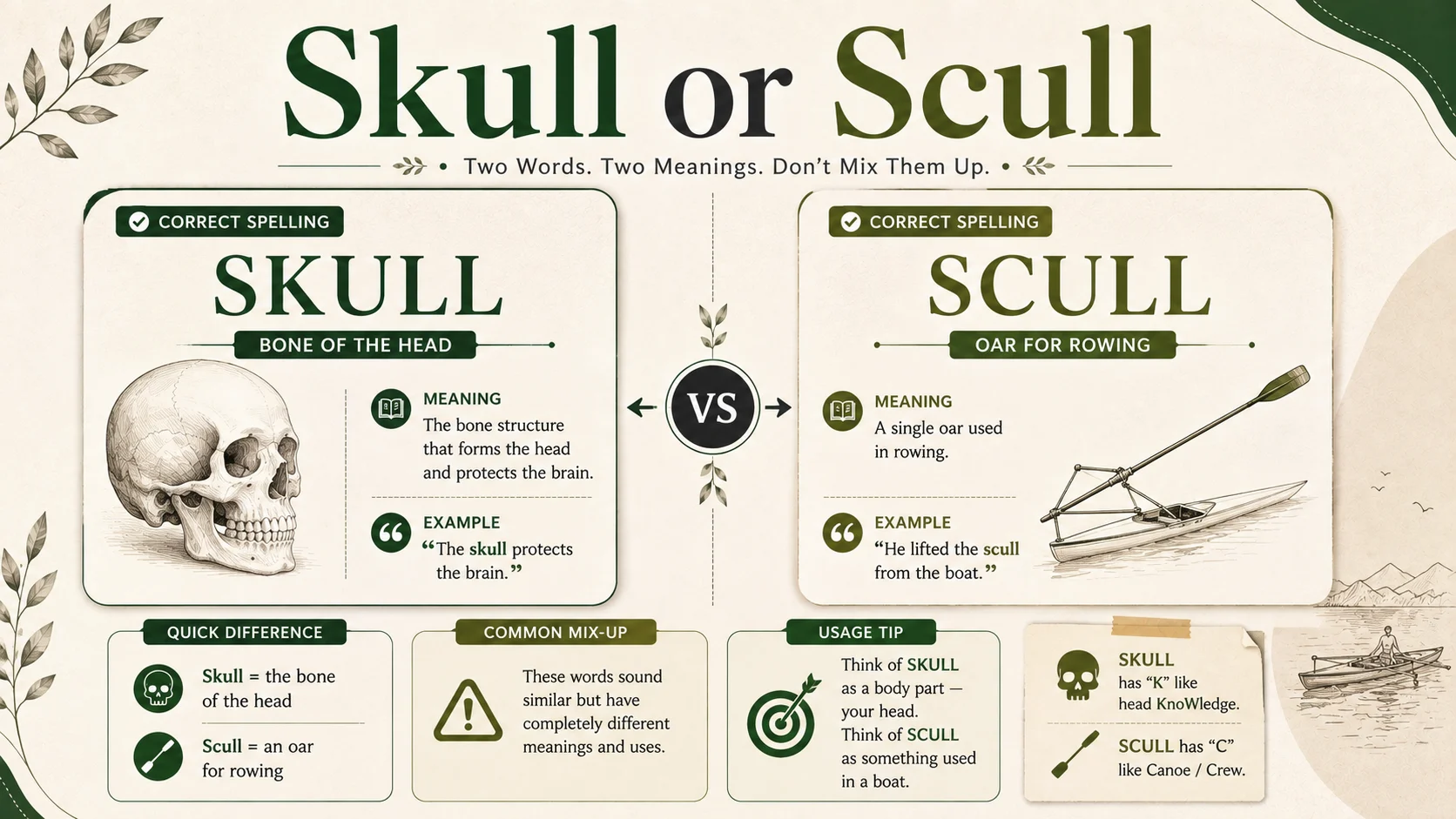
The words “skull” and “scull” sound identical but have completely different meanings. A skull is the bony structure that forms the head and protects the brain. A scull is either a type of small, narrow rowing boat or the oar used to propel it. Choose “skull” for anatomy and “scull” for boating.
Picture this: You’re writing a research paper about human anatomy, and you type “the scull protects the brain.” Your professor immediately circles the error. It’s a small mistake just one letter difference but it changes your sentence from scientific accuracy to a completely nonsensical statement about rowing equipment. This is the kind of confusion that can undermine your professional credibility in a single word.
The skull versus scull mix-up is one of those tricky homophone pairs that trips up even experienced writers. They sound exactly the same when spoken, but their meanings couldn’t be more different. Whether you’re a student working on a biology paper, a business professional drafting a report, or just someone who wants to communicate more clearly, understanding this distinction matters more than you might think.
In this guide, we’ll break down everything you need to know about skull and scull their meanings, proper usage, common mistakes, and practical tips to ensure you never confuse them again.
What’s the Difference Between Skull and Scull?
The difference comes down to anatomy versus aquatic activity.
Skull refers to the bony framework of the head that houses and protects the brain. It’s a fundamental term in anatomy, biology, medicine, and everyday language. When you talk about “the human skull” or “a skull fracture,” you’re discussing this essential part of the skeletal system.
Scull, on the other hand, has two related meanings in the world of boating. It can refer to a lightweight, narrow racing boat propelled by oars, or it can mean the oar itself used in that type of boating. When someone says “I row a scull” or “pass me the scull,” they’re talking about watercraft, not craniums.
| Aspect | Skull | Scull |
|---|---|---|
| Meaning | Bony structure of the head | Small racing boat or its oar |
| Part of Speech | Noun | Noun or verb |
| Refers To | Anatomy, biology, medicine | Rowing, boating, water sports |
| Typical Usage | “The skull protects the brain” | “She rows a single scull” |
| Example | “Archaeologists found an ancient skull” | “The scull glided across the lake” |
| Common Confusion | Often misspelled as “scull” | Often confused with “skull” |
Here’s the key takeaway: If you’re talking about heads, bones, or brains, use skull. If you’re talking about boats, oars, or rowing, use scull. They’re not interchangeable, and using the wrong one creates confusion that ranges from amusing to professionally embarrassing.
Is This a Grammar, Vocabulary, or Usage Issue?
This particular confusion straddles several linguistic categories, which is part of what makes it so tricky for learners and even native speakers.
Grammar classification: Technically, both words function primarily as nouns. Skull” is almost always a noun (though you might occasionally hear “to skull” as a rare verb meaning to hit someone on the head). “Scull” can be both a noun (the boat or oar) and a verb (the act of propelling a boat with oars). The grammar is straightforward the confusion isn’t about how to use them in sentences but which one to choose.
Vocabulary difference: This is where the real distinction lies. These are completely different vocabulary items with unrelated meanings. They’re not synonyms, they’re not related, and they don’t share any semantic connection whatsoever. The only thing they have in common is their pronunciation.
Usage difference: The usage context is your guide here. Skull appears in medical, scientific, forensic, and everyday contexts. You’ll encounter it in biology textbooks, hospital reports, crime shows, and Halloween decorations. Scull belongs to the specialized vocabulary of rowing, boating, and competitive water sports. Unless you’re discussing aquatic activities, you probably won’t need it.
Are they interchangeable? Absolutely not. Using “scull” when you mean “skull” creates a confusing or comical error. Imagine reading “The archaeologist discovered a prehistoric scull” and wondering why ancient people had boats buried with them.
In different English contexts: Both words maintain their meanings across formal English, business English, academic writing, and everyday conversation. The distinction doesn’t change based on register or formality.
Practical takeaway: Remember that these words share only their sound. Their meanings, usage contexts, and even their grammatical flexibility are entirely different. When in doubt, think about whether you’re discussing anatomy or aquatic activity.
Understanding the Skull
Meaning and Definition
The skull is the bony structure that forms the head in vertebrates. It consists of the cranium (which encloses and protects the brain) and the facial bones. In humans, the skull contains 22 bones (not counting the tiny ear bones) and serves several crucial functions: protecting the brain, supporting the facial structures, and providing attachment points for muscles that control chewing and head movement.
Pronunciation
Skull is pronounced /skʌl/ it rhymes with “dull” and “null.” The “sk” sound is hard, and the “ull” is short and crisp.
Part of Speech
Primarily a noun, though rarely used as a verb in informal contexts.
Common Collocations with Skull
- Fractured skull – “The patient arrived with a fractured skull.”
- Human skull – “The museum displayed a replica of a human skull.”
- Skull cap – “The thin bone at the top of the skull.”
- Skull fracture – “A severe blow can cause a skull fracture.”
- Skull base – “The tumor was located at the skull base.”
- Thick skull – An idiom meaning someone is stubborn or slow to understand.
Typical Sentence Patterns
Basic: The skull protects the brain from injury.
With descriptors: The ancient skull showed evidence of tool marks.
In scientific context: Researchers examined the skull structure to determine the species.
Idiomatic: You’ll never convince him he has a thick skull.
Natural Workplace Example
“The autopsy report noted no signs of skull trauma, suggesting the cause of death wasn’t blunt force injury.”
Academic Example
“The human skull consists of eight cranial bones and fourteen facial bones, forming a complex protective structure that has evolved over millions of years.”
Technology Example
“The MRI scan revealed no abnormalities in the skull or brain tissue, confirming the patient’s recovery.”
Email Example
“Dr. Chen, I’ve attached the X-rays showing the skull fracture. Please review and let me know your surgical recommendations.”
Daily Conversation Example
“That fall looked nasty are you sure you didn’t crack your skull?”
One Learner Mistake
Incorrect: “My grandmother says I have a thick scull.”
Correct: “My grandmother says I have a thick skull.”
Why it happens: Learners who hear the word before seeing it written may guess the spelling. Since “scull” is less common, they might default to that spelling, especially if they’ve encountered it in reading.
Mini Recap: Use skull for anything related to the head, brain, bones, or anatomy. If you can point to your head and mean the bone structure underneath, you’re talking about the skull.
Understanding the Scull
Meaning and Definition
Scull refers to either a type of boat or the oar used to propel it. In rowing, a scull is a narrow, lightweight boat designed for racing or recreational rowing. Single sculls carry one rower, double sculls carry two, and quad sculls carry four. The term also applies to the oar itself specifically, a shorter oar used in sculling (as opposed to the larger oars used in sweep rowing). As a verb, “to scull” means to propel a boat using sculling oars, one in each hand.
Pronunciation
Scull is pronounced exactly the same as skull: /skʌl/. It rhymes with “dull” and “null.”
Part of Speech
Scull can be a noun (the boat or oar) or a verb (the action of rowing with sculls).
Common Collocations with Scull
- Single scull – “He competed in the single scull event.”
- Double scull – “The women’s double scull team won gold.”
- Sculling oar – “Each rower uses two sculling oars.”
- Scull race – “The scull race attracted competitors from six countries.”
- Practice scull – “She bought a used practice scull for training.”
- Scull smoothly – “He managed to scull smoothly despite the choppy water.”
Typical Sentence Patterns
As a noun: She bought a new scull for the upcoming regatta.
As a verb: He learned to scull during his summer at the lake.
With location: The scull glided silently across the still water.
In competitive context: The scull crossed the finish line first by a narrow margin.
Natural Workplace Example
“The rowing club has added two new sculls to its training fleet for next season’s competition.”
Academic Example
“Research on scull design has focused on reducing water resistance while maintaining stability in racing conditions.”
Technology Example
“The new fiberglass scull design incorporates hydrodynamic principles that reduce drag by twelve percent.”
Email Example
“Hi Mark, I’ve reserved the single scull for Saturday morning. Let me know if you need me to book the double too.
Daily Conversation Example
“I’d love to try sculling this weekend I’ve never been in a scull before.”
One Learner Mistake
Incorrect: “He fell out of the skull and into the river.”
Correct: “He fell out of the scull and into the river.”
Why it happens: Learners may not realize “scull” refers to watercraft, so they default to the more familiar word “skull.” This creates a comical but confusing image of someone falling out of a head.
Mini Recap: Use scull only in contexts involving rowing, boats, or oars. If you can’t imagine the scene taking place on water, you probably need “skull” instead.
When NOT to Use Each Word
When to Avoid Skull
1. In rowing contexts: Never use “skull” when talking about boats or oars. Saying “The team rowed a skull” makes no sense teams don’t row heads.
2. When discussing water sports: If the conversation involves competition on water, “scull” is your word. “Skull” has no place in this context.
3. In any aquatic sporting conversation: From Olympic rowing to weekend lake activities, “skull” will confuse people who know the sport.
4. When describing rowing equipment: The oars used in sculling are called sculls, not skulls.
5. In boating safety discussions: “Always wear a life vest in a scull” is clear. “Always wear a life vest in a skull” is baffling.
6. When learning about competitive rowing: Study the differences between sculling and sweep rowing in sculling, you use two sculls (oars), not two skulls.
When to Avoid Scull
1. In medical contexts: Doctors treat skull injuries, not scull injuries. A “scull fracture” would confuse medical professionals entirely.
2. In biological discussions: Evolution of the human skull is a scientific topic; evolution of the human scull would be a very different discussion.
3. When discussing anatomy: The skull protects the brain. The scull protects nothing but the rower sitting in it.
4. In forensic contexts: Anthropologists examine skulls for clues about ancient populations. They don’t examine sculls unless they’re investigating an odd boating accident.
5. In everyday conversation about injury: “He hit his head on the scull” suggests he bumped into a boat, not that he hurt his head.
6. In discussions about the head: Any time you mean the head structure, use “skull.”
Quick Memory Rules
- Skull starts with “K” as in “Kranium” (an alternate spelling that can help you remember it’s about the head)
- Scull starts with “C” as in “Canoe” (not a perfect match, but it helps connect it to water)
- Think of the letter “K” for “Knock” you can knock your skull, but you can’t knock a scull
- Scull has “C” for “Crew” you row a scull with a crew (or by yourself in a single scull)
Common Mistakes Table
| Correct Sentence | Incorrect Sentence | Explanation |
|---|---|---|
| The archaeologist found a human skull at the dig site. | The archaeologist found a human scull at the dig site. | Archaeologists study bones and burial sites, not rowing equipment. |
| She rows a single scull in the local regatta. | She rows a single skull in the local regatta. | You row boats, not bone structures. |
| The MRI showed no abnormalities in the skull. | The MRI showed no abnormalities in the scull. | MRI machines image internal anatomy, not boats. |
| He learned to scull during his summer in Oxford. | He learned to skull during his summer in Oxford. | “Skull” isn’t a verb meaning to row “scull” is. |
| The skull protects the brain from impact. | The scull protects the brain from impact. | A boat offers no protection for a brain. |
| Pass me the scull so we can start rowing. | Pass me the skull so we can start rowing. | That would be a very different (and morbid) request. |
| The museum’s skull collection includes several rare specimens. | The museum’s scull collection includes several rare specimens. | Museums collect bones, not boats (unless it’s a maritime museum). |
| The scull design has improved significantly over the years. | The skull design has improved significantly over the years. | Skull design hasn’t changed human evolution took care of that millennia ago. |
Decision Box
If you mean the bony structure of the head that contains the brain, use SKULL.
If you mean a small rowing boat, the oar used in that boat, or the action of rowing with such oars, use SCULL.
Quick test: Ask yourself, “Am I talking about something that belongs to a human body or something that belongs on water?” Body = skull. Water = scull.
Real-World Examples
Office Communication
“During the safety meeting, HR mentioned that the new hard hats provide better skull protection than the previous models.”
Note: Using “scull” here would suggest the hard hats protect boats, which makes no sense in an office safety context.
Business Email
“Subject: Rowing Competition. I’ve arranged for us to use the club’s double scull for Saturday’s charity race. Please confirm you’re available by noon.”
Note: This is clearly about watercraft, so “skull” would be incorrect.
School or University
“Professor Hendricks assigned a lab report on the skeletal system, specifically focusing on the structure of the human skull and its role in protecting the brain.”
Note: Academic writing about anatomy demands “skull.”
Customer Support
“I’m calling about a scratch on my scull. It arrived with a small crack in the hull, and I’d like to discuss a replacement.”
Note: The customer mentions a “hull,” confirming they’re talking about a boat so “scull” is correct.
Technology
“The new CT scanner provides detailed images of the skull, allowing doctors to detect micro-fractures that previous models missed.”
Note: Medical technology context calls for “skull.”
Artificial Intelligence
“The AI-powered diagnostic tool analyzes skull X-rays to identify potential fractures with 98% accuracy.”
Note: Even in AI contexts, “skull” is used for medical imaging.
Daily Conversation
“My grandfather used to scull on the Thames every morning before work. He said it kept him fit and sane for sixty years.”
Note: Describing a daily rowing routine requires “scull.”
Skull vs Scull in Modern Technology
As technology evolves, both words have found their way into specialized contexts. Understanding these applications helps reinforce their distinct meanings.
Artificial Intelligence and Medicine: In medical AI, “skull” appears frequently in discussions about diagnostic imaging, surgical planning, and injury detection. Machine learning models now analyze skull scans with remarkable accuracy, and AI-powered tools help surgeons plan craniofacial procedures. In these contexts, “scull” would be completely out of place.
Virtual Assistants and Voice Recognition: Here’s where things get interesting for language learners. Voice assistants like Siri or Alexa rely on context to distinguish homophones like “skull” and “scull.” If you say, “Show me images of skulls,” the software uses surrounding words to infer you mean bones, not boats. This demonstrates how even AI understands that one word belongs to anatomy and the other to aquatic sports.
Rowing Technology: For those who love water sports, “scull” appears in discussions about high-tech boat designs. Modern competitive sculls use advanced materials like carbon fiber and feature sophisticated hydrodynamic designs. Data analytics helps rowers optimize their technique, and “scull” remains the correct term throughout this technological discussion.
Software and Business Tools: Unless you’re working on rowing-related software, you’ll almost certainly need “skull” if either word appears. Medical record systems, forensic databases, and educational anatomy software all use “skull.” Rowing apps and competition management systems use “scull.”
Word Origin
Both words come from different linguistic roots, which explains their unrelated meanings despite identical pronunciation.
Skull traces back to Old Norse skalli, meaning “bald head” or “a head.” This Viking-era root gave English a word for the bone structure that has remained remarkably consistent in meaning for over a thousand years. The word entered Middle English as sculle before settling into its modern spelling. Interestingly, the original Norse term also gave us the English word “scale” (as in fish scales), because both refer to something that covers or protects.
Scull has a less certain origin, but it likely comes from Old French escule or escoule, which referred to a kind of vessel or bowl and its meaning expanded to include types of boats. Some etymologists also trace it to Middle Dutch schole, which meant a small boat or shell. The maritime connection has been consistent since the word entered English.
Understanding these distinct origins can help you remember that these words are unrelated. One comes from the cold north and heads; the other comes from the water and vessels.
Expert Insight
As a language instructor with over twenty years of experience, I’ve watched countless students struggle with homophones like ‘skull’ and ‘scull.’ Here’s what I tell them: the confusion almost always comes from hearing the word before seeing it written. If you learn these words primarily through spoken English, you’ll naturally spell them based on what you already know.
My most effective teaching method is to ask students to create mental images. When you picture a ‘scull,’ imagine it sitting on the water literally, a boat floating. The ‘c’ in scull looks a bit like the curve of a boat hull. When you picture a ‘skull,’ imagine a skeleton or a Halloween decoration dry, bony, firmly on land. The ‘k’ in skull looks like the sharp angles of bone structure.
When my students start to hesitate, I ask them a simple question: ‘Are we on water or on land?’ That single question resolves about ninety percent of their confusion in real-time. The rest comes from practice and exposure.
Remember, even native English speakers get tripped up by these words. You’re not alone in finding this confusing, and mastering the distinction demonstrates real language awareness.”
Error Prevention Checklist
- ☐ Always use “skull” when you mean the bone structure of the head. If it’s about brains, bones, or heads, it’s “skull.”
- ☐ Always use “scull” when you mean a small rowing boat, oar, or the action of sculling. If it’s about water, rowing, or boating, it’s “scull.”
- ☐ Never confuse them when writing about medicine, anatomy, or biology. In medical contexts, “skull” is the only correct choice.
- ☐ Never confuse them when writing about sports, recreation, or aquatic activities. In rowing contexts, “scull” is the only correct choice.
Quick memory tip: Skull = “K” for “head” (think “Kranium”), Scull = “C” for “Canoe” (think “water”).
Related Grammar Confusions
Understanding the distinction between skull and scull becomes easier when you recognize other common homophone pairs in English. These similarly confusing words follow the same pattern identical sounds but completely different meanings and practicing them helps reinforce your overall language awareness.
- Complement vs. Compliment – Learn when to use each in professional communication.
- Principal vs. Principle – Essential for business and academic writing.
- Stationary vs. Stationery – A common office confusion that’s worth mastering.
- Desert vs. Dessert – One refers to arid land, the other to sweet treats.
- Cite vs. Sight vs. Site – Three words that sound alike with different meanings.
- Faze vs. Phase – Distinguishing between emotional impact and stages.
- Piece vs. Peace – Two commonly confused words in everyday writing.
- Dual vs. Duel – Understanding the difference between two and a fight.
FAQs
Q: Is “skull” or “scull” the correct spelling for the bone in your head?
The correct spelling for the bone structure of the head is “skull.” “Scull” refers to a rowing boat or oar. If you’re talking about anatomy, always choose “skull.”
Q: Why do “skull” and “scull” sound the same if they mean different things?
They’re homophones words that share the same pronunciation but have different meanings and spellings. English has many homophone pairs, and distinguishing them requires learning the specific meanings and contexts for each word.
Q: Can “scull” be used as a verb?
Yes, “scull” functions as a verb meaning to propel a boat using sculling oars. For example: “She learned to scull while studying in England.” “Skull” is rarely used as a verb and has no connection to rowing.
Q: Is one word more common than the other?
“Skull” is significantly more common in everyday language, especially outside the rowing community. Unless you discuss water sports, you’ll encounter “scull” less frequently. This is part of why people often spell “scull” incorrectly they default to the more familiar word.
Q: How can I remember which spelling to use when I’m writing quickly?
Use the “water vs. head” test. Ask yourself whether your sentence is about a boat on water or a bone in a head. If you’re not discussing rowing, boating, or water sports, “skull” is almost certainly the right choice.
Q: What’s the most common mistake people make with these words?
The most common mistake is using “scull” when they mean “skull.” People do this because they’ve heard the word spoken but never seen it written. The error usually appears in non-expert writing about anatomy, where “scull fracture” or “scull shape” appears instead of “skull fracture” or “skull shape.”
Q: Do these words have different plural forms?
Both form plurals regularly: “skulls” and “sculls.” For example: “The museum has several ancient skulls” and “The boathouse stores all the sculls.”
Q: Are there any other meanings for these words?
Skull” can sometimes mean a person’s head informally, as in “He got hit in the skull.” “Scull” can also mean a type of small oar used for this sport. Both have relatively narrow meanings compared to words like “run” or “set.”
Conclusion
The difference between “skull” and “scull” might seem minor, but it’s a distinction that matters. One letter separates anatomy from aquatic activity, and using the wrong word in the wrong context can turn a serious statement into something confusing or even comical. Whether you’re writing a research paper, drafting a business email, or simply trying to communicate clearly, choosing the right word demonstrates attention to detail and command of the language.
Skull belongs to the human body, to medicine, to biology, and to any context involving the bone structure that protects the brain. Scull belongs to the water, to rowing, to sports, and to any context involving small boats or the oars that move them. They sound the same, but their worlds are entirely separate.
The practical rule to remember: If it’s in your head, it’s a skull. If it’s on the water, it’s a scull. Hold onto that simple distinction, and you’ll never confuse these words again.