Quick Answer
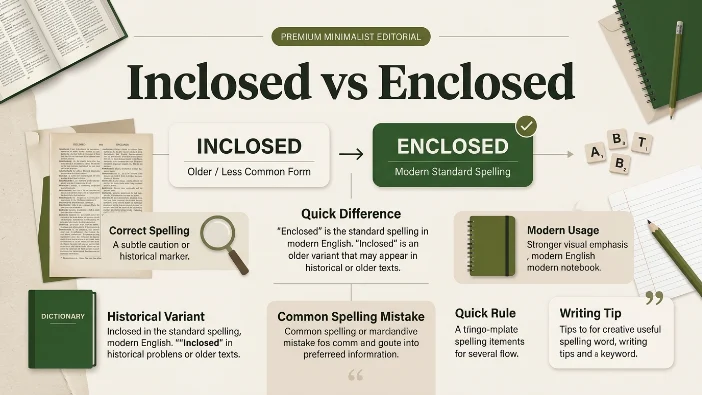
The difference between inclosed and enclosed is that inclosed is an archaic spelling that has largely fallen out of use, while enclosed is the modern standard spelling used in contemporary English for describing something surrounded, contained, or included within something else. Always use enclosed in modern writing.
You’re writing an important email or formal document, and suddenly you pause at a word that doesn’t look quite right. Is it “inclosed” or “enclosed”? You’ve seen both forms floating around, and now you’re second-guessing yourself. This uncertainty is more common than you might think, especially when encountering older texts or receiving feedback from different sources.
The confusion between inclosed and enclosed stems from the fascinating evolution of the English language. While both words have the same meaning, one is now considered obsolete, and the other is the correct modern spelling. The choice between them isn’t about grammar rules or context it’s about recognizing how language changes over time and adapting to contemporary standards.
In this guide, we’ll explore why these two spellings exist, when each was commonly used, and why understanding this distinction matters for clear, professional communication. By the end, you’ll never second-guess yourself again when reaching for this word in your writing.
What’s the Difference Between Inclosed and Enclosed?
Enclosed is the correct, standard spelling in modern English, while inclosed is an outdated variant that was common in the 17th through early 20th centuries. Both words mean the same thing: to surround, contain, or include something within something else.
Here’s a quick comparison:
| Feature | Enclosed | Inclosed |
|---|---|---|
| Meaning | Surrounded, contained, or included within something else | Same meaning as enclosed |
| Part of Speech | Adjective or verb (past tense of enclose) | Adjective or verb (past tense of inclose) |
| Modern Usage | Standard, widely used in all contexts | Obsolete, virtually unused |
| Formal Writing | Correct and preferred | Incorrect in modern writing |
| Example | “Please find the enclosed documents.” | “Please find the inclosed documents.” (dated) |
The difference isn’t one of meaning or grammar it’s purely a matter of spelling evolution. Think of it like “colour” versus “color”: both are correct in different regional contexts. However, inclosed has simply fallen out of use entirely, unlike regional spelling variations that remain active.
Understanding this distinction matters because using “inclosed” in modern writing can make you appear out of touch or unfamiliar with contemporary English standards. It’s a red flag in professional communication that signals your writing may be outdated or uninformed.
Is This a Grammar, Vocabulary, or Usage Issue?
The inclosed vs enclosed question falls primarily into the usage category, with elements of vocabulary and grammar intertwined.
From a grammar perspective, both words function identically. They can be used as verbs in the past tense (“He enclosed the letter”) or as adjectives modifying nouns (“the enclosed package”). The grammatical rules governing their use are identical, so the choice between them isn’t grammatical but historical.
As a vocabulary issue, enclosed is the active vocabulary item you need to know, while inclosed belongs to the category of obsolete words you might encounter in historical texts but should never use in modern writing. It’s similar to knowing that “thou” exists historically but using “you” in contemporary communication.
The usage dimension is where this distinction really matters. Using the correct spelling signals that you understand contemporary English conventions. It demonstrates attention to detail and professional awareness. In business, academic, and even casual writing, the choice between these spellings communicates something about your familiarity with modern English standards.
Are they interchangeable? In theory, yes they mean the same thing. In practice, absolutely not. Using “inclosed” in modern writing is as jarring as using “ye” instead of “the.” While technically understandable, it undermines your credibility.
Takeaway: The priority is using enclosed in all modern writing contexts, from formal business correspondence to casual emails, academic papers to creative writing.
A Closer Look at Enclosed
Let’s explore enclosed in depth, covering how it’s used in various contexts and why it became the standard spelling.
What Does Enclosed Mean?
Enclosed comes from the verb enclose, meaning to surround, close off, or contain something within a boundary. When something is enclosed, it’s physically surrounded by something else or included as an extra item within a larger container or document.
Part of Speech: Enclosed functions as both the past tense and past participle of the verb enclose and as an adjective meaning “surrounded or included.
Common Word Combinations (Collocations)
Enclosed appears frequently with these partners:
- Enclosed space a room or area that is closed off
- Enclosed documents papers included with a letter or email
- Enclosed forms application materials sent with correspondence
- Enclosed area a physically bounded space
- Enclosed property land that is fenced or walled
Sentence Patterns Using Enclosed
Physical enclosure:
“The garden was enclosed by a tall hedge.”
Including items in correspondence:
“Please find the requested documents enclosed with this letter.”
As an adjective:
“The enclosed check covers the first month’s rent.”
Examples of Enclosed in Different Contexts
Workplace email:
“Thank you for your interest in our open position. Please find enclosed a detailed job description and the application form.”
Academic writing:
“The experimental data are enclosed in Appendix B, supporting the conclusions drawn in the main text.”
Technology context:
“The software’s advanced features are enclosed within a user-friendly interface that simplifies navigation.”
Business letter:
“Enclosed is a copy of our updated catalog for your review.”
Daily conversation:
“I always feel nervous in enclosed spaces like elevators.”
One Common Learner Mistake
Many English learners mistakenly use “inclosed” because they’ve seen it in old dictionaries or historical texts and assume it’s a valid alternative. Others confuse the prefix “in-” with the modern spelling, assuming the spelling with “in” is the correct form since it means “inside.
Remember: The modern spelling is always enclosed, regardless of whether you’re talking about physical spaces or included documents.
Mini Recap
- Enclosed means surrounded, contained, or included
- It’s the standard modern spelling for all contexts
- Use it for physical spaces, included documents, and contained areas
- Always choose enclosed in professional and academic writing
A Closer Look at Inclosed
While inclosed is now considered obsolete, understanding its history helps explain why people still encounter it and why the spelling changed.
What Does Inclosed Mean?
Inclosed meant exactly the same thing as enclosed to surround, contain, or include. It was the standard spelling in English during the 1600s through the early 1900s. The word functioned identically as a verb and adjective, just with a different spelling.
Part of Speech: Like enclosed, inclosed functioned as both a verb form and an adjective.
Why Did Inclosed Fall Out of Use?
Spelling standardization in English wasn’t always as uniform as it is today. During the 19th century, as dictionaries became more widely available and education expanded, spelling conventions began to solidify. The enclosed spelling gradually became the preferred form for several reasons:
- Influence of French: The word comes from the Old French enclos, which used the “en-” prefix. English adopted the French-influenced spelling.
- Dictionary standardization: Major dictionaries like Webster’s and the Oxford English Dictionary established enclose and enclosed as the standard forms.
- Consistency with similar words: Other words with the same prefix, like encounter, encourage, and envelope, use “en-” rather than “in-,” making enclose more consistent.
Historical Examples of Inclosed
From 18th-century correspondence:
“Pleas find inclosed the sum of five pounds for the goods received.”
In a 19th-century legal document:
“The inclosed field shall remain the property of the grantor.”
In older dictionaries:
Inclosed appears as an alternate spelling in many 19th-century dictionaries, often listed alongside enclosed.
When You Might Still See Inclosed
You’re most likely to encounter inclosed in:
- Historical documents
- Older literature and poetry
- Colonial-era correspondence and records
- Antique letters and diaries
Why You Shouldn’t Use Inclosed Today
Using inclosed in modern writing creates several problems:
- It signals that you’re unaware of contemporary spelling standards
- It can confuse readers who may wonder if it’s a typo
- It appears unprofessional and outdated
- It suggests you haven’t kept up with language evolution
Mini Recap
- Inclosed is an obsolete spelling with the same meaning as enclosed
- It was common until the early 20th century
- You might encounter it in historical reading
- Never use it in modern writing
When Not to Use Each Word
Understanding when to avoid each spelling helps cement the correct choice in your writing.
Situations Where “Inclosed” Is Definitely Wrong
1. Modern professional communication
Using “inclosed” in business emails, memos, or letters immediately undermines your professionalism.
Wrong: “Please find inclosed the contract for your review.”
Correct: “Please find enclosed the contract for your review.”
2. Contemporary academic writing
In college papers, research articles, or dissertations, “inclosed” will be marked as an error.
Wrong: “The inclosed diagram illustrates the experimental apparatus.”
Correct: “The enclosed diagram illustrates the experimental apparatus.”
3. Digital communication
Email, website content, and social media require modern spelling conventions.
Wrong: “We have inclosed a gift card with your order.”
Correct: “We have enclosed a gift card with your order.”
4. Any writing intended for a general audience
Readers will assume you’ve made a spelling error rather than intentionally used an archaic form.
Why Writers Make This Mistake
The confusion often arises because:
- The word “in” suggests “inside,” leading some to assume “inclosed” is correct
- Writers have encountered the word in older texts or historical dictionaries
- Non-native speakers may encounter outdated examples and assume they’re current
- Autocorrect doesn’t always flag “inclosed” as incorrect
Common Mistakes and Their Corrections
| Correct Sentence | Incorrect Sentence | Explanation |
|---|---|---|
| “Please find enclosed my resume.” | “Please find inclosed my resume.” | Modern English uses enclosed in all correspondence |
| “The garden was enclosed by a stone wall.” | “The garden was inclosed by a stone wall.” | Physical enclosure also uses the modern spelling |
| “The check is enclosed with this letter.” | “The check is inclosed with this letter.” | Including items always uses enclosed |
| “Our community is an enclosed development.” | “Our community is an inclosed development.” | Describing bounded spaces uses the modern spelling |
| “We have enclosed all necessary documents.” | “We have inclosed all necessary documents.” | Past tense verb requires enclosed |
Quick Decision Guide
Always choose ENCLOSED in modern writing because:
- It’s the standard, accepted spelling
- It’s used in professional, academic, and casual contexts
- It demonstrates contemporary language awareness
- It prevents reader confusion or distraction
Never use INCLOSED because:
- It’s obsolete and outdated
- It marks you as unfamiliar with modern English
- It appears as an error to most readers
- It undermines your credibility
When in doubt, remember this memory trick: The modern spelling has an “e” at the beginning, just like “email” and both are used in contemporary communication.
Real-World Examples
Office Communication
Context: Administrative assistant sending a memo
“I am enclosing the new employee handbook with this interoffice memo. The enclosed policies take effect next month, so please distribute the enclosed materials to all team members.”
Business Email
Context: Client correspondence regarding contract details
“We’re pleased to enclose the revised terms for your review. The enclosed document supersedes all previous agreements. Please sign the enclosed copy and return it to us by Friday.”
Academic Setting
Context: Professor providing supplementary material
“The enclosed data set contains the complete survey results. Students should use the enclosed information to complete their analysis assignments. I’ve also enclosed the grading rubric for your reference.”
Customer Support
Context: Responding to customer inquiry
“We’ve enclosed a shipping label with this email for your return. The enclosed instructions explain how to prepare your package. Please find the enclosed return authorization number at the top of the form.”
Technology Context
Context: Software documentation
“The enclosed documentation covers all installation procedures. Users will find the enclosed troubleshooting guide helpful for resolving common issues. We’ve also enclosed a quick-start reference for immediate setup.”
Artificial Intelligence Context
Context: AI system configuration
“The enclosed dataset contains the training examples needed to improve the model’s performance. The enclosed parameters have been optimized for this specific use case, and the enclosed evaluation metrics demonstrate significant improvement.”
Inclosed and Enclosed in Modern Technology
In the digital age, enclosed appears in numerous technology contexts, from email attachments to AI system documentation.
Email and Digital Files:
The most common modern use of enclosed in technology is referencing attachments. While “please find attached” is more common in emails, “enclosed” appears in more formal correspondence and documentation.
Software Documentation:
Technical writers often use enclosed when referring to included files or supplementary materials: “The enclosed README file contains installation instructions.”
Artificial Intelligence and Machine Learning:
In AI contexts, enclosed often appears when describing data subsets, training sets, or contained environments: “The enclosed model parameters reflect the latest optimization run.”
Virtual Environments:
Enclosed describes spaces within digital environments: “The virtual training environment is enclosed within a secure simulation framework.”
Business Tools:
Document management systems and collaboration platforms use enclosed to describe shared files: “The enclosed document has been shared with all project stakeholders.”
Word Origin: The Story Behind Both Spellings
The journey from inclosed to enclosed tells a fascinating story about language evolution.
Roots in Old French:
Both words trace back to the Old French enclos, meaning “closed or shut in.” This came from the Latin includere, meaning “to shut in, enclose,” which combines *in-* (in) and claudere (to close). The French language favored the “en-” prefix, which English adopted.
Early English Usage:
In Middle English, spellings varied widely. You might find inclosen, enclosen, or inclose depending on the scribe and the period.
The Emergence of Standardization:
By the 17th century, both inclosed and enclosed existed side by side. Samuel Johnson’s 1755 dictionary listed inclose as the primary spelling, which influenced English usage for decades.
The Shift to Modern Spelling:
Through the 19th century, enclose gradually became the preferred form. Noah Webster’s American dictionary and the Oxford English Dictionary both promoted the enclosed spelling, and by the early 20th century, it had become the overwhelming standard.
Why Did English Choose “En-” Over “In-“?
The preference for “en-” reflected both the French influence on English vocabulary and the consistency pattern with other words: enclose joined encounter, encourage, envelope, and environment in using the “en-” prefix.
Expert Insight
As a language educator, I often tell my students that understanding why language changes is just as important as knowing the current rules. The shift from inclosed to enclosed perfectly illustrates how English spelling evolves through a combination of standardization, practical usage, and the influence of major publications and dictionaries.
What’s particularly fascinating is that both forms were correct for centuries. This wasn’t a right-or-wrong situation it was a gradual preference that eventually became a standard. When I work with students who’ve encountered older texts, I explain that language is living and constantly changing. Today’s “incorrect” spelling might have been perfectly acceptable in your great-grandparents’ day, just as today’s standard spelling might evolve further in the future.
For non-native speakers especially, I emphasize that being aware of historical variations helps you understand the language more deeply without getting caught up in outdated forms. The key is knowing which form belongs to which era and using the appropriate version for your context.
Error Prevention Checklist
Always Use “Enclosed” When:
- Writing any modern correspondence or document
- Referring to items included in an email or letter
- Describing physical spaces that are surrounded or contained
- Writing for professional, academic, or business contexts
- Creating content for general audiences
Always Use “Enclosed” Also For:
- Past tense verb usage (“The committee enclosed the forms”)
- Adjective usage (“The enclosed package arrived yesterday”)
- All noun forms (“The enclosure was installed last week”)
Never Use “Inclosed” If:
- You’re writing anything intended for a contemporary audience
- You want to maintain professional credibility
- You’re writing in English for academic or business purposes
- You’re creating content that will be read by modern readers
Quick Memory Tip
Remember: The modern spelling has an “e” at the beginning, just like “everyone” uses this spelling today.
Related Grammar Confusions
English has many historical spelling variations that confuse learners. Here are some closely related comparisons worth understanding:
- Enclose vs Inclose The same distinction we’ve covered
- Ensure vs Insure One means “make certain,” the other relates to insurance
- Envelop vs Envelope One is a verb (to surround), the other is a noun (a container for letters)
- Emigrate vs Immigrate Leaving one country versus entering another
- Eminent vs Imminent Distinguished versus about to happen
- Appraise vs Apprise Evaluate versus inform
- Compliment vs Complement Praise versus complete
- Principal vs Principle Head of a school or main idea versus a rule or belief
- Stationary vs Stationery Fixed in place versus writing materials
Each of these pairs can trip up even experienced writers, and understanding the distinctions will significantly improve your professional communication.
FAQs
Is “inclosed” a word in English?
Yes. Inclosed is a historical spelling of enclosed, but it is now considered obsolete or archaic. You may encounter it in older books, historical documents, legal records, or other texts from earlier periods.
Which is correct: inclosed or enclosed?
Enclosed is the standard spelling in modern English. Although inclosed was once used, it has fallen out of contemporary usage. For business, academic, and everyday writing, always choose enclosed.
Why do some people still use “inclosed”?
The spelling may appear in older books, dictionaries, or historical documents, which can lead readers to assume it is still a current alternative. It may also result from confusion about the prefix in-. In modern English, however, enclosed is the established form.
Is it “enclosed” or “inclosed” in a letter?
Use enclosed in modern correspondence. For example, you might write, “Please find enclosed the documents you requested.” Inclosed would sound outdated and may be mistaken for a spelling error.
When was “inclosed” commonly used?
Inclosed appeared regularly in older English, particularly from the 17th through the 19th centuries. The spelling gradually became less common as enclosed emerged as the modern standard.
Do “inclosed” and “enclosed” have different meanings?
No. Historically, the two forms carried essentially the same meaning: surrounded, contained, or included within something. The main difference today is usage and spelling history, not meaning.
Will people understand “inclosed” if I use it?
Most readers would probably understand it from context, but it may look archaic or simply like a spelling mistake. In professional or contemporary writing, enclosed is the clear and appropriate choice.
Is “inclosed” accepted as a modern regional spelling?
No. This is not a British versus American spelling difference. Inclosed is an obsolete form rather than a modern regional variant, while enclosed is the standard spelling across contemporary varieties of English.
Conclusion
The distinction between inclosed and enclosed isn’t about meaning, grammar, or context it’s about recognizing the living, evolving nature of the English language. Inclosed belongs to the past, a historical curiosity you might encounter when reading older texts or exploring language history. Enclosed is the modern standard, the clear choice for any writing you produce today.
When you choose enclosed in your writing, you’re not just following a rule you’re demonstrating awareness of contemporary English standards and respect for your readers. It’s a small choice that signals professionalism, attention to detail, and strong communication skills.
Remember this practical rule: If you’re writing in the twenty-first century, reach for enclosed. The historical form is fascinating to know about but never to use. Your readers and your credibility will thank you.
1 thought on “Inclosed vs Enclosed | Clear Guide to Choosing the Right Word In 2026”