Quick Answer
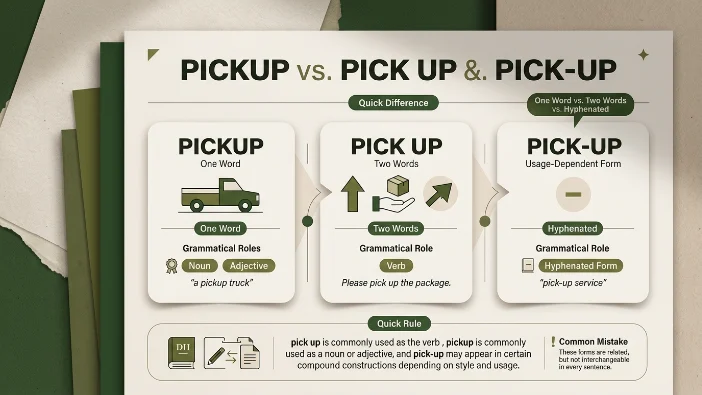
The difference is simple: pick up (two words) is a verb meaning to lift, collect, or acquire. Pickup (one word) is a noun referring to a truck or the act of collecting, or an adjective describing something informal. Pick-up (hyphenated) is a less common adjective or noun variant, primarily used in British English or as a compound modifier before a noun .
Let’s be honest: you’ve probably stared at your screen for a solid minute, trying to figure out if you need to “pick up” a package, schedule a “pickup,” or meet at a “pick-up” point. It’s one of those common English conundrums that can trip up even native speakers.
The confusion isn’t your fault. When you speak the words, they all sound identical. And the rule itself is straightforward one is an action, the other is a thing. But in practice, the choice between pickup, pick up, and pick-up can feel surprisingly tricky. It’s a minor spelling difference, but using the wrong form in a professional email or important document can make your writing look sloppy. By the end of this guide, you’ll never second-guess yourself again. We’ll move beyond the basic rule and arm you with practical examples and a fail-safe memory trick.
What’s the Difference Between Pickup and Pick Up?
At its core, the distinction comes down to one simple question: Are you describing an action or a thing?
The two-word pick up is a phrasal verb. It describes an action. The one-word pickup is a noun (a person, place, or thing) or an adjective (a word that describes a noun). The hyphenated pick-up is a variant that functions as an adjective or a noun, but it’s increasingly rare in American English .
Here is a quick breakdown to help you visualize the difference:
| Term | Part of Speech | Refers To | Typical Usage | Example | Common Confusion |
|---|---|---|---|---|---|
| Pick up | Verb (Phrasal Verb) | An action: to lift, collect, acquire, or learn . | Describing the act of retrieving, gathering, or improving. | “I need to pick up my dry cleaning.” | Confusing a physical action with the item or event itself. |
| Pickup | Noun or Adjective | A thing: a small truck, a scheduled collection, an informal game, an improvement . | Naming a vehicle, service, event, or describing something impromptu. | “I’ll drive the pickup to the store for the curbside pickup.” | Using it as a verb. You can’t “pickup” a friend. |
| Pick-up | Adjective or Noun (Rare) | A compound modifier or alternate noun spelling . | Often used in British English or as a hyphenated adjective before a noun. | “The pick-up point is outside the main entrance.” | Often considered outdated or incorrect in modern U.S. English. |
In short: you perform the action of pick up. You own, attend, or describe a pickup. Use pick-up only when your style guide demands it, or when forming a compound modifier like “pick-up location,” though “pickup location” is now standard.
Grammar, Vocabulary, or Usage Issue?
This isn’t a “grammar” issue in the sense of sentence structure (like subject-verb agreement). It’s a matter of usage and vocabulary specifically, knowing which form of a word to use based on its role in a sentence. It’s a common pitfall for English learners and native speakers alike.
These words aren’t interchangeable. Using the wrong form can confuse your reader, but it won’t break the rules of grammar.
- In formal English, using the correct form is a mark of precision.
- In academic writing, using pick-up might be flagged as non-standard.
- In business English, it’s crucial for clarity, especially when logistics are involved.
The one-word form, pickup, is the standard and preferred form in American English for the noun and adjective, while pick up is your only choice for the verb .
Individual Word Guide
Pick Up (Verb)
Let’s dive into the versatile two-word verb.
- Meaning: To lift something; to collect a person or thing; to acquire (knowledge, a skill, a bargain); to receive (a signal or a scent); to increase speed.
- Part of Speech: Phrasal Verb.
- Common Collocations: Pick up the phone, pick up a language, pick up the bill, pick up speed, pick up the slack.
- Typical Sentence Patterns:
- “I need to [verb] [object].” = “I need to pick up my sister.”
- “We can [verb] [adverb] [object].” = “We can pick up the kids later.”
- “Business is starting to [verb].” = “Business is starting to pick up.”
Examples in the Wild:
- Workplace: “During the weekly review, we’ll pick up the pace on the marketing campaign.”
- Academic: “Linguists can pick up new patterns in language acquisition from studying children’s speech.”
- Technology: “The sensitive microphone can pick up sounds from the next room.”
- Email: “Subject: Quick Question. Could you please pick up the new batch of business cards from the printer before lunch?”
- Daily Conversation: “I need to pick up milk and bread on my way home.”
Common Learner Mistake
A learner might incorrectly write: “She decided to pickup a new hobby.”
The Correct Version: “She decided to pick up a new hobby.”
When pick up appears with a pronoun object (like me, her, it), the pronoun must go between pick and up: “Pick it up,” not “Pick up it” .
Pickup (Noun/Adjective)
Now, let’s look at its one-word counterpart.
- Meaning (Noun): A type of light truck; a scheduled collection of people or goods; an improvement or increase; an informal game or event.
- Meaning (Adjective): Describing something informal or impromptu.
- Part of Speech: Noun or Adjective.
- Common Collocations: Pickup truck, curbside pickup, pickup game, pickup point, trash pickup.
- Typical Sentence Patterns (Noun):
- “[Subject] is a [noun].” = “His new Ford is a pickup.”
- “We offer [noun].” = “We offer free curbside pickup.”
Examples in the Wild:
- Workplace: “Our most profitable product saw a significant pickup in sales after the new ad campaign.”
- Academic: “The professor organized a pickup study group to help students prepare for the final exam.”
- Technology: “He installed a new pickup on his electric guitar to get a heavier sound.”
- Email: “Your online order is ready for pickup at Store #42.”
- Daily Conversation: “Want to join a pickup basketball game at the park tomorrow?”
Common Learner Mistake
A learner might say: “I’m running late; can you please do the child pickup?”
The Correct Version: “I’m running late; can you please do the child pickup?” (This is correct only if you’re referring to the specific event, not the action). If you mean the action, you should say: “I’m running late; can you please pick up the child?
When Not to Use Each Word (Common Mistakes)
Here are the most common situations where writers choose the wrong word and how to avoid them.
1. Using “Pickup” as a Verb (The “Action” Trap)
- Why it happens: It’s spoken the same way, so it feels natural to write it all together.
- Which word is correct: Pick up (two words).
- How to remember: Ask yourself: “Is this an action I can do?” If yes, it’s pick up.
2. Using “Pick Up” as a Noun (The “Thing” Trap)
- Why it happens: The sentence refers to an event or service, and the writer incorrectly treats it as the verb.
- Which word is correct: Pickup (one word) is the noun.
- How to remember: If you are naming a service (like “trash pickup”), a specific point (“pickup point”), or a vehicle (“pickup truck”), it’s a thing.
3. Overusing the Hyphen “Pick-up” in American English
- Why it happens: The hyphen is often seen as a “safe” middle ground when people are unsure.
- Which word is correct: Pickup (one word) is the current standard.
- How to remember: For modern US English, just avoid the hyphen altogether.
- ❌ Outdated: “The pick-up point is outside.”
- ✅ Modern: “The pickup point is outside.”
4. Confusing “Pick Up” with “Pick”
- Why it happens: Both words involve choosing or collecting, but they have distinct nuances.
- Which word is correct: You should use pick when you mean to select or choose something from a group. You use pick up when you mean to physically lift or collect something .
- How to remember: When in doubt, ask yourself if you’re making a choice.
- ❌ Incorrect: “We need to pick our luggage from the carousel.” (This sounds like you need to choose which luggage is yours.)
- ✅ Correct: “We need to pick up our luggage from the carousel.” (This means you need to collect it.)
Common Mistakes Table
The Quick Decision Box
If you’re in a rush and need a decision within 10 seconds, use this simple guide:
- If you mean the action of retrieving, lifting, or collecting: Use Pick Up (two words).
- If you mean the thing, like a truck, a scheduled event, or an adjective describing an informal game: Use Pickup (one word).
- If you’re unsure and writing in American English: Default to Pickup for nouns and adjectives, and Pick up for verbs.
Real-World Examples
Let’s see how these forms work in real-life situations.
- Office Communication: “Please pick up the new marketing materials from the printer. The pickup point will be the main reception desk.” (Here, pick up is the action, and pickup is the named location.)
- Business Email: “Subject: Order #4021. Hi Team, your order is ready for pickup. We recommend you pick up the items by 5 PM to avoid any delivery delays.”
- School or University: “The professor was impressed by the student’s ability to pick up the complex theory. She even organized a pickup study session for her classmates.”
- Customer Support: “For a quick pickup, please have your order number ready. We will pick up your return package from your doorstep between 9 AM and 5 PM.”
- Technology / Artificial Intelligence: “The new AI software was designed to pick up on subtle voice commands. Its voice-activated pickup feature is now standard.”
- Daily Conversation: “I’m going to pick up some pizza. Do you want to drive my pickup? It’s parked out front.”
Pickup in Modern Technology
In today’s world, the distinction between pickup and pick up plays a unique role. As voice assistants and AI become more integrated into our lives, they are designed to “pick up” (verb) on commands and requests. For example, your smart speaker will “pick up” on your keyword, and then you can ask it to schedule a “pickup” (noun) of a package through a delivery service.
The one-word pickup is also used as a noun to describe the technological capability of a device to detect a signal or sound. In the world of software, a “data pickup” or “scheduled pickup” refers to a programmed event in a system. However, the verb “to pick up” remains two words even when used to describe a digital action: “The system will pick up the data from the server.”
Word Origin
The word’s history reinforces the rule. The phrasal verb “pick up” has been in use since the 15th century, referring to the action of lifting or gathering . Over time, this action phrase became so common that it was nominalized. The hyphenated form “pick-up” appeared in the mid-19th century to describe the noun before the combined, single-word “pickup” became standard . This evolution from two words to a hyphenated compound to a single word is common in English, and pickup is now firmly in the final stage.
Expert Insight
Many learners get caught up in memorizing rules, but the key to mastering this is understanding the function of the word in your sentence. Think of “pick up” as a verb that describes the process. Think of “pickup” as a noun that describes the product or result of that process. Once you shift your focus from spelling to function, the confusion vanishes. You’re not just learning how to spell a word; you’re learning how to think about language.
Error Prevention Checklist
Before you hit send on an email or submit a report, run through this quick checklist:
- □ Always use “pick up” when… you’re describing an action. Can you swap it with “collect” or “lift”? Yes? Use two words.
- □ Always use “pickup” when… you’re talking about a thing (a truck, a service, a game) or using it as a describing word.
- □ Never confuse them if… you’re in a professional setting. Using the correct form shows attention to detail.
- □ Quick memory tip: Picture a person doing the action of picking up a box (two words). Now, picture the thing the box itself (one word). Pick up the box for a pickup.
Related Grammar Confusions
Here are some other grammar and vocabulary comparisons that English learners often find tricky:
- “Everyday” vs. “Every day”: Similar to “pickup” vs. “pick up,” one is an adjective and the other is an adverbial phrase.
- “Log in” vs. “Login”: Another verb vs. noun/adjective pair.
- “Setup” vs. “Set up”: A phrasal verb and a noun form (just like pickup).
- “Checkout” vs. “Check out”: The noun/adjective and the verb form.
- “Takeout” vs. “Take out”: Following the same verb vs. noun pattern.
- “Workout” vs. “Work out”: A classic example of the action vs. the thing.
- “Breakup” vs. “Break up”: An emotional situation mirrored by the same grammatical rule.
- “Signup” vs. “Sign up”: Another practical example of the noun and verb forms.
FAQs
Is “pickup” one word or two?
“Pickup” is one word when it functions as a noun (referring to a truck, a collection, or an improvement) or as an adjective . It is two words, “pick up,” when it acts as a verb .
Is it “pick up point” or “pickup point”?
Both can be correct, though “pickup point” is now standard. While “pick-up point” was once common, especially in British English, “pickup point” is the more modern and widely accepted adjective form in US and international English .
Is it “pickup lines” or “pick up lines”?
It is “pickup lines.” In this context, “pickup” is an adjective modifying the noun “lines” . You would never use the verb “pick up” to describe a type of line or comment.
What is the difference between “pick” and “pick up”?
“Pick” generally means to choose or select something from a group . “Pick up” means to physically lift something, collect a person or thing, or acquire a skill . They are not interchangeable.
Is “pick-up” ever correct?
Yes, but it’s becoming less common. It can be used as a hyphenated adjective or noun, particularly in British English. However, in modern American English, the single-word “pickup” is preferred for both noun and adjective uses, and “pick up” is the only correct form for the verb .
Conclusion
The distinction between pickup and pick up is a classic example of English’s flexible nature. While they sound the same, they serve entirely different purposes. By remembering that pick up is the action and pickup is the thing, you can avoid one of the most common writing mistakes in the English language.
Mastering this small distinction will elevate your writing and communication, ensuring you always sound polished and professional. So the next time you’re about to write one of these words, take a second to ask yourself: “Is this an action or a thing?” You’ll be amazed at how quickly the answer becomes second nature.