Quick Answer
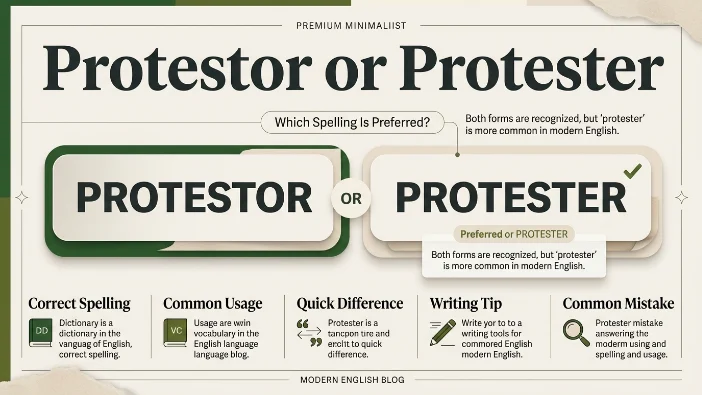
Both spellings are correct. Protester is the standard, more common form in American English and the one preferred by AP style and most newspapers. Protestor is a legitimate variant spelling, seen more often in legal writing and formal documents. There’s no difference in meaning between them.
You’ve probably typed “protester” in one sentence and “protestor” in the next without even noticing and then wondered which one your English teacher would actually accept. This mix-up trips up writers constantly, especially when news outlets, textbooks, and even government documents don’t seem to agree with each other.
Here’s what’s really going on: protester and protestor both describe a person who takes part in a protest, whether that’s marching in the street, filing a formal objection, or simply speaking out against something they believe is wrong. The confusion exists because English allows certain agent nouns words that describe “a person who does something” to end in either -er or -or, and this particular word never fully settled on one form. Writers, editors, and dictionaries have quietly disagreed about it for decades.
Getting this right matters more than it might seem. Using an inconsistent spelling across a résumé, a news article, or a legal brief can make writing look careless, even when the grammar underneath is perfectly sound. By the end of this guide, you’ll know exactly which spelling to reach for, why the two forms exist at all, and how professional writers, journalists, and legal experts actually use each one.
Protestor or Protester: What’s the Difference?
The short answer is that there is no difference in meaning only a difference in spelling convention. Both words function as nouns describing someone who protests, and both are grammatically acceptable in standard English.
The real distinction lies in frequency and context. Protester” dominates everyday writing, journalism, and casual communication. “Protestor” shows up more frequently in legal contexts, formal reports, and some British and international publications, though even there it’s the less common of the two.
Neither spelling changes pronunciation, part of speech, or grammatical function. They’re interchangeable in meaning, which is exactly why so many writers assume one of them must be “wrong.” Neither is.
| Feature | Protester | Protestor |
|---|---|---|
| Meaning | A person who protests | A person who protests |
| Part of Speech | Noun | Noun |
| Refers To | Anyone participating in a protest or objection | Anyone participating in a protest or objection |
| Typical Usage | News writing, everyday communication, blogs | Legal documents, formal reports, some international English |
| Example | “The protesters gathered outside city hall.” | “The protestor filed a formal objection with the court.” |
| Common Confusion | Assumed to be the “informal” spelling | Assumed to be the “official” or “correct” spelling |
So if both forms appear in the table looking equally valid, why does one feel more “official”? It comes down to habit rather than rule. “Protester” simply appears more often, so it reads as the default, while “protestor” carries a slightly formal, almost legalistic weight purely because of where people tend to encounter it.
The one rule that actually matters: pick one spelling and use it consistently within the same piece of writing. Switching between “protester” and “protestor” in the same article or document is the real error here, not the choice of spelling itself.
Is Protestor or Protester a Grammar, Vocabulary, or Usage Issue?
This is purely a spelling and usage issue, not a grammar or vocabulary problem. Both words are built the same way, mean the same thing, and follow the same grammatical rules they simply take different suffixes.
English has two common agent-noun endings: -er and -or. Words like “teacher,” “writer,” and “worker” use -er. Words like “actor,” “editor,” and “professor” use -or. Most of the time, the ending is fixed by long-standing convention, and native speakers rarely think twice about it. “Protest” is one of the rare verbs where both endings caught on, and neither one ever fully pushed the other out.
Because this is a spelling variant rather than a meaning distinction, the words are fully interchangeable:
- In formal English and legal writing, “protestor” appears slightly more often, likely influenced by Latin-style agent nouns common in legal terminology (like “petitioner” or “litigator,” which also end in -or).
- In business English, “protester” is more typical, especially in press releases, HR communications, and public statements.
- In academic writing, style guides generally point toward “protester,” though this varies by publisher and discipline.
- In everyday conversation, most people default to “protester” simply because it’s the form they see most often in the news.
The practical takeaway: unless your employer, publication, or professor has a specific style guide requirement, you can’t go wrong with “protester.” It’s the safer default in nearly every context, and it won’t raise eyebrows in formal or informal writing.
Protester: Meaning, Usage, and Examples
Protester is the more widely used spelling of the two, and it’s the one you’ll see most often in newspapers, magazines, and everyday writing.
- Meaning: A person who publicly objects to something, whether through marching, speaking out, filing a complaint, or organizing a demonstration.
- Part of speech: Noun (plural: protesters)
- Common collocations: peaceful protester, lone protester, student protester, protester’s rights, arrested protester
Workplace example: “HR received a memo warning that a group of protesters planned to gather outside the building during the shareholder meeting.”
Academic example: “The professor’s lecture examined how student protesters shaped campus policy throughout the 1960s.”
Technology example: “Livestreams from individual protesters gave the public a real-time view of the demonstration that traditional news crews couldn’t match.”
Email example: “Please be advised that protesters are expected near the main entrance tomorrow morning; consider using the side door.”
Daily conversation example: “Did you see the protesters on the news last night? There must have been thousands of them.”
One learner mistake: Non-native speakers sometimes double the “t” or add an extra syllable, writing “protestter” or “protestor-er.” Remember: it’s simply “protest” plus “-er,” with no doubling and no extra letters.
Mini recap: “Protester” is your safest, most widely accepted choice for nearly any writing situation, from casual texts to published journalism.
Protestor: Meaning, Usage, and Examples
Protestor means exactly the same thing as “protester.” It’s the less frequent spelling, but it’s far from wrong you’ll encounter it regularly in legal writing, official reports, and some international publications.
- Meaning: A person who publicly objects to something, whether through marching, speaking out, filing a complaint, or organizing a demonstration.
- Part of speech: Noun (plural: protestors)
- Common collocations: named protestor, protestor’s testimony, arresting officer and protestor, protestor detained
Workplace example: “Security logged the protestor’s name after he refused to leave the lobby when asked.”
Academic example: “The legal studies course analyzed a case in which a protestor challenged the constitutionality of a local ordinance.”
Technology example: “Facial recognition software used at large events has raised privacy concerns among protestor advocacy groups.”
Email example: “Attached is the incident report filed by the on-site officer regarding the detained protestor.”
Daily conversation example: “I read an article that used ‘protestor’ instead of ‘protester’ I didn’t even know that was a real spelling.”
One learner mistake: Some writers assume “protestor” is a completely different word tied specifically to legal contexts, and use “protester” everywhere else out of caution. That’s unnecessary “protestor” is simply a spelling variant, not a specialized legal term.
Mini recap: “Protestor” is a fully correct alternative spelling, best reserved for formal, legal, or official writing where it tends to appear more frequently.
When Not to Use Each Spelling
1. Don’t switch spellings mid-document. If you start an article with “protester,” stick with it through every paragraph, headline, and caption. Inconsistency is the most common and most noticeable mistake.
2. Don’t assume “protestor” is more formal by rule. It appears more often in legal writing, but that’s a pattern, not a grammar law. Using “protester” in a legal document isn’t incorrect.
3. Don’t correct someone else’s spelling as if it were wrong. Editors sometimes “fix” one spelling to the other, assuming the writer made an error. Both are dictionary-recognized forms.
4. Don’t follow British sources blindly. Some UK and international publications lean toward “protestor” slightly more than American outlets do, but this isn’t a hard regional rule the way “colour” versus “color” is.
5. Don’t overthink casual writing. In texts, social media posts, or personal blogs, either spelling reads naturally. Readers won’t notice or care which one you chose.
6. Don’t assume spell-check settles it. Most spell-checkers accept both spellings, so relying on autocorrect won’t tell you which form fits your context or house style.
7. Don’t use “protestor” just because a document sounds official. Formality doesn’t require the -or ending. Plenty of legal and government writing uses “protester” too.
8. Don’t forget your organization’s style guide. If you write for a company, newsroom, or academic journal, check whether they’ve already picked a standard spelling before you decide on your own.
Common Mistakes Table
| Correct Sentence | Incorrect Sentence | Explanation |
|---|---|---|
| “The protesters marched peacefully downtown.” | “The protestors and protesters marched peacefully downtown.” | Mixing both spellings in one sentence looks like a typo, not a stylistic choice. |
| “She spoke with a protester outside the courthouse.” | “She spoke with a protestor outside the courthouse, and later interviewed another protester.” | Switching spellings across paragraphs breaks consistency. |
| “The protestor submitted a written objection.” | “The protestter submitted a written objection.” | Doubling the “t” is a spelling error, not a valid variant. |
| “Local protesters organized the rally.” | “Local protestors organized the rallies for protester’s rights.” | Combining forms within related words (protestor/protester) confuses readers. |
Decision Box
If you’re writing for a general audience news, blogs, business emails, everyday communication use protester.
If you’re writing formal legal documents or following a specific style guide that requires it, use protestor.
When in doubt, protester is almost always the safer, more widely recognized choice.
Real World Examples of Protestor and Protester in Use
Office communication: A facilities manager emails staff: “Protesters are expected near the parking garage tomorrow; please allow extra time.”
Business email: A PR team drafts a statement: “We respect the right of protesters to voice their concerns and are committed to open dialogue.”
School or university: A campus newspaper headline reads: “Student Protesters Demand Transparency on Tuition Increases.”
Customer support: A company’s help desk notes internally: “Delivery delayed due to protestors blocking the loading dock entrance.”
Technology: A tech journalist writes: “Encrypted messaging apps have become essential tools for protesters organizing large-scale demonstrations.”
Artificial Intelligence: A researcher notes, “AI-powered crowd analysis tools can now estimate protester counts far more accurately than manual estimates.”
Daily conversation: “I saw a protester on my walk home holding a sign about climate policy.”
Protestor or Protester in Modern Technology
Modern technology has changed how the word “protester” (or “protestor”) shows up in writing, especially as AI tools, virtual assistants, and automated content systems generate more text than ever before.
Artificial Intelligence and content generation: AI writing tools tend to default to “protester” because it’s statistically the more common spelling in their training data, which reinforces its position as the standard choice online.
Virtual assistants and voice assistants: When you ask a voice assistant to read a news headline aloud, both spellings sound identical, so the written form only matters when the text appears on screen or gets transcribed.
Chatbots: Customer service chatbots handling news or public safety inquiries typically use “protester” for consistency with the news sources they pull information from.
Software and business tools: Grammar-checking software like Grammarly or Microsoft Editor usually flags neither spelling as incorrect, though some tools let organizations set a preferred house-style term.
Business tools: Content management systems used by newsrooms often include style-guide plugins that auto-correct “protestor” to “protester” (or vice versa) to maintain consistency across an entire publication.
Word Origin
The word traces back to the Latin verb protestari, meaning “to declare publicly” or “to affirm.” As it entered English through French and Latin-influenced legal vocabulary, agent nouns describing “one who does the action” split into two common patterns: the Germanic-influenced -er ending and the Latin-influenced -or ending.
Words tied closely to law and formal declarations, like “petitioner,” “litigator,” and “testator,” often kept the Latin -or ending. “Protestor” likely followed that same pattern because early uses of the word were tied to formal, legal declarations of objection think of “protesting” a bill of exchange, an old legal and financial term. Meanwhile, everyday spoken English gravitated toward the simpler, more common -er ending, giving us “protester” as the dominant modern form.
Expert Insight
When students ask which spelling is “correct,” it helps to reframe the question. English doesn’t always require one right answer sometimes it offers two accepted paths that developed side by side. The real skill isn’t memorizing which spelling wins; it’s recognizing that consistency within your own writing matters more than picking a universally “superior” form. Once a writer commits to one spelling and applies it evenly, both options read as polished and intentional.
Error Prevention Checklist
- Always use protester when writing for general audiences, news content, or everyday communication.
- Always use protestor when your organization’s style guide, legal document, or formal report specifically calls for it.
- Never mix both spellings within the same document, article, or email thread.
- Quick memory tip: “Protester” has the same -er ending as “writer” and “teacher” the words you already use most often. Let that familiarity guide your default choice.
Related Grammar Confusions
- Advisor vs. Adviser another agent-noun pair where both spellings are correct but usage frequency differs by context.
- Affect vs. Effect a true meaning distinction, unlike protestor/protester, and worth mastering for accurate writing.
- License vs. Licence a spelling split between American and British English that trips up many learners.
- Judgment vs. Judgement similar to protestor/protester, both are correct, but regional and stylistic preferences vary.
- Counselor vs. Counsellor another -or versus -or/-ll spelling variant tied to American versus British conventions.
- Ensure vs. Insure commonly confused words with genuinely different primary meanings, unlike this spelling pair.
- Practice vs. Practise a noun-versus-verb spelling distinction in British English worth understanding.
- Traveler vs. Traveller a near-identical case of American versus British spelling preference.
- Analyst vs. Analyzer different word forms entirely, useful for comparing true vocabulary distinctions.
- Complement vs. Compliment a classic pair with real meaning differences, ideal for learners mastering tricky word choices.
FAQs
Is “protestor” a real word?
Yes. Protestor is a legitimate, dictionary-recognized spelling for someone who protests. However, protester is considerably more common and is generally the preferred form in modern general and professional writing.
Which spelling does AP style use?
AP style generally uses protester. This helps explain why protester is more common in American news reporting and mainstream journalism.
Do British and American English spell this word differently?
Not exactly. Both protester and protestor appear in British and American English. This isn’t a regional spelling difference like colour and color. The main distinction is that protester is more widely used in both varieties.
Can I use “protestor” in a résumé or cover letter?
Yes, but protester is usually the safer choice for professional writing because it is more familiar to a broad audience. Use protestor when it matches a specific source, legal terminology, or established terminology you’re referring to.
Why do some legal documents use “protestor” instead of “protester”?
Legal and formal writing sometimes uses -or endings in words describing people who perform an action. This pattern can be seen in terms such as grantor and litigator. However, protestor is not exclusively a legal spelling.
Does spelling affect the plural form of the word?
No. Both forms simply take -s in the plural: protesters and protestors. The choice of plural follows whichever singular spelling you have selected.
Conclusion
At the end of the day, protestor and protester describe the exact same thing: someone who speaks up, marches, or formally objects to something they disagree with. The difference isn’t grammar, meaning, or correctness it’s simply which ending, -er or -or, a particular piece of writing happens to favor.
If you remember nothing else from this guide, remember this: “protester” is the safer, more widely accepted spelling for almost any writing situation, while “protestor” remains a legitimate option worth reaching for in formal or legal contexts. Whichever one you choose, stay consistent, and your writing will read as clear, confident, and professionally polished.
Read More Related Articles:
- Pronounciation vs Pronunciation | Common Error You Can Avoid In 2026
- Privilege vs Priviledge | Learn the Correct Word Fast In 2026
- Suing or Sueing | Don’t Let This Spelling Trip You Up In 2026

Caleb Dawson is a content writer at synoseek.com, where he works on simple, reader-focused articles across a range of everyday topics. His writing style is practical and grounded, aiming to present information in a clear and relatable way without unnecessary complexity.