Quick Answer
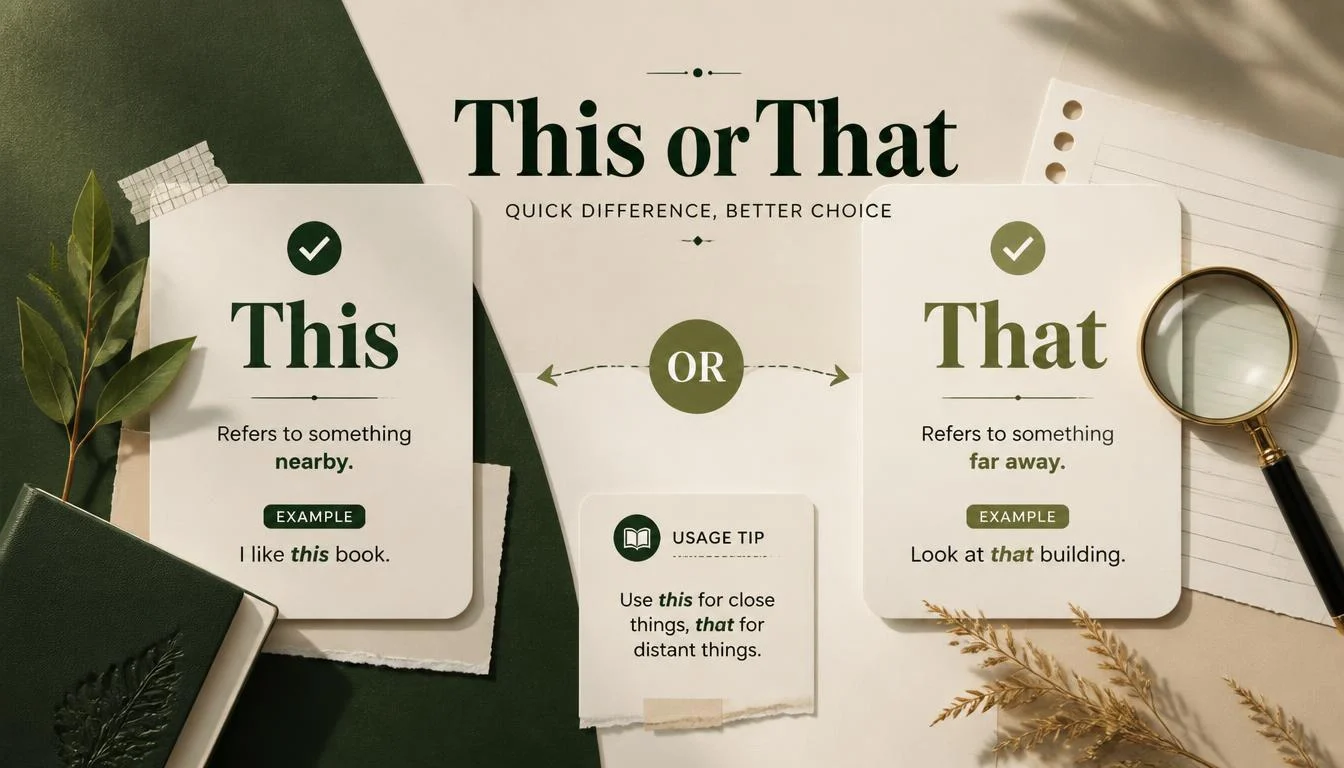
This or that usage depends on physical distance and conversational context. Use this for objects or ideas physically close to you or currently in focus, and use that for items farther away or previously mentioned. Understanding this or that distinction improves clarity in both spoken and written English across all professional contexts.
If you have ever paused mid-sentence wondering whether to say this car or that car, you are not alone. Even native English speakers occasionally second-guess themselves when choosing between these two common determiners. The confusion usually stems from the fact that both words point to specific things, but they do so from different perspectives.
The difference between this and that is not just about physical distance. It also involves emotional distance, conversational flow, and even how recently you mentioned something. Choosing the wrong word can make your writing sound awkward or, worse, confuse your reader about what you are actually referring to.
By the end of this guide, you will understand exactly when to use this and when that fits better. You will learn the rules, see plenty of realistic examples, and pick up practical memory tricks that actually work in real conversations and professional writing.
What Is the Difference Between This and That?
The core difference between this and that comes down to proximity both physical and figurative. This refers to something near the speaker or writer, while that points to something farther away. However, the distinction goes beyond simple distance and touches on how we organize information in conversation and text.
| Feature | This | That |
|---|---|---|
| Meaning | Refers to something close to the speaker | Refers to something farther from the speaker |
| Part of Speech | Determiner, pronoun, or adverb | Determiner, pronoun, or adverb |
| Refers To | Present, current, or immediate things | Distant, past, or previously mentioned things |
| Typical Usage | Introducing new topics; pointing to visible objects | Referring to known information; pointing to distant objects |
| Example | This coffee is hot. | That coffee over there is cold. |
| Common Confusion | Using that for something right in front of you | Using this for something far away or abstract |
The spatial rule works well for physical objects, but here is where it gets interesting. When you are on the phone with someone, you might say “This is Sarah” because you are present in the conversation. If you are referring to a conversation you had yesterday, you would say “That conversation we had” because it is now in the past.
Is This or That a Grammar, Vocabulary, or Usage Issue?
This distinction falls primarily under usage and grammar rather than vocabulary. Both words are grammatically correct in almost any sentence, but choosing the right one depends on context and what you are trying to communicate.
From a grammar perspective, this and that function as demonstrative pronouns and determiners. They help us point to specific nouns in our sentences. The grammatical rules governing them are straightforward, but applying those rules in real conversations requires understanding how English speakers naturally organize information.
In formal English, using this and that correctly signals attention to detail. Business writers and academics often use this to refer to their own arguments and that to refer to opposing views or previously established facts.
In business writing, clarity matters more than ever. Consider the difference between “This proposal addresses your concerns” and “That proposal addresses your concerns.” The first suggests the proposal is currently on the table, while the second suggests a proposal from earlier.
In everyday conversation, English speakers naturally use this to draw attention to something new and that to refer to something already established. Getting this right makes your speech sound more natural and fluent.
The practical takeaway is that both words are correct in most situations, but using them appropriately shows a deeper command of English. The distinction is less about right and wrong and more about precision and natural expression.
This: Individual Word Guide
The word this is your go-to choice when you want to point to something close, current, or immediately relevant. It creates a sense of immediacy and connection between you, your listener, and the thing you are discussing.
Pronunciation: /ðɪs/ (rhymes with “kiss”)
Part of speech: Determiner, pronoun, adverb
Common collocations:
- This morning / this afternoon / this evening
- This time around
- This particular situation
- This very moment
- This kind of thing
Typical sentence patterns:
- This + noun + verb: This book explains everything.
- This is + noun phrase: This is the best option.
- This + adjective + noun: This old house needs work.
Natural workplace example:
“This quarterly report shows our revenue has increased by twelve percent. I will send everyone the full breakdown this afternoon.”
Academic example:
“This study examines the relationship between sleep patterns and cognitive performance in university students.”
Technology example:
“This software update will install automatically. You should see a confirmation message when this process completes.”
Email example:
“Hi James, This email is to confirm our meeting for next Tuesday. Please let me know if this time works for you.”
Daily conversation example:
“This coffee is amazing. Where did you get it?”
One learner mistake:
A common error is using that when this is more appropriate. For example, holding a pen and saying “That pen is blue” instead of “This pen is blue.” The object is right in your hand, so this is the natural choice.
Mini recap: Use this for what is close, current, or being introduced for the first time. It brings attention to something immediate and relevant.
That: Individual Word Guide
The word that creates distance physical, temporal, or emotional. It refers to things that are not immediately present or that your listener already knows about. Using that signals that you are referring to something outside the current moment.
Pronunciation: /ðæt/ (rhymes with “cat”)
Part of speech: Determiner, pronoun, conjunction, adverb
Common collocations:
- That kind of thing
- That being said
- That particular reason
- That very moment
- That sort of behavior
Typical sentence patterns:
- That + noun + verb: That decision changed everything.
- That is + noun phrase: That is exactly what I meant.
- That + adjective + noun: That old photograph brings back memories.
Natural workplace example:
“That presentation you gave last week was very well received. The client mentioned that they appreciated your detailed approach.”
Academic example:
“That theory has been widely debated since its introduction in the 1960s.”
Technology example:
“That error message appears when the system cannot find the requested file.”
Email example:
“Regarding that invoice you sent on Monday, I have forwarded it to our accounts department for processing.”
Daily conversation example:
“That restaurant we visited last month has closed down.”
One learner mistake:
A frequent error involves using this when referring to something far away. For instance, pointing to a building across the street and saying “This building is old” instead of “That building is old.” The distance requires that.
Mini recap: Use that for what is distant, past, or already familiar to your listener. It creates separation and refers to established information.
When Not to Use Each Word
Understanding when not to use each word is just as important as knowing when to use them. Here are common situations where writers and speakers often choose incorrectly.
Using this when the object is far away
If you are pointing to something across the room, that is the right choice. This should only be used for things within reach or immediate proximity.
Using that when introducing a new topic
When you first mention something, use this to introduce it. Switching to that signals that the topic is already familiar. Incorrect: “That new policy was announced yesterday. That policy will affect everyone.” Correct: “This new policy was announced yesterday. That policy will affect everyone.”
Using that for something currently happening
If something is happening right now, this is more appropriate. That suggests the event is over or not immediately occurring.
Using this for something that happened in the past
Referring to a past event with this can feel jarring. That naturally places the event in the past.
Using that for future events you control
If you are planning something, use this to show involvement. That creates distance from the plan.
Using this for something you dislike or want to distance yourself from
This implies closeness, so if you want to create emotional distance, that is more appropriate. “That attitude of yours” sounds more detached than “This attitude.”
Why the mistake happens: Most confusion comes from translating directly from other languages where the distinction does not exist or works differently. English requires this spatial and temporal awareness that many languages do not emphasize.
Common Mistakes Table
| Correct Sentence | Incorrect Sentence | Explanation |
|---|---|---|
| This phone in my hand is brand new. | That phone in my hand is brand new. | The phone is in the speaker’s hand, so this is required. |
| That car across the street is expensive. | This car across the street is expensive. | The car is far away, so that is appropriate. |
| This is the best coffee I have ever had. | That is the best coffee I have ever had. | The coffee is being consumed now, so this works better. |
| That vacation we took last year was amazing. | This vacation we took last year was amazing. | The vacation is in the past, so that is correct. |
| This new feature will improve everything. | That new feature will improve everything. | Introducing a new feature requires this; that would imply it is already known. |
| That idea you had was brilliant. | This idea you had was brilliant. | The idea belongs to the past conversation, so that fits. |
Quick Decision Guide
If you mean something right in front of you → use THIS
If you mean something farther away → use THAT
If you are introducing a new topic → use THIS
If you are referring to something already mentioned → use THAT
If it is happening right now → use THIS
If it happened in the past → use THAT
If you feel close to the subject → use THIS
If you feel distant from the subject → use THAT
Real-World Examples Across Contexts
Understanding the this-or-that distinction becomes easier when you see it in action across different situations.
Office communication
“This project is our top priority for the quarter. That previous project we completed in March was also important, but we have shifted our focus.”
Business email
“I am attaching this document for your review. That version we discussed in the meeting was just a draft, but this one includes all the requested changes.”
School or university
“This semester has been challenging. That exam we took last week was particularly difficult, but this upcoming project should be more manageable.”
Customer support
“I am looking at this issue you reported. That error you experienced should be resolved with this update we are releasing today.”
Technology
“This new operating system is much faster than the previous one. That older system often crashed, but this one has been stable.”
Artificial intelligence
“This AI model was trained on a massive dataset. That earlier version had limitations, but this one handles complex queries more effectively.”
Daily conversation
“This weather is perfect for a walk. That storm we had yesterday was terrible, though.”
This or That in Modern Technology
In the technology world, the this-or-that distinction has taken on new dimensions. Virtual assistants like Siri, Alexa, and Google Assistant have made us more aware of how we refer to digital objects and interfaces.
When you say “This app on my phone,” you are referring to something physically present in your hand. When you say “That app you mentioned yesterday,” you are referring to something from a previous conversation. The same rules apply in digital spaces.
Voice assistants often rely on this distinction to understand context. If you say “Play this song,” the assistant assumes you mean a song currently playing or selected. If you say “Play that song,” the assistant might look for a song mentioned earlier in the conversation.
In software user interfaces, designers use this to indicate the current screen or selection and that to indicate previous states or options. You might see “This page” for the current view and “That page” for the previous one.
Chatbots and AI systems need to track what users mean by this and that to maintain coherent conversations. When a user says “That didn’t work” after trying something, the system must understand that that refers to the previous action.
Expert Insight
The most common misunderstanding I see among English learners involves treating this and that as interchangeable words with the same meaning. They are not synonyms. Each word carries a specific spatial and temporal meaning that native speakers use instinctively. What many students do not realize is that choosing correctly is not about following a rigid grammar rule but about understanding how English speakers naturally organize the world. When you say this, you are inviting your listener into your personal space. When you say that, you are creating a boundary. Learning to use these words well means learning to control that boundary and use it to make your meaning clearer.
Error Prevention Checklist
Always use THIS when the object or idea is physically close, currently happening, or being introduced for the first time.
Always use THAT when the object or idea is physically distant, happened in the past, or was already mentioned.
Never confuse them if you remember that distance physical, temporal, or emotional determines which word to choose.
Quick memory tip: This is here and now. That is there and then.
Related Grammar Confusions
Here vs. There – Similar to this and that, these words indicate proximity. Here refers to the speaker’s location, while there refers to another place.
Who vs. Whom – Another common confusion involving pronoun case that often trips up writers.
Which vs. That – Two relative pronouns that many writers mix up, especially in restrictive and non-restrictive clauses.
Who vs. Which – Knowing when to use who for people and which for things.
It vs. This – Understanding when to use a pronoun versus a demonstrative to refer to something.
These vs. Those – The plural forms of this and that follow the same proximity rules.
One vs. You – Using indefinite pronouns correctly in formal and informal writing.
Me vs. I – One of the most common grammar errors in English, even among native speakers.
Affect vs. Effect – A vocabulary confusion that persists across all levels of English proficiency.
Less vs. Fewer – A distinction that trips up many professionals in business writing.
FAQs
Can I use “this” and “that” interchangeably?
No, they are not interchangeable. This refers to something close, current, or immediate, while that refers to something more distant or previously mentioned. Using the wrong word can make it unclear what you are referring to.
Is “this” only for physical objects?
Not at all. This can refer to abstract ideas, situations, periods of time, and topics being discussed. For example, “This is a great point” refers to the current idea or conversation, not a physical object.
Why do native speakers sometimes use “that” for something close?
Native speakers may use that instead of this to create emotional or conversational distance. For example, “That attitude” can sound more critical or detached than “This attitude.” In such cases, it is a stylistic choice rather than a grammatical error.
Does formal writing require different this-or-that rules?
The basic rules remain the same, but formal writing often requires greater precision. In academic writing, for example, this can refer to your own research or an immediately stated idea, while that may refer to something previously discussed or another study.
What about “these” and “those”?
These and those are the plural forms of this and that. These refers to multiple things that are close or current, while those refers to multiple things that are farther away or more distant.
How do I remember when to use “this” or “that”?
Think of this as pointing to something close enough to touch, while that points to something farther away. In conversation, this often refers to the current topic, while that can refer to something mentioned earlier.
Conclusion
The difference between this and that comes down to one simple idea: proximity. When something is close, current, or being introduced, choose this. When something is distant, past, or already known, choose that. This distinction helps your listener or reader understand exactly what you mean without confusion.
The best way to master this distinction is to practice paying attention to how you use these words in everyday conversation. Notice when you naturally choose this and when that feels more appropriate. With awareness and practice, choosing the right word will become second nature.
The practical rule to remember: If you can point to it without stretching, use this. If you need to gesture, use that.
Read More Related Articles:
- Shiny or Shiney | Avoid This Simple Spelling Error in English In 2026
- Occasion or Ocassion | Common Mistake Explained with Real-Life Examples In 2026
- Cacoon or Cocoon | Simple Rule You’ll Never Forget In 2026

Lucas Mitchell is a content writer at synoseek.com. He writes simple, thoughtful pieces that focus on everyday ideas, observations and general knowledge topics. His work is shaped by a calm, realistic tone that keeps the reader engaged without overstatement.