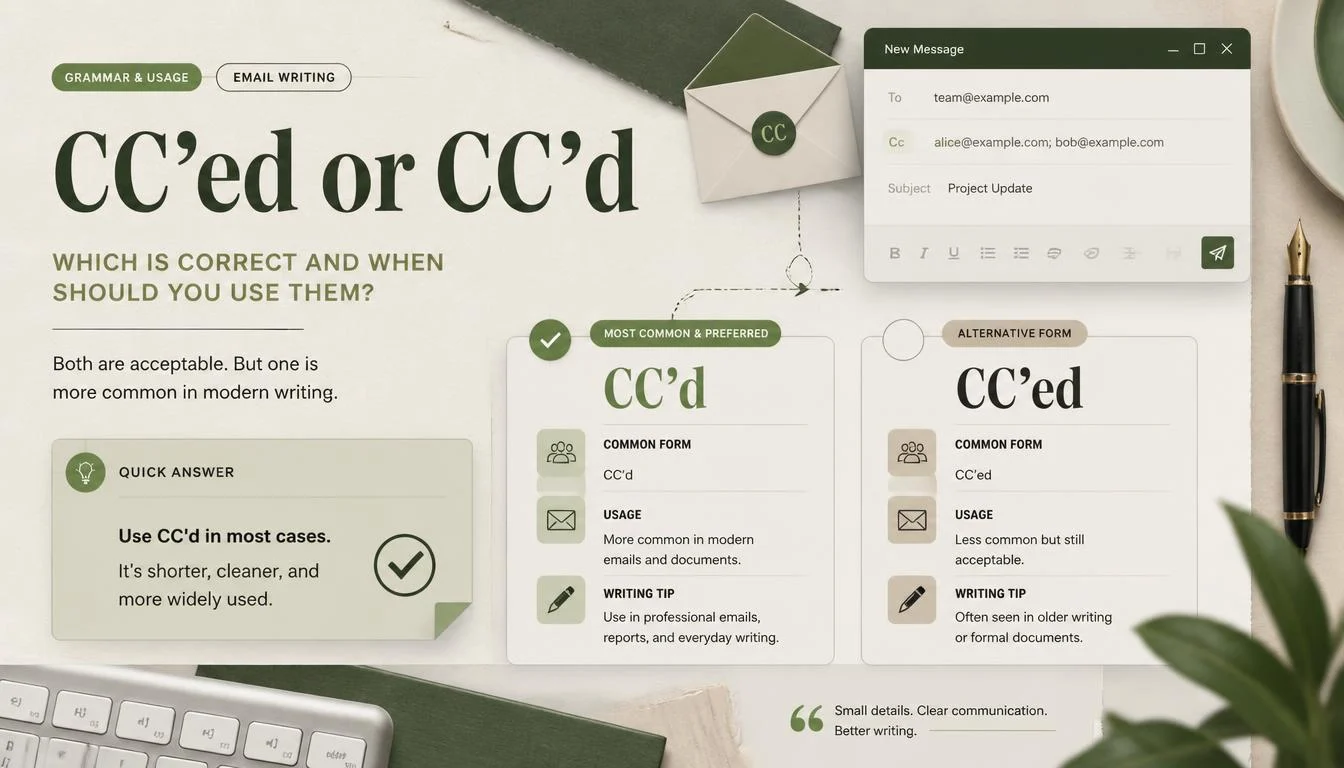
Quick Answer:
Both CC’ed and CC’d are accepted past-tense forms of the verb “to CC,” meaning to send someone a copy of an email. CC’d is shorter and more common in modern business writing, while CC’ed is easier to read for some audiences. Neither is grammatically wrong, but consistency matters more than the choice itself.
CC’ed or CC’d can both appear in professional emails, but the choice can depend on the style you follow. These forms come from the abbreviation “CC,” meaning to send a copy of an email to another recipient.
In everyday business writing, CC’d is often preferred because it is shorter and follows a common pattern for forming past tense from abbreviations. However, CC’ed is also understandable and widely used, so context and consistency matter.
Why This Tiny Word Causes So Much Confusion
You’re halfway through a work email, typing something like “I cc’d Sarah on this” or “I cc’ed the whole team,” and suddenly you stop. Something about the word looks off. You stare at it for a second too long, maybe delete it and retype it, and still aren’t sure which version looks more professional.
This happens because CC started as an abbreviation, not a real verb. “CC” stands for “carbon copy,” a term borrowed from the days when people used carbon paper to duplicate letters. Nobody designed rules for turning an abbreviation into a past-tense verb, so English speakers had to improvise. That’s exactly why you’ll find both CC’ed and CC’d used across emails, style guides, and workplace messages, sometimes even by the same person in the same week.
Choosing the wrong form won’t get you fired, but inconsistency in professional writing does chip away at how polished your emails look. A hiring manager, client, or professor might not consciously notice which spelling you used, but a document that mixes both versions can feel slightly careless. This guide breaks down where each spelling comes from, when to use each one, and how to stay consistent whether you’re writing a quick Slack message or a formal report.
CC’ed or CC’d: What’s the Difference?
Both spellings mean exactly the same thing: they describe the past tense of adding someone as a recipient of a copied email. The difference isn’t about meaning at all — it’s about spelling convention and formatting preference.
CC originally functioned only as a noun and later as an abbreviation used in email headers (“CC:”). Once professionals started using it casually as a verb (“Can you CC me on that?”), they needed a past-tense form. Two natural options emerged. Some writers added “-ed” the way you would with any regular verb, producing CC’ed. Others treated the apostrophe as a stand-in for missing letters, similar to contractions, producing CC’d.
Neither the Associated Press Stylebook nor the Chicago Manual of Style has published a definitive ruling on this exact word, since it developed through business and tech usage rather than formal grammar tradition. That’s part of why you’ll see disagreement even among professional editors.
| Meaning | Part of Speech | Refers To | Typical Usage | Example | Common Confusion |
|---|---|---|---|---|---|
| Past tense of “to CC” | Verb (informal, derived from abbreviation) | Adding someone as an email recipient | Business emails, workplace chat | “I cc’d the manager on the update.” | Mixed with “cc’ed” inconsistently |
| Past tense of “to CC” | Verb (informal, derived from abbreviation) | Adding someone as an email recipient | Formal writing, style-conscious brands | “She cc’ed both departments.” | Looks unusual to readers unfamiliar with the spelling |
In short: pick one spelling and stick with it throughout a single document. That single habit solves ninety percent of the confusion people have with this word.
Is CC’ed or CC’d a Grammar, Vocabulary, or Usage Issue?
This is primarily a usage issue, not a grammar rule you’re breaking or a vocabulary word you’re misunderstanding. Grammatically, both forms attempt to do the same job: turn an initialism into a past-tense verb using an apostrophe to mark the irregular transformation, similar to how “OK’d” or “RSVP’d” work.
From a vocabulary standpoint, there’s no difference in meaning between the two spellings. You’re not choosing between two different words, the way you would with “affect” and “effect.” You’re choosing between two accepted formats for the same word.
Usage is where the real distinction lives. In formal academic writing, many style-conscious writers avoid the construction altogether, preferring a full phrase like “was copied on” or “received a copy of.” In business English, both CC’d and CC’ed appear constantly, with CC’d showing up more often in fast-paced communication like Slack, texts, and short emails. In academic writing, if the term appears at all, CC’ed tends to look slightly more deliberate and less like shorthand.
The interchangeability comes with one condition: pick a lane. Style guides that do address similar constructions, including internal guides at major tech companies, consistently emphasize picking one spelling and using it throughout a document rather than alternating.
Practical takeaway: Treat this as a formatting decision, not a grammar test. Once you choose a version, apply it consistently across your emails, reports, and internal documentation.
Understanding CC’ed
Meaning: Added someone as a recipient of a copied message, using the “-ed” past-tense pattern.
Part of speech: Verb, past tense (informal, derived from the abbreviation CC).
Common collocations: “cc’ed on the thread,” “cc’ed the client,” “already cc’ed you,” “cc’ed for visibility.”
Typical sentence pattern: Subject + cc’ed + object + prepositional phrase (on/in something).
Workplace example: “I cc’ed the finance team so they can track the budget approval.”
Academic example: “The teaching assistant cc’ed the professor on all grade appeal emails this semester.”
Technology example: “The support ticket system automatically cc’ed the account manager whenever a priority issue was logged.”
Email example: “Just following up — I cc’ed Daniel earlier so he’s aware of the timeline change.”
Daily conversation example: “Did you see the message? I cc’ed you on it this morning.”
One learner mistake: Non-native English speakers sometimes write “CCed” without the apostrophe, which looks like a typo rather than an intentional spelling. The apostrophe signals that letters are being skipped, similar to “don’t” or “can’t.”
Mini recap: CC’ed follows a familiar pattern for English learners because it mimics regular past-tense verbs like “walked” or “played,” just with an apostrophe inserted before the ending.
Understanding CC’d
Meaning: Added someone as a recipient of a copied message, using the shortened apostrophe-plus-d pattern.
Part of speech: Verb, past tense (informal, derived from the abbreviation CC).
Common collocations: “cc’d on this,” “already cc’d,” “cc’d the whole group,” “cc’d for reference.”
Typical sentence pattern: Subject + cc’d + object + prepositional phrase (on/in something).
Workplace example: “I’ve cc’d HR so there’s a written record of this conversation.”
Academic example: “The department chair cc’d the dean on the final course scheduling email.”
Technology example: “Every automated invoice is cc’d to the accounting inbox by default.”
Email example: “Quick note — cc’d Priya so she stays in the loop going forward.”
Daily conversation example: “Yeah, cc’d you on that one earlier, check your inbox.”
One learner mistake: Learners sometimes hesitate over where exactly the apostrophe goes, occasionally writing “cc’ed” and “cc’d” interchangeably within the same paragraph. Since both spellings are visually similar, this mistake often slips past a quick read-through.
Mini recap: CC’d is the more streamlined version, closer in feel to contractions like “text’d” in casual digital communication, and it dominates in fast, informal exchanges like chat apps and short emails.
When Not to Use Each Word
1. Formal academic papers. Neither spelling belongs in a research paper or thesis. Instead, write out the full explanation, such as “a copy of the message was sent to.”
2. Legal or contractual documents. These documents demand precision, and an informal abbreviation-turned-verb can look unprofessional or ambiguous. Use “copied” or “received a duplicate of the correspondence.”
3. First-time client emails. When you’re establishing a professional tone with someone new, especially in industries like law, finance, or consulting, spell things out fully rather than relying on shorthand verb forms.
4. Mixed usage within the same document. Switching between CC’ed and CC’d in one report, email chain, or style guide creates visual inconsistency. Readers notice patterns even when they can’t articulate why something feels off.
5. Highly formal internal memos. If your company uses a strict style guide for internal communication, check it first. Some organizations specify “copied” instead of either abbreviation-based verb.
6. Written material intended for global audiences. Non-native English readers may not recognize either spelling as a real word at first glance, since it doesn’t appear in standard dictionaries the way “email” or “text” now do. In these cases, a clearer phrase avoids confusion entirely.
7. Speeches or spoken presentations. Both forms only make sense in writing. If you’re presenting information out loud, say “copied” or “included on the email” instead of trying to pronounce an abbreviation-based verb.
8. SEO or educational content aimed at ESL learners. If you’re writing to teach English, explain the underlying logic (CC = carbon copy, informally verbed) rather than assuming familiarity with either spelling.
Common Mistakes Table
| Correct Sentence | Incorrect Sentence | Explanation |
|---|---|---|
| “I cc’d you on the invoice.” | “I cc you on the invoice.” | Missing the past-tense marker entirely turns the sentence into present tense, which changes the timeline. |
| “She cc’ed the entire team.” | “She CCed the entire team.” | Dropping the apostrophe makes the word look like a typo rather than an intentional past-tense form. |
| “He was cc’d on the thread.” | “He was cc’ing on the thread.” | “Cc’ing” is the present participle, not the past tense, so it doesn’t fit after “was” in this context. |
| “I already cc’d Marcus.” | “I already cc’d too Marcus.” | Adding “too” in the wrong position creates an awkward, unclear sentence structure. |
| “Please cc me next time.” | “Please cc’d me next time.” | Using the past-tense form after “please” is incorrect since the request is about a future action, not a completed one. |
| “They cc’ed HR for documentation.” | “They cc HR’ed for documentation.” | Attaching the past-tense ending to the wrong word breaks the sentence entirely. |
Quick Decision Box
If you’re writing something casual, quick, or chat-based, use CC’d.
If you’re writing something slightly more formal but still want to use the informal verb, use CC’ed.
If you’re writing something highly formal, legal, or academic, avoid both and write “copied” or “sent a copy to” instead.
CC’ed or CC’d in Real-World Communication
Office communication: A manager sending a project update might write, “I’ve cc’d the whole design team so everyone has visibility.” The shorter form fits the fast pace of internal messaging.
Business email: A client-facing email might read, “For transparency, I cc’ed both stakeholders on this proposal.” Here, the slightly more spelled-out version can feel a touch more deliberate.
School or university: A student emailing a professor about a group project might write, “I cc’ed my teammates so they’re aware of the deadline change.” Professors generally accept either spelling in informal course correspondence.
Customer support: A support agent closing a ticket might note internally, “Cc’d the escalation team per policy,” using the shorter form typical of internal ticketing systems.
Technology: Automated systems, like CRM tools or help desks, often generate messages saying a contact was “cc’d” to a specific inbox, since system-generated text tends to favor brevity.
Daily conversation: A quick text between coworkers might say, “Did you see I cc’d you on that email? Check when you get a sec.”
CC’ed or CC’d in Modern Technology
Modern communication tools have quietly settled the popularity contest between these two spellings, even without an official grammar ruling. In fast-moving digital environments like Slack, Microsoft Teams, and text-based customer support, CC’d appears far more frequently because it mirrors the clipped, efficient tone those platforms encourage.
Artificial intelligence writing assistants and grammar-checking tools, including those built into Gmail and Outlook, generally accept both spellings without flagging either as incorrect, though some default to suggesting CC’d for brevity. Virtual assistants and chatbots that generate automated email summaries — for example, a scheduling assistant confirming “You were cc’d on this meeting invite” — almost universally use the shortened form, since automated systems are typically programmed for concise, standardized phrasing.
Voice assistants rarely need to “speak” this word at all, since it only exists in written form, but when text-to-speech tools do encounter it, they typically read it as “see-seed,” regardless of which spelling appears on screen. This reinforces the idea that both versions are functionally identical, differing only in visual formatting rather than pronunciation or meaning.
Software documentation and API references, particularly for email platforms, tend to avoid the past-tense verb form altogether, opting instead for phrases like “the recipient was added to the CC field,” which sidesteps the spelling debate entirely.
A Brief Note on Word Origin
“CC” traces back to “carbon copy,” a physical duplication method used with carbon paper before photocopiers and email existed. Typists would place a sheet of carbon paper between two pieces of regular paper, and the pressure from typing would transfer the text onto the second sheet, creating an instant duplicate.
When email systems adopted the term “CC” for copying recipients, the phrase carried over even though the original carbon-paper method had disappeared. Turning “CC” into a verb, and eventually into a past-tense verb, happened organically through casual business speech rather than formal grammatical development, which explains why two competing spellings exist instead of one standardized form.
Expert Insight
As a language instructor, I tell students to think of this word the same way they’d think about newer internet-born verbs like “texted” or “DM’d.” English constantly repurposes nouns and abbreviations into verbs when a real communication need exists, and formal grammar rules simply haven’t caught up yet. The best approach isn’t memorizing which spelling is “official,” because neither is. It’s about recognizing that consistency signals professionalism far more than which specific version you pick.
Error Prevention Checklist
- Always use CC’d when you want a shorter, more casual tone, especially in chat apps or quick emails.
- Always use CC’ed when you want a slightly more spelled-out feel in business writing.
- Never confuse either version if you’re writing formal, legal, or academic content — use “copied” instead.
- Quick memory tip: If your email sounds more like a text message, use CC’d. If it sounds more like a formal note, use CC’ed. Either way, pick one and use it consistently throughout the document.
Related Grammar Confusions Worth Learning
- Email’d or Emailed — another abbreviation-based verb debate that trips up even experienced writers.
- RSVP’d or RSVPed — shares the exact same apostrophe-versus-ending confusion as CC’d.
- OK’d or Okayed — a classic example of turning an abbreviation into a past-tense verb.
- Affect vs. Effect — one of the most common vocabulary mix-ups in professional writing.
- Its vs. It’s — a grammar rule that trips up even advanced English speakers.
- Text’d or Texted — helps clarify when to spell out a digital-native verb fully.
- BCC vs. CC — useful for understanding the broader email etiquette this word comes from.
- Farther vs. Further — another pair professionals frequently misuse in formal writing.
- Login vs. Log In — a noun-versus-verb distinction relevant to technology writing.
- Setup vs. Set Up — another common one-word-versus-two-word business writing error.
Frequently Asked Questions
Is “CC’d” grammatically correct? Yes, “CC’d” is widely accepted as an informal past-tense verb form, especially in business and digital communication. It isn’t found in traditional dictionaries as a standalone entry, but it’s understood and used consistently across professional writing.
Is “CC’ed” more formal than “CC’d”? Slightly. “CC’ed” tends to appear in business writing that wants a bit more structure, while “CC’d” dominates faster, more casual communication like chat messages and quick emails.
Can I just write “CCed” without an apostrophe? It’s technically understandable, but most style-conscious writers include the apostrophe to clarify that letters are being condensed, similar to how contractions work.
Which spelling do most companies use? There’s no universal standard, but CC’d appears more frequently in fast-paced digital tools like Slack and text-based customer support, while CC’ed shows up more in traditional business emails.
Should I avoid using either spelling in a resume or cover letter? Yes. Both versions are too informal for resumes, cover letters, or other highly polished documents. Use a full phrase like “coordinated communication across departments” instead.
Does Microsoft Word or Google Docs flag either spelling as incorrect? Most grammar checkers accept both spellings without flagging errors, though some tools may underline them as unrecognized words simply because they aren’t in standard dictionaries.
Final Thoughts
The debate between CC’ed and CC’d isn’t really about right or wrong — it’s about consistency and context. Both spellings communicate the exact same action: someone was added as a recipient on a copied message. The real skill isn’t memorizing a rule that doesn’t officially exist; it’s recognizing which version fits the tone of what you’re writing and sticking with it from start to finish.
If you remember one rule from this entire guide, let it be this: casual and quick, go with CC’d; slightly more formal but still conversational, go with CC’ed; and if the writing needs to be fully professional or academic, skip the abbreviation altogether and write “copied” instead.
Internal Linking Opportunities
- Suggested Anchor Text: “how to use RSVP’d correctly” Suggested Topic: RSVP’d or RSVPed: Which Spelling Is Correct?
- Suggested Anchor Text: “the difference between BCC and CC” Suggested Topic: BCC vs. CC: When to Use Each One in Professional Emails
- Suggested Anchor Text: “common email etiquette mistakes” Suggested Topic: 10 Email Etiquette Mistakes That Make You Look Unprofessional
Final SEO Elements
Meta Title: CC’ed or CC’d: Correct Spelling, Meaning & Usage Explained
Meta Description: Confused between CC’ed and CC’d? Learn which spelling to use, when to avoid both, and how to keep your professional emails consistent and polished.
URL Slug: cced-or-ccd-correct-usage
SEO Tags: cc’ed vs cc’d, email grammar, business writing tips, past tense verbs, professional email etiquette
Blog Header Image Prompt: A minimalist editorial infographic in a 16:9 aspect ratio for a professional language-learning website, showing a clean side-by-side comparison of the words “CC’ed” and “CC’d” in elegant modern typography against a warm cream and soft beige background with deep forest green and olive green accent elements, dark charcoal text, a subtle paper texture, soft natural lighting, elegant generous spacing, and a magazine-quality editorial composition, with no watermarks, no logos, and no branding, suitable as a high-resolution professional featured image.

Zoe Chambers works as a content writer at synoseek.com, contributing thoughtful pieces on everyday subjects and ideas. She writes in a simple, grounded way, often drawing from real-world experiences. Her focus is on keeping content natural, clear and easy for readers to connect with.
1 thought on “CC’ed or CC’d | Clear Up the Confusion in One Quick Guide In 2026”